To link to this article:
URL : https://www.phmsociety.org/node/2246
This is an author-deposited version published in:
http://oatao.univ-toulouse.fr/
Eprints ID: 19521
To cite this version
:
Atamuradov, Vepa and Medjaher, Kamal and Dersin, Pierre and
Lamoureux, Benjamin and Zerhouni, Noureddine Prognostics and health
management for maintenance practitioners - Review, implementation and
tools evaluation. (2017) International Journal of Prognostics and Health
Management, vol. 8. ISSN 2153-2648
Open Archive Toulouse Archive Ouverte (OATAO)
OATAO is an open access repository that collects the work of Toulouse researchers and
makes it freely available over the web where possible.
Any correspondence concerning this service should be sent to the repository
administrator: [email protected]
Prognostics and Health Management for Maintenance
Practitioners - Review, Implementation and Tools Evaluation
Vepa Atamuradov1, Kamal Medjaher1, Pierre Dersin2, Benjamin Lamoureux2 and Noureddine Zerhouni3.
1Production Engineering Laboratory (LGP), INP-ENIT 47 Av. d’Azereix, 65000 Tarbes, France [email protected]
2ALSTOM Transport, 93400 Saint-Ouen, France [email protected] [email protected]
3FEMTO-ST Institute, UMR CNRS 6174 – UFC/ENSMM 15B av. des Montboucons, 25000 Besancon, France [email protected]
ABSTRACT
In literature, prognostics and health management (PHM) systems have been studied by many researchers from many different engineering fields to increase system reliability, availability, safety and to reduce the maintenance cost of engineering assets. Many works conducted in PHM research concentrate on designing robust and accurate models to assess the health state of components for particular applications to support decision making. Models which involve mathematical interpretations, assumptions and approximations make PHM hard to understand and implement in real world applications, especially by maintenance practitioners in industry. Prior knowledge to implement PHM in complex systems is crucial to building highly reliable systems. To fill this gap and motivate industry practitioners, this paper attempts to provide a comprehensive review on PHM domain and discusses important issues on uncertainty quantification, implementation aspects next to prognostics feature and tool evaluation. In this paper, PHM implementation steps consists of; (1) critical component analysis, (2) appropriate sensor selection for condition monitoring (CM), (3) prognostics feature evaluation under data analysis and (4) prognostics methodology and tool evaluation matrices derived from PHM literature. Besides PHM implementation aspects, this paper also reviews previous and on-going research in high-speed train bogies to highlight problems faced in train industry and emphasize the significance of PHM for further investigations.
1. INTRODUCTION
Reliability, availability, safety and maintenance cost effectiveness have been an important concern in many
industries. Company profit and competitiveness depend on designing and producing highly reliable systems and/or good quality products. However, designing such sophisticated systems brings about many difficulties and concerns such as component maintenance cost, along with its merits. For industry, an important issue is how to reduce maintenance cost and manage business risks while increasing asset reliability, availability, and safety. Hence there is a need to design and develop sophisticated health assessment technologies, such as PHM, which are easily implementable by maintenance technicians or engineers to improve component reliability and safety.
The Prognostics and Health Management (PHM) discipline provides for viewing overall health state of machines or complex systems and assists in making correct decisions on machine maintenance. The main duties of PHM technology are to detect incipient component or system fault, perform failure diagnostics, failure prognostics, and health management. There are three main issues to be considered when building a robust PHM: an estimation of current health state, prediction of a future state along with time to fail, and determination of a failure’s impact on the performance of a system. For practitioners, to select and implement PHM technology is based on their ability and knowledge about PHM approaches, tools, etc. Models which involve mathematical interpretations, assumptions and approximations make PHM hard to understand and apply. Prior knowledge to implement PHM in complex systems is crucial to building highly reliable systems. The goal of this current review paper is to serve as a handbook for practitioners in industry to motivate and assist them through PHM implementation and help them to accomplish their duty more easily. In this paper, a four-step maintenance assessment approach is designed which consists of (1) critical component analysis, (2) right sensor selection for CM, (3) prognostics feature evaluation and (4) prognostics methodology and tool evaluation matrices derived from PHM approaches presented in the literature.
Vepa Atamuradov et al. This is an open-access article distributed under the terms of the Creative Commons Attribution 3.0 United States License, which permits unrestricted use, distribution, and reproduction in any medium, provided the original author and source are credited.
Besides PHM approaches literature review and proposed an approach, this paper also reviews previous and on-going research in high-speed train bogies to highlight the problems faced in the railway industry and to emphasize the significance of PHM for further investigations. There are several review papers in literature conducted in fault diagnostics and prognostics techniques. Condition Based Maintenance (CBM), which is one of the frequently studied and applied maintenance techniques in many engineering applications, was reviewed in (Jardine, Lin, & Banjevic, 2006). Authors studied implementation issues of CBM for mechanical systems and reviewed diagnostics and prognostics developments, data preprocessing algorithms and data fusion techniques in the literature. Rotating machinery prognostics articles were reviewed and synthesized in (Heng, Zhang, Tan, & Mathew, 2009). Failure prediction methodologies for rotating machinery were classified as reliability models, condition based and integrated models with their merits and drawbacks. Sikorska and M. Hodkiewiczb (2011) reviewed RUL estimation and prognostics modeling approaches under knowledge-based, life expectancy, artificial neural networks (ANN) and physics models. Authors presented prognostics models with their limitations and merits and discussed an appropriate model selection for business cases. J. Lee et al. (2014), presented comprehensive review, conducting in PHM of rotatory machinery and introduced a 5S systematic methodology for PHM design which was evaluated in different industrial case studies. Kandukuri et al. (2016) reviewed diagnostics and prognostics methodologies under reliability centered maintenance (RCM) and CBM for two critical components; planetary gearboxes and low-speed bearings
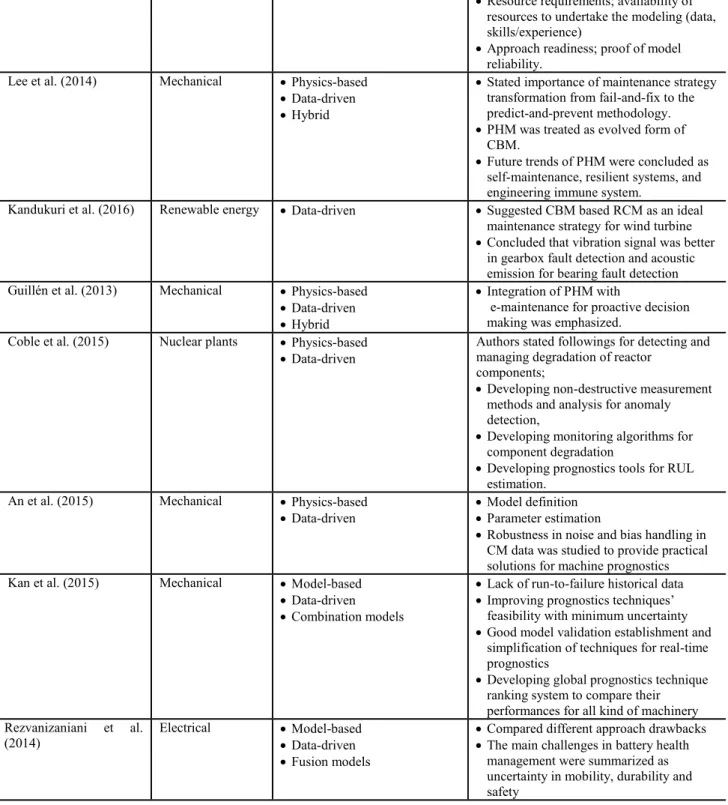
of wind turbines. Authors analyzed different CM data for bearing and gearbox diagnostics and concluded that vibration signal was better in gearbox fault detection and acoustic emission for bearing fault detection. Furthermore, CBM based on RCM as an ideal maintenance strategy was suggested for farm-level wind turbine health assessment. Guillén et al. (2013) studied PHM integration framework main topics regarding monitoring and diagnostics techniques by synthesizing PHM review papers in different application areas. Then, they discussed PHM functionality, maintenance types, prognostics approaches and proposed the integration of PHM with e-maintenance for proactive decision making. State of the art of PHM for nuclear power plants (NNP) was presented in (Coble et al. 2015) where they reviewed prognostics and maintenance techniques for active and passive NNP components. An Kim, and Choi (2015) reviewed a data-driven and physics-based prognostics algorithms in terms of model definition, parameter estimation, robustness in noise and bias handling in CM data, to provide practical prognostics options for beginners. Kan, Tan, and Mathew (2015) reviewed data-driven prognostics techniques for linear and non-stationary machine processes. The authors studied prognostics techniques that can cope with non-linearity and non-stationarity and concluded with further improvements in prognostics. In (Rezvanizaniani, Liu, Chen, & Lee, 2014) authors reviewed a techniques for the battery PHM approaches to provide cost effective solutions for battery health assessment. These reviewed papers can be used to understand the general concepts of system CM. In Table 1, we have summarized important issues and remarks pointed out by the review papers synthesized from the literature.
Authors Domain Approach Classification Issues & Remarks
Jardine et al. (2006) Mechanical · Physics-based · Data-driven ·
· Lack of communication between scientists and industry practitioners
· Lack of data collection and efficient approach validation
· Implementation difficulty due to rapid change of technology design and management executives Heng et al. (2009) Mechanical · Physics-based
· Data-driven
· Integration of CM with event data (ED) · Proper usage of incomplete data · Maintenance action effects · Machine operating conditions · Analysis of nonlinearity between
condition monitoring data and component health state
· Consideration of different failure interactions
· Practical requirements and assumptions · Developing uniform health measurement
framework Sikorska et al. (2011) Mechanical · Knowledge-based
· Life expectancy · Physics-based
· Prediction requirements; the goal of RUL prediction
· Model-process compatibility;
compatibility of the model with the real world.
· Resource requirements; availability of resources to undertake the modeling (data, skills/experience)
· Approach readiness; proof of model reliability.
Lee et al. (2014) Mechanical · Physics-based · Data-driven · Hybrid
· Stated importance of maintenance strategy transformation from fail-and-fix to the predict-and-prevent methodology. · PHM was treated as evolved form of
CBM.
· Future trends of PHM were concluded as self-maintenance, resilient systems, and engineering immune system.
Kandukuri et al. (2016) Renewable energy · Data-driven · Suggested CBM based RCM as an ideal maintenance strategy for wind turbine · Concluded that vibration signal was better
in gearbox fault detection and acoustic emission for bearing fault detection Guillén et al. (2013) Mechanical · Physics-based
· Data-driven · Hybrid
· Integration of PHM with
e-maintenance for proactive decision making was emphasized.
Coble et al. (2015) Nuclear plants · Physics-based · Data-driven
Authors stated followings for detecting and managing degradation of reactor
components;
· Developing non-destructive measurement methods and analysis for anomaly detection,
· Developing monitoring algorithms for component degradation
· Developing prognostics tools for RUL estimation.
An et al. (2015) Mechanical · Physics-based · Data-driven
· Model definition · Parameter estimation
· Robustness in noise and bias handling in CM data was studied to provide practical solutions for machine prognostics Kan et al. (2015) Mechanical · Model-based
· Data-driven · Combination models
· Lack of run-to-failure historical data · Improving prognostics techniques’
feasibility with minimum uncertainty · Good model validation establishment and
simplification of techniques for real-time prognostics
· Developing global prognostics technique ranking system to compare their performances for all kind of machinery Rezvanizaniani et al.
(2014)
Electrical · Model-based · Data-driven · Fusion models
· Compared different approach drawbacks · The main challenges in battery health
management were summarized as uncertainty in mobility, durability and safety
Table 1. Main issues & remarks studied by review papers in literature. The paper is organized as follows: In Section 2, PHM main
tasks are explained to introduce general ideology. Section 3 presents PHM implementation challenges and/or issues System-level based PHM is presented in Section 4. Section 5 presents uncertainty quantification. Section 6 reviews component-level PHM approaches and prognostics tools. Bogie component diagnostics and prognostics techniques are reviewed in Section 7. Section 8 contains PHM implementation steps for industry and Section 9 concludes the paper.
2. PHM MAIN TASKS
In this section, PHM implementation steps are discussed and explained in detail to instruct practitioners and make them familiar with PHM infrastructure. Steps involve data acquisition, data preprocessing, detection, diagnostics and prognostics, decision making and finally human-machine interface. PHM steps are depicted in Fig. 1. Each step will be explained in the following subsections.
Fig. 1. PHM steps.
2.1 Data Acquisition
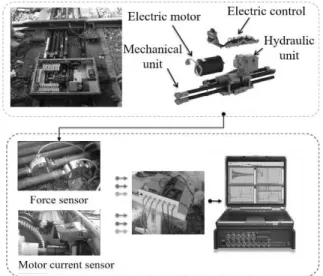
Data acquisition is an initial and essential step of PHM which is known as a process of data collection and storage from physical component/system under investigation for further diagnostics and prognostics purposes. Collected data could be either sensory data or event data (ED). The ED include the information of maintenance actions (e.g. oil change, repairs etc.) taken on the events (e.g. failure, breakdown, installation etc.) that happened to the physical component. CM or sensory data are measurements tracked via installed sensors from asset under investigation, such as; acoustic emission data, vibration data, temperature, pressure, humidity, resistance, voltage, etc. Where ED includes events performed by maintenance technician, such as corrective maintenance, asset repairs, installation, breakdown, cleaning and oiling on the component/system. Data acquisition process is depicted in Fig. 2 for a railway point machine example. ISO definition for data acquisition can be found in (ISO 13374-1:2003, n.d.).
2.2 Data Preprocessing
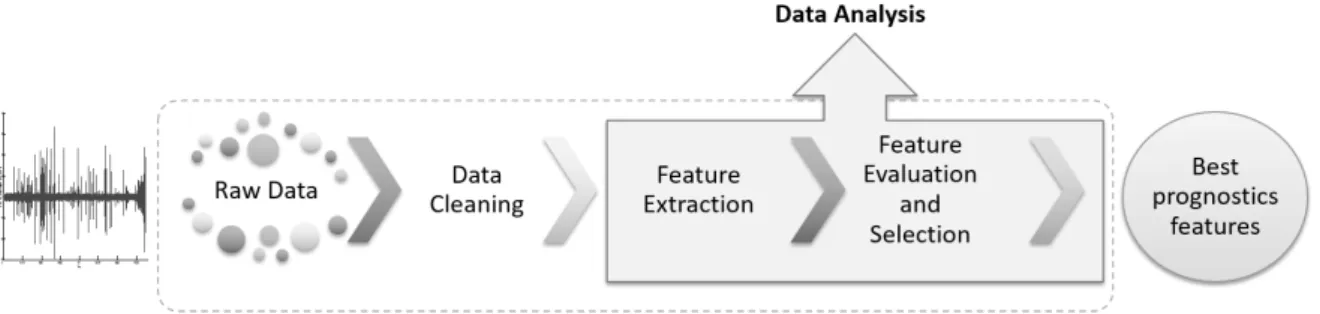
Data preprocessing involves data cleaning and data analysis steps. Cleaning errors/noise from raw data increases the chance of getting error-free data for further investigations. Data analysis, which is the second step of data preprocessing, involves feature extraction, feature evaluation, and selection processes. Cleaned sensory time series should undergo a feature extraction process to extract only the important and useful features that reflect system health state being monitored. Extracted features should indicate the failure progression of the system. The feature extraction techniques are categorized as time-domain based, frequency-based and time-frequency based techniques in the literature (Jardine et al., 2006). The time-domain based feature extraction techniques (e.g. root mean square, kurtosis etc.) are used to analyze the global characteristics of data and to extract the features in time domain. The frequency-domain based feature extraction
techniques (e.g. Fourier transform, envelop analysis etc.) transform the data into frequency domain and are used to detect and identify a faults which are not possible by time-domain based techniques. The time-frequency time-domain based techniques (e.g. Fourier transform, envelop analysis etc. Hilbert-Huang transform, Wigner-Ville distribution etc.) analyze the data in both time and frequency domains. Feature evaluation and selection process is the second important step of data analysis after extraction. A feature evaluation can be defined as a feature goodness quantification process in feature selection. There are different techniques used to quantify the feature goodness (i.e. degradation trend) such as monotonicity, prognosability and trendability (J. Coble & Hines, 2009). The best features, which have clear degradation trend, are further selected in a feature selection process after evaluation (Kimotho & Sextro, 2014). More information on feature extraction techniques can be found in (Sharma & Parey, 2016; Zhu, Nostrand, Spiegel, & Morton, 2014) articles.
Fig. 2. Data acquisition process for railway point machine.
Fig. 3. Data preprocessing procedure. An accurate prediction of remaining-useful-life (RUL) of
assets depends on well evaluated and selected prognostic features. Overall data preprocessing procedure is depicted in Fig. 3. ISO definition for data preprocessing can be found in (ISO 13374-1:2003, n.d.).
2.3 Detection
There are many factors that cause system components to degrade over time, losing their initial performance, and which therefore need to be considered in detection modeling. Health state detection is the process of detecting and recognizing incipient failures and/or anomalies from CM data. A fault detection is typically based on the quantification of the inconsistencies between the actual and the expected behavior of the system in nominal conditions. Fig. 4 illustrates failure propagation of component based on CM data.
In Fig. 4, a component CM indicator increases with time as the component degrades. As illustrated in the figure, the evolution of the health state of the component can be divided into 3 phases; Phase-1 (T0 <T1) where the component is in a healthy state, Phase-2 (T1< T2) where the component is in a faulty state, Phase-3 (T2<) where the component is in the completely failed state. Predefining thresholds (T1 and T2) is very challenging, which needs serious experience for practitioners. Historical CM data can be also used to compare and set new thresholds for the same type of components. Time-to-failure estimation is performed in Phase-2 after the detection process where maintenance activities are planned based on estimated time-to-failure. Therefore, early detection of component failure is important. Fig. 5 illustrates features’ health state
Fig. 4. Component failure propagation.
Fig. 5. Feature health state transitions.
transitions for slowly propagating failures (healthy-faulty- failed) and for sudden failures (healthy-failed). ISO definition for fault detection can be found in (ISO 13374-1:2003, n.d.).
2.4 Diagnostics
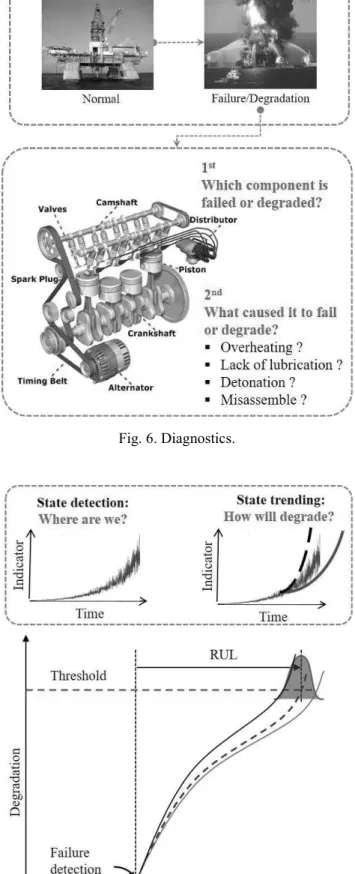
Fault diagnostics is a process of fault detection, isolation (i.e. which component is failed), failure mode identification (i.e. what is the cause of failure or fault) and degradation level assessment (i.e. quantification of the failure severity) in condition monitoring. Diagnostics can be conducted when a machine is either in complete failure state or in faulty state. Fig. 6 illustrates the post-mortem fault diagnostics for failed component. Diagnostics results can be used for reactive as well as proactive decision making (the latter when diagnosing a degraded condition, as opposed to a complete failure). ISO definition for fault diagnostics can be found in (ISO 13372:2012, n.d.).
2.5 Prognostics
Prognostics is defined as the process of predicting the time (RUL) at which a component will no longer perform a particular function and it is illustrated in Fig. 7. Prognostics results are used to support proactive decision making. ISO definition for fault prognostics can be found in (ISO 13381-1:2005, n.d.).
As illustrated in two examples (Fig. 6 and Fig. 7), prognostics serves as prevention of system from possible failures by predicting future states while diagnostics is
concerned with fault isolation and classification process. Prognostics and diagnostics difference is depicted in Fig. 8.
Fig. 6. Diagnostics.
Fig. 7. Prognostics.
Fig. 8. Prognostics vs. Diagnostics.
2.6 Decision Making
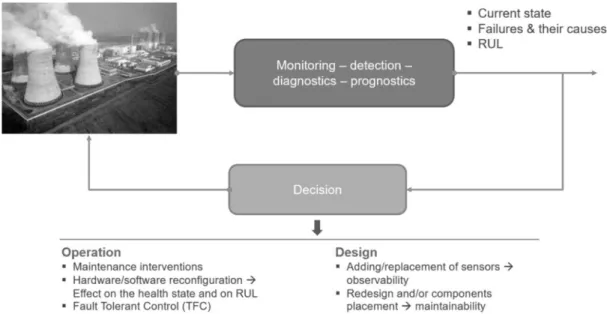
Decision making is a process resulting in the selection of logical and/or right maintenance action among several alternatives. Maintenance technician must evaluate the negatives and positives of each action based on the diagnostics or prognostics results. To make effective decisions, the technician also should be able to estimate the outcomes of each alternative as well. ISO definition for decision making can be found in (ISO 13374-1:2003, n.d.) Outcomes of decisions could be either operational or design based. Decisions made on operational actions could be maintenance interventions, hardware/software reconfigurations and fault tolerant control (FTC). Design based outcomes could be adding and/or replacing sensors observability and redesign and/or components placement. Decision-making process is illustrated in Fig. 9.
2.7 Human-Machine Interface
Human-machine interface is Graphical User Interface (GUI) which is used to visualize component health status, to execute tasks, to analyze data and to control the maintenance operations.
3. PHM CHALLENGES
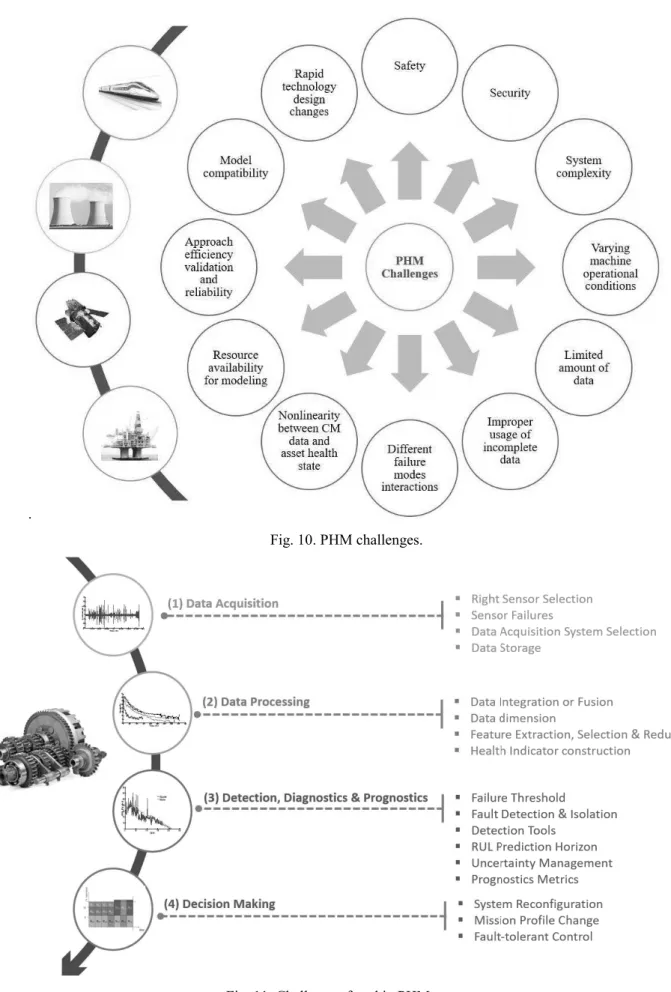
This section will summarize general and step based challenges of PHM. PHM and its implementation is a very challenging task that requires several aspects in need for further investigation before applying it reliably in real applications. Hence, it is important to develop sophisticated reliable degradation models for the accurate estimation and prediction of its evolution. Safety-critical systems such as; automotive, train, nuclear, chemical and aerospace industries, need smart predictive maintenance systems with very high reliability due to potential catastrophic failure consequences. Due to this, smart and reliable PHM technology development is urgent to cope with maintenance optimization tasks of critical complex systems efficiently. Thus, developed PHM system should
take into account asset and system degradation, environmental effects, failure behaviors, failure interactions and related uncertainties (Qiao & Weiss, 2016). These PHM challenges are illustrated in Fig. 10. Further challenges faced in PHM steps are data acquisition, data preprocessing, detection, diagnostics and prognostics and decision making. Challenges in PHM steps are synthesized in Fig. 11.
4. SYSTEM-LEVEL PHM
In this section, scientific works conducted toward system-level based PHM approaches are reviewed and challenges in implementation steps are discussed.
Generally, most of the research conducted in failure diagnostics and prognostics of assets in literature are based on component-level health assessment. However, complex engineering systems are composed of multiple and interactively functioning individual components that can influence the system performance very seriously when they fail. Hence, development of PHM methodologies for system-level monitoring is also important as well as component-level PHM methodologies (Sankavaram et al., 2016). (Khorasgani, Biswas, & Sankararaman, 2016) proposed comprehensive two-step analytic system-level prognostics methodology for rectifier systems which consist of estimation and prediction step. In estimation step, performance degradation models of individual components were combined and were adopted into particle filtering (PF) based estimation. Whereas in the prediction step, first order reliability method (FORM) based system-level prediction model was built to predict system-system-level RUL. The proposed system-level stochastic approach was robust and accurate in RUL prediction but not computationally efficient when compared with inverse-FORM. Sai Sarathi Vasan, Chen, & Pecht (2013) proposed a model-based approach for system-level RUL prediction of the radio-frequency receiver system. The proposed model consists of three steps: knowledge-based creation, offline and on-line testing. In the knowledge-based creation
step, system parameters and critical circuits were identified. Authors decomposed an electronic system into circuit components to detect only the critical ones to minimize the resources and complexity. In the off-line step, fault indicators and failure threshold were identified and finally, prognostics was performed by PF in an on-line step. Fault tree (FT) failure analysis technique which is widely used in safety analysis of aircraft systems, study interactions of sequences of sub-events with the top event. Daigle, Sankararaman, & Roychoudhury (2016) presented a methodology based on FT technique for system-level RUL prediction by combining individually independent components RULs of aircraft environmental control system. Ferri et al. (2013) combined system architecture information with individual component RULs to obtain system RUL of the simplified electrical system.
Jie Liu & Zio (2016) proposed a reliability assessment and system RUL prediction framework based on a recursive Bayesian method for the system with multiple dependent components. The system states were estimated by the recursive Bayesian method and Monte Carlo simulation was applied accurately in RUL prediction of nuclear power plants’ residual heat removal system at system-level reliability.
Although, some papers on system-level PHM exist, there remain many issues and/or challenges to be solved to develop system-level PHM methodologies. Challenges regarding system-level PHM can be stated as, model structure and parameters uncertainties, nonlinearity of system model, environmental effects, measurement noise and component degradation interactions.
5. UNCERTAINTY QUANTIFICATION
Since fault prognostics methodologies deal with machine future health state prediction, there are many uncertainties parameters that influence the prediction accuracy. Sources of fault prognostics uncertainty can be categorized as following;
.
Fig. 10. PHM challenges.
Uncertainty in system parameters: this concerns the
uncertainty in the values of the physical parameters of the system (resistance, inductance, stiffness, capacitance, etc.). This uncertainty is induced by the environmental and operational conditions where the system evolves. This can be tackled by using adequate methods such interval ones.
Uncertainty in nominal system model: this concerns the
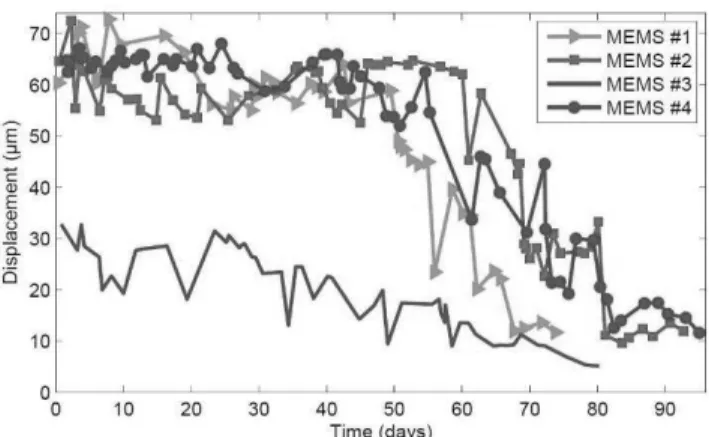
imprecisions in the mathematical models which is generated to represent the behavior of the system. These imprecisions (or uncertainties) can be the result of a set of assumptions used during the modeling process and which lead to models that don’t fit exactly the real behavior of the system. Fig. 12 illustrates an example for this type of uncertainty for Micro Electro Mechanical Systems (MEMS) (Skima, Medjaher, Varnier, Dedu, & Bourgeois, 2016a) which degraded differently under the same operational profiles.
Uncertainty in system degradation model: the degradation
model can be obtained from accelerated life tests which are conducted on different data samples of a component. In practice, the data obtained by accelerated life tests performed under the same operating conditions may have different degradation trend. This difference in the degradation trends can then be considered as an uncertainty in the degradation models derived from the data related to the accelerated life tests.
Uncertainty in prediction: uncertainty is inherent to any
prediction process. Any nominal and/or degradation model predictions are inaccurate which is impacted by several uncertainties such as uncertainty in the model parameters, the environmental conditions and the future mission profiles. The prediction uncertainty can be tackled by using Bayesian and online estimation and prediction tools (e.g. PF and Kalman filter etc.).
Uncertainty in failure thresholds: the failure threshold is
important in any fault detection and prediction methods. It determines the time at which the system fails and consequently the remaining useful life. In practice, the value of the failure threshold is not constant and can change in time. It can also change according to the nature of the system, operating conditions and in the environment which
Fig. 12. Uncertainty in degradation model of MEMS (Skima et al., 2016a).
it evolves. All these parameters induce uncertainty which should be considered in the definition of the failure threshold.
Sankararaman, (2015) analyzed the uncertainty in fault prognostics by quantifying the sources of uncertainty from different aspects of view. In (Sun, Zuo, Wang, & Pecht, 2014), the authors developed state-space-based degradation model to reduce the crack growth prediction uncertainty based on data fusion. A similar work conducted in fault prognostics uncertainty quantification can be found in (Duong & Raghavan, 2017; Sankararaman & Goebel, 2013; Zhao, Tian, & Zeng, 2013) articles. Hence, it’s important to quantify the uncertainty sources in fault prognostics.
6. PHM APPROACHES- A REVIEW
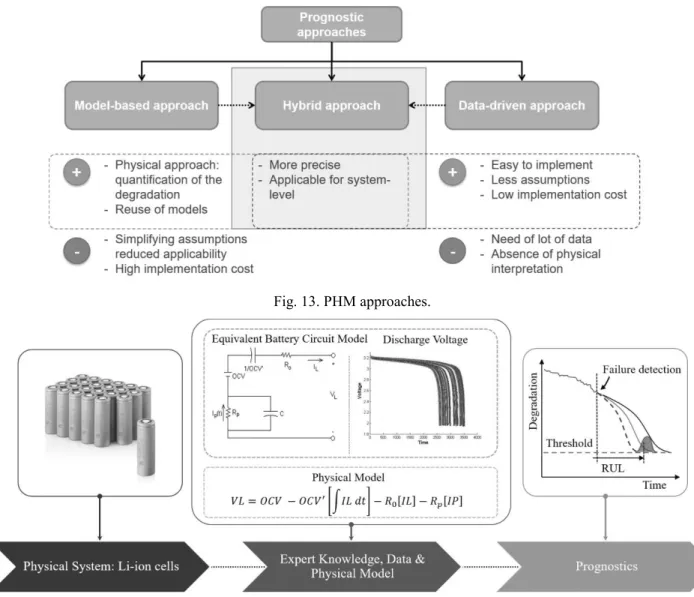
In this section, we have reviewed scientific papers which have been published in component-level PHM, especially in complex components which have a high maintenance cost and severe failure consequences. And they were summarized under three categories, in general: model-based (or physics-model-based), data-driven and hybrid approach with their drawbacks and merits. The Experience-based approaches, which is solely based on expert-knowledge, is not presented in this paper. Only the most studied approaches are presented and reviewed. PHM approaches are illustrated in Fig. 13 with their pros and cons.
6.1 Model-based Prognostics Approaches
In Model-based prognostics approaches, the behavior of a system/component degradation process leading to failure is described by mathematical models and/or equations derived from physical systems. Derived mathematical model is combined with condition monitoring data to identify model parameters, then used to predict the future evolution of component health state. Model-based approaches are more accurate than other approaches and have long-term RUL prediction horizon but need good expert knowledge. Deriving models from real physical systems is very challenging due to system complexity and stochastic degradation behavior of components. A model-based approach for Li-ion cells is illustrated in Fig. 14. The equivalent battery circuit degradation model was adapted from Mohamed et al. (2010).
Commonly used model-based prognostics approaches in literature are Paris-Erdogan law (Irwin & Paris, 1971; Paris & Erdogan, 1963) and Forman law (Forman, 1972). In (LI, Kurfess, & Liang, 2000), stochastic defect-propagation model was presented based on Paris equation for bearing defect prognostics.
Feasibility of proposed approach was tested by numerical simulations. Gearboxes are force transmission components of mechanical systems that need health assessment due to its importance. In (C. J. Li & Lee, 2005), was proposed model-based methodology based on Paris crack propagation to predict RUL of cracked gears. Gear meshing stiffness was identified by embedded model from measured
Fig. 13. PHM approaches.
Fig. 14. Model-based prognostics approach for Li-ion battery.
vibration data. Experimental results showed that model-based approach could accurately predict RUL of gear crack with minimum error. In (Marble & Morton, 2006), was developed a model-based approach for turbine engine bearing spall progression prognostics. Depending on operating conditions, presented model could compute failure time and spall growth trajectories very well and prediction uncertainty was reduced by model updating. In (Choi & Liu, 2007), was studied spall progression life model due to crack formation and wear of rolling contact. Crack initiation and propagation models were combined with developed spall progression model to predict finish hard machined specimens’ total life. Developed spall progression life model was experimentally tested and was less sensitive to different machine operations when compared with fatigue life models.
Cracks in mechanical components of complex machines can cause serious failures in the industry unless diagnosed well. In (Pennacchi & Vania, 2008), was presented model-based diagnostics approach for failure identification in gas
turbines. They analyzed shaft vibrations caused by crack propagation during load coupling of gas turbines and successfully obtained good diagnostics results to avoid catastrophic failures.
In many safety-critic complex systems, such as bridges (J. He, Lu, & Liu, 2012) and aircraft (Campbell & Lahey, 1984), fatigue crack growth prognostics is efficiently used for structural health management to avoid catastrophic failures. In (Guan et al. 2012), was proposed Maximum relative Entropy (MrE) to manage measurement uncertainties. Physics of fatigue crack was modeled using Paris-Erdogan law (Paris & Erdogan, 1963) and was validated on using Virkler (Virkler, Hillberry, & Goel, 1979) fatigue crack propagation dataset. In comparison with the classical Bayesian method, proposed approach gave improved prediction results in fatigue crack prognostics.
Self-adaptive RUL prediction methodology based on Paris law for rolling element bearing prognostics was studied in
(Liang et al., 2014) paper, using vibration data acquired by accelerated aging procedure and bearing defect propagation was effectively predicted without a priori knowledge about model parameters.
Kalman Filter (KF) (Kalman, 1960), which is a widely known Bayesian method, has been used to model linear systems with additive Gaussian noise for estimation and prediction purposes. In (Lim & Mba, 2015), Switching Kalman Filter (SKF) was adopted for model estimation and RUL prediction of aircraft gearbox bearings using CM data. And it was concluded that, when CM data is available, using SKF for diagnostics and prognostics of bearing degradation, could support to make better maintenance decisions. Prognostics of Proton Exchange Membrane Fuel Cells (PEMFC) were studied in (Bressel et al. 2016). Extended Kalman Filter (EKF) was used in State of Health (SoH) estimation and RUL prediction of fuel cells and it was stated that EKF could offer good SoH estimation and accurate RUL prediction results using experimental data for degradation modeling. In (Andre et al. 2013), was proposed an online mathematical approach based on a combination of dual KF and Support Vector Machines (SVM) to estimate State of Charge (SoC) and SoH values of Li-ion batteries. The developed approach was validated using internal resistance features from real driving cycle test data which gave accurate and comprehensive results for both SoH and SoC estimation of aged Li-ion batteries in a laboratory environment. Since batteries are electrochemical substances, they have nonlinear degradation pattern due to many environmental effects. In (Burgess, 2009), was developed a methodology using KF to estimate remaining service life of the nonlinearly degraded lead-acid battery. Nonlinear capacity degradation of the lead-acid battery was modeled by dividing capacity time series data into two phases; phase-1which was assumed as healthy part and phase-2 which as the faulty part where degradation is more rapid. KF algorithm was conducted when capacity degradation reached to phase-2 in order to predict the remaining service life of the lead-acid battery. An important issue that was not handled in this paper is how to detect incipient failure from nonlinear capacity degradation time series before jumping to phase-2. The uncertainty of degradation parameters due to environmental effects is one of the main problems in Li-ion SoC and SoH estimations.
Particle filters (PF), which are known as state-space models, has been used in many prediction problems. Jouin et al. (2014) studied PEMFC stack degradation and developed prognostics model for RUL estimation using PF. Despite the PF’s robustness in prediction process, it has a degeneracy phenomenon. After some iteration, particle weights tend to zero affecting estimation result. This problem was handled in (H. Dong et al 2014) by adopting SVM to resample weights in order to avoid degeneracy problem. Internal resistance and capacity features were used as system health indicators to estimate SoH of Li-ion batteries. Integration of SVM-PF algorithm improved SoH estimation and RUL prediction when compared with standard PF itself. Piyush Tagade et al. (2016), developed
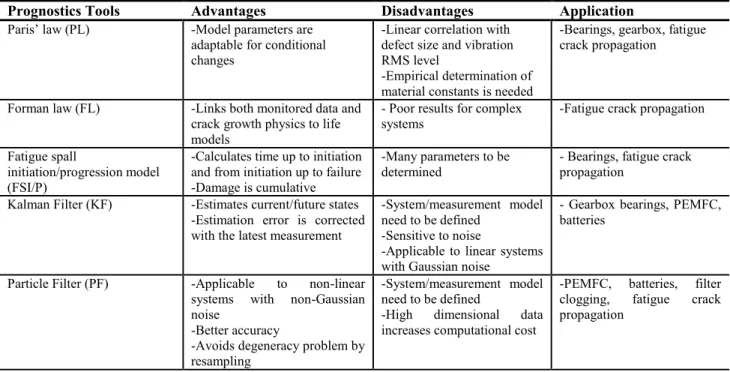
an improved PF algorithm to indicate battery state estimation at different driving cycle protocols and was compared with KF algorithm. Proposed model accurately predicted battery parameters at different driving cycle protocols outperforming KF algorithm. Filtration, which is a process of cleaning and/or trapping suspended particles from a liquid, is an important process in many engineering applications, such as automotive, chemical industry, nuclear plants, etc. In (Omer F. Eker, Camci, & Jennions, 2015), was presented a physics-based model for filter clogging phenomena. PF was integrated with presented physics model to estimate RUL of fuel filters and it was validated on experimental data acquired from test rig under laboratory environment. Zio & Peloni, (2011) presented PF-based prognostics framework for dynamic fatigue crack propagation. A tutorial on PF with Matlab code implementation was presented in (An, Choi, & Kim, 2013). Marine J. et al. (2016) presented comprehensive review. Even though model-based approaches have accurate prognostics results, they might not be a feasible solution in many industrial applications, due to failure type uniqueness, dynamic damage evolution and specific theoretical knowledge about the system. Failure progression of components and/or subsystems in a complex system might be different from each other which limits the applicability of physical models in system level prognostics. Model-based prognostics tools studied in the literature, are given in Table 2 below with their application areas, advantages, and disadvantages.
6.2 Data-driven Prognostics Approaches
Data-driven approaches attempt to build degradation models using information from CM data collected via installed sensors and to predict future health state instead of building physical models. Data-driven approaches can be easily applied in prediction problems and require more computational time than model-based approaches. The accuracy of data-driven approaches is highly dependent on the amount of CM data available. Data-driven prognostics approach is illustrated in Fig. 15. And battery degradation model in this present figure was adapted from the work of W. He et al. (2011).
In traditional prognostics methodologies, results of multiple algorithms are compared and the one which gives the best result is selected for prediction of system health state while discarding other algorithms. Ensemble based prognostics approach which combines multiple algorithms using different weighted-sum functions for accurate RUL prediction was proposed to overcome this limitation in (Hu Y. et al. 2012). Proposed ensemble approach was tested using 2008 IEEE PHM challenge problem: power transformer and electric cooling fan problems, by combining 5 different prognostics algorithm which increased RUL prediction accuracy.
ARIMA, which is the generalization of ARMA, is another widely-used approach in time series forecasting aiming to describe autocorrelation of the data. In (Wei Wu, 2007), was proposed an improved ARIMA model for rotating
Prognostics Tools Advantages Disadvantages Application
Paris’ law (PL) -Model parameters are adaptable for conditional changes
-Linear correlation with defect size and vibration RMS level
-Empirical determination of material constants is needed
-Bearings, gearbox, fatigue crack propagation
Forman law (FL) -Links both monitored data and crack growth physics to life models
- Poor results for complex systems
-Fatigue crack propagation
Fatigue spall
initiation/progression model (FSI/P)
-Calculates time up to initiation and from initiation up to failure -Damage is cumulative
-Many parameters to be determined
- Bearings, fatigue crack propagation
Kalman Filter (KF) -Estimates current/future states -Estimation error is corrected with the latest measurement
-System/measurement model need to be defined
-Sensitive to noise
-Applicable to linear systems with Gaussian noise
- Gearbox bearings, PEMFC, batteries
Particle Filter (PF) -Applicable to non-linear systems with non-Gaussian noise
-Better accuracy
-Avoids degeneracy problem by resampling
-System/measurement model need to be defined
-High dimensional data increases computational cost
-PEMFC, batteries, filter clogging, fatigue crack propagation
Table 2. Model-based prognostics tools and their advantages and disadvantages.
Fig. 15. Data-driven prognostics approach for Li-ion battery. machinery prognostics which could detect underlying
changes from machine degradation data. It was validated on vibration signals collected from test rig and gave better prediction result than standard ARIMA. Furthermore, prognostics on miniature bulb degradation data was studied by modeling trend and seasonal components of time series analysis technique in (T. Huang et al. 2010).
Jianbo L. et al. (2007) developed a novel prediction algorithm so-called Match Matrix (MM) with long prediction horizon. MM was formed by comparing two degradation data based on similarity distances. If the similarity or match value between currently developing degradation and historical one is bigger, then one can use historical degradation time series data in modeling to predict future behavior of currently developing
degradation. MM prediction results were compared with Elman Recurrent Neural Network (ERNN) and gave better long term prediction accuracy. Gaussian Process Regression (RPG) statistical non-parametric method was adopted for nuclear plant prognostics in (Piero Baraldi, Mangili, & Zio, 2015).
GPR was validated on simulated creep growth time series and real filter clogging degradation with accurate RUL prediction results. In (Yu, 2011), Gaussian Mixture (GM) was integrated with feature extraction methodology for bearing defect diagnostics. In (P. Wang, Youn, & Hu, 2012), an offline-online methodology for structural health prognostics was proposed. In online step, the probabilistic recursive Bayesian algorithm was used for learning system health level whereas in offline step similarity-based
interpolation was used to predict the lifetime of an electric cooling fan.
An offline-online methodology for prognostics of CNC machines using Bayesian network was proposed in (D. A. Tobon-Mejia, Medjaher, & Zerhouni, 2012). In an offline phase, reliable features were extracted from raw data and were fed for further modeling using Mixture of Gaussian Hidden Markov Model (MoG-HMM), whereas, in the online phase, the learned model was used in cutting tool health assessment and RUL estimation processes. Wavelet packet decomposition was adopted in feature extraction using vibration signals and MoG-HMM was used to model bearing degradation and RUL estimation in (Diego A. et al., 2012). In (M. Dong & He, 2007), was proposed diagnostics and prognostics framework for hydraulic pump health monitoring based on hidden semi-Markov Models (HSMM). Furthermore, authors modified the forward-backward algorithm to estimate model parameters and using HSMM estimated time duration of hidden states performed RUL prediction which was better than traditional HMM. Research done in battery prognostics mainly aims to estimate Charge (SoH), State-of-Health (SoH) and to predict RUL. Two prognostics methods; linear and artificial neural network (ANN), were implemented to predict RUL of batteries using capacity degradation time series in (S. Lee et al, 2012). ANN approach performed better than linear model since it gives better results in one-step-ahead RUL predictions. Li-ion self-recovery which is known as cell regeneration phenomenon was investigated and combined with capacity degradation data for prognostics of batteries utilizing a
combination of GPR functions in (D. Liu et al., 2013). As a result presented approach reduced prediction uncertainty while increasing accuracy. Prognostics of Li-ion batteries based on capacity degradation time series was presented using Autoregressive (AR) model with Particle Swarm Optimization (PSO) algorithm in (Long, Xian, Jiang, & Liu, 2013) paper for PF.
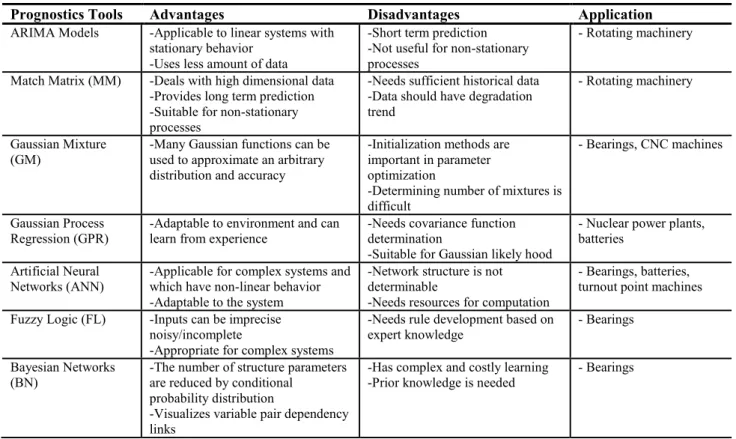
Reliability, availability and safety are subjects of great importance in many complex systems and indeed in the railway industry. Railway turnout systems, which are electro-mechanical structures, are key contributors to the reliability and availability of a railway network. In (Omer Faruk Eker et al., 2011), the authors developed a prognostics methodology to detect and forecast failures in electro-mechanical systems named as simple-state based prognostics method. Results of proposed methodology were quite good in comparison with Hidden Markov Models (HMM) using real datasets collected from a railway turnout machine. Time Delay Neural Network (TDNN) was used for failure prediction using real sensory data collected from a railway turnout machine in (Halis Yilboga, Ömer Faruk Eker, 2010). Data-driven prognostics approaches build degradation models using monitored data collected via installed sensors and they may be more practical and/or available solution for diagnostics and prognostics of complex systems in many applications instead of building physical models. However, those models have no or less physical meaning which makes them less sensitive to real system behavior. Table 3 presents application areas, advantages, and disadvantages of data-driven prognostics tools.
Prognostics Tools Advantages Disadvantages Application
ARIMA Models -Applicable to linear systems with stationary behavior
-Uses less amount of data
-Short term prediction -Not useful for non-stationary processes
- Rotating machinery
Match Matrix (MM) -Deals with high dimensional data -Provides long term prediction -Suitable for non-stationary processes
-Needs sufficient historical data -Data should have degradation trend
- Rotating machinery
Gaussian Mixture (GM)
-Many Gaussian functions can be used to approximate an arbitrary distribution and accuracy
-Initialization methods are important in parameter optimization
-Determining number of mixtures is difficult
- Bearings, CNC machines
Gaussian Process Regression (GPR)
-Adaptable to environment and can learn from experience
-Needs covariance function determination
-Suitable for Gaussian likely hood
- Nuclear power plants, batteries
Artificial Neural Networks (ANN)
-Applicable for complex systems and which have non-linear behavior -Adaptable to the system
-Network structure is not determinable
-Needs resources for computation
- Bearings, batteries, turnout point machines Fuzzy Logic (FL) -Inputs can be imprecise
noisy/incomplete
-Appropriate for complex systems
-Needs rule development based on expert knowledge
- Bearings
Bayesian Networks (BN)
-The number of structure parameters are reduced by conditional
probability distribution
-Visualizes variable pair dependency links
-Has complex and costly learning -Prior knowledge is needed
- Bearings
6.3 Hybrid Prognostics Approach
Both model-based and data-driven prognostics approaches have their own merits and limitations as was discussed in previous sections. The hybrid prognostics approach, which is a newly developing PHM approach, aims to integrate merits of different approaches while minimizing limitations for better system and/or component level health state estimation and RUL prediction. None of the prognostics approaches that is presented in the literature is superior to another. Hence, it’s important to note that superiority of prognostics approaches can only be case specific.
In (Liao & Köttig, 2014), was presented a comprehensive literature review aiming to developed a hybrid prognostics approach combining advantages and disadvantages of different prognostics approaches. Authors validated developed a hybrid approach for Li-ion degradation as a case study to show potential benefits. They categorized prognostics models as experience-based, data-driven, and physics-based models and presented 5 different hybrid approach classes as illustrated in Fig. 16. Here we briefly explain those classifications with their advantages and disadvantages. Interested readers are kindly referred to the original paper (Liao & Köttig, 2014) for more information.
Class 1 ─ combines Experience-based and Data-driven approach models. Experience-based approaches, which is
solely based on expert-knowledge, is integrated with data-driven models for asset prognostics. The advantage of this hybrid approach is that expert-knowledge can help to determine system faults and those rules can be used in data- driven models for RUL prediction. However, expert-knowledge may not capture all faults occurring in system degradation and this hybrid approach is not a feasible option for long-term RUL predictions. Satish & Sarma (2005), presented a cost-effective method for bearing fault prognostics combining ANN and fuzzy logic. Results of developed hybrid approach were more suitable for bearing health assessment than ANN.
Class 2 ─ combines Experience-based and Physics-based approach. This hybrid approach integrates
expert-knowledge to improve the physics-based model. This is similar to Class 1, the only difference is, it uses physics-based models for prognostics. In (Swanson, 2001), was presented a hybrid approach for crack propagation problem using KF and fuzzy logic algorithms. KF was used to detect
feature changes and estimate remaining time to failure where fuzzy logic was adopted to define failure thresholds for vibration signals of machines under different operational modes.
Class 3 ─ combines multiple Data-driven approach models. In this hybrid approach, two or more data-driven
models are combined to improve asset performance prediction by means of information fusion. In this class, one data-driven approach can be used to estimate the health state and a second one to predict asset residual life. In (Gebraeel et al., 2004), was developed a hybrid approach for bearing failure prediction based on ANN. Authors collected vibration signals from 25 accelerated bearing tests and trained 25 ANN for bearing failure time prediction. Then residual lifetime prediction was accomplished by weighting the outputs of ANNs. In (Peng & Dong, 2011), was proposed a hybrid approach for pump wear prognostics. Grey prediction model which also was studied in (Gu et al., 2010) for electronic prognostics was integrated with aging factor integrated HMM RUL prediction algorithm for asset prognostics. Only the drawback of this approach is RUL prediction process that is carried out by data fusion, could be computationally hard if multiple models are used.
Class 4 ─ combines Data-driven and Physics-based approach models. This hybrid approach aims to integrate
the strengths of both data-driven and physics-based approaches for accurate performance prediction. There are many research papers which have been studied in the literature falling into this class, only some of them are presented here.
Kumar et al. (2008) proposed hybrid approach utilizing data-driven approach and model-based approach for electronic products prognostics. Hong-feng (2012), presented general fusion framework utilizing both merits of data-driven and model-based approaches to increase system reliability and to reduce maintenance cost. In many complex assets, performing online health measurement may not be practical and even impossible and thus model-based approach such as PF is not applicable for machine prognostics. P. Baraldi et al. ( 2013) proposed a novel ensemble approach embedding ANN in the PF scheme for crack depth prediction problem. The main idea for this approach proposition is based on unavailability of measurement model but only dataset itself. Different datasets were generated to train different ANNs and their
outputs were combined to get ensemble output. It was validated on fatigue crack propagation dataset and results showed that if ANN is trained with large dataset it was possible to get accurate estimations. In (Goebel, Eklund, & Bonanni, 2006), was presented a fusion prognostics approach combining data-driven and physics-based prediction results for bearing prognostics to reduce prediction uncertainty. The physics-based approach was based on a spall-growth model where the data-driven model was based on load and speed measurements from bearing spall growth. Results of both different approaches were fused by well-known Dempster-Shafer regression. Yang et al. (2016) presented a hybrid approach that integrates relevance vector machine (RVM) with a model-based model for Li-ion capacity degradation. Several batteries were aged under aging process and capacity features were extracted for RUL prediction. Combined two exponential physical model was fit to capacity features to track degradation trend. Furthermore, both selective kernel ensemble-RVM and an exponential regression model were used to predict RUL of aged batteries and proposed hybrid approach prediction was pretty accurate when it was compared with ANN and SVM. In (Liao & Köttig, 2016), was proposed a hybrid approach for Li-ion prognostics. They integrated two data-driven models and one physical model to reduce the uncertainty. Support vector regression was adopted to estimate measurement model and similarity-based prediction method in measurement prediction part. The output of second data-driven model was fed to PF algorithm for long-term Li-ion RUL prediction. They extracted internal resistance degradation features and used in hybrid model validation. It was concluded that prediction uncertainty and accuracy was better than traditional PF and data-driven method. Skima et al. (2016) presented a hybrid approach for Micro Electro Mechanical Systems (MEMS) prognostics. An approach involves two phases; online and offline. In offline phase degradation model was constructed based on health indices (HI) extracted from experimental data. The combination of two exponential regression model was constructed to represent MEMS degradation phenomena. Furthermore, in an online phase, a model-based method which is PF was adopted. Online phase also had learning stage and prediction stage. In learning stage, PF parameters were estimated and in prediction stage, RUL prediction was carried out. They claimed that proposed hybrid approach could predict RUL of MEMS effectively. The authors in (Pillai, Kaushik, Bhavikatti, Roy, & Kumar, 2016) proposed a hybrid approach for gas turbine failure prognostics based on machine learning.
Class5 ─ combines Experience-based, Data-driven and Physics-based approach models. This class of hybrid
approach fuses the strength of experience-based, data-driven and physics-based models. In (Orsagh, Sheldon, & Klenke, 2003), was proposed a hybrid approach that fuses data-driven, physics-based prediction results with expert-knowledge information to predict RUL of bearings. This category of the hybrid approach is not practical and hard to implement in real applications due to designing appropriate data fusion methodology to combine different types of
information, resulting from different prognostics approaches.
In general, hybrid prognostics approach is a combination of heterogeneous models. It leverages advantages of different approaches to making robust RUL predictions. But the main challenge in hybrid approach is uncertainty management issue (Liao & Köttig, 2014), which needs further improvements.
7. RAILWAY INDUSTRY – A CASE STUDY ON BOGIE DIAGNOSTICS AND PROGNOSTICS
Reliability, availability and safety are subjects of great importance in many complex systems and indeed for the railway industry. When we compare railway vehicles with other industrial structures such as wind turbines and nuclear plants one can see a big difference between operating conditions. Wind turbines and nuclear plants are stationary where rail vehicles are mobile complex systems. Hence, maintenance and reliability policies can be slightly different than stationary complex systems for rail vehicles. Reliability-critical systems such as rolling stock may have longer life expectancy than other systems, which makes introducing new technology costly and difficult. To provide high safety and good comfort for passengers in rolling stock industry, wheel/rail contact, bogie design and component health assessment is very crucial especially for high-speed operations. Maintenance and online monitoring system platforms should be designed in such manner as to maintain train operations under different environmental conditions by optimizing maintenance to reduce costs and increase the fleet availability.
The Bogie, which is the most important and complex part of the rolling stock, is responsible for fundamental functions such as supporting car body, transferring brake and traction forces, train stability at high speeds, safe rail curve passing, good and comfort ride. Main bogie components are as follows: bogie frame, wheelset, primary and secondary suspension systems. Bogie and its components are illustrated in Fig. 17.
· Bogie frame is the main and largest structural component of the rail vehicle.
· Wheelsets are a complex structural component of bogie which involves axles, brake systems, and wheels.
· Primary suspension is the structural system that links wheelset to the bogie frame.
· The secondary suspension is the system which links bogie frame to the car body.
7.1 Failure Mode, Mechanism and Effect Analysis (FMMEA)
To develop an effective and robust diagnostics and prognostics system for bogie condition monitoring, one should have a comprehensive understanding of the component degradation behaviors and mechanisms under different load or environmental conditions. Bogie
Fig. 17. Bogie components (adopted from (Ling et al., 2014)). components are exposed to different stress levels resulting
in component fatigue or wear. Such failures can lead railway industry to costly shutdowns even may have human causalities. To avoid or minimize component failures, we should understand failure modes and causes to perform better diagnostics and prognostics. Failure mode, mechanism, and effect analysis (FMMEA) is an efficient tool used to analyze component failures, identify the main causes or mechanisms and failure effects on the system and/or component operation (Hendricks, Williard, Mathew, & Pecht, 2015; Mathew, Alam, & Pecht, 2012). FMMEA can be used at the system level, subsystem, and component level. Failure mode describes the way of how physical failure occurs. Failure mechanism, on the other hand, describes the fundamental causes or processes such as chemical, physical and mechanical stresses that lead to a failure mode. Finally, the failure effect describes consequences or impacts of failures on the system and/or component operation. In Table 4, we have summarized some failure modes and mechanisms for the following bogie components: bogie frame, wheels, axle bearings, axle box, suspension (primary and secondary) system and gear box. Since bogies are critical components, diagnostics, and prognostics policies should be carefully carried out to avoid bogie failures and prevent rail vehicle from catastrophic disasters. The scientific papers conducted for fault diagnostics and prognostics of bogie components are as follows: Shahidi et al. (2014) presented vibration signal based condition monitoring strategy to estimate bogie component deterioration to analyze bogie hunting and reviewed critical criteria affecting the performance of bogie. To increase the efficiency of monitoring strategy authors addressed monitoring algorithms nearby sensing techniques. In (Hong et al., 2014), was studied bogie frame health monitoring by deploying online structural health monitoring (SHM) and diagnostics system to high-speed trains. A huge amount of signals was acquired during different operational profiles. Furthermore, different features were extracted from those signals to form damage
indices to detect bogie frame damages. They concluded that online SHM diagnostics system could detect any kind of damages that might occur in bogie frame and could be used efficiently in real-world applications. Similar work was also studied in (Q. Wang, Su, & Hong, 2014) to develop online SHM to increase the safety of high-speed train bogie frames. In (Shahidi et al., 2015), was presented a data-driven method for bogie component fault classification based on mutual information (MI) measure feature selection and SVM. Features were extracted from acceleration signals and were divided into training and testing datasets. Features were ranked based on their similarity degree to the classified fault state by MI algorithm and were fed into SVM for bogie fault classification.
7.2 Axles and Bearings
One of the critical components of high-speed trains is rolling element bearings. In (Pennacchi et al., 2013), was studied rolling element bearings diagnostics of high-speed trains. They built experimental test-rig to collect vibration signals for bearing diagnostics. Different signal processing techniques were adopted to process vibration signals for fault detection. Spectral kurtosis algorithm was used to detect bearing faults. Furthermore, based on fault detection results they also analyzed sensitivity metrics of sensors to the bearing faults to reduce the number of sensors employed in diagnostics. Symonds et al. (2015) studied axle-bearing damage analysis. Using collected vibration signals, tested different techniques to identify bearing failure causes by identifying physical damage links between CM signals. Xie et al. (2015) presented health state diagnostics methodology for high-speed train axles. Temperature CM data collected from test line underwent the pre-processing step to replace zero values and noise cancellation by adopting interpolation and discrete wavelet transform techniques. Smoothed temperature data were used to calculate rising rates by a presented methodology
for axle health state evaluation and it was concluded that this approach could be used effectively and was more practical when compared to other diagnostics approaches. In (Yi, Lin, Zhang, & Ding, 2015) was presented a novel approach for fault diagnostics of railway axle bearings
based on ensemble empirical mode decomposition (EEMD) and Hilbert transform (HT) signal processing techniques. To overcome the limitations of EEMD, which decomposes signals into varying intrinsic modes, they proposed an improved EEMD approach by introducing
Component Failure mode Failure mechanisms
Bogie frame
Surface defects · Fatigue cracks propagation · Impacts
Loss of structural integrity · Fatigue cracks propagation · Impacts
· Thermal shocks
· Material deformations (Yielding, creep)
Wheel
Surface defects · Shelling · Spalling · Scaling · Metal build-up
· Fatigue crack propagation Subsurface defects · Fatigue crack propagation
Axle bearing
Bearing rotates with difficulty or cannot rotate · Fatigue (Subsurface initiated fatigue / Surface-initiated fatigue)
· Wear (Abrasive wear / Adhesive wear)
· Fracture and Cracking (Forced fracture / Fatigue fracture / Thermal cracking)
Bearing rotates with difficulty or cannot rotate · Fatigue (Subsurface initiated fatigue / Surface-initiated fatigue)
· Wear (Abrasive wear / Adhesive wear)
· Fracture and Cracking (Forced fracture / Fatigue fracture / Thermal cracking)
Axle box Surface defects · Fatigue crack propagation Inner and outer springs Reduction of the primary suspension effect · Fatigue crack propagation
· Material deformation (Yielding, creep) Centering springs Reduction of the centering effect · Fatigue crack propagation
· Material deformation (Yielding, creep) Primary damper Reduction of the damping effect · Seals wear
· Leakage
Emergency springs Reduction of emergency suspension effect · Fatigue crack propagation
· Material deformation (Yielding, creep) Air spring Reduction of the secondary suspension effect · Leakage
· Fatigue crack propagation Vertical damper Reduction of the vertical damping effect · Seals wear
· Leakage Lateral damper Reduction of the lateral damping effect · Seals wear
· Leakage
Gearbox
Gearbox rotates with difficulty or cannot rotate · Bearings:
o Fatigue (Subsurface initiated fatigue / Surface-initiated fatigue)
o Wear (Abrasive wear / Adhesive wear)
o Fracture and Cracking (Forced fracture / Fatigue fracture / Thermal cracking)
· Gears:
o Subsurface initiated bending fatigue o Scuffing
o Fretting corrosion o Micropitting/Macropitting Bad or insufficient lubrication · Oil reservoir leakage
· Grease quality degradation o High Temperatures Ageing o Mechanical Ageing o Contamination