Analysing Artefacts Dependencies to Evolving Software
Systems
par Fehmi Jaafar
D´epartement d’informatique et de recherche op´erationnelle Facult´e des arts et des sciences
Th`ese pr´esent´ee `a la Facult´e des arts et des sciences en vue de l’obtention du grade de Philosophiæ Doctor (Ph.D.)
en Informatique
Aoˆut, 2013
c
Universit´e de Montr´eal Facult´e des arts et des sciences
Cette th`ese intitul´ee:
Analysing Artefacts Dependencies to Evolving Software
Systems
pr´esent´ee par : Fehmi Jaafar
a ´et´e ´evalu´ee par un jury compos´e des personnes suivantes :
Pr´esident-rapporteur : Nadia El-Mabrouk Directeur de recherche : Yann-Ga¨el Gu´eh´eneuc Codirectrice : Sylvie Hamel
Membre du jury : Giovanni Beltrame Examinateur externe : Martin Pinzger Repr´esentant du doyen de la FAS : Nadia El-Mabrouk
Les logiciels sont en constante ´evolution, n´ecessitant une maintenance et un d´eveloppement continus. Ils subissent des changements tout au long de leur vie, que ce soit pendant l’ajout de nouvelles fonctionnalit´es ou la correction de bogues. Lorsque les logiciels ´evoluent, leurs architectures ont tendance `a se d´egrader et deviennent moins adaptables aux nouvelles sp´ecifications des utilisateurs. En ef-fet, les architectures de ces logiciels deviennent plus complexes et plus difficiles `a maintenir `a cause des nombreuses d´ependences entre les artefacts. Par cons´equent, les d´eveloppeurs doivent comprendre les d´ependences entre les artefacts des logi-ciels pour prendre des mesures proactives qui facilitent les futurs changements et ralentissent la d´egradation des architectures des logiciels.
D’une part, le maintien d’un logiciel sans la compr´ehension des les d´ependences entre ses artefacts peut conduire `a l’introduction de d´efauts. D’autre part, lorsque les d´eveloppeurs manquent de connaissances sur l’impact de leurs activit´es de main-tenance, ils peuvent introduire des d´efauts de conception, qui ont un impact n´egatif sur l’´evolution du logiciel. Ainsi, les d´eveloppeurs ont besoin de m´ecanismes pour comprendre comment le changement d’un artefact impacte le reste du logiciel.
Dans cette th`ese, nous proposons trois contributions principales :
• La sp´ecification de deux nouveaux patrons de changement et leurs
utilisa-tions pour fournir aux d´eveloppeurs des informations utiles concernant les d´ependences de co-changement.
• La sp´ecification de la relation entre les patrons d’´evolutions des artefacts et
les fautes.
• La d´ecouverte de la relation entre les d´ependances des anti-patrons et la
ABSTRACT
Program maintenance accounts for the largest part of the costs of any program. During maintenance activities, developers implement changes (sometimes simul-taneously) on artefacts to fix bugs and to implement new requirements. Thus, developers need knowledge to identify hidden dependencies among programs arte-facts and detect correlated artearte-facts.
As programs evolved, their designs become more complex over time and harder to change. In the absence of the necessary knowledge on artefacts dependencies, developers could introduce design defects and faults that causes development and maintenance costs to rise. Therefore, developers must understand the dependen-cies among program artefacts and take proactive steps to facilitate future changes and minimize fault proneness. On the one hand, maintaining a program with-out understanding the different dependencies between their artefacts may lead to the introduction of faults. On the other hand, when developers lack knowledge about the impact of their maintenance activities, they may introduce design de-fects, which have a negative impact on program evolution. Thus, developers need mechanisms to understand how a change to an artefact will impact the rest of the programs artefacts and tools to detect design defects impact.
In this thesis, we propose three principal contributions. The first contribution is two novel change patterns to model new co-change and change propagation scenarios. We introduce the Asynchrony change pattern, corresponding to macro co-changes, i.e., of files that co-change within a large time interval (change periods), and the Dephase change pattern, corresponding to dephase macro co-changes, i.e., macro co-changes that always happen with the same shifts in time. We present our approach, named Macocha, and we show that such new change patterns provide interesting information to developers.
The second contribution is proposing a novel approach to analyse the evolution of different classes in object-oriented programs and to link different evolution be-havior to faults. In particular, we define an evolution model for each class to study the evolution and the co-evolution dependencies among classes and to relate such dependencies with fault-proneness.
The third contribution concerns design defect dependencies impact. We propose a study to mine the link between design defect dependencies, such as co-change dependencies and static relationships, and fault proneness. We found that the negative impact of design defects propagate through their dependencies.
The three contributions are evaluated on open-source programs and the ob-tained results enable us to draw the following conclusions:
• The new change patterns, Asynchrony and Dephase change patterns,
pro-vide developers useful insights regarding hidden co-change dependencies and improve precision and recall of co-change analysis.
• Two major kinds of class evolution dependencies, i.e., class lifetime and class
co-evolution, inform us about fault-proneness. Indeed, Persistent classes are significantly less fault-prone than other classes and faults fixed to maintain co-evolved classes are significantly more frequent than faults fixed using not co-evolved classes.
• Dependencies with anti-patterns have a negative impact on fault-proneness.
We show that classes having static relationships with anti-patterns or co-changing with anti-patterns are significantly more fault-prone than other classes.
CONTENTS
CHAPTER 1: INTRODUCTION . . . . 2
1.1 Research Context . . . 2
1.2 Problem Statement and Contributions . . . 4
1.3 Roadmap . . . 7
CHAPTER 2: RELATED WORK . . . . 8
2.1 Software Design Evolution . . . 8
2.2 File Stability . . . 10
2.3 Co-change: Definition and Detection . . . 11
2.4 Faults-proneness: Definition and Detection . . . 15
2.5 Anti-patterns: Definition and Detection . . . 16
CHAPTER 3: IMPROVEMENT OF CO-CHANGE ANALYSIS . 19 3.1 Introduction . . . 19
3.2 Approach: Macocha . . . 23
3.2.1 Definitions . . . 23
3.2.2 Data Model, Implementation, and Outputs . . . 31
3.3 Empirical Study . . . 32
3.3.1 Research Questions . . . 33
3.3.2 Objects . . . 33
3.3.3 Analyses . . . 35
3.4 Study Results . . . 36
3.4.1 RQ1: How does Macocha compare to previous work in terms of number of changed files found? . . . . 37
3.4.2 RQ2: How does Macocha compare to previous work (associ-ation rules) in terms of precision and recall? . . . . 40
3.4.3 RQ3: What is the precision and recall of Macocha when de-tecting occurrences of the Asynchrony change pattern? . . . 42
3.4.4 RQ4: How many occurrences of Dephase change patterns are in programs and how can they be useful for developers? . . . 46
3.5 Discussions . . . 52
3.5.1 Observations . . . 52
3.6 Summary and Lessons Learned . . . 55
CHAPTER 4: RELATIONS BETWEEN EVOLUTION AND CO-EVOLUTION DEPENDENCIES AND FAULT-PRONENESS 57 4.1 Introduction . . . 57
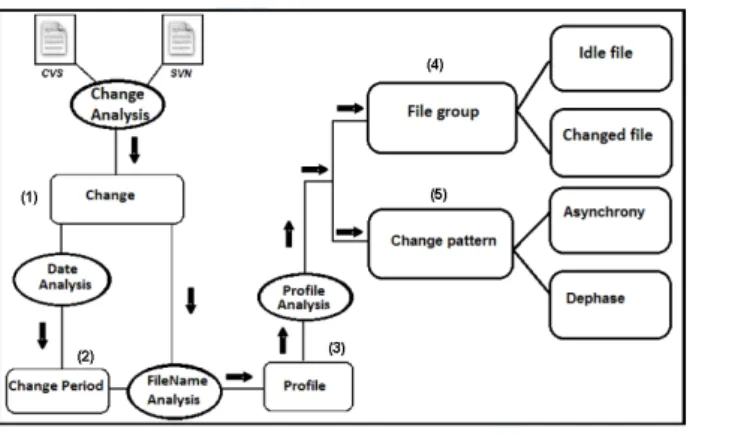
4.2 Approach: Profilo . . . 58
4.3 Empirical Study . . . 64
4.3.1 Objects . . . 64
4.4 Exploratory Study Analyses . . . 65
4.4.1 Research Questions . . . 68
4.5 Study Results . . . 68
4.5.1 RQ5: What is the relation between class lifetime and fault-proneness? . . . 69
4.5.2 RQ6: What is the relation between co-evolution dependencies and fault-proneness? . . . . 71
4.6 Discussions . . . 72
4.6.1 Class Lifetime and Fault-proneness . . . 72
4.6.2 Similarities in Classes Evolution Profiles . . . 73
4.6.3 Threats to Validity . . . 73
4.7 Summary and Lessons Learned . . . 74
CHAPTER 5: RELATIONS BETWEEN ANTI-PATTERNS DEPEN-DENCIES AND FAULT-PRONENESS . . . . 76
5.1 Introduction . . . 76 5.2 Approach: AntImpacts . . . 78 5.3 Empirical Study . . . 82 5.3.1 Research Questions . . . 83 5.3.2 Objects . . . 83 5.3.3 Analyses . . . 84 5.4 Study Results . . . 84
5.4.1 RQ7: Are classes that have static relationships with anti-patterns more fault-prone than other classes? . . . 84
5.4.2 RQ8: Are classes that co-change with anti-patterns more fault-prone than other classes? . . . 87
5.5 Discussions . . . 89
vii
5.5.2 Threats to Validity . . . 91
5.6 Summary and Lessons Learned . . . 93
CHAPTER 6: CONCLUSION . . . . 95
6.1 Summary . . . 95
6.2 Opportunities . . . 97
6.2.1 Using Change Patterns to Predict Changes . . . 97
6.2.2 Identifying Risky Parts of Programmes and “Buggy” Changes 98 6.2.3 Extending the Approaches Presented in this Thesis . . . 99
BIBLIOGRAPHY . . . 102
APPENDIX A: DEFINITIONS OF METRICS AND QUALITY AT-TRIBUTES . . . 113
A.1 Metrics . . . 113
A.2 Quality Attributes . . . 113
APPENDIX B: DEFINITIONS OF CODE SMELLS AND ANTI-PATTERNS . . . 115
B.1 Code Smells . . . 115
3.1 F1 and F2 follow an Asynchrony change pattern . . . 20
3.2 F1 and F2 follow a Dephase change pattern . . . 20
3.3 Illustration of the KNN-based algorithm’s steps to identify the change periods in a program history . . . 25
3.4 The distribution of change period durations in ArgoUML detected by the KNN algorithm . . . 26
3.5 Profiles for change periods of length n = 10 showing the changes committed in two different files . . . 27
3.6 Files F1 and F2 follow the Asynchrony change pattern . . . 27
3.7 Three different profiles showing an example of the Dephase change pattern . . . 27
3.8 Three different bit vectors showing approximate Asynchrony change pattern . . . 28
3.9 The mean of precision and recall achieved by Macocha with different values of DH for the seven programs . . . 30
3.10 Analysis-process . . . 31
3.11 Change period durations in different programs detected by the KNN algorithm . . . 37
3.12 The variation of precision and recall using other values for the initial duration of the change period . . . 37
4.1 Profilo Overview . . . 59
4.2 Types of class evolution considered in this study . . . 62
LIST OF TABLES
3.1 Number of approximate Asynchrony change patterns detected using different values of the Hamming distance . . . 30 3.2 Descriptive statistics of the object programs . . . 33 3.3 Cardinalities of the sets of Idle files, Changed files and (approximate)
Asynchrony change pattern occurrences obtained in the empirical study . . . 38 3.4 Cardinality of Macocha sets (idle groups and changed groups) in
accordance with UMLDiff clusters [106] . . . 39 3.5 Internal evaluation of Macocha (CPs: Change periods; T:
Transac-tions) . . . 41 3.6 Internal evaluation of Macocha in comparison to an approach based
on Association Rules [115] . . . 41 3.7 Evaluation of Macocha when using the results of an approach based
on Association Rules [115] as oracle (*: number of cases that Ma-cocha said were true/false, that also Association Rules said were true/false; **: number of cases that Association Rules found, that also Macocha found) . . . 44 3.8 Adjusted precision of Macocha when using the results of an approach
based on Association Rules [115] as oracle and after manual vali-dation using external information and static analysis (V.S.A: Val-idation by static analysis; SM CCH: The set of approximate macro
co-changing files with similar profiles in a program by using the Hamming distance; SAR: The set of co-changed files found by an
approach based on Association Rules) . . . 45 3.9 Adjusted Recall of Macocha when using the results of an approach
based on Association Rules [115] as oracle and after manual vali-dation using external information and static analysis (V.S.A: Val-idation by static analysis SM CCH: The set of approximate macro
co-changing files with similar profiles in a program by using the Hamming distance; SAR: The set of co-changed files found by an
3.10 Evolution of the number of occurrences of (Approximate) Dephase change patterns, DC, detected and manually confirmed by static analysis for different values of shift s . . . . 48 4.1 Descriptive statistics of the object programs . . . 65 4.2 Cardinalities of the sets obtained in the study . . . 66 4.3 Contingency table and Fisher test results in ArgoUML, JFreeChart
and XercesJ for Persistent, Non-Persistent classes (Short-lived and Transient classes) with at least one fault . . . 71 4.4 Contingency table and Chi-Square test results in ArgoUML, JFreeChart
and XercesJ for faults fixed by co-evolved (CC)or not co-evolved classes (NCC) . . . 72 5.1 Descriptive statistics of the object systems . . . 82 5.2 Contingency table and Fisher test results in ArgoUML, JFreeChart
and XercesJ for classes with at least one fault (S.R.: Static Rela-tionships, AP: Anti-pattern . . . 87 5.3 Contingency table and Fisher test results in ArgoUML, JFreeChart
and XercesJ for classes with at least one fault (AP: Anti-patterns) . 88 5.4 Proportion of the anti-patterns dependencies (CC: co-changing
situ-ations of anti-patterns with other classes; S.R.: Anti-patterns static relationships) . . . 89
LIST OF ACRONYMS
Macocha Macro Co-change Identification OO Object Oriented
MCC Macro co-change
DMCC Dephase Macro co-change
SM CC The set of macro co-changing files with identical profiles in a program
SDM CC The set of dephase macro co-changing files identified when shifting profiles
SM CCH The set of approximate macro co-changing files with similar profiles in a program by using the Hamming distance
SDM CCH The set of approximate dephase macro co-changing files identified by using the Hamming distance
SAR The set of co-changed files found by an approach based on Association Rules
Profilo Evolution Profile detection and analysis ADvISE Architectural Decay In Software Evolution
CVS Concurrent Versions System DECOR Defect dEtection for CORrection
KNN k-Nearest Neighbor Algorithm
PADL Pattern and Abstract-level Description Language POM Primitives, Operations, Metrics
Ptidej Pattern Trace Identification, Detection, and Enhancement in Java SVN Apache SubVersioN
To my wife
To my brothers and sisters
ACKNOWLEDGEMENTS
Feeling gratitude and not expressing it is like wrapping a present and not giving it.
William Arthur Ward (1921–1994).
Many people accompanied me during the endeavor of my doctoral studies. I am deeply grateful for their support. First of all, I would like to thank my supervisor, Yann-Ga¨el Gu´eh´eneuc, for giving me a chance to select research problems and pursue them. He taught me how to assess the research value of each proposal and how to be selective. He is a patient and thoughtful mentor; he listens to his students, not only what they are saying but also what they are not saying. I am proud to be one of his students. I would also like to thank my co-supervisor, Sylvie Hamel, for her support and advocacy. Her advice as a bioinformatic researcher was very valuable to this thesis.
My thankful admiration goes to Prof. Bram Adams, for his advice. He always made time to listen to my research ideas. A great thanks goes also to Prof. Foutse Khomh for his insightful discussions and his valuable comments.
Great thanks to my fellow doctoral students from the Ptidej and Soccer labs for creating an enjoyable working environment. Special thanks go to Salima Hassaine and Darine Ameyed. I always enjoy discussing and brainstorming research ideas with you. I would also like to thank all my friends who made the long experience of graduate school more manageable.
Special gratitude to my parents Amor Jaafar and Miriam Elmonsor, and my wife Wided, for their unconditional love and support, and for believing in me– whenever and wherever. They taught me the importance of passion and persistence in everything I do.
This research was partially supported by FQRNT, NSERC, the Research Chairs in Software Patterns and Patterns of Software and the Tunisian Ministry of Higher Education and Scientific Research.
INTRODUCTION
1.1 Research Context
Programs evolve continuously, requiring constant maintenance and development [66]. Maintenance has been recognized as the most costly and difficult phase in the software life cycle [10, 94]. Maintenance effort has been estimated to be frequently more than 70% of the overall software development cost [81]; an increase due in part to design decay. Design decay is the deviation of an actual software design from its originally planned design, i.e., the violation of design choices during evolution [45, 79, 103]. This design decay can be detected by measuring the instability of the program artefacts1 [40], high fault rates [98], and poor code quality [26, 98].
For example, Ostrand et al. [77] found that 20% of artefacts contains 80% of faults. At the same time, these 20% of artefacts accounted for 50% of the source code. Assuming that all artefacts are considered to have the same likelihood for fault-proneness is not realistic, because, for example, not all artefacts are there to last forever, some are meant for experimentation, so it could be expected that they have more faults.
Developers must continually adapt programs to meet new requirements and user needs. Thus, they need knowledge to identify hidden dependencies among programs artefacts and to detect critical parts of source code. This knowledge will help to improve the speed [115] and accuracy of maintenance tasks [87] while reducing the risk of introducing faults in the source code.
At a low level, detecting and understanding dependencies among different arte-facts is important from the points of views of both researchers and programmers. For researchers, it gives useful knowledge about the impact of such dependencies on program quality. For programmers, it provides knowledge concerning co-evolved classes: clusters of classes exhibiting similar evolution profiles, due to hidden inter-dependencies among them, not necessarily visible when examining their relations
3 at the code level [106]. It could help them to realise their maintenance tasks more simply and systematically [38]. At a high level, studying the dependencies between some motifs, such as anti-patterns, and the rest of the program artefacts, provide programmers with a simplified but accurate picture of the programs in time to understand their full complexity.
Previous literature describes several approaches to extract and analyse depen-dencies among artefacts and to infer the patterns that describe their changes [9, 53]. Several of these approaches identify co-changes among artefacts, e.g. [111, 115], which represent the (often implicit) dependencies or logical couplings among arte-facts that have been observed to frequently change together [31]. Ying et al. [111] and Zimmermann et al. [115] applied association rules to identify co-changing files. Their hypothesis is that past co-changed files can be used to recommend source code files potentially relevant to a change request. An association-rule algorithm extracts frequently co-changing files in a transaction and categorizes them into sets that are regarded as change patterns to guide future changes. Such algorithm uses co-change history and avoids the source code dependency parsing process. How-ever, it only computes the frequency of co-changed files in the past and omits many other cases, e.g. files that co-changed with always the same period of time between changes. In Chapter 3, we show that theses approaches miss interesting occurrences of co-changes, so called macro co-change because, by their very definition, they do not integrate the analysis of artefacts that are maintained by different developers and–or with some shifts in time.
In addition, artefacts that exhibit similar evolution profiles, due to interdepen-dencies among them, are considered as co-evolved artefacts [106]. Thus, co-change is only one aspect of co-evolution. Indeed, if two artefacts co-changed then they co-evolved. But if two artefacts co-evolved, they not necessarily co-changed. Xing
et al. [106] analysed the evolution profiles of classes. Class-evolution profiles report
the complete history of changes made to an individual class in each subsequent ver-sion. Such approach identifies co-evolved classes but does not analyse the relations between class evolution profiles and architectural decay. Indeed, some of these classes are added, renamed, and changed in the same versions of the program. In Chapter 4, we found that these classes have similar evolution trends and that many of them are involved in the same faults. Indeed, we detect dependencies among
these classes and we analyse the impact of such dependencies on maintenance tasks such as change propagation.
Another factor affecting the effort required for maintenance is the design quality of programs [109]. Design quality deterioration manifests itself in the form of design
defects, which are “poor” solutions to recurring software design and
implementa-tion problems, such as code smells [28] and anti-patterns [17]. Design defects occur generally in object-oriented programs when developers lack knowledge and–or expe-rience in solving a design problem or when applying some design patterns: “some-thing that looks like a good idea, but which backfires badly when applied” [21]. They have a negative impact on the quality characteristics (e.g. change-proneness and fault-proneness [54, 95]) and the evolution of programs [17, 28]. Classes in anti-patterns have dependencies with other classes, such as static relationships, that may propagate potential problems to these other classes. In Chapter 5, we show that, in almost all releases of three programs, classes having dependencies with anti-patterns are more fault-prone than others. We also report other obser-vations about these dependencies, such as their impact on fault prediction.
1.2 Problem Statement and Contributions
The above section leads us to formulate our thesis:
Software maintenance and evolution is negatively impacted by un-controlled changes, hidden artefacts dependencies, and design de-fects.
To show our thesis, we propose to address three main problems: co-change analysis, evolution analysis, and design-defects dependencies analysis. To confirm our findings and to improve the precision and recall of used tools, we generally use external information, such as bug reports and mailing lists.
5 Two artefacts are co-changing if they were changed by the same author and with the same log message in a time-window of less than 200 ms. [115]. Mockus et al. [72] defined the proximity in time of check-ins by the check-in time of adjacent files that differ by less than three minutes. Other studies (e.g. [27] and [33]) described issues about identifying atomic change sets and reported that, in all cases, they differed by few minutes.
Previous co-changes are intrinsically limited in time. They cannot express pat-terns of changes between long time intervals and–or committed by different devel-opers. In Chapter 3 we present typical examples of co-changes not detected by any previous approach. We present, the first approach to detect and to report such co-changes.
We compare the results of our approach on different programs developed with three different programming languages, C, C++, and Java. We also use external information provided by bug reports, mailing lists, and requirement descriptions to validate co-changes not found using previous approaches and to show that they explain real evolution phenomena.
Therefore, our first contribution [47] is a novel approach, called M acocha, that introduces the novel concepts of macro change and dephase macro
co-change, inspired from co-changes and using the concept of change periods. The macro co-change describes a set of files that always change together in the same
periods of time. The dephase macro co-change describes a set of files that always change together with some shift in time in their periods of change.
We find that Macocha has a better precision and recall than association rules and can find novel occurrences of change patterns.
Contribution 2: Spotting the Relation Between Program Evolution and Fault-proneness
We find in the literature different approaches to analyse the evolution of soft-ware designs [56, 58, 106]. Most of these previous approaches aim at finding design changes and class evolution occurring in object-oriented programs. Identifying co-evolution dependencies is useful to study the relation between the co-evolution of
artefacts, their dependencies, and fault-proneness. However, existing approaches thus far did not link the evolution of classes to faults. Because (1) some classes evolve independently, other classes have to do it together with others (co-evolution); and (2) not all classes are meant to last forever, but some are meant for experi-mentation or to try out an idea that was then dropped or modified. Then, in our second contribution [48], we group classes based on their evolution to infer their lifetime models and co-evolution trends. Then, we link each group’s evolution to faults.
We find that (1) classes with specific lifetime models are significantly less fault-prone than other classes and (2) faults fixed by maintaining co-evolved classes are significantly more frequent than faults fixed using other classes.
Contribution 3: Analysing the Impact of Anti-patterns Dependencies
Without proper knowledge, developers may introduce anti-patterns in pro-grams. In theory, anti-patterns [102] are “poor” solutions to recurring problems. In practice, an anti-pattern is a literary form that describes a bad solution to recurring design problems that leads to negative effects on code quality [17].
Most previous work agree that anti-patterns render the maintenance of pro-grams more difficult [1, 54]. However, there are only few previous work about the dependencies (static relationships and co-change dependencies) between anti-patterns and other artefacts in programs. Yet, understanding the impact of such dependencies, in particular on fault-proneness, help developers to better under-stand and maintain programs.
No empirical study has been conducted so far to detect and to analyse the fault proneness of classes that have static or co-change relationships with anti-patterns and to adjust the possibility of introducing faults during the maintenance of such classes.
Therefore, our third contribution [49] is the detection of the impact of design defects dependencies. We conduct an empirical study, performed on three object-oriented programs, which provides empirical evidence of the negative impact of
7 dependencies with anti-patterns on fault-proneness. Indeed, we find that having dependencies with anti-patterns can significantly increase fault-proneness.
1.3 Roadmap
The remainder of this thesis provides the following content: Chapter 2 reviews related work on evolution and co-evolution analysis, co-change analysis, and design defects impact. Chapter 3 reports our first contribution, improving co-change analysis. Chapter 4 reports our second contribution, studying the relation between the evolution and co-evolution of artefacts and fault-proneness.Chapter 5 reports our third contribution, which concerns anti-patterns dependencies impact on fault-proneness. Chapter 6 presents the conclusions of this thesis and outlines some directions of future research. Appendix A presents the definitions of metrics and quality attributes considered in this thesis. Appendix B presents the complete list of anti-patterns considered in this thesis with their definitions.
RELATED WORK
This chapter provides a survey of work related to this thesis. The structure of the chapter is as follows: Section 2.1 recapitulates related work on software evo-lution. Section 2.2 provides a description of leading work on file stability. Section 2.3 discusses the state of the art on co-change dependencies analysis. Section 2.4 reviews earlier work on fault-proneness. Section 2.5 summarises exiting work on design defect detection and impact.
2.1 Software Design Evolution
Antoniol et al. [4] proposed an automatic approach, based on cosine similar-ity of class identifiers to automatically identify links between classes (obtained from refactoring) of two subsequent releases. In particular, the approach aimed at identifying cases of class replacement, split, merge, as well as feature migration from/to other classes. They represented classes of different releases as documents and queries. Then, they applied a vector space model that treats these documents and queries as vectors [29]. The documents was ranked against queries to compute a similarity function between the corresponding vectors. Their approach does not take into account the relations between classes.
The phenomenon of software aging is the result of software evolution. Parnas [78] suggested that programs suffer from various aging problems such as increasing complexity, faults, unstructured code, feature overloading, etc. Eick et al. [26] suggested that a code is decayed if it is more difficult to maintain than it used to be. We believe, like the above cited authors, that code decay is essentially the re-sult of program evolution. The design of a program deviates from its planned form with every new version of program to incorporate new features by implementing new classes and–or deleting, refactoring and changing old classes. We relate the evolution of classes in object-oriented programs and fault-proneness to emphasize program evolution consequences. Fraser [30] presented DiffTree to infer a
phylo-9 genetic tree from related programs. It described the retrospective computation of version trees for a set of programs, without mining source code control systems.
Gagandeep and Hardeep Singh [92] reported that that software tends to be-come more complex over the series of releases and maintaining them bebe-comes a difficult task. The authors also investigated the applicability of Lehman’s Law of Software Evolution using different metrics and found that Lehman’s laws related to increasing complexity and continuous growth are supported by computed metrics. DiffTree compared set of codes with one another, and presents a parsimonious phylogenetic tree for them. It can also help to identify cases where a repair made to one version was missed in others. We share with the author the idea that it is interesting to identify commonalities and divergences among versions to acknowl-edge the contributions of each version relative to one another. Karim et al. [52] described a method for constructing phylogeny models that used n-perms to match possibly permuted code and to discover malicious programs, such as viruses and worms, frequently related to previous programs through evolutionary relationships. Demeyer et al. [25] presented an approach to understand how object-oriented programs have evolved by discovering which refactoring operations have been ap-plied from one version of the software to the next.
Discussion
Previous approaches were useful to identify some replacement, merge and refac-toring during the evolution of programs but they cannot relate program evolution with faults proneness.
Indeed, existing approaches for design evolution compare two versions of a soft-ware design to study its evolution. They adopted techniques to automatically identify evolution discontinuities when analyzing the evolution of object-oriented source code at class level. In this thesis, we will present approaches to analyse programs artefacts according to their evolutionary history to recognize and to un-derstand co-evolution situations among them in the goal to relate these situations with faults.
2.2 File Stability
Many approaches exist to group files based on their relative stability through-out the software development life cycle. For example, UMLDiff [106] compares and detects the differences between the contents of two object-oriented program ver-sions. A fact extractor parses each version to extract models of their design. Next, a differencing algorithm, UMLDiff, extracts the history of the program evolution, in terms of the additions, removals, moves, renamings, and signature-changes of design entities, such as packages, classes, interfaces, and their fields and methods. UMLDiff then assigns a stability to each class: short-lived classes (that exist only in a few versions of the program and then disappear), idle classes (that rarely un-dergo changes after their introduction in the program), and active classes (that keep being modified over their whole lifespan).
Kpodjedo et al. in [60] and [58] proposed to identify all files that do not change in the history of a program, using an Error Tolerant Graph Matching algorithm. They studied the evolution of the program class diagram by collecting program source code over several years, reverse-engineering their class diagrams, and re-covering traceability links between subsequent class diagrams. Their approach identified evolving classes that maintain a stable structure of relations (associa-tion, inheritance, and aggregation) and so on, which likely constitute the stable backbone of a program.
Lanza et al. [62] presented an evolution matrix to display the evolution of the files of a program. Each column of the matrix represents a version of the program, while each row represents the different versions of the same file. Within the columns, the files are sorted alphabetically. Then, the authors presented a categorisation of files based on the visualisation of different versions of a file: a pulsar file grows and shrinks repeatedly during its lifetime, a supernova file suddenly explodes in size, a white dwarf is a file that used to be of a certain size, but lost its functionality, a red giant file tends to implement too many functionalities and is quite difficult to refactor, and an idle file does not change over several versions.
Discussion
The Error Tolerant Graph Matching algorithm and UMLDiff require parsing and comparing AST-like representations of the programs before performing their
11 analysis. We propose to compute stability in a more simple way by using the version control systems, wich keeps track of all work and all changes in each file in the program.
Our work differs in the level of granularity and on the aspects considered. In-deed, Lanza et al. [62] considered only file implementation to identify stability in different versions without considering information coming from version-control systems. Therefore, idle classes, for example, are those that did not change too much after their introduction in terms of source code and not in terms of commits. Thus, if a file changes frequently but without majors modifications in it implemen-tation during the observation period, it will be identified as an “idle file”, which is contradictory to its category name (idle files). We propose to identify file stability by mining program history. In the context of change analysis, if a file changes frequently, it will be identified as a “changed file”.
2.3 Co-change: Definition and Detection
Ying et al. [111] and Zimmermann et al. [115] applied association rules to identify co-changing files. Their hypothesis is that past co-changed files can be used to recommend source code files potentially relevant to a change request. An association-rule algorithm extracts frequently co-changing files of a transaction into sets that are regarded as change patterns to guide future changes. Such an algorithm uses co-change history in CVS and avoids the source code dependency parsing process.
Ceccarelli et al. [20] and Canfora et al. [19] proposed the use of a vector auto-regression model, a generalisation of univariate auto-auto-regression models, to capture the evolution and the inter-dependencies between multiple time series representing changes to files. They used the bivariate Granger causality test to identify if the changes to some files are useful for forecasting changes to other files. They concluded that the Granger test is a viable approach to change-impact analysis and that it complements existing approaches like association rules.
Antoniol et al. [5] presented an approach to detect similarities in the evolution of files starting from past maintenance. They applied the LPC/Cepstrum technique, which models a time evolving signal as an ordered set of coefficients representing
the signal spectral envelope, to identify in version-control systems the files that evolved in the same or similar ways. Their approach used cepstral distance to assess series similarity (if two cepstra series are “close”, the original signals have a similar evolution in time).
Bouktif et al. [16] defined the general concept of change patterns and described one such pattern, Synchrony, that highlights co-changing groups of artefacts. Their approach used a sliding window algorithm as in [115] to build Synchrony change pattern occurrences. They also used the technique of Dynamic Time Warping developed in pattern recognition and adopted in speech recognition systems, to identify groups of co-changing files. Yet, the authors reported that their approach has an average precision and recall that could be significantly improved by using clustering techniques in addition to Dynamic Time Warping.
Discussion
Approaches based on association rules [111], [115], compute only the frequency of co-changed files in the past and they omit many other cases, e.g. files that co-change with some shifts among change periods. In Section 3.4, we showed that approaches based on association rules cannot detect all occurrences of co-change because, by their very definition, they do not integrate the analysis of files that are maintained by different developers and–or with some shift in time, which could lead to missed co-changing files.
Indeed, previous approaches could find files having very similar maintenance evolution history, but they did not present a tool to detect co-changed files main-tained by different developers in periods of time of more than a few minutes. We were inspired by [16] to name the Asynchrony change pattern presented in this thesis. We also introduced a novel change pattern inspired from co-changes, the Dephase change pattern, that describes co-change among files with the some shifts in time.
Change propagation analyses how changes made to one file propagate to oth-ers. Law and Rothermel [64] presented an approach for change propagation analysis based on whole-path profiling. Path profiling is a technique to capture and rep-resent a program dynamic control flow. Unlike other path-profiling techniques, which record intra-procedural or acyclic paths, whole-path profiling produces a
13 single, compact description of a program’s control flow, including loops iteration and inter-procedural paths. Law et al.’s approach builds a representation of a pro-gram’s behavior and estimates change propagation using three dependency-based change-propagation analysis techniques: call graph-based analysis, static program slicing, and dynamic program slicing.
Zhang et al. [112] conducted a case study in an industry project to investigate whether the dependency between individual requirements are useful in practise, in particular for change propagation analysis. They found that change propagation analysis is affected by a practitioner’s viewpoint and experiences. The participant with project management experiences may emphasize the changes that happen at the business and high-level design level. The participants with requirements engi-neering experiences pay special attention on the changes at the level of requirements description and business. The participant with development experiences care more about the changes happening at the implementation level.
Hassan and Holt [42] investigated several heuristics to predict change propa-gation among source code files. They defined change propapropa-gation as the changes that a file must undergo to ensure the consistency of the program when another file changed. They proposed a model of change propagation and several heuristics to generate the set of files that must change in response to a changed file. Their approach uses: (1) frequency techniques to return the most frequently related files; (2) recency techniques to return files that were related in the recent past; and, (3) hybrid (frequency + recency) techniques.
Zhou et al. [113] presented a change propagation analysis based on Bayesian networks that incorporates static source code dependencies as well as different features extracted from the history of a program, such as change comments and author information. They used the Evolizer system that retrieves all modification reports from a CVS and uses a sliding window algorithm to group them.
Canfora and Cerulo [18] proposed an approach to derive the set of files impacted by a proposed change request. A user submits a new change request to a Bugzilla database. The new change request is then assigned to a developer for resolution, who must understand the request and determine the files of the source code that will be impacted by the requested change. Their approach exploits information
retrieval algorithms to link the change request descriptions and the set of historical source file revisions impacted by similar past change requests.
D’Ambros et al. [22] presented the Evolution Radar, an approach to integrate and visualise module-level and file-level logical couplings, which is useful to answer questions about the evolution of a program, the impact of changes at different levels of abstraction, and the need for restructuring. German [33] used the information in the CVS to visualize what files are changed at the same time and who are the people who tend to modify certain files. He presented SoftChange, a tool that uses a heuristic based on a sliding window algorithm to rebuild the Modification Record (MRs) based on file revisions. In Softchange, a file revision is included in a given MR if all the file revisions in the MR and the candidate file revision were created by the same author and have the same log. Beyer and Hassan [12] introduced the evolution story-board, a new concept for animated visualisations of historical information about the program structure, and the story-board panel, which highlights structural differences between two versions of a program. They also formulated guidelines for the usage of their visualisation by non-experts and to make their evaluations repeatable on other programs.
Discussion
We share with all the above authors the idea that change propagation iden-tification into existing source code is a powerful mechanism to assess code main-tainability. Their change-propagation models can be used to predict future change couplings, but they do not allow differentiation between different change patterns. All of these approaches grouped change couplings created by the same author and have the same log message; consequently, they cannot detect typical situation of co-changed file such as file maintained by different developers.
In addition, Xing and Stroulia [108], reported that visualisations approaches are limited in their applicability, because they assume a substantial interpretation effort by their users and they do not scale well: they become unreadable for large programs with numerous components.
15 2.4 Faults-proneness: Definition and Detection
Shah and Morisio [89] analysed the relationship of different complexity metrics with the faults for three categories of software projects i.e. large, medium and small. They observed that for some complexity metrics high complexity results in higher defects. They called these metrics as effective indicators of defects. For example, they reported that in the small category of projects, they found LCOM metrics, i.e. Lack of Cohesion of Methods which measures the correlation between the methods and the local instance variables of a class, as effective indicator in the medium category of project. They reported that complexity metrics relation to defects also varies with the size of projects.
Nagappan and Ball [74] performed a study on the influence of code churn [41],
i.e. which measures the changes made to a component over a period of time,
quan-tifies the extent of this change, on the fault density. They found that relative code churn was a better predictor than absolute churn. Moser et al. [73] used metrics (e.g. code churn, past faults and refactorings, etc.) to predict the presence/absence of faults in files of Eclipse. Hassan and Holt [43] proposed heuristics to analyse fault proneness and they found that recently modified and fixed classes were the most fault-prone. Ostrand et al. [77] predict faults on two industrial programs, using change and fault data. Bernstein et al. [11] used fault and change infor-mation in non-linear prediction models. Zimmermann and Nagappan [114] used dependencies between binaries in Windows server 2003 to predict faults. Marcus et
al. [70] used a cohesion measurement based on LSI for fault prediction. Neuhaus et al. [75] used a variety of features of Mozilla, such as past faults, package imports,
call structure, to determine fault vulnerabilities. Discussion
Previous approach on fault-proneness did not link artefact dependencies and artefacts evolution behaviors to faults. In this thesis, we link between (1) specific change patterns and fault-proneness, (2) artefact evolution and co-evolution trends and fault-proneness and, (3) and anti-patterns dependencies and fault-proneness.
2.5 Anti-patterns: Definition and Detection
The first book on “anti-patterns” in object-oriented development was written in 1995 by Webster [102]. In this book, the author reported that an anti-pattern describes a frequently used solution to a problem that generates ineffective or de-cidedly negative consequences. Brown et al. [17] described 40 anti-patterns, which are often described in terms of lower-level code smells. These books provide in-depth views on heuristics, code smells, and anti-patterns aimed at a wide academic audience. They are the basis of all the approaches to detect anti-patterns.
The study presented in this thesis relies on the anti-patterns detection approach proposed in [96]. However several other approaches have been proposed. For example, Van Emden et al. [97] developed the JCosmo tool. This tool parses source code into an abstract model (similar to the Famix meta-model). It used primitive and rules to detect the presence of smells and anti-patterns. The JCosmo tool can visualize the code layout and anti-patterns locations. The goal of this tool is to help developers assess code quality and perform refactorings. The main difference compared with other detection tools is that JCosmo tries to visualize problems by visualizing the design. Marinescu et al. developed a set of detection strategies to detect anti-patterns based on metrics [82]. Settas et al. explored the ways in which an anti-pattern ontology can be enhanced using Bayesian networks [88]. Their approach allowed developers to quantify the existence of an anti-pattern using Bayesian networks, based on probabilistic knowledge contained in an ontology.
The Integrated Platform for Software Modeling and Analysis (iPlasma) de-scribed in [63] can be used for anti-patterns detection. This platform calculates metrics from C++ or Java source code and applies rules to detect anti-patterns. The rules combine the metrics and are used to find code fragments that exceed some thresholds.
There are few papers analyzing empirically the anti-patterns relationships: Binkley et al. [13] defined the dependence anti-pattern as a dependence struc-ture that may indicate potential problems for ongoing software maintenance and evolution. Dependence anti-patterns are not structures that must always be avoided. Rather, they denote warnings that should be investigated. Typically these prob-lems will take the form of difficulties in comprehension, testing, reverse engineering,
17 re-use, and maintenance. The authors showed how these anti-patterns can be iden-tified using techniques for dependence analysis and visualization.
Vokac [101] analyzed the corrective maintenance of a large commercial program, comparing the defect rates of classes participating in design motifs against those that did not. Their approach showed correlation between some design patterns and smells like LargeClass but do not report an exhaustive investigation of possi-ble correlations between these patterns and anti-patterns. Pietrzak and Walter [80] defined and analysed the different relationships that exist among smells and provide tips how they could be exploited to alleviate detection of anti-patterns. They pro-posed six coarse relations that describe dependencies between smells: plain support, mutual support, rejection aggregate support, transitive support, and inclusion.
Despite the above studies on design defects, only a few studies empirically anal-ysed the impact of design defects on source code-related phenomena, in particular class change- and fault-proneness.
Bois et al. [14] showed that the decomposition of God Classes into a number of collaborating classes using well-known refactorings can improve comprehension. They did not consider source code evolution.
Wei and Shatnawi [69] investigated the relation between the probability of a class being faulty and some anti-patterns based on three versions of Eclipse, showed that classes with the anti-patterns God Class, Shotgun Surgery, and Long Method have a higher probability to be faulty than other classes. They concluded that there was a need for broader studies to validate their results.
Olbrich et al. [76] analysed the historical data of Lucene and Xerces over several years and concluded that God Classes and Shotgun Surgery have a higher change frequency than other classes; with God Classes featuring more changes. They neither performed an analysis to control the effect of the size on their results nor studied the kinds of changes affecting these anti-patterns.
Khomh et al. [54, 95] studied the impact of classes with design defects (code smells and anti-patterns) on change proneness and fault proneness. They showed that classes participating in design defects are more change- and fault-prone than classes not participating in design defects.
Previous approaches advanced the state-of-the-art in the specification and analysing of design defects and their relation with fault-proneness. In this thesis, we focus on detecting anti-patterns relationships with others classes to report the impact of such relationships on the fault-proneness of programs.
Indeed, we share with all the above authors the idea that anti-patterns detection is a powerful mechanism to asses code quality, in particular indicating whether the existence of anti-patterns and the growth of their relationships makes the source code more difficult to maintain.
Rather than focusing on the relationships among code smells and anti-patterns, our study focuses on analysing anti-patterns dependencies and their impact on fault-proneness.
While it is hard to define what a “bad” dependence structure should look like, we believe that it is comparatively easy to identify dependence between anti-patens and others classes in the programs that denote potential problems.
CHAPTER 3
IMPROVEMENT OF CO-CHANGE ANALYSIS
3.1 Introduction
As discussed in Chapter 2, several of the previous approaches identify co-changes among files, e.g., [111], and [115], which represent the dependencies be-tween files that have been observed to frequently change together. In the same context, Change patterns [16] are described as motifs that highlight co-changing groups of files [16] and that report the (often implicit) dependencies or logical couplings among files that have been observed to frequently change together [31].
In [47], we showed that previous approaches could not detect change patterns between files in long time intervals and–or performed by different developers and with different log messages, so they miss these varieties of co-changed files. Yet, we also showed that such new change patterns provide interesting information to developers. For example, in the Bugzilla of ArgoUML, the bug ID 53781 states,
in relation to ArgoDiagram.java, that an “ArgoDiagram should provide construc-tor arguments for the concrete classes to create”, which relates to ModeCreate-AssociationClass.java. The bug report confirms that these two files have a re-lationship, which is hidden because we could not detect dependencies between these two files by static analysis. However, no previous approach can detect that these files co-changed because they were maintained by the same developer bobtarling, but their changes were always separated by a few hours. Knowing the dependency among these files is useful to a new developer that must change ArgoDiagram-.java: she must, also, assess ModeCreateAssociationClass.java for change. In-deed, Vanya et al. [100] found that, depending on the commit practices used, a suitable time intervals between check-in timestamps of files has to be determined and leveraged to reliably approximate change sets.
Let F1 and F2 be two files of the same program, the scenario illustrated with ArgoUML could happen when a developer is in charge of a subset of a large program
Figure 3.1 – F1 and F2 follow an Asynchrony change pattern.
Figure 3.2 – F1 and F2 follow a Dephase change pattern.
composed of, among others, files F1 and F2. She may change and commit these two files in the same day but with a few hours between each commit, as illustrated in Figure 3.1. This scenario may repeat for years and would be undetected by previous approaches, which use sliding windows of a few minutes to group changes committed by the same developer and with the same log message. Yet, such co-change situations contains important information both for the developer and her colleagues: to avoid introducing bugs into programs, changes to F1 must likely propagate to F2, because these two files have a, possibly hidden, dependency.
As another example in ArgoUML, we found that the developers mvw and tfmorris contributed with some patches that contain NotationUtilityJava.java and
Model-21 ElementNameNotationUml.java2 and the bug ID 29263 confirms that the two files
have dependencies (see Section 3.4 for details). No previous approach can detect that these files co-changed because, during the development and the maintenance of ArgoUML, these two files were never changed by the same developer at the same time but were always changed by developers mvw and tfmorris in two consecu-tive times: first NotationUtilityJava.java and, subsequently, after some hours, ModelElementNameNotationUml.java, pointing out dependency among these files. This previous scenario from ArgoUML happens when a developer D2 is re-minded to change file F2 to correct a bug after some time by developer D1, when-ever D1 changed file F1, as illustrated in Figure 3.2. Previous work, e.g. [111], [115], [19], does not consider co-changed files if they were changed by two dif-ferent developers in the same period even though knowing the, possibly hidden, dependency among such co-changed files could prevent developers from releasing a program with a bug because of a mismatch between files F1 and F2.
In this thesis, we describe Macocha, an approach for detecting two novel change patterns [47] detailed in Section 3.2. Macocha, inspired from a previous work [16], defines and detects the Asynchrony change pattern, macro co-changes (MCC), and the Dephase change pattern, dephase macro co-changes (DMCC). It builds on previous work on co-changes and uses the concept of change periods, detailed in Section 3.2. It is defined as a set of changes committed by developers in a continuous period of time. In particular, we use the k-nearest neighbor algorithm [24] to group changes into their change periods.
The Asynchrony change pattern (MCC ) describes a set of files that always change together in the same change periods. The Dephase change pattern (DMCC ) describes a set of files that always change together with some shift in time in their periods of changes. We also consider approximate MCC and DMCC using the Hamming distance.
We formulate four research questions:
• RQ1: How does Macocha compare to previous work in terms of number of changed files found?
2http://argouml.tigris.org/issues/showattachment.cgi/2118/
20101116-patch-notation.txt
• RQ2: How does Macocha compare to previous work (association rules) in terms of precision and recall?
• RQ3: What is the precision and recall of Macocha when detecting occurrences of the Asynchrony change pattern?
• RQ4: How many occurrences of Dephase change patterns are in programs and how can they be useful for developers?
We perform two types of empirical studies. Quantitatively, we compare the findings of Macocha with that of UMLDiff [106] and the co-change analysis of Ma-cocha with the state-of-the-art association rules [111, 115] in term of precision and recall. Qualitatively, we use external information provided by bugs reports, mailing lists, and requirement descriptions to validate the Asynchrony and Dephase change patterns not found using previous approaches and to show that these novel change patterns explain real evolution phenomena and thus could help reduce mainte-nance costs. We apply our approach on seven programs: ArgoUML, FreeBSD, JFreeChart, Openser, SIP, XalanC, and XercesC, developed with three different programming languages, C, C++, and Java.
In this chapter, we describe our approach, Macocha, in more detail and we show how we use the k-nearest neighbor algorithm (KNN) to group changes into change periods and therefore to determine automatically the different duration of change periods. Then, we study the variations in precision and recall of our approach when using different values of its parameters and we perform a static analysis to validate the occurrences of new change patterns. Finally, we provide evidence on the relevance of the Dephase change patterns detected with different shifts in time. This chapter is organised as follows: Section 3.2 presents Macocha. Section 3.3 describes our empirical study, while Sections 3.4 and 3.5 report and discuss its results as well as threats to validity. Section 3.6 concludes with future work.
23 3.2 Approach: Macocha
We now present the concepts of our approach using examples from ArgoUML. Macocha mines version-control systems (Concurrent Versions System named CVS4 and Apache Subversion System named SVN5), to identify the change periods in a program, to group source files according to their stability through the change periods, and to identify the Asynchrony and the Dephase change patterns, i.e., are macro co-changing or dephase macro co-changing.
3.2.1 Definitions
3.2.1.1 Change Period
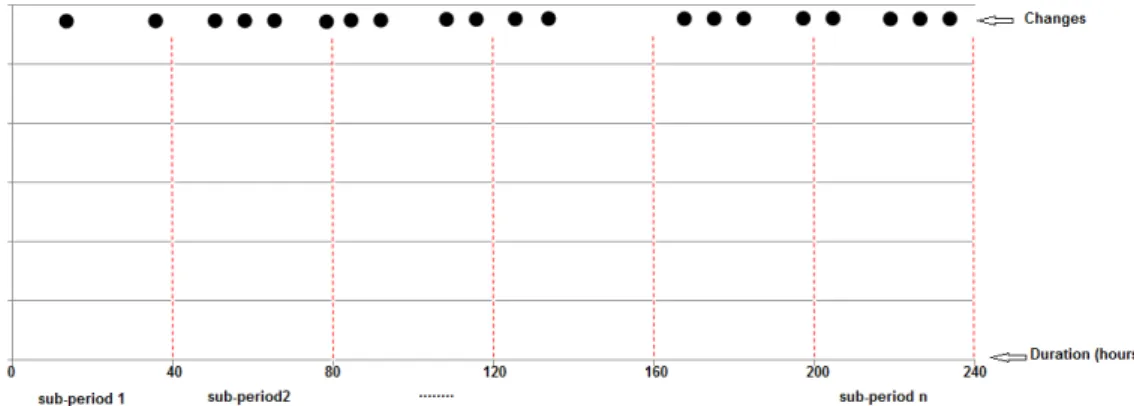
A change period is a period of time during which several commits to different files occurred without “interruption”, i.e., these commits are separated by a few seconds or minutes. We conducted a case study to detect the duration of change periods for each subject. We need the concept of change period because the change periods (beginning dates and durations) differ across programs.
Consequently, we want to identify the change periods in a program by grouping all the changes committed closely together in time, independent of the developers who committed them and of their log messages. To identify changes occurring close to one another, i.e., belonging to a same change period, we use the k-nearest neighbor algorithm (KNN). The KNN is a non-parametric learning algorithm[57] that does not make any assumptions on the underlying data distribution.
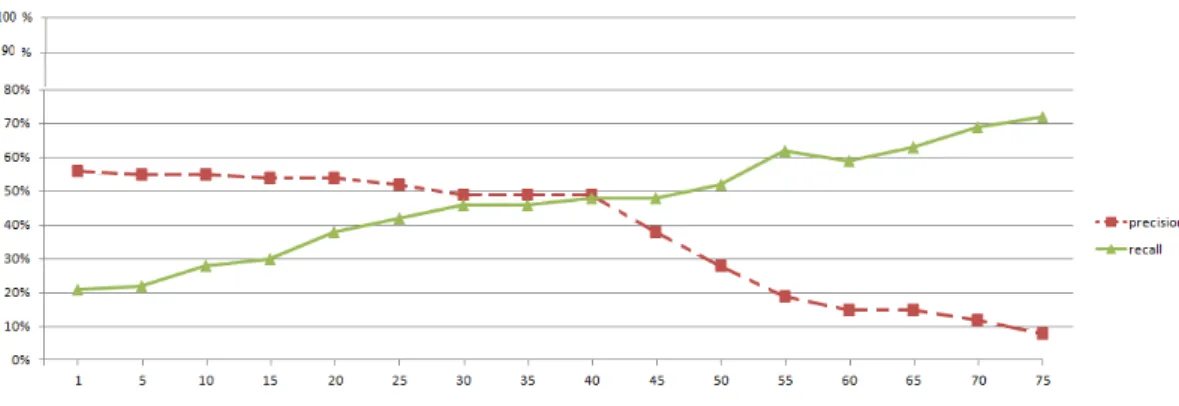
Hatton [44] presented an empirical study to estimate the time for the handling of a particular maintenance request (also known as change request) and showed that the largest duration of a change period to implement a maintenance request is not more than 40 hours. Therefore, we set the initial duration of the change period to 40 hours. However, as we noted earlier: these durations could change across subjects. Thus, we also report the variation of precision and recall using other values for the initial duration of the change period in Section 3.4. This variation
4
http://cvs.nongnu.org/
5
shows us, that for the seven subjects in this study, the 40 hours period yields the best results.
Our KNN-based algorithm to identify the change periods in a program history is illustrated in Figure 3.3 and consists of four separate phases:
• First, we divide the whole maintenance period, from first to last of the
consid-ered changes, of a given program, into equal sub-periods. Therefore, following Hatton, we divide the history of the program into change periods of equal duration of 40 hours.
• Second, to each change period, we assign the first change committed at a
date nearest to, but no later than, the beginning date of the change period.
• Third, we use the KNN algorithm with k = 2 (we start the execution with k =
2 before testing other values of k) to assign the rest of the changes into their appropriate change periods: each change is assigned to the change period including its k nearest neighbors in terms of date of commit, whatever their developers and their log messages regardless of commit author and commit log message, and even if its change date is earlier than the beginning date of the change period.
• Fourth, when the KNN algorithm has assigned all changes into change
peri-ods, we recompute the beginning and end dates of each change period based on the dates of their earliest and latest changes. If there exists one or more change periods of duration greater than 40 hours, we reapply the KNN algo-rithm with an increased value of k, else we stop.
In Section 3.4, we show that using this algorithm to group changes into change periods allows us to improve precision and recall over the state-of-the-art associa-tion rules approach [115].
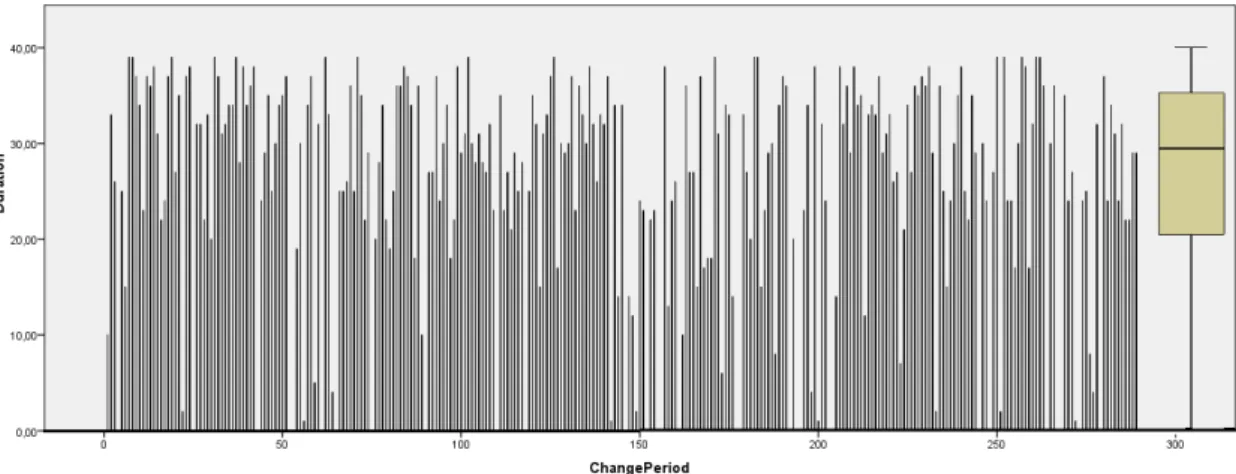
In ArgoUML. We find 290 change periods in two years of development. In Figure 3.4, we present the durations of all the different change periods detected in ArgoUML using the KNN algorithm. The mean duration of these change periods is around 27 hours 8 minutes, the standard deviation is around 12 hours 6 minutes. In addition, in Figure 3.4, we use box plots to display differences between the durations
25
Figure 3.3 – Illustration of the KNN-based algorithm’s steps to identify the change periods in a program history.
Figure 3.4 – The distribution of change period durations in Ar-goUML detected by the KNN algorithm.
of change periods in ArgoUML without making any assumptions concerning the underlying statistical distribution. The spacings between the different parts of the box help indicate the degree of dispersion (spread) and skewness in the data, and identify outliers. Figure 3.4 is a box plot that summaries: the smallest observation (one millisecond), lower quartile (20 hours and 13 minutes), median (29 hours and 16 minutes), upper quartile (35 hours and 17 minutes), and largest observation (39 hours and 58 minutes).
3.2.1.2 Profile
We define a profile as a bit vector that describes whether a file is changed, or not, during each of the change periods of a program.
For each file in a program, its profile is defined as a vector x = x1...xn, where
n represents the number of change periods determined by the KNN algorithm
described above. The value of xi indicates whether the file F is changed or not at
the ith change period:
xi =
{
1 if file is changed in the change period i 0 otherwise.
27
Figure 3.5 – Profiles for change periods of length n = 10 showing the changes committed in two different files.
Figure 3.6 – Files F1 and F2 follow the Asynchrony change pattern.
We use bit vectors to model profiles because they allow efficient operations: setting a bit is constant in time, O(1); computing the union, the intersection of two bit vectors, or the complement of a bit vector, is linear in time, O(n).
3.2.1.3 File Stability
Macocha groups files according to their stability: idle and changed, as shown in Figure 3.5. Each group is a set of profiles with similar stability. Idle files do not change after their introduction into the program, while changed files are files that changed after their introduction into the program. Macocha uses this group to identify which changed files follow the Asynchrony or Dephase change patterns. In ArgoUML. Macocha identifies 1,143 changed files from 1,621 files analyzed in two years of evolution of this program.
Figure 3.7 – Three different profiles showing an example of the Dephase change pattern.
Figure 3.8 – Three different bit vectors showing approximate Asyn-chrony change pattern.
3.2.1.4 Change Patterns
Similar profiles grouped together represent occurrences of the Asynchrony and Dephase change patterns. Idles files do not change in any change period after their introduction into the program. Therefore, we do not consider this group of files because they are not useful for the co-change analysis due to their non-evolution.
Macocha returns the following sets of occurrences of change patterns:
• SM CC, the set of macro co-changing files with identical profiles in a program;
• SDM CC, the set of dephase macro co-changing files identified when shifting
profiles by s change periods with s∈ [0, 5];
• SM CCH, the set of approximate macro co-changing files with similar profiles
in a program by using the Hamming distance with DH ∈]0, 3[;
• SDM CCH, the set of approximate dephase macro co-changing files identified
when shifting profiles by s change periods and by using the Hamming distance with DH ∈]0, 3[.
A SM CC is two or more changed files that exactly change together with long
time intervals between their changes and–or performed by different developers and with different log messages, i.e., that have identical profiles during the life of a program, as illustrated in Figure 3.6. Given a file F1, a SDM CC is the set composed
of F1 and one or more files, F2...FM, such that F2...FM always macro co-change with the same shift in time s ∈ [0, n − 1] with respect to F1 during the evolution of a program. Thus, a Synchrony change pattern is a Dephase change pattern where
29 Figure 3.7 illustrates that F1 and F2 are in dephase macro co-change with s = 1; F2 and F3 are in a DMCC with s = 2; and, F1 and F3 are in a DMCC with s = 3. In ArgoUML. Macocha reports that ProgressEvent.java and TestAction-AddEnumerationLiteral.java followed a Dephase change pattern with s = 2; and, ProgressEvent.java and IConfigurationFactory.java followed a Dephase change pattern with s = 3. Previous approaches could not detect that these files follow such change patterns.
Macocha considers both identical and similar profiles (with or without shifts in time) to account for cases where the files did not change exactly in the same change periods. We use the Hamming distance [39] DH to measure the amount of difference
between two profiles, i.e., the number of positions at which the corresponding bits are different. For a fixed length n, the Hamming distance is a metric on the vector space of the bit vectors of that length, as it fulfills the conditions of non-negativity and symmetry. The Hamming distance between two profiles a and b is equal to the number of ones in the the vector a⊕ b.
To determine the value of the appropriate Hamming distance for the detection of change pattern occurrences, we conduct a comparative study based on the evolution of the precision and recall when we use different values of DH. In information
retrieval contexts, precision and recall are defined in terms of a set of retrieved documents (e.g. the list of co-changed files produced by a query) and a set of relevant documents. Precision is the fraction of co-changed files that are relevant. Recall is the fraction of the co-changed files that are relevant to the query that are successfully retrieved. We also use the F-measure [85] to test accuracy. This measure considers both the precision and the recall of the test to compute the score. The traditional F-measure or balanced F-score (F1 score) is the harmonic mean of precision and recall:
F − measure = 2.P recision× Recall P recision + Recall
The F-measure score can be interpreted as a weighted average of the precision and recall, where an F-measure score reaches its best value at 1 and worst score at 0. We use the F-measure score when we compare the results of Macocha approach and the co-change detection approach based on association rules. We provide more
The Hamming distance DH= 1 DH = 2 DH = 3 DH= 4 DH= 5 DH = 6 ArgoUML 44 353 439 499 528 621 FreeBSD 19 98 119 140 239 326 JFreeChart 116 425 502 533 647 801 Openser 7 41 50 82 128 166 SIP 102 570 598 652 703 788 XalanC 8 69 79 133 142 186 XercesC 11 125 158 196 206 290
Table 3.1 – Number of approximate Asynchrony change patterns detected using different values of the Hamming distance.
Figure 3.9 – The mean of precision and recall achieved by Macocha with different values of DH for the seven programs.
details about the evaluation of our method in Section 3.4. After analysing several values of DH between two profiles in different programs, we found that DH = 2 is
the best trade-off between precision and recall (as shown in Figure 3.9). Based on this finding, we will consider that two profiles are similar if the Hamming distance between them is equal to 1 or 2.
Table 3.1 reports the number of occurrences of approximate Asynchrony change pattern detected by Macocha with some values of Hamming distance DH. For
ex-ample, we find that with DH = 4, Macocha reports 499 occurrences of approximate
Asynchrony change pattern in ArgoUML. However, the precision and recall of Ma-cocha with this value of DH were less than 40%.