HAL Id: hal-02379527
https://hal.archives-ouvertes.fr/hal-02379527
Submitted on 25 Nov 2019
HAL is a multi-disciplinary open access
archive for the deposit and dissemination of
sci-entific research documents, whether they are
pub-lished or not. The documents may come from
teaching and research institutions in France or
abroad, or from public or private research centers.
L’archive ouverte pluridisciplinaire HAL, est
destinée au dépôt et à la diffusion de documents
scientifiques de niveau recherche, publiés ou non,
émanant des établissements d’enseignement et de
recherche français ou étrangers, des laboratoires
publics ou privés.
Enteric alpha-synuclein expression is increased in
Crohn’s disease
Alice Prigent, Arthur Lionnet, Emilie Durieu, Guillaume Chapelet, Arnaud
Bourreille, Michel Neunlist, Malvyne Rolli-Derkinderen, Pascal Derkinderen
To cite this version:
Alice Prigent, Arthur Lionnet, Emilie Durieu, Guillaume Chapelet, Arnaud Bourreille, et al.. Enteric
alpha-synuclein expression is increased in Crohn’s disease. Acta Neuropathologica, Springer Verlag,
2019, 137 (2), pp.359-361. �10.1007/s00401-018-1943-7�. �hal-02379527�
Vol.:(0123456789)
1 3
Acta Neuropathologica (2019) 137:359–361 https://doi.org/10.1007/s00401-018-1943-7
CORRESPONDENCE
Enteric alpha‑synuclein expression is increased in Crohn’s disease
Alice Prigent
1,2,3· Arthur Lionnet
1,2,4· Emilie Durieu
1,2,3· Guillaume Chapelet
1,2· Arnaud Bourreille
1,2,3·
Michel Neunlist
1,2,3· Malvyne Rolli‑Derkinderen
1,2,3· Pascal Derkinderen
1,2,4Received: 8 October 2018 / Revised: 27 November 2018 / Accepted: 28 November 2018 / Published online: 30 November 2018 © Springer-Verlag GmbH Germany, part of Springer Nature 2018
An accumulating body of evidence has emerged in the last
decade to suggest that gastrointestinal (GI) inflammation
might be involved in the development of Parkinson’s
dis-ease (PD). Elevated levels of proinflammatory cytokines
[
3
] and fecal markers of inflammation have been reported
in PD patients [
5
]. Data from genetic studies further
sup-port the close relationship between PD and GI inflammation
as PD and Crohn’s disease (CD) share common causative
and susceptibility genes such as leucine-rich repeat kinase
2 (LRRK2) and nucleotide-binding oligomerization
domain-containing protein 2 (NOD2) (reviewed in [
2
]). Two recent
large epidemiological studies, by showing an increased risk
of subsequent PD in patients with inflammatory bowel
dis-ease (IBD) when compared with non-IBD subjects, tie even
closer together these two disorders [
4
,
7
].
The mechanisms by which gastrointestinal inflammation
might influence PD development or progression are still
unclear. A recent report showed that viral-induced
gastro-intestinal inflammation is associated with alpha-synuclein
upregulation in the upper gastrointestinal tract [
6
]. In the
context of PD, this observation suggests that a sustained
low-grade inflammation might increase alpha-synuclein
expression and aggregation in the submucosal neurons
whose terminal axons are only micrometers away from the
gut lumen, thereby initiating or worsening the pathological
process. The recent findings demonstrating both
epidemio-logical and genetic links between PD and IBD epidemio-logically led
us to study the expression levels and aggregation of
alpha-synuclein in the GI tract of IBD patients with either CD or
ulcerative colitis (UC).
For biochemical analysis, a total of 34 subjects
partici-pated in this study: 10 CD and 12 UC patients with an active
disease, as well as 12 healthy controls who had a normal
colonoscopy for colorectal cancer screening (see suppl.
Table 1 [Online Resource 1] for subjects’ demographics and
treatments). IBD patients had 4 biopsies (2 in an inflamed
and 2 in a non-inflamed area) taken during the course of a
colonoscopy. Biopsies were analyzed by Western-Blot and
filter-trap assay (see Online Resource 2 for further details
on the methods). For immunohistochemical analysis,
full-thickness segments of colon containing the myenteric plexus
were obtained from 8 IBD patients (4 CD and 4 UC) and
from 4 controls who underwent colonic resection for
dis-ease management and non-obstructive colorectal carcinoma,
respectively (Online Resource 2).
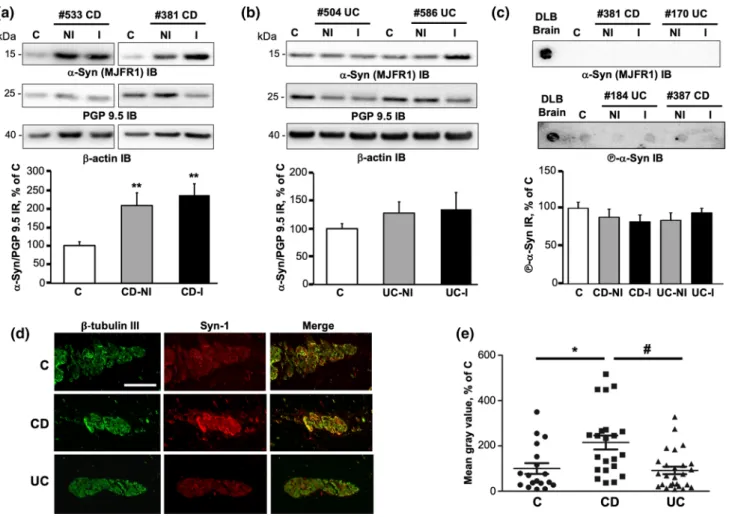
A significant 2.07- and 2.35-fold increase in the
expres-sion levels of alpha-synuclein protein was observed in the
non-inflamed and inflamed area of CD patients when
com-pared to controls, respectively (Fig.
1
a and suppl. Fig. 1
[Online Resource 3]). By contrast, no significant differences
were observed between UC patients and controls (Fig.
1
b
and suppl. Fig. 1 [Online Resource 3]). Filter-trap assays
were performed in samples from 6 controls, 6 CD and 6
UC patients to detect alpha-synuclein aggregates. Although
our assay efficiently detected alpha-synuclein aggregates
in a brain sample from a patient with dementia with Lewy
bodies, it did not show any appreciable difference in the
immunoreactivity for alpha-synuclein or phosphorylated
alpha-synuclein between colonic samples from CD, UC
and controls (Fig.
1
c and suppl. Fig. 2 [Online Resource
4]). Additional immunohistochemistry experiments showed
that alpha-synuclein immunoreactivity was increased in
Malvyne Rolli-Derkinderen and Pascal Derkinderen havecontributed equally to this work.
Electronic supplementary material The online version of this article (https ://doi.org/10.1007/s0040 1-018-1943-7) contains supplementary material, which is available to authorized users. * Pascal Derkinderen
[email protected]; [email protected]
1 Inserm, U1235, Place Gaston Veil, 44035 Nantes, France 2 University Nantes, Nantes 44035, France
3 CHU Nantes, Institut des Maladies de l’Appareil Digestif,
Nantes 44093, France
4 Department of Neurology, CHU Nantes, Nantes 44093,
360 Acta Neuropathologica (2019) 137:359–361
1 3
myenteric neurons of CD patients when compared to UC
patients and control subjects (Fig.
1
d, e).
Our results show that alpha-synuclein protein levels are
increased in the colon of CD, but not of UC patients and
that this upregulation is not associated with more protein
aggregation. These findings further reinforce the possible
link between IBD and PD and the causal role of
gastroin-testinal inflammation in the development of PD. They also
outline the fact that despite being grouped under the term
IBD and sharing overlapping symptoms and complications,
UC and CD are two different disorders from a
pathophysio-logical point of view. While CD is primarily associated with
T-helper type 1 immune responses, UC predominantly shows
a characteristic atypical T-helper type 2 cytokine pattern [
1
].
It is, therefore, tempting to speculate that some of the
proin-flammatory cytokines and/or para-inproin-flammatory responses
that are activated in CD but not in UC are involved in the
regulation of alpha-synuclein expression. Further in vitro
Fig. 1 Expression levels and aggregation of alpha-synuclein in colonic biopsies from patients with Crohn’s disease (CD) and ulcera-tive colitis (UC). a, b Colonic biopsies lysates from 10 CD patients, 12 UC patients and 12 controls (C) (see suppl. Table 1 [Online Resource 1] for subjects’ demographics and treatments) were sub-jected to immunoblot analysis using antibodies against total alpha-synuclein (α-Syn MJFR1 IB) and PGP 9.5 (PGP 9.5 IB). For UC and CD patients, biopsies taken in non-inflammatory (NI, CD-NI and UC-NI) and inflammatory area (I, CD-I and UC-I) were analyzed separately. For one UC subject (#283), no biopsies were taken in the non-inflamed area. To ensure equal protein loading, membranes were probed with anti-β-actin antibody. Illustrative images are shown; raw immunoblots are provided in suppl. Fig. 1 [Online Resource 3]. Alpha-synuclein immunoreactive bands were measured, normal-ized to the optical densities of PGP 9.5 and expressed as percentage of controls. Data correspond to mean ± SEM of 12 samples for con-trol subjects (C), 12 samples for UC patients in the inflamed area, 11
samples for UC patients in the non-inflamed area and 10 samples for CD patients in both inflamed and non-inflamed area, **p < 0.005. c Colonic biopsies lysates from 6 UC and CD patients and 6 controls (C) were subjected to filter-trap assay with cellulose acetate mem-brane using antibodies against total alpha-synuclein (α-Syn MJFR1 IB) and phosphorylated alpha-synuclein (℗-α-Syn IB). Illustrative images are shown, raw results are provided in suppl. Fig. 2 [Online Resource 4]. Phosphorylated alpha-synuclein immunoreactive spots were measured and expressed as percentage of controls. d Anti-alpha-synuclein Syn-1 and anti-β-tubulin III antibodies were used to detect alpha-synuclein in the myenteric ganglia in CD and UC samples and in control subjects. Scale bar is 50 µm. e Quantitative analysis of alpha-synuclein immunofluorescence in the myenteric plexus of CD, UC patients and controls. Data are shown as corrected mean gray value normalized to controls and presented as mean ± SEM, n = 18, 22 and 26 myenteric ganglia for control, CD and UC group, respec-tively. *p < 0.05, CD vs C, #p < 0.05, CD vs UC
361 Acta Neuropathologica (2019) 137:359–361
1 3
studies are definitely needed to identify these signaling
path-ways and to study if they are shared between the central and
enteric nervous system. Such an approach should help us
better understand the role of systemic inflammation in PD.
Acknowledgements This work was supported by a grant from
cen-tre d’entraide et de coordination des associations de parkinsoniens
(CECAP) and Parkinsonien de Vendée (FFGP) to AP and PD and
Insti-tut de France to PD.
Author’s contribution AP, AL, ED, GC and MRD performed the exper-iments. AB, ED, MN and MRD were involved in tissue sampling and biobanking. MRD and PD supervised the study, wrote the first draft and the final version of the manuscript.
Compliance with ethical standards
Conflict of interest The authors declare no actual or potential conflict of interest.
References
1. Christophi GP, Rong R, Holtzapple PG, Massa PT, Landas SK (2012) Immune markers and differential signaling networks
in ulcerative colitis and Crohn’s disease. Inflamm Bowel Dis 18:2342–2356. https ://doi.org/10.1002/ibd.22957
2. Derkinderen P, Neunlist M (2018) Crohn’s and Parkinson dis-ease: is LRRK2 lurking around the corner? Nat Rev Gastroenterol Hepatol. https ://doi.org/10.1038/s4157 5-018-0006-9
3. Devos D, Lebouvier T, Lardeux B, Biraud M, Rouaud T, Pouclet H et al (2013) Colonic inflammation in Parkinson’s disease. Neu-robiol Dis 50:42–48. https ://doi.org/10.1016/j.nbd.2012.09.007
4. Peter I, Dubinsky M, Bressman S, Park A, Lu C, Chen N et al (2018) Anti-tumor necrosis factor therapy and incidence of Par-kinson disease among patients with inflammatory bowel disease. JAMA Neurol. https ://doi.org/10.1001/jaman eurol .2018.0605
5. Schwiertz A, Spiegel J, Dillmann U, Grundmann D, Bürmann J, Faßbender K et al (2018) Fecal markers of intestinal inflammation and intestinal permeability are elevated in Parkinson’s disease. Parkinsonism Relat Disord. https ://doi.org/10.1016/j.parkr eldis .2018.02.022
6. Stolzenberg E, Berry D, Yang D, Lee EY, Kroemer A, Kauf-man S et al (2017) A Role for neuronal alpha-synuclein in gas-trointestinal immunity. J Innate Immun 9:456–463. https ://doi. org/10.1159/00047 7990
7. Villumsen M, Aznar S, Pakkenberg B, Jess T, Brudek T (2018) Inflammatory bowel disease increases the risk of Parkinson’s dis-ease: a Danish nationwide cohort study 1977–2014. Gut. https :// doi.org/10.1136/gutjn l-2017-31566 6