This is an author-deposited version published in:
http://oatao.univ-toulouse.fr/
Eprints ID: 10073
To link to this article: DOI: 10.1109/TSP.2013.2272924
URL:
http://dx.doi.org/10.1109/TSP.2013.2272924
To cite this version:
Abramovich, Yuri and Besson, Olivier Regularized
Covariance Matrix Estimation in Complex Elliptically Symmetric Distributions
Using the Expected Likelihood Approach - Part 1: The Over-Sampled Case.
(2013) IEEE Transactions on Signal Processing, vol. 61 (n° 23). pp. 5807-5818.
ISSN 1053-587X
Open Archive Toulouse Archive Ouverte (OATAO)
OATAO is an open access repository that collects the work of Toulouse researchers and
makes it freely available over the web where possible.
Any correspondence concerning this service should be sent to the repository
administrator:
[email protected]
Regularized Covariance Matrix Estimation in
Complex Elliptically Symmetric Distributions
Using the Expected Likelihood Approach—
Part 1: The Over-Sampled Case
Yuri I. Abramovich, Fellow, IEEE, and Olivier Besson, Senior Member, IEEE
Abstract—In Abramovich et al. [“Bounds on Maximum Likelihood Ratio—Part I: Application to Antenna Array Detec-tion-Estimation With Perfect Wavefront Coherence,” IEEE Trans. Signal Process., vol. 52, pp. 1524–1536, June 2004], it was demon-strated, for multivariate complex Gaussian distribution, that the probability density function (p.d.f.) of the likelihood ratio (LR) for the (unknown) actual covariance matrix does not depend on this matrix and is fully speciÞed by the matrix dimension and the number of independent training samples . This invariance property hence enables one to compare the LR of any derived covariance matrix estimate against this p.d.f., and eventually get an estimate that is statistically “as likely” as . This “expected likelihood” quality assessment allowed signiÞcant improvement of MUSIC DOA estimation performance in the so-called “threshold area,” and for diagonal loading and TVAR model order selection in adaptive detectors. Recently, the so-called complex elliptically symmetric (CES) distributions have been introduced for descrip-tion of highly in-homogeneous clutter returns. The aim of this series of two papers is to extend the EL approach to this class of CES distributions as well as to a particularly important derivative, namely the complex angular central distribution (ACG). For both cases, we demonstrate a similar invariance property for the LR associated with the true scatter matrix . Furthermore, we derive Þxed point regularized covariance matrix estimates using the generalized expected likelihood methodology. ThisÞrst part is devoted to the conventional scenario ( ) while Part II deals with the undersampled scenario ( ).
Index Terms—Covariance matrix estimation, elliptically symmetric distributions, expected likelihood, likelihood ratio, regularization.
I. INTRODUCTION
I
N A LARGE NUMBER OF RADAR APPLICATIONS, the traditional assumption on training data being a set of independent identically distributed (i.i.d) complex Gaussian random samples is strongly violated due to a signiÞcant in-homogeneity of this data. Examples from airborne movingY. Abramovich is with W R Systems, Ltd., Fairfax, VA 22030 USA (e-mail: [email protected]).
O. Besson is with the ISAE, Department Electronics Optronics Signal, Uni-versity of Toulouse, 31055 Toulouse, France (e-mail: [email protected]).
target indicator or ship-borne radars with strongly in-ho-mogeneous clutter are well-known [1]. For high-frequency over-the-horizon radars, and speciÞcally for mode-selective multiple input multiple output (MIMO) radars, similar scenario takes place when adaptive MIMO beamformers are trained using Doppler-processed training data [2], [3]. If ignored, signiÞcant non-homogeneity of training data has an adverse effect on adaptive processing since it signiÞcantly reduces the effective number of training data and more generally, makes the Gaussian model-based inference inaccurate. In most studies, such in-homogeneous set of data is modeled as a set of spheri-cally invariant random vectors (SIRV) [4]–[6]. A SIRV can be viewed as a special case of a broader class, complex elliptically symmetric (CES) distributions which are considered in the sequel. While this model describes in-homogeneous clutter, in-discriminatory application of this model that ignores additive white Gaussian noise, may lead to a number of problems, as demonstrated in [7]. In other words, this approach is suitable in “clutter-limited” applications, where the clutter-only covari-ance matrix is a full-rank matrix with the minimal eigenvalue that signiÞcantly exceeds the additive white noise power. In such a case, the latter may be ignored and the training data that contains energetic clutter may be described as a set of i.i.d SIRV or CES data.
Yet, so far, the Gaussian assumption has been predominating and much attention has focused on the problem of maximum likelihood (ML) covariance matrix estimation and, more gener-ically, on adaptive detection based on ML principles in the Gaussian case. Within this framework, it was demonstrated that for a limited number of i.i.d training data , a number of adaptive detection-estimation techniques properties, derived under the for ML principle asymptotic condition, are not true. Typical example is provided by MUSIC direction of arrival (DOA) estimation technique proven to be asymptotically efÞcient [8], [9]. However, as demonstrated in [10], for a certain small enough sample support MUSIC “breaks down” i.e., it starts to generate severely erroneous DOA estimates. Another well-known problem is a relatively poor performance of adaptive Þlters (antennas) and adaptive detectors that adopt the ML covariance matrix estimate under a limited sample support [11]. It has been evidenced in various studies that regularization (“shrinkage”) of the covariance matrix estimate, such as diagonal loading [13], [14] can sig-niÞcantly improve detection performance, if the shrinkage parameters are properly chosen. To address these and similar issues that occur under small sample support, in [10]–[12]
the technique called “Expected Likelihood” (EL) has been proposed. This technique is based on the invariance of the likelihood ratio (LR), constructed for the multivariate complex Gaussian data. More speciÞcally, it uses the fact that the p.d.f. of (where is the true (actual) covariance matrix) does not depend on and is fully speciÞed by matrix dimen-sion and the i.i.d sample volume . This invariance makes it possible to evaluate the “quality” of any (possibly parametric or regularized) covariance matrix estimate by comparing its likelihood ratio against the p.d.f. for . The estimate is then treated as appropriate if
is within the support of p.d.f., pre-calculated for given and . In other words, if is statistically as likely as , the EL approach deems it properly regularized. Recall that the unrestricted ML covariance matrix estimate produces the ultimate equal to one LR value irrespective of sample support , while the LR value generated by the true covariance matrix is signiÞcantly smaller for realistic – sample support volumes [10], [11]. The EL approach was shown to be effective in identifying “broken” MUSIC-produced DOA estimates (“breakdown prediction) and rectifying the set of these estimates to meet the expected likeli-hood ratio values (“breakdown cure”) [10], [12]. Accordingly, its ability to improve adaptive Þlters has been proved in [11].
Obviously, this EL methodology could be quite useful in addressing similar problems when dealing with non-Gaussian data. For this reason, the extension of the EL principles over the broader class of complex elliptically symmetric (CES) multivariate random variables constitutes the focus of this study. CES distributions are parameterized by the scatter ma-trix and a one-dimensional function called the density generator [15]. Since the latter is usually unknown in practice, we also consider complex angular central Gaussian (ACG) distributions which depend on the scatter matrix only.
The paper is organized as follows. In Section II we intro-duce the discussed above likelihood ratios and for conventional training conditions and derive their respective invariance properties. In Section III we derive the Þxed point ML covariance matrix estimate, while in Section IV we discuss the application of the EL methodology to selection of the loading factor and
order in diagonally loaded and
covariance matrix estimates. In Section V we present the results of Monte-Carlo simulations that demonstrate signiÞcant superiority of the regularizedÞxed point estimates with respect to the unconstrained (Þxed point) ML estimates for adaptive Þlters (antennas) applications. The summary and conclusions are given in Section VI.
II. LIKELIHOODRATIO ANDITSINVARIANCE FORDATAWITH
COMPLEXELLIPTICALLYSYMMETRICDISTRIBUTION
A. Complex Elliptically Symmetric Distributions
Description of CES distributions and their properties can be found e.g., in [16]–[19]. A very comprehensive review along with application of CES distributions to a number of array pro-cessing problems can be found in the recent paper [15]. We refer the reader to this paper for details that could be skipped in the short review to be presented now and which is inspired
by the presentation in [15]. Herein we consider the special ab-solutely continuous case with zero mean, when the p.d.f. of the r.v. is of the form
(1) for a positive deÞnite Hermitian (PDH) matrix called the scatter matrix, and function called density generator that satisÞes Þnite moment condition
to ensure integrability of . Above is a normalization constant ensuring that in-tegrates to 1 and is given by where is the surface area of the unit complex
-sphere . We adopt the
fol-lowing notation in the folfol-lowing . Some important properties of CES distributions will be of use in the sequel [15]–[19]. First, admits the following stochastic repre-sentation
(2) where the non-negative real random variable , called the modular variate, is independent of the complex random vector possessing a uniform distribution on denoted as . Here, means “has the same distribution as”. Second, the p.d.f. of the modular variate is given by
(3) which is also the p.d.f. of the Hermitian form as fol-lows from (2). The complex normal distribution is obtained for the particular , yielding
as the normalizing constant. Note that if admits Þnite -th order moments, and
. Thus, the scatter matrix is proportional to the co-variance matrix under Þnite 2nd-order moment assumption.
Given (1), for a set of i.i.d r.v. , we get for
(4)
For , the maximum likelihood estimator (MLE) of the scatter matrix is the matrix that minimizes over the set of PDH matrices the negative log-likelihood function:
(5)
and hence is the solution (assuming that is continuously differentiable) to the estimating equation [15], [20], [21]
(6a) (6b)
where . For where
and from (6) follows the well-known sample covariance matrix estimate. In general
case, where the weight function is not a constant, the esti-mation equation is implicit and an algorithm to Þnd its solution is needed. In [[15], Theorem 6] based on the results of Kent and Tyler [22], [23] for the real case, the uniqueness and con-vergence of the Þxed point iterations
to the unique solution of (6), for any initial estimate of , has been proven under certain technical conditions on , see [15] for further details.
For distributions that meet these condi-tions, let us consider the likelihood ratio for any parametric scatter matrix model where is a set of param-eters that uniquely specify the scatter matrix model. This
may be found as usual [24]:
(7) From (4), we get
(8)
With respect to (2) the “expected likelihood”, i.e., the LR value for the actual (true) scatter matrix may be presented as
(9)
where and . Now, due
to the invariance of the MLE under non singular data transfor-mations, is the MLE of the scatter matrix from a
distribution. Consequently, does not depend on , only on . This could also be seen by pre and post-multiplying (6) by and using (2) to get
(10)
Therefore, the p.d.f. of is invariant with re-spect to (w.r.t) the true scatter matrix , and is explicitly spec-iÞed by in (3) and parameters and .
B. Angular Central Gaussian Distribution
For all cases where is accurately known a priori and only the scatter matrix (or its parameters) is to be esti-mated, the EL principle can be applied since the p.d.f. for could be pre-calculated for the given , using Monte-Carlo simulations at least. As dis-cussed in the introduction, in many cases the distribution is not known a priori, and hence are often treated as unknown deterministic parameters. For unknown , the input vectors are often being transformed to the set of normalized vectors
(11) If , then the distribution of its projection onto the unit complex -sphere is said to have a com-plex angular elliptic distribution. In particular, if the CES
dis-tribution is a central complex Gaussian, i.e.,
then the distribution of is said to have a complex angular central Gaussian (ACG) distribution, which we denote as . For non-singular , the p.d.f. of is given by [15], [25]
(12) Note that the matrix can be only identiÞed up to a scale, since and yield the same distribution for any . Note also that for a central (zero mean) case, the central Gaussian distribu-tion for could be replaced by any central CES distribution and the resulting angular distribution would be the same. That is, if
then . Note that
although the density in (12) looks like the generic density of a complex elliptical distribution in (1), it does not have a CES dis-tribution itself and does not possess the characterizing stochastic representation (2) [15]. Yet, the non-singular ACG distribution can be generated using the r.v. as
for and non-singular .
Assuming independence of the , the joint distribution of is thus given by
(13)
In [25] it was demonstrated that the MLE for in this case still corresponds to a solution to (6) with the weight function being simply . In other words, in the ACG case satisÞes
(14)
Moreover in [26] it was demonstrated that the estimate (14) being the ML estimate of under assumption for is also the ML esti-mate for a more general case when
with the functions being given but not necessarily the same. Clearly this quite a universal property of the complex Tyler’s M-estimator, along with the invariance of the likelihood ratio (see below) makes this estimate very attrac-tive. Note that with respect to (14), the Þxed point iterations
(15)
converge to which exists and is unique up to a positive scalar [23], [27]–[29]. For uniqueness, one may want to restrict in a suitable way, e.g., by assuming (or
).
For a (possibly parameterized) scatter matrix , the like-lihood ratio in the ACG case is given by
We can now specify . Since where or , it follows that (17) where veriÞes (18)
Consequently is distribution-free and therefore, for any given and we can pre-calculate the p.d.f. for with any required accuracy and use it as the expected likelihood p.d.f. for quality assessment of any given scatter matrix model .
III. ML COVARIANCEMATRIXESTIMATION FOR
COMPLEXANGULARCENTRALGAUSSIANDISTRIBUTION
Let us consider a set of i.i.d -variate complex angular central Gaussian vectors generated by an arbitrary complex central elliptical distribution. Let be an identiÞed scatter matrix parameterized by a set of param-eters . Then the likelihood function (LF) can be introduced as follows
(19)
For a model , we have to
Þnd the maximum of this LF over the class of structured pos-itive deÞnite (p.d.) Hermitian matrices with
which according to [30], is the only necessary condition for a p.d. matrix to serve as the scatter matrix
of a process. Let with
for . Then, up to an additive constant,
(20)
Since only are subject to optimization, the ML equation may be presented as
(21a) (21b)
Using the fact that [31]
(22a)
(22b)
it follows that the MLE of in the model satisÞes
(23a) (23b)
The latter means that the ML estimate of the scatter matrix satisÞes the estimation equation
(24)
where is the Dym-Gohberg band-inverse transforma-tion of a Hermitian non negative deÞnite matrix, deÞned as [30] (25a) (25b)
Note that is invariant to scaling since
. In order to obtain in (24), we propose to resort to the Þxed point iterations
(26a)
(26b)
At this stage, we were unable to prove convergence of the iter-ative scheme (26) to a unique solution: therefore, this is still an open issue to be solved.
IV. APPLICATION OF THEEXPECTEDLIKELIHOODAPPROACH FORSCATTERMATRIXESTIMATION
The unrestricted (unstructured) MLE Tyler’s M-esti-mator (Þxed point solution) for provides the globally optimal solution that yields the ultimate value . Hence, even for conventional training conditions this esti-mate, may not be that effective for adaptive processing applications. For this reason, initially in [32] and then in [33], [34] the “shrinkage” Þxed point (diagonally loaded)
estimator has been proposed, where is obtained from the following iterative procedure:
(27a) (27b) The proof of convergence of this iterative routine to a unique solution has been recently introduced in [33] based on Perron-Frobenius theory. We refer to as FP-DL in the se-quel. Yet, the problem of selecting the shrinkage (loading factor) is open and crucial. In [33] the authors suggested to specify the optimal loading factor as the stochastic approximation of the Oracle (clairvoyant) scatter matrix , found as the min-imum of the Frobenius norm of the error, i.e.,
(28) where
(29)
We would like to investigate how this Oracle estimator com-pares with the EL approach for selecting : for conventional scenario the EL approach selects the loading factor such that
(30) where is the true p.d.f. of the
is the complex Tyler’s M-estimate (15) and stands for the median value. Comparative analysis of the loading factor selection rules (28), (30) is introduced in the next section.
Let us now consider our Þxed point so-lution (26). Similarly to (27), we may introduce the diagonally loaded Þxed point solution as (provided that this limit exists and is unique, which so far is still an open problem) where is obtained from
(31a) (31b)
In the sequel, we refer to as FP-DG-DL. It is note-worthy that for conventional Gaussian model , the loaded covariance matrix estimate proved quite an impressive improvement when applied to realistic data [35].
There are all reasons to expect similar improvement delivered by diagonal loading in (31). Yet, for this model two parameters should be properly selected. Similarly to (30), param-eters or may be treated as being properly selected if the likelihood ratio of the scatter matrices in (24) and in (31) meet the expected likelihood condition. Finally, observe that while convergence of the Þxed point iterations is an important theoretical issue, practically though, the EL criterion (30) may be used as a “stopping rule” for iterates that approach the EL threshold. Actual improvement in adaptive processing performance delivered by the suggested EL-supported regularized estimators is analyzed in the next section.
V. PERFORMANCEANALYSIS. SIMULATIONRESULTS
Let us consider the case of data distributed according to a multivariate Student -distribution with degrees of freedom, deÞned herein as
(32) The r.v. where stands for the complex chi-square distribution with degrees of freedom, whose p.d.f. is deÞned as . In all simulations below, we set . All algorithms will use the normalized data
. Dimension of uniform linear array (ULA) with half wavelength spacing was chosen to be and the true scatter matrix was considered to be as per process
Instead of mean-square error in covariance matrix estimation, we assess the quality of our estimates by analyzing the statistical properties of the SNR loss factor deÞned as [36], [37]
(33)
where stands for
the steering vector corresponding to the looked direction . In our simulations, we choose and so that the SNR gain provided by the optimal Wiener Þlter
compared to a conventional beamformer is about 12 dB. In (33), is a notation for a generic covariance matrix estimate considered in the sequel.
A. Distribution of the Likelihood Ratio
Let us Þrst illustrate the theoretical results about the
distribu-tions of and : both of them
are independent of . The latter depends on and only while the former also depends on . The median value of , for both a Gaussian and a Student -distri-bution with degree of freedom, as well as the median value of are plotted in Fig. 1. Additionally, the p.d.f. of the above likelihood ratios is displayed in Fig. 2 for
. The following comments can be made:
• The p.d.f. of are seen to be nearly iden-tical and seem to depend weakly on : they are the same for (Gaussian case) and
Fig. 1. Median value of and versus . .
Fig. 2. Probability density function of and
. and .
(Student case). Moreover, they are very close to the p.d.f. of . Therefore, the p.d.f. of the LR for the true scatter matrix shows quite an in-variance with respect to the distribution of the data. Note that asymptotically, it is known that
converges to a distribution, which obviously does not depend on the data distribution: therefore, as , the distribution of the log likelihood ratio should not depend on . It turns out that this is also approximately true in Þnite sample, although the Þnite sample distribution is not close to the asymptotic one.
• The median values are seen to be much inferior to 1, the value obtained with the MLE. These median values in-crease when increases (for a Þxed ) and when de-creases (for a Þxed ). For large values of the LR take very small values.
B. Diagonally Loaded Estimates
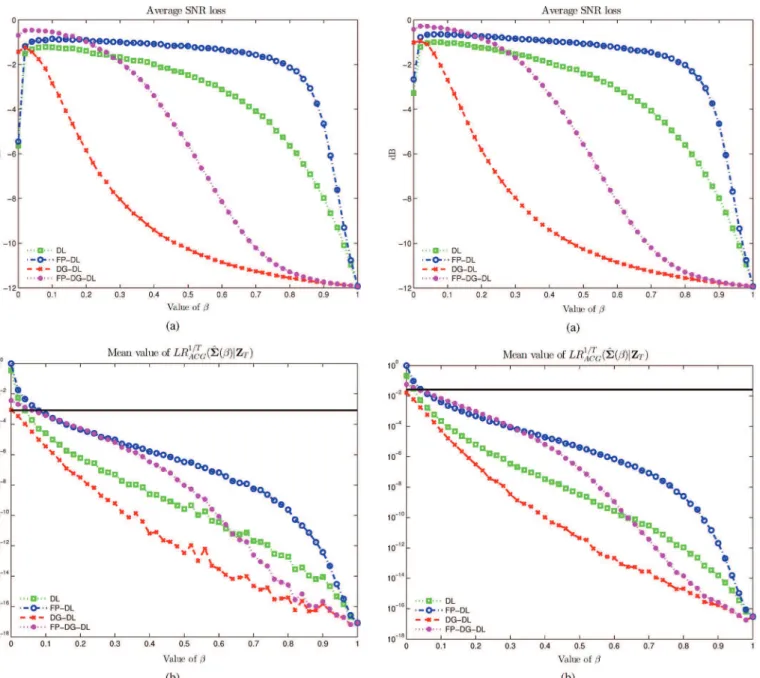
We now study diagonally loaded regularized estimates, and more particularly the inßuence of the shrinkage factor on both the LR values and the SNR loss. We consider here the estimate based on shrinkage of the normalized sample covariance matrix
(NSCM) , i.e.,
(34) (referred to as DL in the Þgures), its Þxed-point version in (27) and their Dym-Gohberg regularization
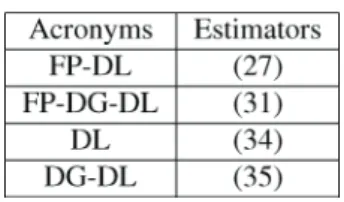
(35) (referred to as DG-DL in the Þgures) and the Þxed-point TVAR(1) estimate (31). The value of is set to . For the sake of convenience the following table relates the acronyms used in the Þgures with their corresponding estimators:
In Figs. 3–4 we investigate the inßuence of and the re-lation between LR and SNR loss. The solid line there repre-sents . These Þgures illustrate the fact that selecting the loading factor from the EL principle results in a SNR very close to that of the optimal (clairvoyant) Þlter. There-fore, this validates selection of the loading factor using the EL approach. Observe that selecting is a crucial issue for some estimates which are very sensitive to variations in : this is par-ticularly so for estimates. In such cases, EL principle offers a quite efÞcient solution to the problem of selecting . On the other hand, FP-DL is seen to be less sensitive to varia-tions of in terms of SNR loss: but this is also the case for the corresponding LR. Finally, note (and this will be observed in all simulations) that Þxed-point estimates always outperform their non-iterative counterparts.
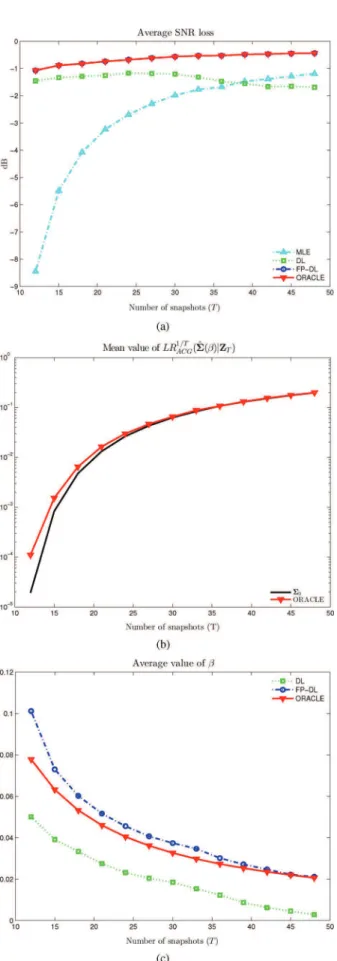
We now turn to performance analysis versus . As before, we consider the shrinkage estimate (34) and its Þxed-point iterative version in (27). For both of them, the loading factor is chosen according to the EL principle in (30), viz
(36) that is the value of for which is closest to the median value of . For comparison pur-poses, we compare the EL-based estimates with the estimate of [33]. The latter corresponds to the FP-DL estimate of (31) where the loading factor is chosen as in (28), and is given by
Fig. 3. Performance of diagonally loaded estimates versus . and . (a) SNR loss (b) Mean value of .
We refer to as the Oracle estimate. In Fig. 5 we dis-play the average SNR loss, the mean value of the LR and the mean value of the loading factor selected by each method (DL and FP-DL correspond to the choice (36) of ). Interestingly enough, it appears that the Oracle loading factor in (37) re-sults in a matrix whose LR closely matches that of . As a result, the SNR loss achieved by the Oracle estimate is very high. More interesting is the fact that the EL approach yields
the same LR value as the Oracle estimate, but slightly different
values of the loading factor . Yet, the EL and the Oracle esti-mate yields the same output SNR. This is because, as illustrated in Fig. 3(a), the FP-DL estimate is not very sensitive to varia-tions in . To summarize, this simulation shows that the Oracle estimate results in a LR value which matches . Since the EL approach selects the loading factor so that the re-sulting LR is also , the EL approach performs
Fig. 4. Performance of diagonally loaded estimates versus . and . (a) SNR loss (b) Mean value of .
as well as the Oracle. It should also be stressed that FP-DL sig-niÞcantly outperforms the MLE, especially in low sample sup-port, demonstrating the interest of regularization in this regime.
C. Regularization
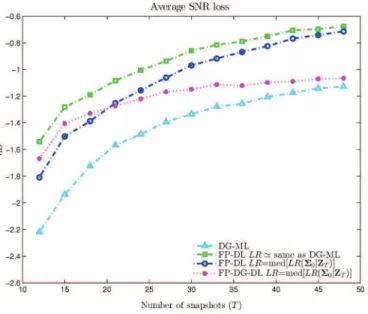
We now consider simulations with estimates. In Fig. 6, we compare the estimates
, and the estimates in (31) and (35). When shrinkage is used in conjunction with Dym-Gohberg approxi-mation, the value of is selected according to the EL principle, i.e.,
Fig. 5. Performance of diagonally loaded estimates versus number of snapshots . and . (a) SNR loss (b) Mean value of
(c) Mean value of loading factor.
The value of is set to in this simulation. As can be observed, the Þxed-point diagonally loaded TVAR estimate
Fig. 6. Performance of estimates versus number of snapshots . and .
offers the highest output SNR (average SNR loss of about dB for ), followed by a Dym-Gohberg approximation of Tyler’s MLE. It appears that shrinkage (or diagonal loading) associated with modeling is not useful. This is further investigated now.
D. Comparison Between DL and Estimates
Our next simulation explores the inßuence of the true under-lying model for onto regularized schemes which are based on a model . More precisely, we study the respective performance of “shrinkage to the structure” (i.e.,
only without diagonal loading), diagonal loading, and their combination, i.e., Þxed-point diagonally loaded
estimates. We still consider the case of an scatter matrix : in this case, we wish to study if only is better than FP-DL, and if diagonal loading can improve estimation. We also consider a case where the element of corresponds to the -th correlation lag of an process whose spectrum (correlation) is close to but different from that of the process considered so far. In any case, is not longer a banded matrix and does not correspond to the covariance matrix of a process. The Þxed-point diagonal loading will be tested with two different choices of the loading factor : either is selected according to (36) or it is chosen so
that . In the latter
case, we thus compare only and diagonal loading with the same likelihood ratio. Figs. 7–8 consider
while in Figs. 9–10. The following conclusions can be drawn from observation of these Þgures. First, note that if the true scatter matrix belongs to the class , in the instance , shrinkage to the structure alone (i.e., without DL) performs better than FP-DL even if the two estimates have the same LR, see Fig. 7. However, even in this case, a further reduction of LR to the median value leads to additional gains, i.e., is found to be better than
Fig. 7. Comparison between , Þxed point diagonal loading and Þxed point diagonally loaded estimates in the case.
and .
Fig. 8. Comparison between , Þxed point diagonal loading and Þxed point diagonally loaded estimates in the case.
and .
scatter matrix, when is not as per a model, diag-onal loading performs better than . It even performs better than diagonally loaded , as if when the two are used jointly, shrinkage to the structure is predominant. Therefore, there is no universally “best” regularization scheme: all depends on how close is the selected model to the true one. If we know or are lucky to select such one that the true matrix belongs to the restricted set, we get best results. If the restricted class does not include the true matrix, this “shrinkage to the structure” may be less efÞcient, and another shrinkage (actually FP-DL) may be more efÞcient.
So far, the order of our estimates was Þxed. We now consider joint estimation of and according to the EL principle. When estimating for Þxed , we fol-lowed the rule in (38), i.e., we looked for the matrix
Fig. 9. Comparison between , Þxed point diagonal loading and Þxed point diagonally loaded estimates in the case.
and .
Fig. 10. Comparison between , Þxed point diagonal loading and Þxed point diagonally loaded estimates in the case.
and .
whose LR is closest to the median LR. If the same strategy is adopted for estimation of both and , i.e., if we select
the couple so that is closest to
, then high orders are likely to be chosen. In order to favor models with minimal order, we estimate as the minimal order for which
complies with [11]. More precisely, is esti-mated as
(39) where is the 10% quantile of , i.e.,
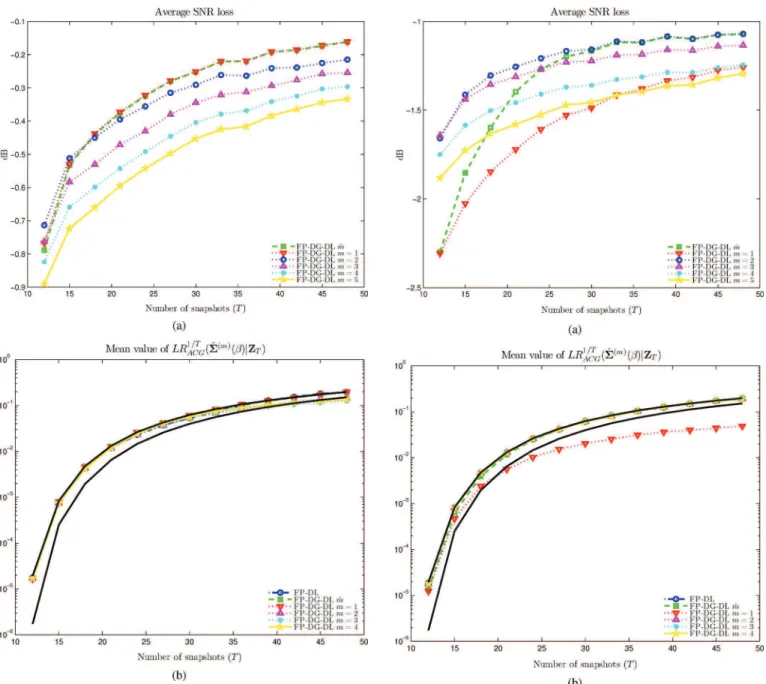
Fig. 11. Performance of estimates versus number of snapshots with an -type scatter matrix. and . (a) SNR loss (b) Mean value of .
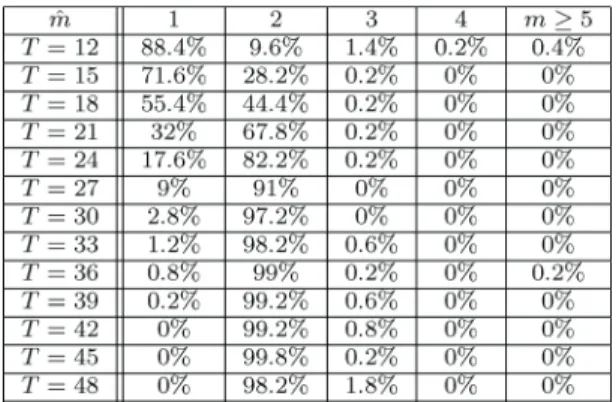
For comparison purposes, we also display the performance achieved when is Þxed to some value. The results are re-ported in Figs. 11–12 where we compare the performance of and in terms of SNR loss. In these Þgures, the black solid lines represent the threshold and the median value. Additionally, we display in Tables I–II an his-togram of the values of . As can be seen, in the -type scatter matrix , the estimated order is nearly always , which is the true underlying model order. However for this case all models yield LR values compliant with that of the true scatter matrix, i.e., at least above the threshold . In the case, as increases, one has with high probability: this appears to be the best choice as least for large enough. In fact the estimate results in a LR which is below the threshold, which explains why one has to go to at least . These two simulations show that selecting
Fig. 12. Performance of estimates versus number of snapshots with an -type scatter matrix. and . (a) SNR loss (b) Mean value of .
according to the EL principle yields a close to optimal solution. The is shown to perform quite well, at least it does not penalize too much performance compared to Þxing . In this case, the optimal value of is but the SNR loss of is within 0.4 dB. To summarize, whatever the case, in practice one does not know which value of is op-timal, and hence the latter must be set somehow arbitrarily. The EL principle offers an automatic way of estimating which, in most situations, is very efÞcient. Accordingly, selection of only for the FP-DL estimate according to the EL principle is very efÞcient.
VI. SUMMARY ANDCONCLUSIONS
In this paper, we extended the expected likelihood method-ology introduced in [10], [11] over the i.i.d. training samples
TABLE I
HISTOGRAMS OFTVAR MODELORDERESTIMATEDFROM THEEL PRINCIPLE
VERSUSNUMBER OFSNAPSHOTS IN THE CASE. AND
TABLE II
HISTOGRAMS OFTVAR MODELORDERESTIMATEDFROM THE
EL PRINCIPLEVERSUSNUMBER OFSNAPSHOTS IN THE
CASE. AND
with complex elliptically symmetric distributions, and partic-ularly over the class of samples with complex angular central Gaussian distribution. These distributions are appropriate for non-homogeneous clutter description when the covariance (scatter) matrix of this clutter is of full rank and the additive Gaussian internal noise may be ignored. In this Þrst part, for conventional (over-sampled) training conditions, we demon-strated that for the true (a priori unknown) scatter matrix, the p.d.f. of the likelihood ratio does not depend on this matrix. For angular central Gaussian complex data, this p.d.f. is fully speciÞed by the sample volume and matrix dimension , and does not depend on the density generator as per complex elliptically symmetric data. In those cases where the density generator is not accurately known a priori, it is therefore more appropriate to operate with the normalized training data that are described by the complex ACG distribution. While closed-form analytical formulas for the scenario-invariant p.d.f. have not been derived, Monte-Carlo simulations with i.i.d. white noise Gaussian random vectors could be used to pre-calculate these p.d.f. with any required accuracy. The particular quantiles of these p.d.f., such as median value, are then used as thresholds or target value for appropriate selection of shrinkage parameters in Þxed-point scatter matrix estimation.
In particular, the EL approach was proposed for diagonal loading factor selection in the Þxed-point regularized scatter matrix estimation scheme of [32]–[34]. Interestingly enough, we observed that the Oracle estimator (which minimizes the
MSE) yields a value of the likelihood ratio which is very close to the median LR for the true scatter matrix. Since the latter is the target value for the EL approach, it demonstrates that the EL approach is statistically sound. Furthermore, we explored in this paper another type of regularization, different from diagonal loading, often referred to as shrinkage to the structure. SpeciÞ-cally, we introduced the Þxed-point ML scatter ma-trix estimate, along with a diagonally loaded version of it. We showed that for autoregressive experimental data, es-timates perform better than Þxed-point diagonal loading: yet, introduction of DL in conjunction with shows im-provement with respect to only. When the true scatter matrix does not belong to the class, then Þxed-point diagonal loading was shown to outperform -based estimates, while the difference is not large. It was also demon-strated that the EL approach allows for an accurate estimation of the best model order.
Hence, the EL approach offers a systematic, statistically sound and efÞcient way of Þxing the regularization parameters in regularized covariance matrix estimation schemes. More-over, the extension to CES and ACG distributions presented in this paper expand our ability to address problems with severe in-homogeneity of training data in adaptive processing applica-tions. Regularized covariance matrix estimates, well developed and proven to be highly effective in adaptive antenna (Þlter) applications with multivariate complex Gaussian data, now got extended over a broader class of CES and ACG distributions.
REFERENCES
[1] M. Rangaswamy, “Spherically invariant random processes for mod-eling non-Gaussian radar clutter,” in Proc. 27th Asilomar Conf., PaciÞc Grove, CA, Nov. 1–3, 1993, pp. 1106–1110.
[2] G. Frazer, D. Meehan, Y. Abramovich, and B. Johnson, “Mode-selec-tive OTHR: A new cost-effec“Mode-selec-tive sensor for maritime domain aware-ness,” in Proc. IEEE Radar Conf., May 10–14, 2010, pp. 935–940. [3] G. Frazer, Y. Abramovich, and B. Johnson, “Mode-selective OTH
radar: Experimental results for one-way transmission via the iono-sphere,” in Proc. IEEE Radar Conf., May 23–27, 2011, pp. 397–402. [4] K. Yao, “A representation theorem and its application to spherically
invariant processes,” IEEE Trans. Inf. Theory, vol. 19, no. 5, pp. 600–608, Sep. 1973.
[5] E. Conte and M. Longo, “Characterisation of radar clutter as a spheri-cally invariant process,” in Proc. IEE Radar, Sonar Navig., Apr. 1987, vol. 134, no. 2, pp. 191–197.
[6] E. Conte, M. Lops, and G. Ricci, “Asymptotically optimum radar de-tection in compound-Gaussian clutter,” IEEE Trans. Aerosp. Electron.
Syst., vol. 31, no. 2, pp. 617–625, Apr. 1995.
[7] J. H. Michels, M. Rangaswamy, and B. Himed, “Performance of parametric and covariance based STAP tests in compound-Gaussian clutter,” Digit. Signal Process., vol. 12, no. 2–3, pp. 307–328, Apr.–Jul. 2002.
[8] P. Stoica and A. Nehorai, “MUSIC, maximum likelihood and Cramér-Rao bound,” IEEE Trans. Acoust. Speech Signal Process., vol. 37, no. 5, pp. 720–741, May 1989.
[9] P. Stoica and A. Nehorai, “MUSIC, maximum likelihood and Cramér-Rao bound: Further results and comparisons,” IEEE Trans.
Acoust. Speech Signal Process., vol. 38, no. 12, pp. 2140–2150, Dec.
1990.
[10] Y. Abramovich, N. Spencer, and A. Gorokhov, “Bounds on maximum likelihood ratio—Part I: Application to antenna array detection-estima-tion with perfect wavefront coherence,” IEEE Trans. Signal Process., vol. 52, no. 6, pp. 1524–1536, Jun. 2004.
[11] Y. I. Abramovich, N. K. Spencer, and A. Y. Gorokhov, “ModiÞed GLRT and AMF framework for adaptive detectors,” IEEE Trans.
Aerosp. Electron. Syst., vol. 43, no. 3, pp. 1017–1051, Jul. 2007.
[12] Y. I. Abramovich, N. K. Spencer, and A. Y. Gorokhov, “GLRT-based threshold detection-estimation performance improvement and applica-tion to uniform circular antenna arrays,” IEEE Trans. Signal Process., vol. 55, no. 1, pp. 20–31, Jan. 2007.
[13] Y. I. Abramovich, “Controlled method for adaptive optimization of Þl-ters using the criterion of maximum SNR,” Radio Eng. Electron. Phys., vol. 26, pp. 87–95, Mar. 1981.
[14] O. P. Cheremisin, “EfÞciency of adaptive algorithms with regularised sample covariance matrix,” Radio Eng. Electron. Phys., vol. 27, no. 10, pp. 69–77, 1982.
[15] E. Ollila, D. Tyler, V. Koivunen, and H. Poor, “Complex elliptically symmetric distributions: Survey, new results and applications,” IEEE
Trans. Signal Process., vol. 60, no. 11, pp. 5597–5625, Nov. 2012.
[16] P. R. Krishnaiah and J. Lin, “Complex elliptically symmetric dsitri-butions,” Commun. Statist.—Theory Methods, vol. 15, no. 12, pp. 3693–3718, 1986.
[17] K. T. Fang and Y. T. Zhang, Generalized Multivariate Analysis. Berlin: Springer Verlag, 1990.
[18] T. W. Anderson and K.-T. Fang, Theory and Applications of Ellip-tically Contoured and Related Distributions Dep. Statistics, Stanford Univ., , Tech. Rep. 24, Sep. 1990.
[19] A. C. Micheas, D. K. Dey, and K. V. Mardia, “Complex elliptical dis-tributions with application to shape analysis,” J. Statist. Plan. Interf., vol. 136, no. 9, pp. 2961–2982, Sep. 2006.
[20] E. Ollila and V. Koivunen, “Robust antenna array processing using -estimators of pseudo-covariance,” in Proc. 14th IEEE Int. Symp.
Pers., Indoor Mobile Radio Commun., Beijing, China, Sep. 7–10, 2003,
pp. 2659–2663.
[21] E. Ollila and V. Koivunen, “Inßuence function and asymptotic efÞ-ciency of scatter matrix based array processors,” IEEE Trans. Signal
Process., vol. 57, no. 1, pp. 247–259, Jan. 2009.
[22] D. E. Tyler, “A distribution-free M-estimator of multivariate scatter,”
Ann. Statist., vol. 15, no. 1, pp. 234–251, Mar. 1987.
[23] J. T. Kent and D. E. Tyler, “Redescending M-estimates of multivariate location and scatter,” Ann. Statist., vol. 19, no. 4, pp. 2102–2119, Dec. 1991.
[24] R. J. Muirhead, Aspects of Multivariate Statistical Theory. New York: Wiley, 1982.
[25] D. E. Tyler, “Statistical analysis for the angular central Gaussian dis-tribution on the sphere,” Biometrika, vol. 74, no. 3, pp. 579–589, Sep. 1987.
[26] E. Ollila and D. E. Tyler, “Distribution-free detection under complex elliptically symmetric clutter distribution,” in Proc. 7th SAM
Work-shop, Hoboken, NJ, Jun. 17–20, 2012, pp. 421–424.
[27] J. T. Kent and D. E. Tyler, “Maximum likelihood estimation for the wrapped Cauchy distribution,” J. Appl. Statist., vol. 15, no. 2, pp. 247–2549, 1988.
[28] F. Pascal, Y. Chitour, J.-P. Ovarlez, P. Forster, and P. Larzabal, “Covariance structure maximum-likelihood estimates in compound Gaussian noise: Existence and algorithm analysis,” IEEE Trans.
Signal Process., vol. 56, no. 1, pp. 34–48, Jan. 2008.
[29] Y. Chitour and F. Pascal, “Exact maximum likelihood estimates for SIRV covariance matrix: Existence and algorithm analysis,” IEEE
Trans. Signal Process., vol. 56, no. 10, pp. 4563–4573, Oct. 2008.
[30] Y. I. Abramovich, N. K. Spencer, and M. D. E. Turley, “Time-varying autoregressive (TVAR) models for multiple radar observations,” IEEE
Trans. Signal Process., vol. 55, no. 4, pp. 1298–1311, Apr. 2007.
[31] A. Hjorugnes, Complex-Valued Matrix Derivatives With Applications
in Signal Processing and Communications. Cambridge, U.K.: Cam-bridge Univ. Press, 2011.
[32] Y. I. Abramovich and N. K. Spencer, “Diagonally loaded normalised sample matrix inversion (LNSMI) for outlier-resistant adaptive Þl-tering,” in Proc. ICASSP, Honolulu, HI, Apr. 2007, pp. 1105–1108. [33] Y. Chen, A. Wiesel, and A. O. Hero, “Robust shrinkage estimation of
high-dimensional covariance matrices,” IEEE Trans. Signal Process., vol. 59, no. 9, pp. 4097–4107, Sep. 2011.
[34] A. Wiesel, “UniÞed framework to regularized covariance estimation in scaled Gaussian models,” IEEE Trans. Signal Process., vol. 60, no. 1, pp. 29–38, Jan. 2012.
[35] Y. Abramovich, M. Rangaswamy, B. Johnson, P. Corbell, and N. Spencer, “Performance analysis of two-dimensional parametric STAP for airborne radar using KASSPER data,” IEEE Trans. Aerosp.
Elec-tron. Syst., vol. 47, no. 1, pp. 118–139, Jan. 2011.
[36] I. S. Reed, J. D. Mallett, and L. E. Brennan, “Rapid convergence rate in adaptive arrays,” IEEE Trans. Aerosp. Electron. Syst., vol. 10, no. 6, pp. 853–863, Nov. 1974.
[37] J. Ward, Space-Time Adaptive Processing for Airborne Radar Lin-coln Lab., Mass. Inst. Technol., Lexington, MA, Tech. Rep. 1015, Dec. 1994.
Yuri I. Abramovich (M’96–SM’06–F’08) received the Dipl. Eng. (Honors)
de-gree in radio electronics in 1967 and the Cand. Sci. dede-gree (Ph.D. equivalent) in theoretical radio techniques in 1971, both from the Odessa Polytechnic Uni-versity, Odessa (Ukraine), U.S.S.R., and in 1981, he received the D.Sc. degree in radar and navigation from the Leningrad Institute for Avionics, Leningrad (Russia), U.S.S.R.
From 1968 to 1994, he was with the Odessa State Polytechnic University, Odessa, as a Research Fellow, Professor, and ultimately as Vice-Chancellor of Science and Research. From 1994 to 2006, he was at the Cooperative Re-search Centre for Sensor Signal and Information Processing (CSSIP), Adelaide, Australia. He joined the Australian Defence Science and Technology Organi-sation (DSTO), Adelaide, in 2000, as principal research scientist, seconded to CSSIP until its closure. As of January 2012, he has been with W.R. Systems Ltd., Fairfax, VA. His research interests are in signal processing (particularly spatio-temporal adaptive processing, beamforming, signal detection and esti-mation), its application to radar (particularly over-the-horizon radar), electronic warfare, and communications.
Dr. Abramovich was Associate Editor of IEEE TRANSACTIONS ONSIGNAL
PROCESSINGfrom 2002 to 2005. Since 2007, he has served as Associate Editor of IEEE TRANSACTIONS ONAEROSPACE ANDELECTRONICSYSTEMSand is cur-rently a member of the IEEE AESS Board of Governors.
Olivier Besson (SM’04) received the M. S. and Ph.D. degrees in signal
pro-cessing in 1988 and 1992, respectively, both from the Institut National Poly-technique, Toulouse.
He is currently a Professor with the Department of Electronics, Optronics and Signal of the Institut Supérieur de l’Aéronautique et de l’Espace (ISAE), Toulouse. His research interests are in the area of robust adaptive array pro-cessing, mainly for radar applications.
Dr. Besson is a member of the Sensor Array and Multichannel technical com-mittee (SAM TC) of the IEEE Signal Processing Society.