O
pen
A
rchive
T
OULOUSE
A
rchive
O
uverte (
OATAO
)
OATAO is an open access repository that collects the work of Toulouse researchers and
makes it freely available over the web where possible.
This is an author-deposited version published in :
http://oatao.univ-toulouse.fr/
Eprints ID : 12478
To link to this article : DOI :10.1109/WETICE.2013.58
URL :
http://dx.doi.org/10.1109/WETICE.2013.58
To cite this version : Mefteh, Wafa and Migeon, Frédéric and Gleizes,
Marie-Pierre and Gargouri, Faiez
S-DLCAM: A Self-Design and
Learning Cooperative Agent Model for Adaptive Multi-Agent Systems
.
(2013) In: IEEE International Conference on Collaboration
Technologies and Infrastructures - WETICE 2013, 17 June 2013 - 20
June 2013 (Hammamet, Tunisia).
Any correspondance concerning this service should be sent to the repository
administrator:
[email protected]
S-DLCAM: A Self-Design and Learning Cooperative Agent Model for Adaptive
Multi-Agent Systems
Wafa M EF T EH∗,∗∗, Frédéric M IGEON∗, Marie-Pierre GLEIZES∗, and Faiez GARGOU RI∗∗ *University of Paul Sabatier, IRIT, 118 Route de Narbonne, 31062 Toulouse, Cedex 9, France
(mefteh, migeon, gleizes)@irit.fr
**University of Sfax, MIRACL, Pôle Technologique de Sfax BP 242, 3021, Sakiet Ezzit Sfax. TUNISIE. ([email protected]), ([email protected])
Abstract—Given the incomplete knowledge that an Adaptive Multi Agent System (AMAS) has on its dynamic environment, the detection and the correction of problems encountered called Non Cooperative Situations for the construction of the good behaviour of the AMAS agent can challenge even the most experienced designer. Our goal is to help the AMAS designer in his task by providing an agent behaviour able to self-design. In this paper, we propose a self-design and learning cooperative agent model.
Keywords-Adaptive Multi-Agent Systems; Cooperative Agent; Self-Design and Learning Cooperative Agent Model.
I. INTRODUCTION
For Adaptive Multi-Agent System (AMAS) [1], the de-velopment of adaptation implies the need to focus on the agent level. This is to give the agent the means to decide autonomously to change its relationships with other agents in order to move toward a cooperative organization. Thus, depending on the interactions that the AMAS has with its environment, the organization between its agents emerges. Building such self-organized systems is not a trivial task. In this paper, we propose a new cooperative agent model based on Self-Design and learning mechanisms developed from the agent model associated with the AMAS theory [1], [2], [3]. We take in account the following important works: [4] (in which Capera et al. present a model based upon a sort of extended automata product, dedicated to multi-agent systems) and [5] (in which Russel and Norvig present how an agent can find a sequence of actions that achieves its goals, when no single action will do). Indeed, we consider that the Self-Design and Learning Cooperative Agent (S-DLCA) life cycle goes through two levels: the preliminary level (PL) (nominal and cooperative behaviour) given by the designer and the heigh level (HL) which is responsible of the detection and correction of the Non Cooperative Situations (NCS) that the agent may encounter during its life. This model was developed under SeSAm (http://www.simsesam.de/) and it can be used by any AMAS designer in order to help him in the detection and correction of the NCS using the new ADELFE methodology extensions [6].
II. REDEFINITION ANDLOCATION OF THENON
COOPERATIVESITUATIONS IN THE AGENT LIFE CYCLE
We consider that the agent life-cycle goes throw three phases: Perception & Interpretation (P & I), Reasoning & Decision (R & D) and Communication & Action (C & A). We identify new types of Non Cooperative Situations that an AMAS agent may encounter and we locate them with the old ones in the agent life cycle (Table I).
P & I
• INCOMPREHENSION: the agent is unable to extract the
information content of a signal;
• AMBIGUITY,UNCERTAINTY: the agent is not sure about the interpretation that it assigns to a perception;
• AMBIGUITY,EQUIVOCATION: the agent gives two (or more) interpretations to the same perception. R & D
• INCOMPETENCE: the agent is unable to exploit a given
interpretation in its reasoning or decisions;
• UNPRODUCTIVENESS: the use of a signal does not lead to any new conclusion. The information produced is either already known, either uninteresting or incomplete;
• INCOHERENCE(NORMSVIOLATION): this NCS can
be encountered when the agent’s reasoning leads to a conclusion that does not agree with its knowledge; C & A
• INABILITY: this NCS can be encountered when the agent is enable to perform an action or a sequence of actions due to aCONFLICT(its action is incompatible with the action of another agent), aCONCURRENCE(it make the same action as another agent), aUSELESS
-NESS(its action is useless for it and for other agents) or because the agent hasn’t the skills that allow it to realize the action.
Table I
REDIFINITION AND LOCATION OF THENCSIN THE AGENT LIFE-CYCLE
III. THE STATIC STRUCTURE OF THE PROPOSED AGENT MODEL
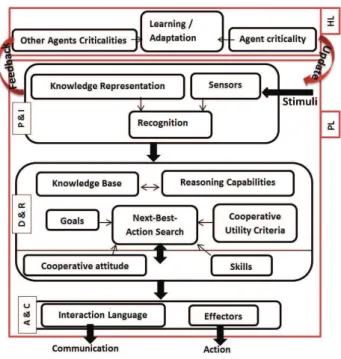
Figure 1 presents the static view of our agent model and its different modules are defined in table II.
Figure 1. The static view of the Self-design and Learning Cooperative Agent.
Sensors This module enables the agent to sense its environment. Knowledges
Representa-tion
This module represents The language of representation used by the designer to represent the agent’s knowl-edges.
Recognition This module enables the agent to recognize/interpret what it perceives.
Knowledge Base
This module represents the agent’s knowledge about itself and its environment.
Reasoning Capabilities
This module is given by the designer in order for the agent to reason on its interpretations using its knowledges.
Goals This module represents the local goal that the agent must achieve in the form of a future agent state. Skills This module represents the atomic actions and the
sequences of actions that the agent can perform. Cooperative
Utility Criteria
This module is responsible for the utility measurement of an agent state. It allows the agent to choose between different future states that can lead to its objective.
Next-Best-Action Search
This module is responsible for searching for the best next action to decide. The next best action is decided cooperatively.
Cooperative attitude
This module represents how the agent must behave to realize a good cooperation with other agents and its environment.
Interaction Language
This module represents the protocols used by the agent to interact with other agents.
Effectors This module enables to the agent to realize a desired action.
Other Agents Criticalities
This module support the criticalities of the other agents. The agent must behave in the way that permits it to equilibrate the criticalities of the other agents. Learning /
Adaptation
This module is responsible for the learning of the agent in order for it to adapt to its environment and achieve the functional adequacy of the system.
Agent criti-cality
The agent must behave in the way that permits it to equilibrate its local criticality.
Table II
DEFINITION OF THE AGENT MODULES
IV. THE DYNAMIC BEHAVIOUR OF THE PROPOSED AGENT MODEL
The agent perceives its environment and stores its percep-tions in the list of perceppercep-tions (Lp). It gives interpretations about these perceptions and stores them in the list of interpretations (Li). It connects each perception "p" with the predicates "pr" it knows and likely to be perceived. Dc(p, i) represents the degree of certainty of the interpretation given to this perception. Algorithm 1 presents how the agent can detect an NCS related to the first phase (N CSp). Then, the
Algorithm 1 Detection of N CSp for all p∈ Lpdo
Incomprehension(p) ← T RU E if Li(p) IS NOT NULL then
Incomprehension(p) ← F ALSE if Li= i then if ε < Dc(p, i) ≤ λ then U ncertainty(p, i) ← T RU E end if else Equivo(p) ← T RU E() end if end if end for
agent reasons on the Li using its Knowledge Base (Kb). It gives conclusions which are stored in the list of conclusions (Lc) and it decides what activities to perform and save them in the list of decisions (Ld) and finally schedules them and stores them in the list of scheduled activities (Lsa). Algorithm 2 illustrates the detection of the NCS related to the second phase (N CSr). It is an INCOMPETENCEwhen an interpretation "i" is not used to produce any conclusion or to make any decision. It is an Unproductiveness when the
Algorithm 2 Detection of N CSr if Lc⊂ Kb then U nproductiveness(i) ← T RU E end if if Ld= {} then Incompetence(Lc) ← T RU E end if
given conclusion already exists in Kb. It is an Incoherence when the given conclusion breaks one or more agent’s rules. Finally, it performs activities elaborated in the R & D phase and saves each performed action in the list of performed actions (Lpa). Algorithm 3 illustrates the detection of the NCS related to the third phase (N CSa). A decided activity is not performed because there is a Conflict and/or a Con-currence and/or a Uselessness and/or the agent hasn’t the skills that enable it to perform this activity. It is a Conflict
Algorithm 3 Detection of N CSa Inability(a) ← F ALSE Lnpa← Lsar{Lpa} for all a1 ∈ Lnpa do
Inability(a1) ← T RU E U selessness(a1) ← T RU E Lrest← Lsar{a1} for all arest∈ Lrestdo
if(a1.ad ⊂ arest.pr) then U selessness(a1) ← F ALSE end if
end for
for all Ag∈ Lpagdo
Cnf lict(a1, Ag) ← F ALSE Concurrence(a1, Ag) ← F ALSE for all a2 ∈ LaAg do
if(a1.ad = a2.ad) ∧ (a1.de = a2.de) then Concurrence(a1, a2) ← T RU E else if(a1.de ⊂ a2.pr) then
Conf lict(a1, a2) ← T RU E else if(a1.ad ⊂ a2.pr) then
U selessness(a1) ← F ALSE end if
end for end for end for
if the deletions made by the execution of an action (a1.de) contain preconditions of a perceived agent’s action (a2.pc). The perceived agents are stored in the list of perceived agents (Lpag). The actions to be made by a perceived agent "Ag" are saved in the list of actions to be performed by a perceived agent (LaAg). It is a Concurrence if all of the agent’s action additions (a1.ad) (and respectively all deletions (a1.de) are among the additions (a2.ad) (respectively deletions (a2.de) of a perceived agent’s actions. It is a Uselessness when the additions made by the agent’s action (a1.ad) are not part of the preconditions of its other actions La1.pc nor the preconditions of perceived agent’s actions La2.pc.
To deal with the encountered NCS, the agent realizes a set of specific actions to go out from each type of NCS. For the Conflict, Concurrence and Uselessness, the agent can anticipate them if possible since the R & D phase. For each encountered NCS, the agent tries to follow the following actions:
• α: Relate the current situation to other previous situa-tions based on its experience in order to find a way to correct the current situation.
• β: if⌉α =⇒ it tries to ask the perceived agents if they can help it.
• δ: if⌉β =⇒ it asks the designer to improve his work by giving more examples (for an N CSp), enhancing
the reasoning capabilities and the knowledge base (for an N CSr) or enhancing the skills (for an N CSa) We propose that the agent operates in two modes: the "Ex-perimentation Mode" and the "Deployment Mode". During the "Experimentation Mode", when detecting a NCS, the agent can ask the designer if it can find a solution for it. When a correction of a NCS occurrence is proposed to the agent, it learns from this in order to avoid it the next time. After many executions, the agent should be able, during the Deployment Mode, to correct by itself the encountered NCS based on its learning from the many corrections made during the "Experimentation Mode".
V. CONCLUSION
In this paper, we provide a new cooperative agent model for Adaptive Multi Agent Systems. This model is based on learning mechanisms to give the agent the ability to self-design. Our objective is to help the designer and facilitate his task by automating as much as possible the task of detection and correction of the Non Cooperative Situations.
REFERENCES
[1] J.-P. Georgé, M. P. Gleizes, and P. Glize, “Conception de systèmes adaptatifs à fonctionnalité émergente: la théorie des AMAS,” Revue d’Intelligence Artificielle, vol. 17, no. 4/2003, pp. 591–626, 2003.
[2] N. Daures, “Etude de la simulation de systèmes multi-agents pour la conception vivante d’multi-agents dans la méthode ADELFE,” Université Paul Sabatier, Toulouse, France, Rapport de Master Master Recherche IARCL, June 2006.
[3] S. Lemouzy, “Auto-ordonnancement coopératif de règles com-portementales,” Université Paul Sabatier, Toulouse, France, Rapport de Master, June 2007.
[4] D. Capera, J. Fanchon, J.-P. Georgé, and V. Camps, “A Generic Model Based on Automata for Multi-Agent Systems,” in Eu-ropean Workshop on Multi-Agent Systems (EUMAS), Brussels, Belgium, 06/12/2005-08/12/2005. http://www.kvab.be: The Royal Flemish Academy of Belgium (KVAB), Dcember 2005, pp. 79–90.
[5] R. Stuart and N. Peter, Artificial Intelligence - A Modern Approach (3. internat.ed.). Pearson Education, 2010. [6] W. Mefteh, F. Migeon, M. P. Gleizes, and F. Gargouri,
“Simulation Based Design for Adaptive Multi-Agent Sys-tem: Extensions to the ADELFE methodology,” in WETICE 2013 Conference, 11th Adaptive Computing (and Agents) for Enhanced Collaboration (ACEC), Hammamet, Tunisie, 17/06/2013-20/06/2013. IEEE.