Testing the Finch Hypothesis on Green OA Mandate Effectiveness
Y Gargouri 1, V Lariviere 1, Y Gingras 1, T Brody 2, L Carr 2 & S Harnad 1,21
Université du Québec à Montréal, Canada 2
University of Southampton, UK In June 2012, the UK Finch Committee made the following statement:
"The [Green OA] policies of neither research funders nor universities themselves have yet had a major effect in ensuring that researchers make their publications accessible in institutional repositories…"
[Finch Committee Recommendation, June 2012]
Testing the Finch Hypothesis
We have now tested the Finch Hypothesis. Using data from ROARMAP institutional Green OA mandates and data from ROAR on institutional repositories, we found that deposit number and rate is significantly correlated with mandate strength (classified as 1-12): The stronger the
mandate, the more the deposits. The strongest mandates generate deposit rates of 70%+ within 2 years of adoption, compared to the un-mandated deposit rate of 20%. The effect is already detectable at the national level, where the UK, which has the largest proportion of Green OA mandates, has a national OA rate of 35%, compared to the global baseline of 25%.
Conclusion
The conclusion is that, contrary to the Finch Hypothesis, Green Open Access Mandates do have a major effect, and the stronger the mandate, the stronger the effect (the Liege ID/OA mandate, linked to research performance evaluation, being the strongest mandate model). RCUK (as well as all universities, research institutions and research funders worldwide) would be well advised to adopt the strongest Green OA mandates and to integrate institutional and funder mandates.
Mandate strength:
12 immediate deposit required + linked to performance evaluation (Liege) (no waiver
option)
9 immediate deposit required (no waiver option) 6 6-month delay allowed (no waiver option) 3 12-month delay allowed (no waiver option) 3 rights-retention with waiver option
2 deposit if/when publisher says it's ok
1 no requirement: just request, recommendation or encouragement (policies in ROARMAP that are not classified as mandates)
- MAND-STRENGTH: strength of institution’s deposit mandate - MAND_AGE: age of institution’s deposit mandate (in months) - REPOS_AGE: age of institution’s repository
- depos_total : total number of deposits in institutional repository, normalized by the number the researchers at institution
- depos_average : yearly average number of deposits in institutional repository, normalized by number of researchers at institution
- depos_rate : rate of deposit (number of days per year with 10-99 deposits)i, normalized by the number of researchers at institution
- INST_RANK (12,000 minus Webometrics rank of institution)
We used data from ROARMAP (the Registry of Open Access Repositories’ Mandatory
Archiving Policies) to classify the age (MAND_AGE) (1-103 months) and the strength (MAND-STRENGTH) (1–12) of self-archiving mandates for the 155 institutions that have adopted a mandate to date.
We then used ROAR (the Registry of Open Access Repositories) to determine for each registered institutional repository (c. 1,890 repositories to date) its age (REPOS_AGE) and the number
(depos_total) rate (depos_rate) and yearly average (depos_average) of its deposits.
Thompson-Reuters database (WoK) was used to normalize the number and the rate of deposits by the number of researchers at each institution that had published at least one article during the last 4 years.
Webometrics university ranking was used to classify institutions according to their rank among 12,000 institutions. INST_RANK (12,000 minus ranking) reversed the rank scale to give the positive correlations a natural interpretation (in which a higher number means a higher rank). Negative Binomial Regressions:
We then used negative binomial regression to test whether mandate MAND-STRENGTH, MAND_AGE, REPOS_AGE and INST_RANK were predictive of the normalized deposit number, average or rate of deposit. These tests were conducted on 5 samples of mandated institutions:
1. All mandated institutions
2. Institutions where MAND_AGE > 2 years 3. Institutions where MAND_AGE > 3 years
4. The top 50% of institutions classified by INST_RANK (INST_RANK < 10,736) 5. The bottom 50% of institutions (10,736 < INST_RANK < 12,000)
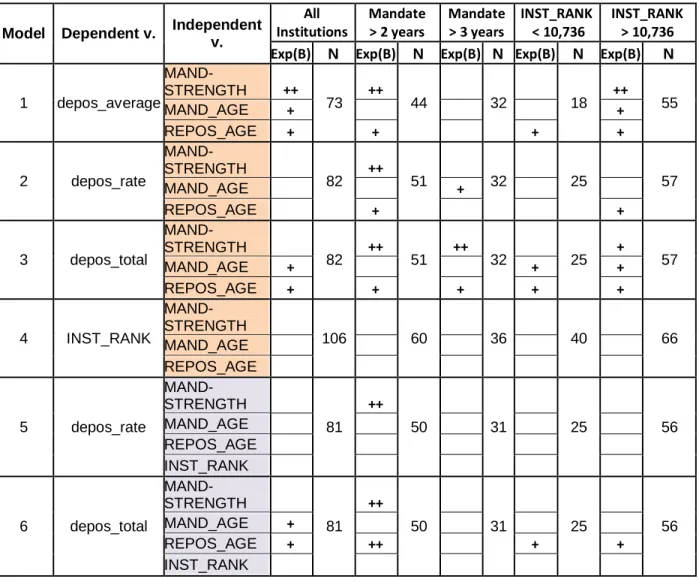
The following table shows the significant correlations for each model, tested on each of 5 sub-sets of institutions. The + sign indicates a significant positive correlation of (Exp(B) < 1.05). The ++ indicates a significant positive correlation of (Exp(B) > 1.05). N is the number of institutions.
Model Dependent v. Independent v. All Institutions Mandate > 2 years Mandate > 3 years INST_RANK < 10,736 INST_RANK > 10,736 Exp(B) N Exp(B) N Exp(B) N Exp(B) N Exp(B) N
1 depos_average MAND-STRENGTH ++ 73 ++ 44 32 18 ++ 55 MAND_AGE + + REPOS_AGE + + + + 2 depos_rate MAND-STRENGTH 82 ++ 51 32 25 57 MAND_AGE + REPOS_AGE + + 3 depos_total MAND-STRENGTH 82 ++ 51 ++ 32 25 + 57 MAND_AGE + + + REPOS_AGE + + + + + 4 INST_RANK MAND-STRENGTH 106 60 36 40 66 MAND_AGE REPOS_AGE 5 depos_rate MAND-STRENGTH 81 ++ 50 31 25 56 MAND_AGE REPOS_AGE INST_RANK 6 depos_total MAND-STRENGTH 81 ++ 50 31 25 56 MAND_AGE + REPOS_AGE + ++ + + INST_RANK
Table 1: Significant Positive Correlations for Negative Binomial Regressions: MAND_AGE, REPOS_AGE, MAND-STRENGTH and INST_RANK tested with normalized number and/or rate of deposit: The stronger the mandate, the higher the deposit number total, average and rate.
Mandate strength:
- MAND-STRENGTH is highly and positively correlated with deposit average
- MAND-STRENGTH is highly and positively correlated with deposit rate when mandate age is older than 2 years.
- MAND-STRENGTH is highly and positively correlated with number of deposits when mandate age is older than 3 years (N is as low as 32), as well as when mandate age is older than 2 years (N=51)
Mandate age:
- MAND_AGE is positively correlated with deposit number and average
- MAND_AGE is positively correlated with deposit rate when mandate age is older than 3 years (N=32).
Repository Age:
- REPOS_AGE is positively correlated with deposit rate and average.
- REPOS_AGE is positively correlated with number of deposits when mandate age is older than 2 years (N = 51), as well as for higher ranked institutions.
INST_RANK
There is no significant correlation with INST_RANK, so there is no ranking bias.
Comparing percent OA globally and in UK. UK average OA is close to 40%, 15%
higher than the global average of about 25%. The most likely reason is that RCUK as well as about a third of UK universities have mandated Green OA. The UK mandates are not very effective, lacking compliance-verification mechanisms, but they are nevertheless substantially more effective than the global average, which is almost all
unmandated OA. UK Green OA can be increased to 100% cost-free, by mandating it (effectively). Gold OA can only be increased by both mandating it and paying publishers extra for it, over and above subscriptions. (Data source: Gargouri et al 2012)
The Need to Strengthen Green OA Mandates. As in the rest of the world, most UK OA
is Green, not Gold. UK Green OA can be increased to 100% cost-free, by mandating it. Gold OA can only be increased by both mandating it and paying publishers extra for it, over and above subscriptions. (Data source: Gargouri 2012)
Effective Mandates. Effective Green OA Mandates generate 70%+ OA. (Data source:
Gargouri et al 2010)
U. Liège Mandate and Deposit Rate. U Liège's Rector, Bernard Rentier, reported in
2010 that over the prior year deposits to the U. Liège repository (ORBi) had grown from
10 to 40 thousand publications, 25 thousand of them full-text. This is the highest deposit
rate in ROAR's single institutional repository range. Viewed 650 thousand times and downloaded 61 thousand times, the 40 thousand deposits coincided with the first year in
which, as a part of U Liège's Open Access Mandate, ORBi was designated as U Liege's
sole official means of submitting publications for performance review for academic
promotion. (Data source: ROAR)
References
How to Integrate University and Funder Open Access Mandates
Integrating Institutional and Funder Open Access Mandates: Belgian Model Liège ORBi model: Mandatory policy without rights retention but linked to assessment procedures
Optimizing OA Self-Archiving Mandates: What? Where? When? Why? How? Which Green OA Mandate Is Optimal?
Finch, Dame Janet et al (2012) Accessibility, sustainability, excellence: how to expand access to research publications. Report of the Working Group on Expanding Access to Published Research Findings.
Gargouri, Y, Lariviere, V, Gingras, Y, Carr, L & Harnad, S (2012) Green and Gold Open Access Percentages and Growth, by Discipline. Montreal: 17th International Conference on Science and Technology Indicators (STI)
Gargouri, Y., Hajjem, C., Lariviere, V., Gingras, Y., Brody, T., Carr, L. and Harnad, S. (2010) Self-Selected or Mandated, Open Access Increases Citation Impact for Higher Quality Research. PLOS ONE 5 (10) e13636
Harnad, S (2012) United Kingdom's Open Access Policy Urgently Needs a Tweak. D-Lib Magazine 18 (9/10)
Harnad, S (2102) How and Why the RCUK Open Access Policy Needs to Be Revised. Oxford: Digital Research 2012.
RCUK (2012) Policy on Access to Research Outputs RCUK Research Councils UK
ROAR Registry of Open Access Repositories
ROARMAP Registry of Open Access Repositories Mandatory Archiving Policies
Xia, JF; SB Gilchrist, NXP Smith, JA Kingery, JR Radecki, ML Wilhelm, KC Harrison, ML Ashby & AJ Mahn (2012) A Review of Open Access Self-Archiving Mandate Policies. Libraries and the Academy 12(1): 85–102
i
Deposit rate is calculated as the number of middle-activity days. A low-activity day is 1-9 deposits per day, a middle-activity day is 10-99 deposits per day, and a high-activity day is 100+ deposits per day. ROAR experience has shown that the middle-activity range corresponds to an active single institutional repository’s activity level, whereas the high-activity range corresponds to central (multi-institutional) repository activity levels. Central repositories were not included in this study of institutional mandates.