This is an author-deposited version published in:
http://oatao.univ-toulouse.fr/
Eprints ID: 4362
To cite this document:
CHIKHAOUI Oussama, GRESSIER Jérémie, GRONDIN
Gilles. Assessment of the Spectral Volume Method on inviscid and viscous flows. In:
The Sixth International Conference on Computational Fluid Dynamics - ICCFD,
12-16 Jul 2010, St-Pertersburg, Russia.
Any correspondence concerning this service should be sent to the repository
administrator:
[email protected]
Inviscid and Viscous Flows
Oussama Chikhaoui, J´er´emie Gressier and Gilles Grondin
Abstract The compact high-order ’Spectral Volume Method’ (SVM, Wang (2002)) designed for conservation laws on unstructured grids is presented. Its spectral recon-struction is exposed briefly and its applications to the Euler equations are presented through several test cases to assess its accuracy and stability. Comparisons with classical methods such as MUSCL show the superiority of SVM. The SVM method arises as a high-order accurate scheme, geometrically flexible and computationally efficient.
1 INTRODUCTION
Despite the constant improvements in computational and data processing resources, the continuously growing requirements of computational fluid dynamics still re-main unsatisfied. In the last decade, the CFD community showed a growing inter-est in high-order approximations to address these issues (WENO, Discontinuous Galerkin, . . . ). An attractive choice is the ’Spectral Volume Method’ (SVM) pro-posed and developed by Wang et al. [6, 5, 3] which achieves high-order accuracy on unstructured grids through polynomial reconstruction.
To assess the performance of the SVM method, different test cases were com-puted with Typhon, an unstructured open-source code. The numerical experiments were chosen to cover a large set of flow configurations from continuous quasi-incompressible problems to shock wave propagations and mixing flows.
The results presented here are up to expectations with a significant increase in accuracy and a reduction in CPU time compared to a usual second order method.
D´epartement d’A´erodynamique, ´Energ´etique et Propulsion Institut Sup´erieur de l’A´eronautique et de l’Espace
10 av. Edouard Belin - BP 54032 - 31055, Toulouse, FRANCE e-mail: {oussama.chikhaoui, jeremie.gressier, gilles.grondin}@isae.fr
2
2 Spectral Volume Method for the 2D Euler equations
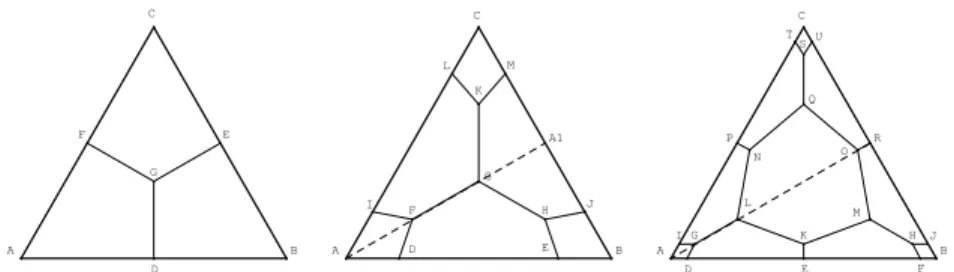
The SVM method achieves high-order accuracy on unstructured grids through poly-nomial reconstruction within initial grid cells (spectral volumes, SVs) with a subdi-vision of the each SV into polygonal control volumes (CVs, Fig. (1)). The spectral splitting of the SV is designed to minimize internal reconstruction oscillations [1]. The flux computations are finally achieved with Gaussian quadrature directly in-ferred from CV states ponderation with a constant and unique set of coefficients for each SV in the whole domain.
A B C D E F G A B C G D E I L J M F H K A1 A B C D E F I P T J R U G H S O N K L M Q
Fig. 1 Geometric splitting definitions for the second, third and fourth order partitions
While high-order reconstructions are often based on projections and gradient evaluations on a quite large region of neighboring cells, the SVM compact sten-cil makes it computationally efficient and attractive. The polynomial reconstruction used remains exact (at a given order) on arbitrarily shaped triangles.
2.1 Spectral volumes partitions
The subdivision of a spectral volume Siin different controle volumes Ci jis an
es-sential step for the SVM scheme. For example, some geometric partitions can lead to degenerated systems and thus should be excluded. The splitting procedure must conserve the existing symmetries in a triangle, use straight edges and consider con-vex CVs. Fig. 1 shows different geometric partitions of a spectral volume for differ-ent desired orders. While the second order splitting definition is unique, the higher order partitions introduce some geometric parameters. The third order partitions is defined by two parameters: α =ADAB and β =AA1AF. The fourth order partitions have four degrees of freedom: α = ADAB, β = AGAR, γ =ORAR and δ =ARAL. The accuracy and stability of a given spectral volume scheme depends on the choice of these geomet-ric parameters [1, 2].
Table 1 sums up the different implemented and tested partitions with their geo-metric parameters.
Partition Order α β δ γ SVM2 2 - - - -SVM3W 3 1/4 1/3 - -SVM3K 3 91/1000 18/100 - -SVM3K2 3 0.1093621117 0.1730022492 - -SVM4W 4 1/15 2/15 2/15 1/15 SVM4K 4 78/1000 104/1000 52/1000 351/1000 SVM4K2 4 0.0326228301 0.042508082 0.0504398911 0.1562524902 Table 1 Geometric parameters for the different SVM partitions
The SVMW splittings were proposed by Wang et al. and designed by minimizing the Lebesgue constant over the SV. Whereas the minimization of this constant pro-vides a good assessment of the quality of the SVM splitting, different observations show that it is not a sufficient condition for the stability of the scheme. Thus, Abeele proposed other geometric splittings noted as SVMK and SVMK2 [1, 2] .
2.2 Spectral volume method assets
The spectral volume method uses a compact stencil which is a great advantage com-pared to other high order reconstructions. The SVM geometric splitting is designed and optimised in a spectral way to minimize internal reconstruction oscillations known as Runge phenomena. The reconstructed field is continuous over the entire SV, therefore internal faces do not constitute Riemann problems, which reduces the flux computation cost and contains the problem of data limitation to the SV faces. The other interesting aspect of the SVM is the homothetic nature of the splitting reconstruction: no new metric terms need be kept in memory. The interpolation on Gauss points for fluxes computation is directly inferred from a weighting of CV states with constant and unique coefficients for the whole domain.
Lastly, while the usual finite-volume and finite-difference methods depend strongly on the grid quality and density, the SVM reconstruction remains exact (at a given order) on arbitrarily shaped triangles.
3 Numerical experiments
To assess the performance of the SVM method, different test cases were computed with Typhon, an open-source unstructured solver [4]. The numerical experiments were chosen to cover a large set of flow configurations. In the next sections, we focus on the results of two chosen cases: the evolution of a convected vortex and a simple Mach reflection on a wedge. The HLLC solver is used for the Riemann problem at faces. Time integration is performed with a third order TVD Runge-Kutta scheme and SVM results are compared to results provided by a usual MUSCL method.
4
3.1 Convected Vortex
We consider a vortex evolution problem governed by:∂ p∂ t = ρvθ2
r and convected with
a speed of Vconv= 20 in the x direction on a regular domain of [−5 : 5] × [−5 : 5].
Periodic boundary conditions are set in the x and y directions. Thus, the vortex crosses the whole domain twice from left to right between t=0 and t=1. No limiters were employed for the SVM simulations.
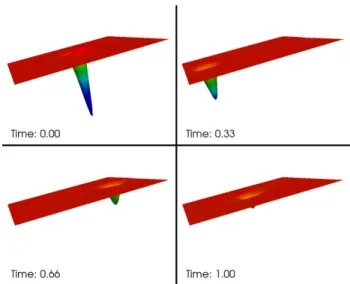
Fig. 2 Overview of numerical damping of a convected vortex using MUSCL scheme
The overview of the vortex damping is presented on figure 2 for the MUSCL simulation using the Van Albada limiter. While the theoretical maximum transverse velocity is Vymax= 30, Vymax∼ 10 is obtained for this MUSCL simulation, thereby
showing that this test case is very sensitive to numerical dissipation.
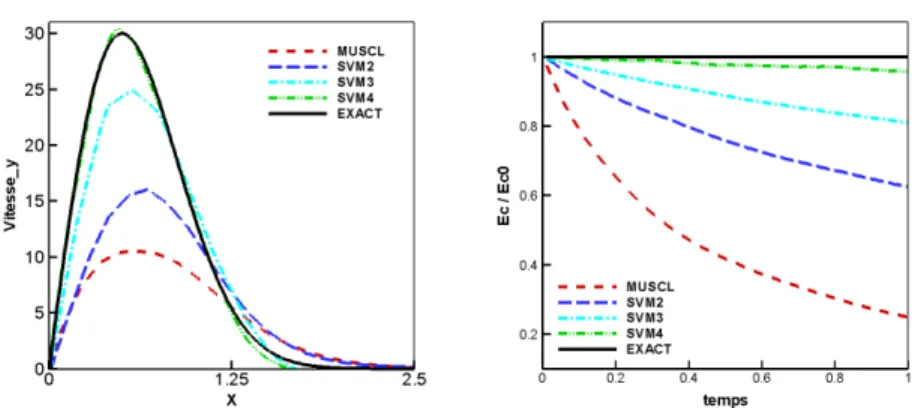
For comparison purposes, the velocity profiles are considered on figure 3 at t=1 along a horizontal line passing through the vortex center. With the SVM schemes, the velocity profile is better preserved when the order is increased. Thus, Vymax∼
15, Vymax∼ 25 and Vymax∼ 30 are obtained for the second, third and fourth order
respectively.
Another interesting aspect of SVM simulations is the reduction in CPU time per time step compared to a classic MUSCL method using the same number of control volumes: 50% for 2ndorder, 32% to 35% for 3rdorder and 22% to 25% for 4th order. The CPU time savings are due to the absence of gradient evaluation for inviscid fluxes and the continuity of state variables through internal faces. This latter fact reduces the limitation problems and several cases can be computed without any limitation procedure.
Fig. 3 Comparison of velocity profiles along a line through the vortex center at t = 1 (left) and kinetic energy time evolution (right)
3.2 Simple Mach reflection
This case deals with a classic problem of shock reflection with a Mach number Ms= 1.7 and a wedge angle of θ = 25◦. The numerical results were obtained on a
domain of [25 × 16.5] on the x, y plane with the apex of the wedge placed at x, y = 4.69, 0. The upstream shock conditions are ambient conditions, with ρa= 1.225,
pa= 1.01325 · 105and u = 0.
Different SVM simulations were carried out with different orders. Observations show that the contours around the incident and reflected shocks and the slip sur-face are better captured when the order increases. To prove that the capture of these features and the better resolution of the flow are due to the increasing order, other simulations have been performed using the MUSCL scheme. The results obtained
Fig. 4 Entropy contours at slip surface: MUSCL, 800.000 CV (left) and SVM4, 422.080 CV (right)
with the SVM4 scheme were compared to those provided by the MUSCL method on a finer structured cartesian grid. While the unstructured grid for SVM4 contains 422.080 CVs, the structured grid used for MUSCL simulation contains almost twice
6
the number of CVs, i.e. 800.000 CVs. Yet, the shocks thicknesses obtained are large and no improvement of the slip surface resolution is observed when increasing the number of CVs with the MUSCL method. Figure 4 clearly shows that the SVM scheme better captures the slip surface: Kelvin-Helmholtz instabilities can be ob-served on the shear line. These observations suggest that the better resolution of the problem is achieved by the order increase rather than the mesh refinement.
4 Conclusion
In this study, analysis and applications of the Spectral Volume Method through ap-plications were presented. This high-order reconstruction is particularly interesting owing to its compact support. The use of flux evaluation on split control volumes makes this method very similar to Finite-Volume method which makes the SVM implementation in existing codes relatively easy.
The results are up to expectations with a significant increase in occuracy and a reduction in CPU time compared to a MUSCL method with the same number of elements. The CPU gains are due to the absence of gradient evaluation for inviscid fluxes and the continuity of status variables through internal faces. This property re-duces the limitation problems and several cases can be computed with no limitation procedure.
For all previously reported assets, the Spectral Volume Method arises as a promising high-order reconstruction mode for both academic and industrial stud-ies especially for complex applications which require great accuracy with computa-tional resource savings.
References
1. Abeele, K. and Lacor., C. An accuracy and stability study of the 2d spectral volume method. Journal of Computational Physics, 226(2):1007–10026, May 2007.
2. Abeele, K., Ghorbaniasl, M., Parsani, M., Lacor C., A stability analysis for the spectral volume method on tetrahedral grids Journal of Computational Physics, 228, pp. 257-265, 2009.
3. Sun, Y. , Wang, Z.J., and Liu. Y., Spectral (finite) volume method for conservation laws on un-structured grids vi: Extension to viscous flow. Journal of Computational Physics, 215(1):41– 58, June 2006.
4. Typhon, http://typhon.sourceforge.net/
5. Wang., Z. J., Spectral (finite) volume method for conservation laws on unstructured grids. basic formulation: Basic formulation. Journal of Computational Physics, 178(1):210–251, May 2002.
6. Wang, Z. J., Zhang, L., and Liu., Y. Spectral (finite) volume method for conservation laws on unstructured grids iv: extension to two-dimensional systems. Journal of Computational Physics, 194(2):716–741, March 2004.