O
pen
A
rchive
T
oulouse
A
rchive
O
uverte (
OATAO
)
OATAO is an open access repository that collects the work of Toulouse researchers and makes it freely available over the web where possible.
This is an author deposited version published in: http://oatao.univ-toulouse.fr/ Eprints ID: 3293
To link to this article: DOI: 10.1007/s11334-010-0122-3 URL: http://dx.doi.org/10.1007/s11334-010-0122-3
To cite this document: SAQUI-SANNES, Pierre de, VILLEMUR, Thierry , FONTAN, Benjamin. MOTA, Sara, BOUASSIDA5, Mohamed Salah, CHRIDI, Najah, CHRISMENT, Isabelle, VIGNERON, Laurent. Formal verification of secure group communication protocols modelled in UML. In : Innovations in Systems and Software Engineering. London : Springer, 2010. Vol. 6, n° 1-2, mars 2010, pp. 125-133.. ISSN 1614-5046, EISSN 1614-5054
Any correspondence concerning this service should be sent to the repository administrator:
Formal Verification of Secure Group
Communication Protocols modelled in UML
P. de Saqui-Sannes1,2, T. Villemur1,2, B. Fontan3, S. Mota4, M.S. Bouassida5, N. Chridi6, I. Chrisment6, L. Vigneron6
1
CNRS ; LAAS ; 7 av. du colonel Roche, F-31077 Toulouse, France
2
Université de Toulouse ; UPS, INSA, INP, ISAE ; LAAS ; F-31077 Toulouse, France
3
THALES Research & Technology France, Campus Polytechnique, 1 avenue Augustin Fresnel, F-91767 Palaiseau Cedex
4
ITESM, Campus Toluca, Mexico
5
CNRS, Laboratoire Heudiasyc UMR 6599, Compiègne, France
6
LORIA, University of Nancy, France
Abstract: The paper discusses an experience in using UML and two complementary verification tools in the framework of SAFECAST, a project on secured group communication systems design. AVISPA enabled detecting and fixing security flaws. The TURTLE toolkit enabled saving development time by eliminating design solutions with inappropriate temporal parameters.
Keywords: UML, formal verification, security, real-time, group protocols.
I. INTRODUCTION
Secured group communication systems, or SGC for short, implement group management functions and communication services. The complexity level reached by SGCs has stimulated research work on dedicated modelling and formal verification techniques. The Unified Modelling Language (UML) enables system formalization and opens new avenues for formal verification of SGC models against security flaws and timing errors.
The paper shares an experience in joint application of UML and formal
verification tools to SGC design. The SGC is modelled using an extended UML that contains sufficient information to derive two formal models in HLPSL (High Level Protocol Specification Language [1]) and TURTLE (Timed UML and RT-LOTOS Environment [2]), respectively. The AVISPA [1] tool uses the Dolev-Yao intruder model [3] to detect security flaws. The TURTLE toolkit, or TTool for short [4], checks TURTLE models against temporal requirements. The SGC protocol designed in the framework of SAFECAST project [5] serves as running example throughout the paper.
The paper is organized as follows. Section II defines a UML method that captures requirements using SysML requirement diagrams, and extends UML to achieve use-case driven analysis and object-oriented design. Section III introduces requirement, analysis and design patterns that apply to a broad variety of SGCs. Section IV presents the UML model of the SAFECAST SGC. The latter is hierarchically organized, and consequently members may be upgraded or
downgraded. Section V addresses the Upgrade service and discusses the benefits of using two complementary verification tools (AVISPA and TURTLE). Section VI surveys related work. Section VII concludes the paper.
II. UML
METHOD
The UML standard defines a notation, not a method. The paper promotes the use of verification-centric methods that enable early detection of design errors. The purpose is not to cover the entire design trajectory from requirement capture to maintenance, but to emphasize on the early stages of that trajectory.
A. Overview
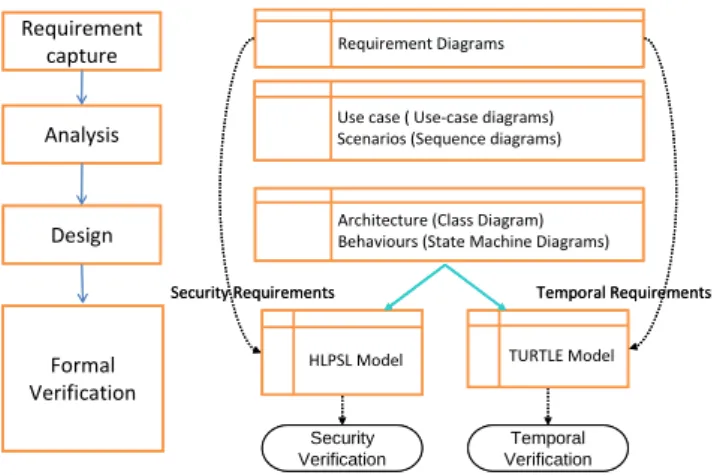
The OMG-based UML does not provide any diagram to capture requirements. The method depicted by Figure 1 imports SysML requirement diagrams. In SysML, requirements remain informal, which hampers formal checking of design models against user or system requirements. The solution proposed for SGC design is to include logic formulas and chronograms into requirement diagrams in order to formalize security and temporal requirements, respectively.
Use-case driven analysis enables to specify the system by its boundary, the set of actors it interacts with, and the function or services it is expected to provide. Use-cases are documented by scenarios expressed in terms of sequence diagrams. Analysis diagrams contain annotations that contribute to achieve security and temporal requirement traceability.
Object-oriented design enables to model the system’s architecture. An active class has a behaviour described by a state-machine which contains security and real-time information. The UML model gives sufficient information to derive HLPSL and TURTLE codes, and therefore to cater the AVISPA and TTool, respectively.
Requirement
capture Requirement Diagrams
Analysis Use case ( Use‐case diagrams)Scenarios (Sequence diagrams)
Architecture (Class Diagram) Behaviours (State Machine Diagrams) Design Formal Verification TURTLE Model HLPSL Model Security Verification Temporal Verification Security Requirements Temporal Requirements Requirement
capture Requirement Diagrams
Analysis Use case ( Use‐case diagrams)Scenarios (Sequence diagrams)
Architecture (Class Diagram) Behaviours (State Machine Diagrams) Design Formal Verification TURTLE Model HLPSL Model Security Verification Temporal Verification Security Requirements Temporal Requirements
Figure 1. A UML method including formal verification
B. Security-oriented verification with AVISPA
The AVISPA [1] tool checks Internet security-sensitive protocols against security flaws. AVISPA accepts a problem specification and a property specification. Both are expressed in HLPSL, which describes each participant by a basic role and composes roles to represent scenarios. A HLPSL specification is converted to an intermediate form that is accepted by all back-ends of AVISPA. The Constraint-Logic-based Attack Searcher (CL-AtSe) backend verifies security properties, such as secrecy, authentication, fairness, and non-repudiation. Security properties may be expressed as linear logical formulas or algebraic properties. Rewriting and constraint solving techniques enable attack detection.
C. Temporal verification with TTool
TURTLE belongs to the family of real-time UML profiles that bridge the gap between the UML and formal methods worlds. The TURTLE toolkit offers a user-friendly interface to formal verification tools and supports a verification-centric method for distributed real-time system design. Formal code generators for Real-Time LOTOS (RTL), Construction and Analysis of Distributed Processes (CADP) and UPPAAL allow one to access verification techniques such as timed
reachability analysis, transition system minimization and model checking of logic formulas. A Java code generator enables rapid prototyping of systems whose model includes component and deployment diagrams in addition to the requirement capture, analysis and design ones.
III. PATTERNS FOR SGCS
The benefits of using patterns have regularly been acknowledged in the literature. This section introduces patterns dedicated to a broad variety of SGCs, including situations where groups are hierarchically organized. The patterns nevertheless focus on two major functions: security algorithms that use keys and group management.
A. Requirement capture pattern
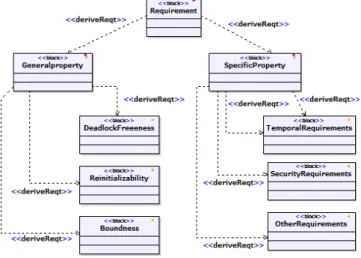
The requirement diagram pattern depicted by Figure 2 categorizes requirements in two groups (see the two <<deriveReqt>> links in the upper part of the figure). The term “general properties” denotes a set of properties that almost of systems should satisfy. Other properties are specific to the studied system. Figure 2 focuses on security and temporal requirements. For space reasons, blocks whose name ends with an “s” (e.g. SecurityRequiments) are not refined.
Figure 2. Requirement diagram pattern
B. Analysis pattern
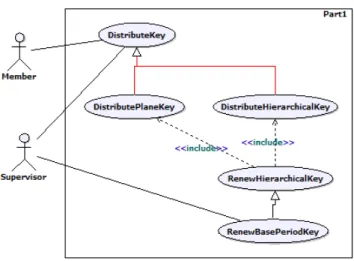
SGCs commonly use security keys. The pattern in Figure 3 identifies key creation, distribution and renewal services.
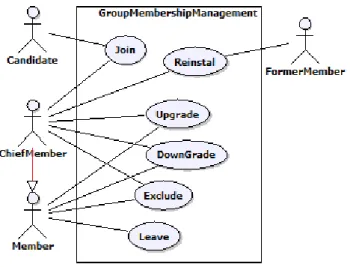
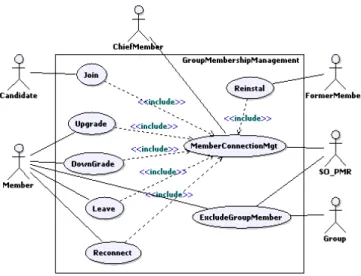
SGCs also manage groups. The pattern in Figure 4 presents services that allow one person to join a group (Join), to leave a group upon request (Leave), to leave a group after an exclusion (Exclude), and to reenter the group (Reinstal).
When the group is hierarchically organized, one member moves up and down in the hierarchy using the Upgrade and Downgrade services, respectively.
Figure 3. Analysis pattern for key management
Figure 4. Pattern for group management
C. Design pattern
It is common practice in protocol design to define a 3-layer architecture where the protocol entities in the central layer rely on some pre-existing communication service to render in turn a value-added service to their upper users. The pattern in Figure 5 extends that principle to SGCs and splits the protocol layer into two sub-layers. GMM and GCKM respectively implement group management and group communication functions.
IV. SAFECAST SYSTEM MODELLING
A. The SAFECAST systemThe secured group communication protocol designed in the framework of SAFECAST project manages hierarchically organized group of policemen, firemen and military men that work together on the same operation theatre. Each group member owns a mobile phone, and talks to others using the PMR
technology (Private Mobile Radio). The protocol secures communication and manages newly created groups of Humans in a way that preserves the original hierarchies of the original groups of policemen, firemen and military men. The groups are not only hierarchical but also dynamic, since receivers may join or leave groups at any time. Last but not least, security requirements may not be dissociated from temporal ones.
B. Security and temporal requirements
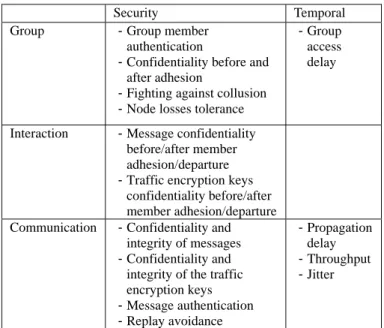
Security requirements essentially address integrity and confidentiality issues (Table 1). On the other hand, temporal requirements mainly relate to maximum response delays.
Security Temporal
Group - Group member
authentication
- Confidentiality before and after adhesion
- Fighting against collusion - Node losses tolerance
- Group access delay
Interaction - Message confidentiality before/after member adhesion/departure - Traffic encryption keys
confidentiality before/after member adhesion/departure Communication - Confidentiality and
integrity of messages - Confidentiality and
integrity of the traffic encryption keys - Message authentication - Replay avoidance - Propagation delay - Throughput - Jitter
C. Key management services
The use-case diagram in Figure 6 identifies several functions that achieve communication key renewal. RenewHierarchicalKey applies to a group whose members are hierarchically linked. The use-case includes two use-cases named
DistributeHierarchicalKey (DHK) and DistributePlaneKey (DPK). DHK allows
one chief to send his/her key to one group member that is responsible for his/her hierarchical level. DPK allows each responsible member to send a session key to all members belonging to its hierarchical level. DHK and DPK both use
DistributeKey.
The keys have to be renewed on a regular basis. The diagram in Figure 6 thus contains the RenewBasePeriodKey use-cases.
Figure 6. Security mechanism management services
D. Group management services
The use-case diagram in Figure 7 identifies a set of services that enable changes inside one group.
Join and Leave allow one member to enter and exit a group, respectively. Upgrade and Downgrade services. A member has promotion when he/she
moves from his/her current class i to an upper class j.
Reconnect allows a member who formerly lost connection to connect again.
ExcludeGroupMember manages member exclusion.
Reinstal may be invoked to reinstall a previously excluded member. All services but ExcludeGroupMember use the MemberConnectionMgmt subservice, which manages group member connections and disconnections.
Figure 7. Services for group dynamics
The next section focuses on Upgrade, a service for which we identified security flaws and temporal violations.
V. UPGRADE
SERVICE
A. Overview
The SAFECAST system manages a set of dynamic and hierarchical groups. The group chief is the one who decides which actions may be performed by his/her group members. Moving up in the hierarchy using the Upgrade service is an example of such actions.
B. Requirement capture
The Upgrade service enables a member endowed with responsibilities to leave his/her group (Figure 8) and to be replaced by another member um who occupied a lower position in the hierarchy. The group’s administrator (not necessarily the group’s chief) asks um to move up in the hierarchy.
Figure 8. Use-case diagram
C. Use-case driven analysis
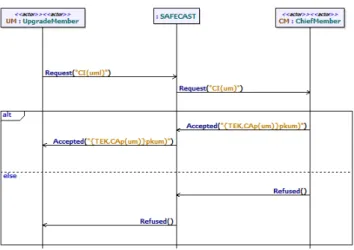
The Upgrade protocol works as follows. Member um issues a move-up request - including his/her Identity Certificate CI - to the chief cm. Depending on the validity of the attributes of um’s Identity certificate, cm decides to accept the
Upgrade request or not. In case of acceptance, um receives the key of the leader’s
class (TEK) and a new group membership certificate (CAp), both encrypted under his or her public key pkum. After successful completion, the Upgrade service brings the upgraded member up to an upper hierarchical level (not necessarily the closest upper level). If the upgrade request is refused, a message informs um, which therefore stays at the same hierarchical level. The sequence diagram in Figure 9 depicts that scenario. For the sake of clarity, only the main attributes of the certificates are represented.
Figure 9. Sequence diagram
D. Design
The design model (Figure 10) of the SAFECAST system relies on the architectural pattern that is depicted by Figure 5.
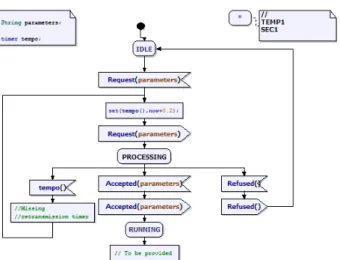
Figure 11. UpgradeMemberCom behaviour
Figure 11 depicts a fragment of the state machine used to implement the Upgrade service. Of particular interest are the tempo primitive and the security requirement starting with secret.
The above state machine is one among the design model elements from which formal code is derived to cater the AVISPA and TURTLE toolkits.
E. Security flaws detection using AVISPA
(1) um cm : SeqNumum, {Hash1}pk-1(um), CI (um) Hash1 is the digest of the message SeqNumum
(2) cm um: SeqNumcm, {TEKj, CAp(um)}pkum, {Hash2}pk-1(cm), CI (um)
Hash2 is the digest of the message SeqNumcm, {TEKj, CAp(um)}pkum
Figure 12. AVISPA code derived from the model
A security flaw was found in the scenario attack described in Figure 12, step (1). It conforms to the “Man in the Middle” paradigm. It results from playing a single session between the um and cm members. The intruder i starts executing the protocol with um. um sends his/her identity certificate. The certificate is divided into an encrypted part and a part in clear. Therefore, the intruder can intercept the message and get the public key of um. Then, the intruder sends the intercepted message to the chief cm who gets the public key pk and uses it to encrypt the
intruder uses the encrypting key to create a message similar to the one awaited by
um. Also, it forces the participant um to take as group key any key not coming
from cm, but composed by the intruder. None of the members is able to directly communicate with the other member, but the intruder is able to decrypt any message sent by any of them. Moreover, the intruder has the ability to become a communication relay between the two members.
The attack was fixed by adding a signature of the message (Figure 12, step (2)), using the private key of cm. Thus, um can authenticate the source of the message and extract the valid class key TEKj. A sequence number is introduced in each
message in order to avoid replay attacks.
AVISPA enabled detection of other non trivial flaws, in particular confidentiality violation. Dealing with reinstallation of a former member, AVISPA demonstrates that an intruder was able to access to information private to the group. The
Reinstallation sub-protocol was fixed in [6].
F. Temporal verification using TURTLE
The reader may ask himself or herself whether the fixed version of the Upgrade protocol verified by AVISPA meets its expected deadlines or not. Formal verification using the TURTLE toolkit enabled comparing two configurations with a low-rate PMR at 6 kb/s with a 3 kms range and an average-rate PMR at 100 kb/s value with a 100 kms range, respectively.
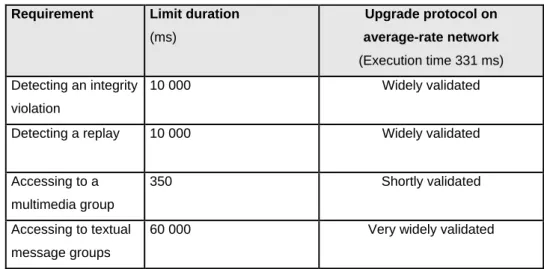
Formal verification identified four temporal requirements met for an average-rate PMR (Table 2), but unmet for a low-rate PMR. A concrete benefit of formal verification using the TURTLE toolkit was to save development time: it was decided to not develop the SAFECAST SGC over a low-rate PMR.
For the middle-rate PMR network, all the services verified using TURTLE meet the requirements of middle-rate PMR network, but the Downgrade and Reinstall services. Duration of 490 ms was computed for the two services, which exceeds the 350 ms limit required for the “accessing to multimedia groups.” In order not to sacrifice the entire security procedure, it was decided to relax the “accessing to multimedia groups” requirement to 500 ms.
Requirement Limit duration (ms) Upgrade protocol on average-rate network (Execution time 331 ms) Detecting an integrity violation 10 000 Widely validated
Detecting a replay 10 000 Widely validated
Accessing to a multimedia group
350 Shortly validated
Accessing to textual message groups
60 000 Very widely validated
Table 2. Temporal requirements and computed time for the Upgrade service
VI. RELATED
WORK
A. Formal automated security verification of group protocols The benefits of applying formal verification to security protocols have first been acknowledged for two- and three-party protocols. Nowadays, group protocols raise much more complex security problems [7] [8] [9] [10] since they involve an unbounded number of participants and consider some complicated security
properties. Significant attacks on such protocols have been found using automated techniques.
Taghdir and Jackson [9] modelled the multicast group key management protocol proposed by Tanaka and Sato [11]. They exhibited several properties not satisfied by the protocol and proposed an “improved” protocol whose model did not include any active attacker. Steel and Bundy [12] identified serious attacks in the so-called “improved” protocol. They used CORAL, a tool also used to discover attacks on the Asokan-Ginzboorg and Iolus [13] protocols.
Work on group protocol verification systematically raises an infinite search space problem since even one legal execution of the protocol requires an unlimited number of steps. Meadows and Syverson [14] extended the NRL protocol analyzer in order to tackle the GDOI's protocols [8].
Several tools primarily designed for attack search have been extended to handle group protocols. Examples include algebraic primitives (e.g. XOR) and the exponentiation often encountered in extensions of key agreement based upon
Diffie-Hellman. CL-AtSe, one of the four back-ends used in AVISPA [1], is an example addressed in this paper.
Tools for protocol falsification (searching for attacks) have been extended to handle group protocols and to cope with additional requirements, such as algebraic primitives and exponentiation (regularly encountered in extensions of Diffie-Hellman-based key agreement). These tools include CL-AtSe. Modular by its extensibility to new classes of protocols or requirements, and powerful by the number of protocol sessions that it can deal with, the tool has been applied to a large number of Internet security protocols.
Other tools extensions are due to the fact that most group protocols include
algebraic properties (xor, exponentiation). To our knowledge, CL-AtSe is the only tool for protocol analysis that simultaneously offers complete unification
algorithms for xor and exponentiation and does not limit either terms or intruder operations.
Apart from algebraic requirements, group protocols guarantee security properties that do not limit to secrecy or authentication properties. Unlike tools that
exclusively verify these two properties, CL-AtSe can verify any state-based security property. Besides secrecy and authentication, it indeed verifies additional properties such as fairness and non-repudiation.
B. Temporal requirements and verification of SGC systems Research papers that identified security flaws in SGC systems mostly address security functions without taking temporal constraints into account. Corin et al. [15] demonstrated that protocols with secret exchanges that had been proven robust and secure by time-independent analysis may be no longer robust as soon as time is explicitly taken into account.
With the exponential growth of wireless networks [16], ad-hoc networks [17] [18] and peer to peer technology, SGC have become an extremely important and active research area. The complexity in these SGC stems from the addition of security and temporal requirement to the dynamic evolution of the groups.
Isis [19] [20], RMP [21], Transis [22], Horus/Ensemble [20] and Totem [23] were the first communication systems developed with distributed group management in mind. They offer programmers a flexible group communication model and group protocols stacks. Auto-configuration was introduced in Renesse et al. [24]. Other
improvements include auto-adaptation, integrated security, real-time and fault-tolerance mechanisms. Bimodal-Multicast (Gossip-based protocols) [19] and Springlass systems (Ensemble follow-up) include new reliability, authentication and delivery services to improve scalability and stability of secure group
communication systems. Evaluation and failure identification were proposed for these approaches, based on formal analysis.
Group communication systems with security services were introduced at the network level by the Enclave project [25] and at the middleware level by the Cactus environment [26]. Another avenue was opened by policy-based systems. For instance, the Antigone system [27] uses policies to address membership capabilities (e.g. control access) and security requirements (e.g. data
confidentiality, integrity and authentication).
Other recently published work simultaneously addresses temporal requirements and security constraints. Spread [23] is a group communication platform which offers an integrated and secure architecture for distributed client-server systems. Group communications are enhanced with security services without sacrificing the robustness and performance of the system. Spread’s layered architecture is based on dedicated servers implementing security services. Almeida [28] proposes a set of group communication protocols to satisfy real-time and dependability requirements, despite of some difficulties introduced by the groups’ dynamicity. Three different Quality of Service properties are guaranteed: timeliness, order and agreement. Gutierrez-Nolasco et al. [29] also explore two adaptability issues - namely security and synchrony of group communications systems (GCS) - to maintain a consistent view of dynamic groups.
C. UML modelling of SGC systems
UML standards and extensions are of great help for proposing methodological approaches that embed temporal and security requirements during the system design processes.
In [30], Jürjens et al. apply a UML profile (UMLsec) to a mobile communication system. The authors use analysis, design and deployment diagrams. The system is verified against security flaws. In the paper, we propose a method centred on requirement capture, analysis and design. The deployment phase is not addressed. We map UML models into their corresponding formal representations for
automated verification using TURTLE and AVISPA. The result is that we check the security and temporal properties of the model correspondingly. This joint use of two formal verification tools enabled eliminating design solutions that passed security tests but did not meet the deadlines.
Like Jürjens et al. [30], Morimoto et al. [31], Abie et al. [32] and Woodside et al. [33] extend UML with security-centric constructs. Morimoto et al. [31] promotes the use of patterns. In practice they detail an “authentication pattern” and its translation to Z, a formal language which enables formal verification. The patterns proposed in this paper are more general and take group management functions into account.
Woodside et al. [33] discusses performances issues and therefore opens a new avenue for security modelling in UML. To evaluate performance and scalability, the SAFECAST project used an approach based on simulation with the NS1 tool.
VII. CONCLUSIONS
Secure group communication systems capture complex design problems in terms of group management, security flaws and temporal violations detection. Some SGC, in particular the SAFECAST system discussed in the paper, further manage hierarchically organized groups. The design of such systems therefore deserves research investigations in rigorous development methodologies based on modelling techniques and formal verification tools.
The paper proposes a UML method which covers the requirement capture, analysis and design steps of the design trajectory of SGCs. The requirement, analysis and design steps use an annotated UML to take security and temporal requirements into account. Formal codes amenable to the AVISPA and TURTLE toolkits are derived from the design models in UML. They enable early checking of design models against security and temporal requirements. AVISPA and TURTLE remain separate and so each tool explores the system’s state space separately. Work has still to be done for discovering problems where security and timing cannot be verified in sequence but in parallel.
The proposed method was applied to the SAFECAST system. The latter was checked against security flaws and temporal requirements. Several security flaws were detected with AVISPA. The problems have been fixed and the group
communication protocol is now more secure. On the other hand, the system was investigated with two PMR radios, termed as ‘low-rate’ and ‘medium-rate’ PMR radios. The TURTLE toolkit proved that most temporal requirements are satisfied by the version based on the medium-rate PMR. Conversely, the configuration using a low-rate PMR violates important temporal requirements. It was decided to not develop it.
The approach proposed in the paper is not restricted to the SAFECAST SGC. Indeed, we plan to apply our approach to validate the applicability of others communication architectures, such as an audio-video multicast streaming
application within ad hoc networks. This kind of applications requires a high level of security, in addition to the real-time requirements, to offer the best possible quality of service, within constrained environment.
ACKNOWLEDGEMENTS
Support from the Réseau National de la Recherche en Télécommunications (RNRT) is greatly acknowledged. The authors are grateful to all the partners of SAFECAST project. AVISPA has been developed by LORIA. The TURTLE profile has been partly developed by LAAS-CNRS, ISAE and Telecom-Paris. The TURTLE toolkit (TTool) has been developed by Ludovic Apvrille.
REFERENCES
[1] A. Armando, D. Basin, Y. Boichut, Y. Chevalier, L. Compagna, J. Cuellar, P. Hankes Drielsma, P. C. Héam, O. Kouchnarenko, J. Mantovani, S. Mödersheim, D. Von Oheimb, M. Rusinowitch, J. Santos Santiago, L. Vigano, M. Turuani, L. Vigneron, The AVISPA Tool for the Automated Validation of Internet Security Protocols and Applications. In Proceedings of 17th International Conference on Computer Aided Verification (CAV'05). Springer-Verlag (LNCS 3576). Edinburgh, Scotland, 281-285, July 2005.
[2] L. Apvrille, J.-P. Courtiat, C. Lohr, P. de Saqui-Sannes, “TURTLE: A Real-Time UML Profile Supported by a Formal Validation Toolkit, ” IEEE Trans. on Software Engineering, Vol. 30, No. 7, 473-487, July 2004.
[3] D. Dolev and A.C. Yao. On the Security of Public-Key Protocols. IEEE Transactions on Information Theory, 29(2):198-208, 1983.
[4] http://labsoc.comelec.enst.fr/turtle/ttool.html, 2009.
[5] S. Mota, Protocol Modeling and Verification for Secured Group Communications, Ph; D thesis, University of Toulouse, 2008 (in French).
[6] M.S. Bouassida, I. Chrisment, O. Festor, Group Key Management in MANETs. International Journal of Network Security IJNS. Vol. 6, N°1, 67-79, January 2008.
[7] M.Steiner, G. Tsudik, M. Waidner, CLIQUES: A new approach to group key agreement. In Proceedings of the 18th IEEE International Conference on Distributed Computing System, Amsterdam, 380-387, May 1998.
[8] C. Meadows, Extending formal cryptographic protocol analysis techniques for group protocols and low-level cryptographic primitives. In Proceedings of the First Workshop on Issues in the Theory of Security. Degano P., Geneva, Switzerland, 87-92, July 2000.
[9] M. Taghdir, D. Jackson, A Lightweight Formal Analysis of a Multicast Key Management Scheme. In Proceedings of 23rdIFIP International Conference on Formal Techniques for
Networked and Distributed SystemsFORTE’03, 240-256, Oct. 2003.
[10] G. Steel, A. Bundy, M. Maidl, Attacking a Protocol for Group Key Agreement by Refuting Incorrect Inductive Conjectures. In Proceedings of the International Joint Conference on Automated Reasoning. Springer-Verlag (LNAI 3097), 137-151, 2004.
[11] S. Tanaka, F. Sato, A Key Distribution and Rekeying Framework with Totally Ordered Multicast Protocols. In Proceedings of 15th IEEE International Conference on Information Networking ICOIN’01, 831-838, Feb. 2001.
[12] G. Steel, A. Bundy, Attacking Group Multicast Key Management Protocols using CORAL. In Proceedings of the ARSPA Workshop. ENTCS, Vol. 125, N° 1, 125-144, Mars 2004. [13] S. Mittra, Iolus: A Framework for Scalable Secure Multicasting, In Proceedings of ACM SIGCOMM’97, 277-288, Sept. 1997.
[14] C. Meadows, P. Syverson, Formalizing GDOI group key management requirements in NPATRL. In Proceedings of the 8th ACM conference on Computer and Communications Security, 235-244, Nov. 2001.
[15] R. Corin, S. Etalle, P.H. Hartel, A. Mader, ADER, Timed Analysis of Security Protocols. In Proceedings of ACM workshop on Formal methods in security engineering, Washington DC, USA, 26-32, Oct. 2004.
[16] T. Chick, J.C.M. Teo, Energy-efficient ID-based group key agreement protocols for wireless networks. In Proceedings of 20thParallel and Distributed Processing Symposium, Apr. 2006.
[17] B. Wu, J. Wu, B. Fernandez, M. Ilyas, S. Magliveras, Secure and efficient key
management in mobile ad hoc networks. Journal of Network and Computer Applications, Vol. 30, No 3, 937-954; Aug; 2007.
[18] M. Bohio, A. Miri, Authenticated secure communications in mobile ad hoc networks, In Proceedings of IEEE Conference on Electrical and Computer Engineering. Vol. 3, 1689-1692, May 2004.
[19] K.P. Birman, M. Hayden, O. Ozkazap, Z. Xiao, M. Bidiu, Y. Minsky, Bimodal Multicat. ACM Transactions on Computer Systems. Vol. 17, N°2, 41-88, May 1999.
[20] K.P. Birman., M. Hayden., J. Hickey, C. Kreitz, R. van Renesse, O. Rodeh, W. Vogels, The Horus and Ensemble projects: accomplishments and limitations. Information Survivability Conference and Exposition DISCEX '00.Vol.1, 149-161, Jan. 2000.
[21] B. Whetten, S. Kaplan, T. Montgomery, A High Performance Totally Ordered Multicast Protocol. In Proceedings of the Workshop on Theory and Practice in Distributed Systems, 1994. [22] Y. Amir, D. Dolev, S. Kramer, D. Malki, Transis: A Communication Sub-System for High Availability. In Proceedings of 22nd Annual International Symposium on FaultTolerant Computing, 76-84, July 1992.
[23] Y. Amir, L.E. Moser, P.M. Melliar-Smith, D. A. Agarwal, P. Ciarfella, The Totem Single-Ring Ordering and Membership Protocol. ACM Transactions on Computer Systems, Vol. 13, N°4, 311-342, Nov. 1995.
[24] R. van Renesse, K. P. Birman, S. Maffeis, HORUS: A flexible Group Communication System. Communications of the ACM; Vol. 39, No 4, 76-83, Apr. 1996.
[25] L. Gong, Enclaves: Enabling Secure Collaboration over the Internet. IEEE Transactions on Selected Areas in Communications, Vol. 15, no. 3, 567-575, Apr. 1997.
[26] M.A. Hiltunen, R.D. Schlichting, Adaptative Distributed and Fault-Tolerant Systems. Computer Systems Science and Eng., Vol. 11, No. 5, 125-133, 1996.
[27] J. Irrer, A. Prakash, P. McDaniel, Antigone: Policy-based Secure Group Communication System and AMirD: Antigone-based Secure File Mirroring System. In Proceedings of the DARPA Information Survivability Conference and Exposition DISCEX, 44-46, Apr. 2003.
[28] C. Almeida, Handling QoS in a Dynamic Real-Time Environment. In Proceedings of the 8th IEEE International Workshop on Object-Oriented Real-Time Dependable Systems, 217-224, Jan. 2004.
[29] S. Gutierrez-Nolasco, M. Stehr, C. Talcott, N. Venkata, Exploring Adaptability of Secure Group Communication using Formal Prototyping Techniques. In Proceedings of 3rd Workshop on Adaptative and Reflective Middleware, Toronto, Canada, Oct. 2004.
[30] J. Jürjens, J. Schreck, P. Bartmann, Model-based Security Analysis for Mobile Communications, 30th International Conference on Software Engineering (ICSE’08), leipzig, Germany, May 2008.
[31] S. Morimoto, J. Cheng, Pattern Protection Profiles by UML for Security Specifications, International Conference on Computational Intelligence for Modelling Control and Automation (CIMCA-IAWTIC’05), Vienna, Austria, November 2005.
[32] H. Abie, D.B. Aredo, T. Kristoffersen, S. Mazaber, T. Raguin, Integrating a Security requirement Language with UML, 7th International Conference on the Unified Modeling Language (UML 2004), Lisbon, Portugal, LNCCS 3273, pp. 350-364, 2005.
[33] M. Woodside et al., Performance analysis of security aspects by weaving scenarios extracted from UML models, Journal of Systems and Software, Volume 82, Issue 1, January 2009, pp. 56-74.