ÉCOLE DE TECHNOLOGIE SUPÉRIEURE UNIVERSITÉ DU QUÉBEC
THESIS PRESENTED TO
ÉCOLE DE TECHNOLOGIE SUPÉRIEURE
IN PARTIAL FULFILLMENT OF THE REQUIREMENTS FOR
A MASTER’S DEGREE WITH THESIS IN CONSTRUCTION ENGINEERING M. A. Sc.
BY
Ali ALAGHBANDRAD
BIM MATURITY ASSESSMENT AND CERTIFICATION IN CONSTRUCTION PROJECT TEAM SELECTION
MONTREAL, OCTOBER 8, 2015 © Copyright, Ali Alaghbandrad, 2015, All rights reserved
© Copyright
Reproduction, saving or sharing of the content of this document, in whole or in part, is prohibited. A reader who wishes to print this document or save it on any medium must first obtain the author’s permission.
THIS THESIS HAS BEEN EVALUATED BY THE FOLLOWING BOARD OF EXAMINERS
Mr. Daniel Forgues, Thesis Supervisor
Department of Construction Engineering, École de technologie supérieure
Mr. Alain April, Thesis Co-supervisor
Department of Software Engineering and Information Technology, École de technologie supérieure
Mr. Louis Rivest, Chair, Board of Examiners
Department of Automated Manufacturing Engineering, École de technologie supérieure
Mrs. Danielle Monfet, Member of the jury
Department of Construction Engineering, École de technologie supérieure
THIS THESIS WAS PRESENTED AND DEFENDED
IN THE PRESENCE OF A BOARD OF EXAMINERS AND THE PUBLIC SEPTEMBER 8, 2015
ACKNOWLEDGMENTS
I would like to acknowledge my supervisor, Dr. Daniel Forgues and co-supervisor, Dr. Alain April for their kind help in this research. I am also grateful to Dr. Alan Redmond for his kind help in this research.
ÉVALUATION ET CERTIFICATION DE LA MATURITÉ BIM LORS DE LA SÉLECTION DE L’ÉQUIPE D’UN PROJET DE CONSTRUCTION
Ali ALAGHBANDRAD
RÉSUMÉ
Afin de mettre en œuvre, avec succès, l’approche BIM dans un projet de construction, tous les participants du projet, en tant qu’utilisateurs du BIM, doivent posséder un minimum de capacités BIM. Avant le début d’un projet, l’évaluation des capacités BIM des intervenants de projet est une préoccupation majeure pour les clients de construction. Les clients du domaine de la construction n’ont actuellement aucun mécanisme afin de s’assurer que les participants clés qu’ils veulent engager, pour un projet de construction, possèdent les capacités (c.-à-d. les qualifications) minimales afin de participer pleinement à la conception et la livraison d’un projet de construction qui utilise une approche BIM. L’importante variabilité de la maîtrise du BIM peut causer des coûts additionnels aux clients ainsi que nuire aux membres les plus matures du projet. Donc, les clients du domaine de la construction ont besoin de s’assurer d’un minimum de maturité BIM, préalablement à la sélection de leurs fournisseurs. Les différentes propositions de modèles de maturité BIM actuels tentent d’évaluer la maturité BIM des firmes, mais ne se concentrent pas sur l’utilisation BIM. Les cas d’utilisation spécifiques de BIM sont au centre des bénéfices escomptés du BIM. Ce projet de recherche propose donc un nouveau modèle de maturité BIM qui se concentre sur les capacités des firmes en utilisation spécifiques de BIM. La méthodologie de recherche est basée sur une révision détaillée de la littérature et plusieures discussions avec des groupes d’experts. À L’aide de la revue de littérature, les chercheurs ont concu un premier modèle de maturité. Par la suite, des experts BIM ont discuté des améliorations possibles aux pratiques décrivant les utilisations spécifiques du BIM. Il est attendu que par l’utilisation de ce modèle, les clients de construction pourront obtenir plus d’avantages du BIM à travers la sélection de fournisseurs qualifiés.
Mots-clés : modélisation de l'information du batiment (BIM), modèle de maturité BIM, construction, certification BIM
BIM MATURITY ASSESSMENT AND CERTIFICATION IN CONSTRUCTION PROJECT TEAM SELECTION
Ali ALAGHBANDRAD
ABSTRACT
To implement BIM in a construction project successfully, all the project participants, as BIM users, must have minimum BIM capabilities. Before any project starts, assessing the BIM capabilities of project stakeholders is a concern for construction clients. The main problem however is that they have no mechanism to ensure that the key participants they hire for a BIM project have the minimum capabilities (BIM infrastructure, processes and qualified resources) to participate in the design and delivery of a BIM project. The high variability of a firms’ readiness to work with BIM may impose a high cost for the client and the most mature members of the supply chain. Therefore, construction clients need a way to ensure a minimum BIM maturity, such as a maturity audit to assess the BIM competency of potential project team members. From a client’s perspective, “minimum BIM qualification” means “minimum capability to use BIM”. The current BIM maturity models try to assess the BIM capability level of firms, but do not focus on BIM Uses. This research proposes a maturity model that focuses on the capability of firms for specific BIM Uses, while measuring their general BIM competencies. The research methodology is based on a review of literature and focus group discussions. Through literature review, the researchers proposed a BIM uses maturity model. Then, BIM experts discussed possible improvements. After an analysis of the discussion, the author proposed the resulting model. It is expected that by using this model, construction clients may achieve more BIM benefits through the selection of BIM qualified project team members, i.e. reduced cost, time, and increased quality of project. Keywords: building information modeling (BIM), BIM maturity model, construction, BIM certification
TABLE OF CONTENTS
Page
INTRODUCTION ...21
CHAPTER 1 BUILDING INFORMATION MODELING (BIM) ...25
1.1 Current Practice in the Construction Industry ...25
1.2 Definition of BIM ...25
1.3 BIM Uses ...28
1.4 BIM impacts and Benefits ...31
CHAPTER 2 BIM CAPABILITY ASSESSMENT ...33
2.1 Concept of a Maturity Model ...33
2.2 BIM Maturity Assessment for Project Team Selection ...41
2.2.1 BIM Quick Scan tool ... 41
2.2.2 BIM Qualifications and Proposal Scoring Matrix ... 42
2.2.3 IU BIM Proficiency Matrix ... 43
2.3 BIM Maturity Assessment for Minimum BIM Certification ...45
2.4 BIM Maturity Assessment for Performance Measurement And Improvement ...48
2.4.1 BIM Maturity Matrix (BIm³) ... 48
2.4.2 Organizational BIM Assessment Profile ... 51
2.5 Analysis of Contributions to This Study ...53
CHAPTER 3 METHODOLOGY ...59
3.1 Research Methodology ...59
3.2 Proposed Model Development Activities ...62
3.3 Model Validation ...64
3.4 Conclusion ...65
CHAPTER 4 PROPOSED BIM USES MATURITY MODEL (BIMUMM) FOR INDEPENDENT CERTIFICATION ...67
4.1 Proposed Perspective ...67
4.2 Proposed Architecture ...69
4.2.1 BIM Domains ... 69
4.2.2 Key Process Areas (KPAs) ... 71
4.2.3 Roadmaps and Practices ... 72
4.3 Proposed Maturity Scale ...73
4.4 Proposed Evaluation Process ...74
4.5 Conclusion ...76
CHAPTER 5 BIM PROCESSES DOMAIN ...79
5.1 Design Authoring KPA ...80
5.1.1.1 ‘Design Authoring’ Process Map Capability in
Maturity Level 1 ... 82
5.1.1.2 ‘Design Authoring’ Process Map Capability in Maturity Level 2 ... 83
5.1.2 Model Content ... 83
5.1.2.1 Model Content’ Capability in Maturity Level 1 ... 85
5.1.2.2 ‘Model Content’ Capability in Maturity Level 2 ... 85
5.1.3 ‘Design Authoring’ Required Resources... 86
5.1.3.1 ‘Design Authoring’ Resources in Maturity Level 1 ... 87
5.1.3.2 ‘Design Authoring’ Resources in Maturity Level 2 ... 87
5.2 3D Coordination KPA ...88
5.2.1 Detailed Process Map of ‘3D Coordination’ ... 90
5.2.1.1 ‘3D Coordination’ Process Map Capability for Maturity Level 1 ... 90
5.2.1.2 ‘3D Coordination’ Process Map Capability for Maturity Level 2 ... 91
5.2.2 Defining ‘3D Coordination’ Information Requirements ... 91
5.2.2.1 ‘3D Coordination’ Information Requirements Capability in Maturity Level 1 ... 92
5.2.2.2 ‘3D Coordination’ Information Requirements Capability in Maturity Level 2 ... 92
5.2.3 Performing Collision Detection and Solving Collision Problems ... 92
5.2.3.1 Clash detection and solving capability in Maturity level 1 ... 94
5.2.3.2 Clash detection and solving capability in Maturity level 2 ... 94
5.3 Design Reviews KPA ...95
5.3.1 Detailed Process Map of ‘Design Review’ ... 96
5.3.1.1 ‘Design Review’ Process Map Capability for Maturity Level 1 ... 96
5.3.1.2 ‘Design Review’ Process Map Capability for Maturity Level 2 ... 97
5.3.2 Virtual Model Review ... 97
5.3.2.1 Virtual Model Review Capability in Maturity Level 1 .. 97
5.3.2.2 Virtual Model Review Capability in Maturity Level 2 .. 98
5.3.3 Constructability review ... 98
5.3.3.1 Constructability Review Capability in Maturity Level 1 ... 98
5.3.3.2 Constructability Review Capability in Maturity Level 2 ... 99
5.3.4 Operation and Maintenance (O&M) Review ... 99
5.3.4.1 Operation and Management (O&M) Review Capability in Maturity Level 1 ... 99
5.3.4.2 Operation and Management (O&M) Review Capability in Maturity Level 2 ... 100
5.4 BIM Project Management KPA ...100
5.4.1 BIM project execution planning ... 101
5.4.1.1 BIM Project Management in Maturity Level 1 ... 102
5.4.1.2 BIM Project Execution Planning Capability in Maturity Level 2 ... 102
5.4.2 BIM collaboration ... 103
5.4.2.1 BIM Collaboration Capability in Maturity Level 1 ... 104
5.4.2.2 BIM Collaboration Capability in Maturity Level 2 ... 105
5.4.3 BIM quality control ... 105
5.4.3.1 Quality Control Capability in Maturity Level 1 ... 106
5.4.3.2 Quality Control Capability in Maturity Level 2 ... 106
5.5 Conclusion ...107
CHAPTER 6 BIM RESOURCES DOMAIN ...109
6.1 Infrastructure KPA ...109
6.1.1 Software ... 110
6.1.1.1 Software Capability in Maturity Level 1 ... 111
6.1.1.2 Software Capability in Maturity Level 2 ... 111
6.1.1.3 Software Interoperability Capability in Maturity Level 2 ... 112
6.1.2 Hardware ... 112
6.1.2.1 Hardware Capability in Maturity Level 1 ... 112
6.1.2.2 Hardware Capability in Maturity Level 2 ... 113
6.1.2.3 BIM Infrastructure Upgrade Capability in Maturity Level 2 ... 113
6.1.3 Network ... 114
6.1.3.1 Network Capability in Maturity Level 1 ... 114
6.1.3.2 Network Capability in Maturity Level 2 ... 114
6.2 Human Resources KPA ...115
6.2.1 Organization roles and staffing ... 116
6.2.1.1 Roles and Staffing Capability in Maturity Level 1 ... 116
6.2.1.2 Roles and Staffing Capability in Maturity Level 2 ... 117
6.2.2 BIM expertise, educational and training programs ... 117
6.2.2.1 BIM Expertise, Educational and Training Capability in Maturity Level 1 ... 118
6.2.2.2 BIM Expertise, Educational and Training Capability in Maturity Level 2 ... 119
6.3 Conclusion ...119
CHAPTER 7 MODEL VALIDATION ...121
7.1 BIMUMM Focus Group Validation ...121
7.2 Validation Results ...122
7.3 Conclusion ...125
APPENDIX I Level of Development in alignment with AIA – Exhibit 202
Document ...129
APPENDIX II BIM Manager roles and responsibilities...134
APPENDIX III System requirements for Autodesk Revit 2015 products ...137
APPENDIX IV The roles in a BIM team ...143
APPENDIX V Project owner’s questions about BIM qualifications of project ...145
APPENDIX VI BIMUMM v.0 presented in focus group ...146
APPENDIX VII Glossary ...152
LIST OF TABLES
Page
Table 2.1 Purposes of BIM Maturity Models ... 38
Table 2.2 BIM Maturity Models evaluation according to the four criteria ... 56
Table 3.1 Research Methodological approach ... 60
Table 5.1 Design Authoring Roadmaps ... 80
Table 5.2 3D Coordination Roadmaps ... 88
Table 5.3 Design Reviews Roadmaps... 95
Table 5.4 BIM project management Roadmaps ... 100
Table 6.1 Infrastructure Roadmaps ... 109
Table 6.2 Human resources Roadmaps ... 115
Table 7.1 Focus group participant information ... 121
LIST OF FIGURES
Page
Figure 1.1 BIM as a process and a tool ... 27
Figure 1.2 An example of parametric modeling-Exterior curtain wall ... 28
Figure 1.3 BIM Uses throughout a building lifecycle ... 29
Figure 1.4 BIM activities... 30
Figure 2.1 Quality Management Maturity Grid ... 34
Figure 2.2 Bew-Richards BIM maturity map ... 36
Figure 2.3 Importance of BIM capability for project team selection ... 37
Figure 2.4 Comparison of BIM Maturity Models ... 39
Figure 2.5 BIM Qualifications Scoring Matrix ... 42
Figure 2.6 BIM Proposal Scoring Matrix ... 43
Figure 2.7 Indiana University BIM Proficiency Matrix ... 45
Figure 2.8 NBIMS CMM Chart ... 46
Figure 2.9 Interactive NBIMS CMM ... 47
Figure 2.10 BIM capability and maturity assessment and reporting workflow diagram–v2.0 ... 49
Figure 2.11 The BIM planning elements ... 52
Figure 2.12 Organizational BIM Assessment Profile ... 54
Figure 3.1 BIM Uses Maturity Model (BIMUMM) development steps ... 62
Figure 3.2 BIMUMM validation process ... 65
Figure 4.1 Proposed BIM Uses Maturity Model (BIMUMM) architecture overview ... 69
Figure 4.2 A detailed view of proposed architecture of the BIM Uses Maturity Model (BIMUMM) ... 70
Figure 4.3 Selected BIM Uses for BIMUMM ... 71
Figure 4.4 BIM Maturity Levels ... 74
Figure 4.5 Sample hypothetical BIMUMM assessment ... 75
Figure 5.1 BIM Logic of numbering practices ... 80
Figure 5.3 Clash and interference management in Autodesk Navisworks Manage ... 93 Figure 5.4 BIM beneficiaries of a project ... 104 Figure 5.5 An overview for KPAs, Roadmaps, and Practices of BIM domain of
‘Processes’ ... 108 Figure 6.1 An overview for KPAs, Roadmaps, and Practices of BIM domain of
LIST OF ABBREVIATIONS
3D 3 Dimensions
4D 4 Dimensions
AEC Architectural, Engineering, Construction AIA American Institute of Architects
BIM Building Information Modeling
BIMUMM Building Information Modeling Uses Maturity Model CAD Computer Aided Design
CIC Computer Integrated Construction CMM Capability Maturity Model CMMI Capability Maturity Model Integration
COBie Construction-Operations Building information exchange CPU Central Processing Unit
DDC Department of Design and Construction
FM Facility Management
QMMG Quality Management Maturity Grid
ICT Information and Communication Technology IFC Industry Foundation Class
IPD Integrated Project Delivery
ISO International Organization for Standardization
IU Indiana University
KPA Key Process Area
LOD Level Of Detail/Level Of Development MEB Model Element Breakdown
MEP Mechanical, Electrical, and Plumbing O&M Operation and Maintenance
PC Personal Computer
PLM Product Lifecycle Management
NBIMS National Building Information Model Standard NIBS National Institute of Building Sciences
RFQ Request For Qualification
RFP Request For Proposal
RFI Request For Information
ROI Return On Investment
INTRODUCTION
The construction industry has been facing many problems and barriers in the past two decades, such as cost overruns, time delays, prolonged contractual claims (Liberda et al., 2003), disputes (Musonda, 2011), and labor productivity decline (Teicholz, 2004), leading to low performance and productivity. In addition, characteristics of construction industry, such as the project-oriented nature and the uniqueness of every project (Wegelius-Lehtonen, 2001), multi-disciplinary, cross-organizational, the organizational change of Architectural, Engineering, and Construction (AEC) project teams (Liston, 2009), and fragmented supply chains (Cox and Ireland, 2002), increases the complexity of working on large construction initiatives. To improve productivity of the construction industry, different solutions such as digital construction are emphasized. Digital construction aims to address the growing fragmentation problems and improve productivity by using technologies such as BIM for integrating processes throughout the entire lifecycle of a construction project. BIM proposes a consistent digital information platform to be used by the stakeholders throughout the lifecycle of the project. To date, many construction projects have reported benefits from the use of BIM technology and BIM is recommended as a remedy for productivity issues (Mihindu and Arayici, 2008). According to McGraw-Hill (2009) the most notable reported BIM benefits to a project, include: reduced conflicts during construction, improved collective understanding of design intent, improved overall project quality, reduced changes during construction, reduced number of RFIs (Requests for Information), and better cost control/predictability.
To implement BIM in a project successfully and fully benefit from its use, all the project members, as users of BIM, should demonstrate minimum BIM capabilities. However, clients have no mechanism to measure the minimum BIM capabilities (BIM infrastructure, processes and qualified resources) of the key suppliers to participate in the design and delivery of the project using BIM technology. The high variability of BIM maturity levels of project members may result in high costs for the client and the most mature members of the supply chain. Therefore, a way to help solve this issue is that project members obtain and
provide a BIM maturity certificate, granted by an independent party, in order to participate in project team selection process.
The research motivation is the lack of a BIM maturity assessment model to evaluate firms in achieving specific BIM Uses, as unique tasks or procedures “on a project which can benefit from the integration of BIM into that process” (CIC, 2011, p. 1). The research question is: • How can the current BIM maturity models evolve to develop a BIM maturity model for
construction project clients to pre-qualify project applicant firms in BIM? To answer the research question, the research objective is defined as follows:
• This research aims to develop a prototype of a BIM use maturity model, which could be used to assess the BIM maturity of construction project applicants, so that the client can verify if the applicant firms of project are pre-qualified in BIM. The assessment process occurs before the project bid and is performed by an independent party.
This thesis includes seven chapters. In chapter 1, the current practice of the construction industry is investigated and BIM is introduced as a solution. Then BIM is defined, different uses of BIM in projects are introduced, and BIM impacts and benefits are explained. In chapter 2, the concept of a maturity model is explained, a brief history of maturity models is provided, BIM maturity model is introduced, different BIM maturity models are reviewed and their contribution to this research in analyzed. In chapter 3, the BIM Uses Maturity Model (BIMUMM) is proposed. The recommended perspective, architecture, maturity scale, and evaluation process of this model is described in this chapter. Chapter 4 explains the research methodology, the research question and objectives are described, the method of model development is discussed, and the model validation is presented. Chapter 5 presents the BIM domain of ‘Processes’. In this domain, BIM maturity practices are presented within four Key Process Areas (KPAs) of ‘Design Authoring’, ‘3D Coordination’, ‘Design Review’, and ‘BIM Project Management’. Chapter 6 includes detailed practices of the BIM resources domain, within the two KPAs of ‘Infrastructure’ and ‘Human Resources’. The proposed BIMUMM validation method and results are explained in chapter 7.
The result of this research contributes to the BIM maturity assessment area for the purpose of project team selection. Maturity assessment of BIM Uses in the proposed model fill the gap of previous BIM maturity models in considering BIM Uses maturity measurement, and establish a new basis for future development in this area. Integration of BIM maturity practices from different resources in the proposed model is another contibution of this research.
CHAPTER 1
BUILDING INFORMATION MODELING (BIM)
In this chapter, the current practice in the construction industry is presented and BIM is introduced as a solution. BIM definition and uses in a construction project, its impact and its benefits is also presented in this chapter.
1.1 Current Practice in the Construction Industry
Labor productivity has declined in the construction industry over last forty years (Teicholz, 2004). Various causes lead to this productivity decline. Uniqueness of projects in the construction industry (Wegelius-Lehtonen, 2001; Teicholz, 2004) make it difficult to take advantages of past « lessons learned » for future projects and to optimize knowledge (Teicholz, 2004). The construction industry is multi-disciplinary, and cross-organizational (Liston, 2009) with a fragmented supply chain (Cox and Ireland, 2002). A lack of integration of design and construction and poor collaboration between team members (Teicholz, 2004) lead to cost overruns, time delays, and contractual claims (Teicholz, 2004; Liberda et al., 2003).
To increase productivity, by overcoming the existing problems in the construction industry and its complex nature, various solutions are proposed. BIM is one of these solutions that brings values to the construction industry and can be a source of potential positive change (Teicholz, 2004).
1.2 Definition of BIM
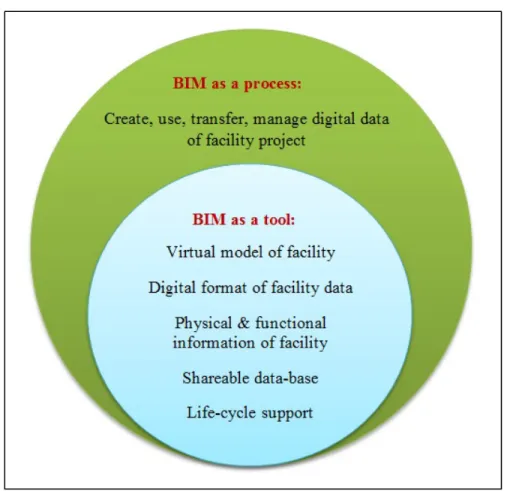
Two perspectives exist to define BIM. One view looks at BIM as a tool for representation of building data. Another perspective considers BIM as a process to develop the model of building (see Figure 1.1).
There are different characteristics attributed to BIM as a tool. In this way, BIM is defined as “a digital representation of physical and functional characteristics of a facility. As such, it serves as a shared knowledge resource for information about a facility forming a reliable basis for decisions during its life cycle from inception onward” (NIBS, 2007). According to Eastman et al. (2011), « with BIM technology, one or more accurate virtual models of a building are constructed digitally. They support design through its phases, allowing better analysis and control than manual processes. When completed, these computer-generated models contain precise geometry and data needed to support the construction, fabrication, and procurement activities through which the building is realized » (p. 1).
Different definitions are presented to describe the Building Information Modeling (BIM) process. For this purpose, BIM is defined as “… a process focused on the development, use and transfer of a digital information model of a building project to improve the design, construction and operations of a project or portfolio of facilities” (CIC, 2011, p. 1) or “…The process of creating and using digital models for design, construction and/or operations of projects” (McGraw-Hill Construction, 2009, p. 4). This process includes “a set of interacting policies, processes and technologies (Succar, 2009) generating a ‘methodology to manage the essential building design and project data in digital format throughout the building's life-cycle’” (Penttila, 2006)” (as cited in Succar, 2010a, p. 66).
Figure 1.1 BIM as a process and a tool
Adapted from NIBS, (2007); McGraw-Hill, (2009); Succar, (2010a), CIC, (2011); Eastman et al., (2011); Staub-French et al., (2011)
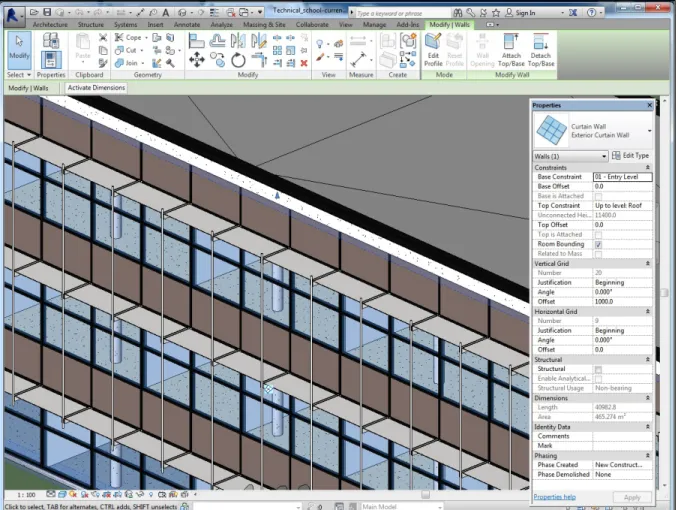
BIM tools enable parametric object-based modeling of a building (refer to Figure 1.2). In BIM, modeling building components are more than just creating their geometric information by line, surface, and volume. More properties can be added to the components. In BIM applications, sets of object classes and families are pre-defined. Modeling is automated in BIM. It means that the object automatically updates when a change happens in the model and affects other object (Eastman et al., 2011). Figure 1.2 demonstrates an exterior curtain wall, which is defined in a parametric table of Autodesk Architecture Revit 2014.
Figure 1.2 An example of parametric modeling-Exterior curtain wall Taken from software of Revit Architecture (2014)
1.3 BIM Uses
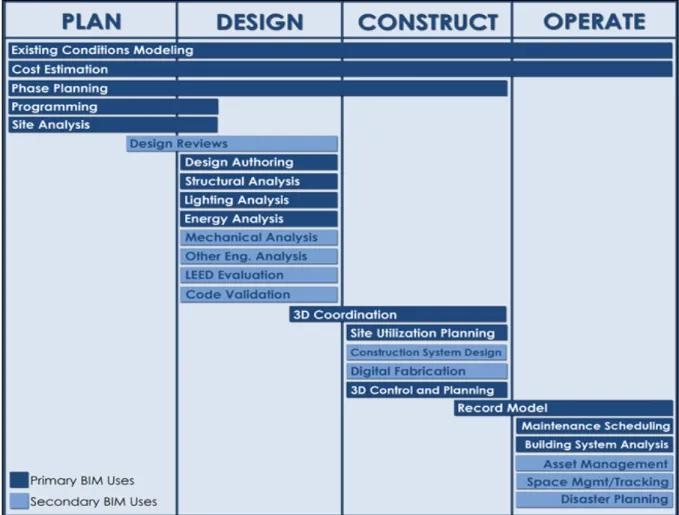
According to CIC (2011), « A BIM Use is a unique task or procedure on a project which can benefit from the integration of BIM into that process » (p. 1). BIM can be used during all phases of the project for various tasks by different project members, such as architects, engineers, contractors, and owners. CIC (2011) identified 25 BIM Uses, within different phases of a project, namely, Planning, Design, Construction, and Operation, as shown in Figure 1.3. Some BIM Uses can be performed in more than one project phase. For example, BIM can be used for cost estimation during the whole lifecycle of a project. Design reviews can be performed in both ‘planning’ and ‘design’ phases of project.
Figure 1.3 BIM Uses throughout a building lifecycle Taken from CIC (2011)
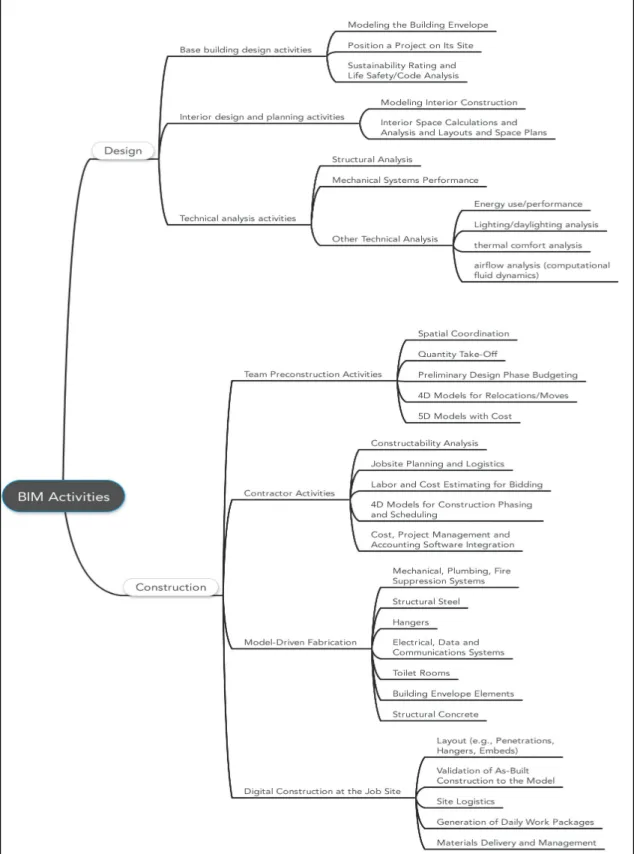
McGraw-Hill Construction (2012) also identified different BIM Uses or BIM activities, as shown in Figure 1.4. Primary BIM uses are considered as the uses with more frequency of use on project, in compare of secondary BIM uses. However, ‘Design Reviews’ must be considered as a primary BIM use, since it is ranked as second most frequent BIM use in the survey of Kreider et al. (2010). BIM activities are categorized within two project phases of ‘design’ and ‘construction’.
Figure 1.4 BIM activities
By reviewing the two above references (McGraw-Hill Construction, 2012; CIC, 2011), it can be understood that BIM can be used in different phases of the project, by different project players. However, depending on each specific BIM use, a level of collaboration among project members for using BIM may be required. For example, as shown in Figure 1.3, ‘3D coordination’ is a BIM use in the design and construction phases. Therefore, the collaboration of the design and the construction teams may be an important factor in the success of ‘3D coordination’ BIM use. One of the critical issues in collaboration of project participants for BIM may be their different BIM maturity levels, which means that low level maturity misuses BIM content. To reduce the collaboration problems in using BIM, a minimum BIM capability maturity level may be required for each project participant.
1.4 BIM impacts and Benefits
Different researchers mentioned the achieved benefits through the use of BIM. According to McGraw-Hill’s “SmartMarket Report on Building Information Modeling: Transforming Design and Construction to Achieve Greater Industry Productivity” (2008), the surveyed companies, who are actively tracking BIM return on investment (ROI), get 300% to 500% initial BIM ROIs on projects using BIM.
McGraw-Hill Construction (2009) identified the BIM benefits that bring most value to a project as follows: “Reduced conflicts during construction, improved collective understanding of design intent, improved overall project quality, reduced changes during construction, reduced number of RFIs (Requests for Information)” and finally “Better cost control/predictability” (p. 22).
The potential benefits of BIM adoption in many projects are (Tocoman, 2008; Takes, 2008; as cited in Mihindu & Arayici, 2008) “… 1) faster and more effective processes, 2) better design, 3) controlled whole life and environmental data, 4) better production quality, 5) automated assembly, 6) better customer service, 7) lifecycle data, 8) integration of planning and implementation processes, 9) more effective and competitive industry”.
Although in literature review, many benefits are observed from using BIM, it is difficult to quantify these benefits. Barlish and Sullivan (2012) found that the most quantifiable benefits are: schedule, change orders, request for information (RFIs), and project or pilot cost. However, there are other benefits, which are not easily quantifiable. For example, it is not easy to quantify quality improvement of a project by using BIM since measuring ‘quality’ can vary from case to case.
Another issue in achieving these benefits is the effect of different factors in the degree to which a BIM value can be reached. For example, the BIM competency or maturity level of firms in using BIM can affect the reached level of BIM benefits.
In the next chapter, the concept of BIM maturity is introduced and several BIM maturity models are reviewed.
CHAPTER 2
BIM CAPABILITY ASSESSMENT 2.1 Concept of a Maturity Model
A “maturity model” can be defined as “… a conceptual framework, with constituent parts, that defines maturity in the area of interest. […] In some cases, […], a maturity model may also describe a process whereby an organization can develop or achieve something desirable, such as a set of Capabilities or practices” (OPM3, 2003, p. 5).
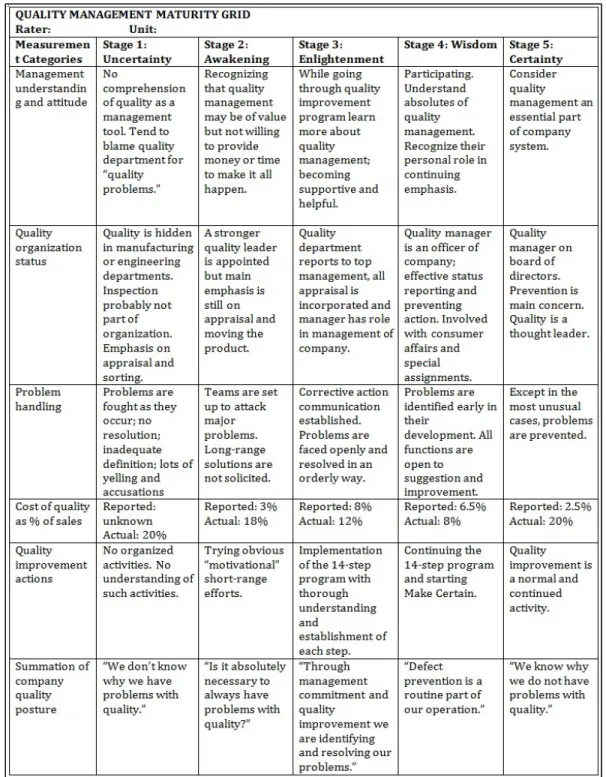
Capability Maturity Models (CMMs) are originally from the field of quality management (Crosby, 1979) and identify a set of standardized process improvement levels to enable implementers in obtaining significant business benefits (Succar, 2010a). The goal of the Quality Management Maturity Grid (QMMG) developed by Crosby (1979) was to enable organizations to understand how mature they are in quality management and was “… valuable in comparing the status of different companies or divisions. It also provides a continual source of direction concerning what needs to be done next” (Crosby, 1979, p. 40). This 5 × 6 maturity grid (Figure 2.1) presents five evolutionary stages of an organization’s maturity in quality management against six quality management categories.
Figure 2.1 Quality Management Maturity Grid Taken from Crosby (1979)
For an evaluation using Crosby’s (1979) maturity grid, a number of people are asked to rate the company based on their subjective judgment about the stage of the company in each of the six measurement categories. A value of 1 to 5 is awarded to each stage respectively from “Uncertainty” to “Certainty”. The total score of organization’s maturity in quality management is calculated by adding all awarded values, which would be a maximum sum of 30 (Crosby, 1979).
The maturity framework of Crosby (1979) was adapted to the Software Engineering industry (Paulk et al., 1993). The Software Engineering Institute (SEI) defined Capability Maturity Models (CMMs), which “… focus on improving processes in an organization. They contain the essential elements of effective processes for one or more disciplines and describe an evolutionary improvement path from ad hoc, immature processes to disciplined, mature processes with improved quality and effectiveness. […] The essential elements of effective processes […] are based on the concepts developed by Crosby, Deming, Juran, and Humphrey” (SEI, 2010b, p. 4). The CMM worked originally “… as a tool to evaluate the ability of government contractors to perform a software project. […] Its successor, the more comprehensive Capability Maturity Model Integration (CMMI), continues to be developed and extended by the Software Engineering Institute, Carnegie Mellon University” (Succar, 2010a, p. 77).
The concept of maturity has also been applied to BIM in the construction industry, because BIM is also defined as a process (see section 1.2), which can include a set of improvement levels.
Bew-Richards’ BIM maturity map (Department of Business, Innovation and Skills (2011) as cited in Barlish and Sullivan, 2012), as shown in Figure 2.2, represents different levels of BIM maturity from level 0 to 3, where Computer Aided Design (CAD) is defined at level 0 (no BIM maturity), and life-cycle management with BIM is defined at the highest level of maturity. Creating 2D and 3D models and BIM collaboration start at level 1 and 2. At level 3, interoperable data exchange and integrated web services exist. Levels 1 to 3 are supported by different standards regarding BIM, which clarify more detail about quality of BIM in each level.
Figure 2.2 Bew-Richards BIM maturity map
Taken from Department of Business, Innovation and Skills (2011) as cited in Barlish and Sullivan, (2012)
Numerous BIM maturity models are developed for different purposes. These purposes can be explained as follows:
1) BIM Maturity Assessment for Project Team Selection:
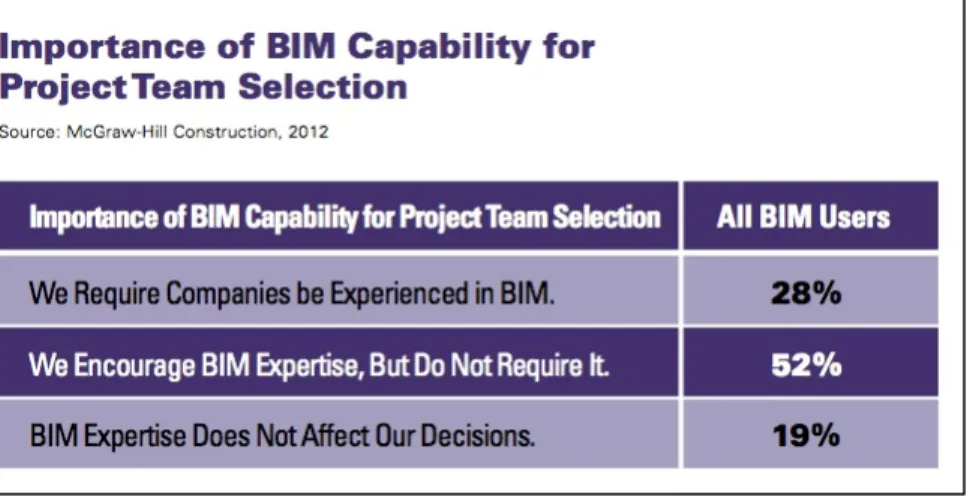
BIM maturity assessment tools can be used in order to evaluate BIM competency of firms for a project team selection. The results of McGraw-Hill Construction (2012) research on North America revealed the importance of BIM capability for project team selection, as shown in Figure 2.3. 80% (28% + 52%) of the respondents (BIM users) consider importance of BIM capability for their project team selection.
Figure 2.3 Importance of BIM capability for project team selection Taken from McGraw-Hill Construction, (2012)
2) BIM Maturity Assessment for Minimum BIM Certification:
The National Building Information Model Standard (NBIMS) (2007; 2012) introduced the concept of using the Capability Maturity Model to define a minimum BIM capability, and looked at what this constitutes. This minimum level is defined as having some characteristics in the associated areas of maturity, and by achieving a certain score in an evaluation.
3) BIM Maturity Assessment for Performance Measurement and Improvement:
Although a BIM maturity assessment tool can work as a measurement tool to evaluate the BIM capability maturity level of firms, its use can also lead to BIM maturity improvements. By knowing the current maturity level, a firm can plan to achieve a target level of BIM maturity (i.e. Organizational Assessment Profile (CIC, 2012)).
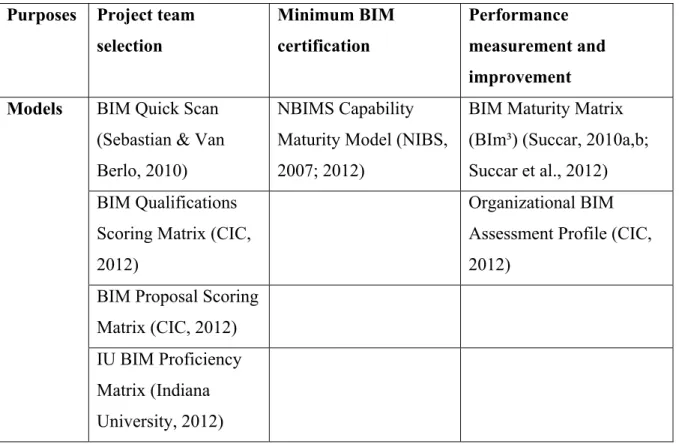
This research investigates several BIM maturity models, which have been developed for different purposes (i.e. Succar, 2010a,b; Succar et al., 2012; Sebastian and Van Berlo, 2010; CIC, 2011, 2012; Indiana University, 2012; NIBS, 2007, 2012). Table 2.1 presents the purpose of each model.
Table 2.1 Purposes of BIM Maturity Models
Purposes Project team selection Minimum BIM certification Performance measurement and improvement Models BIM Quick Scan
(Sebastian & Van Berlo, 2010)
NBIMS Capability Maturity Model (NIBS, 2007; 2012)
BIM Maturity Matrix (BIm³) (Succar, 2010a,b; Succar et al., 2012) BIM Qualifications
Scoring Matrix (CIC, 2012)
Organizational BIM
Assessment Profile (CIC, 2012)
BIM Proposal Scoring Matrix (CIC, 2012) IU BIM Proficiency Matrix (Indiana University, 2012)
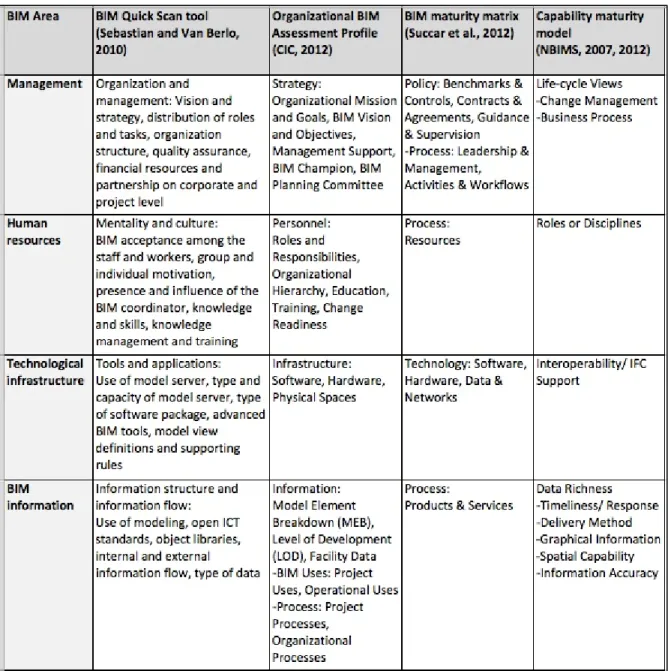
Each one of these BIM maturity models has its own BIM categories that are used to assess maturity. Figure 2.4 provides a representation of BIM categories, defined in four BIM areas of a) management; b) human resources; c) technological infrastructure; and d) BIM information. As cited in in Figure 2.4 for these four BIM areas, BIM area of “Management” considers BIM-related management capabilities of firms/project members. The area of “Human Resources” is about the human resources dedicated for BIM, BIM competency of personnel, their roles, and educational programs of firms. The area of “Technological Infrastructure” considers supporting software, hardware, and network for BIM, and the way
of using and updating them. The area of “BIM Information” is about different subjects, such as BIM information flow, BIM model contents and modeling, use of BIM, etc.
Figure 2.4 (continued) Comparison of BIM Maturity Models
A review of the above BIM maturity models reveals that BIM fields can be categorized in different ways, with more or less details. There is no standard way to categorize BIM subjects in a BIM maturity model. It depends on the purpose and expectations of model developers and users for the application of a model.
2.2 BIM Maturity Assessment for Project Team Selection
As Table 2.1 indicates, four BIM maturity models were developed for the purpose of project team selection. This section reviews these models.
2.2.1 BIM Quick Scan tool
Sebastian and Van Berlo (2010) developed the BIM Quick Scan tool to benchmark the current BIM performance level of AEC organizations for the Dutch construction industry. The purpose was to justify qualification of project parties to be involved in projects and to “… raise awareness and establish a common strategy for innovation through BIM” (Sebastian & Van Berlo, 2010, p. 254). In this approach, a certified BIM consultant carries out the assessment upon request of an organization and produces an assessment report. This approach combines quantitative and qualitative assessments of the ‘hard’ and ‘soft’ aspects of BIM at the a) corporate level, b) ICT infrastructure level, and c) model/modeling level. Four main chapters of an organization, including: 1) organization and management; 2) mentality and culture; 3) information structure and information flow; and 4) tools and applications, are assessed by the BIM Quick Scan tool. Each one of these chapters contains a number of Key Performance Indicators (KPIs) “… in the form of a multiple-choice questionnaire. […] With each KPI, there are a number of possible answers. For each answer, a score is assigned. Each KPI also carries a certain weighting factor. The sum of all the partial scores after considering the weighting factors represents the total score of BIM performance of an organization” (Sebastian & Van Berlo, 2010, pp. 258 and 259). KPIs are assessed using a percentile scale and then the chapters are assessed with a five-level scale of 0 to 4 (Sebastian & Van Berlo, 2010). The tool asks about the presence of ‘BIM Uses’ in the firm, but there is a problem associated with the categorization of BIM Uses. While some of these BIM Uses are specific, such as planning (4D) and quantities/costing, the others are very general, such as simulations, design, architectural, construction, etc. In addition, although it asks for the presence of a BIM Use, the maturity level of a specific BIM Use is not evaluated
by the tool. For example, if a firm has BIM 4D planning, this assessment tool cannot assess how well the firm is using BIM for planning (4D) with a scale.
2.2.2 BIM Qualifications and Proposal Scoring Matrix
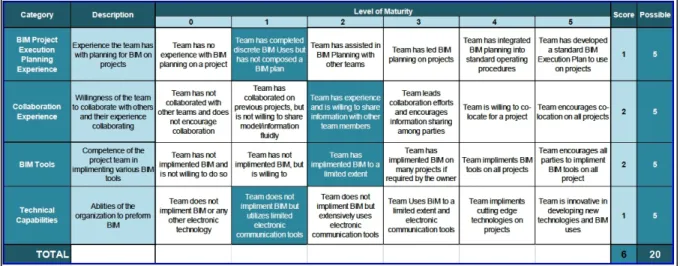
According to CIC (2012), the BIM maturity level of project applicants must be evaluated during the team selection stage, namely during Request For Qualification (RFQ) and Request For Proposal (RFP). At the project team selection stage, to enable the owner to measure the BIM maturity level of applicants, two BIM capability maturity models are presented. The owner asks about BIM experience and the expertise of applicants in the RFQ. In analyzing the submitted RFQs, a matrix similar to the ‘BIM Qualifications Scoring Matrix’, shown in Figure 2.5, “assists the owner in organizing the submissions into a quantifiable score that can quickly and easily be ranked” (CIC, 2012, p. 57). To enable an owner to filter possible exaggerated BIM qualifications, applicants must provide proof of the qualifications they claim to have, for example, by answering questions of owner as presented in Appendix V.
Figure 2.5 BIM Qualifications Scoring Matrix Taken from CIC, (2012)
In the RFP, the applicants must propose the BIM services that they can provide for the project, with a price. The owner can use a matrix similar to the ‘BIM Proposal Scoring Matrix’, shown in Figure 2.6, in order to “rank the proposals based on the BIM services of greatest importance, and identify deficiencies in proposals prior to any contract award” (CIC, 2012).
Figure 2.6 BIM Proposal Scoring Matrix Taken from CIC (2012)
Although this model (CIC, 2012) considers the proposed BIM Uses of applicants, it fails to measure the maturity level of a firm in performing specific BIM Uses, such as 3D Coordination, 4D Modeling, etc. The BIM assessment categories of ‘BIM tools’, ‘Technical Capabilities’, and ‘Deliverables’, are general in the BIM maturity assessment.
2.2.3 IU BIM Proficiency Matrix
Another BIM maturity model, in form of a matrix, was developed by Indiana University (IU) to evaluate the BIM expertise and experience of construction project participants
(consultants) (Indiana University, 2012). An “IU BIM Proficiency Matrix” must be submitted to Indiana University by the design team before the contract award for construction projects of $5M or greater and the construction projects that have already used BIM. For other projects, it is encouraged but not required to submit it. The consultant scores the matrix based on the examples of previous projects, which used BIM. The IU can measure the BIM level of expertise and experience of design team by receiving the filled maturity matrix. Interested contractors can submit an “IU BIM Proficiency Matrix” to the University at the bid submittal stage (Indiana University, 2012). This matrix, which is shown in Figure 2.7, contains eight categories. Each category has four sub-categories. A total of thirty-two subcategories are scored ranging from 0 to 1. A maximum total score of thirty-two can be achieved based on this mechanism. The total achieved score locates the BIM maturity level of firm on a defined range: total score of 0 to 12 is assigned for the “Working Towards BIM” category, 13 to 18 for “Certified BIM”, 19 to 24 for “Silver”, 25 to 28 for “Gold” and 29 to 32 is assigned for “Ideal”. The problem with this scoring system is that for each subcategory a value from 0 to 1 is earned based on subjective judgement of the maturity level. This approach is not very accurate. For example, although a score of 0.45 represents a higher maturity level than a score of 0.4, it is not clear how to justify this scoring and the actual difference it represents. This model considers some BIM Uses, such as ‘Design side collision detection’ and ‘Coordination modeling’ in the maturity assessment. However, lack of development of capabilities within different maturity levels is a deficiency. According to Succar (2010a), “the matrix focuses on the accuracy and richness of the digital model (as an end-product) and has less focus on the process of creating that digital model”. In addition, the matrix has very little consideration for BIM resources. For example, the sub-category of “Model managers’ role defined” asks about the presence of a model manager for each discipline. However, the level of BIM expertise, experience, and knowledge of model managers is not considered in the scoring. The matrix also has other weaknesses, for example, in the BIM technological resources assessment. Although delivering a rich and accurate digital model is the focus of this model, the required technological infrastructure was not considered in maturity assessment.
Figure 2.7 Indiana University BIM Proficiency Matrix Taken from Indiana University (2012)
It is important for construction clients to measure how well a potential project member can use a specific BIM application. All the reviewed models in section 2.2 have a common problem, which is the lack of development of capabilities in maturity levels of BIM Uses. There is a need to address this issue. It is suggested that clients should not have to expend effort on a case-by-case basis to perform this assessment. Having an independent certification body where BIM maturity certification is obtained using independent certified assessors (i.e. like ISO) would be simpler for the clients and would better control the quality of the assessment.
2.3 BIM Maturity Assessment for Minimum BIM Certification
The process of BIM capability maturity assessment was used to define a minimum BIM by the National Building Information Model Standard (NBIMS) (2007; 2012). This model is reviewed as follows.
• NBIMS CMM
The National Building Information Model Standard (NBIMS) Capability Maturity Model (CMM) (NIBS, 2007) is a tool developed for the strategic management in the BIM implementation of an organization (McCuen et al., 2012). The NBIMS CMM helps users measure their current BIM maturity level, and enables them to plan for future maturity goals (NIBS, 2007). This tool, which is part of the national BIM standard (NIBS, 2007), measures eleven weighted BIM capabilities or area of interest against ten maturity levels. Each area of interest is described in the NBIMS CMM. Figure 2.8 shows the eleven BIM areas of interest with their maturity levels.
Figure 2.8 NBIMS CMM Chart Taken from NIBS (2007)
NBIMS CMM is presented in two versions: Tabular (Figure 2.8) and Interactive (Figure 2.9). The Tabular version is a static Microsoft Excel® workbook including three worksheets of information while the Interactive version is a multi-tab Excel workbook with the same information that interacts with the user entering information and calculations.
In the assessment process, a score, named credit sum, is awarded by adding the perceived maturity level’s credit of each area of interest. This approach proposes a minimum score as a threshold to achieve minimum BIM capability. The minimum required score is adjusted yearly by the “National Institute of Building Sciences (NIBS)”. If the minimum score is not achieved, it shall not be called BIM. Therefore, the certification will not be achieved and the needed improvements will be specified. As indicated in Figure 2.9, after ‘Minimum BIM’ level of certification, the other levels, include ‘Certified’, ‘Silver’, ‘Gold’, and ‘Platinum’, respectively requiring a higher credit sum to be reached, namely 60, 70, 80, and 90.
Figure 2.9 Interactive NBIMS CMM Taken from NIBS (2007)
There are a few critics of NBIMS CMM in the literature. According to Sebastian and Van Berlo (2010) there are several limitations for the use of NBIMS CMM: “It is an internal tool to determine the level of maturity of an individual BIM as measured against a set of pre-defined weighted criteria. CMM is not intended to be used to compare different models or BIM implementations. It is designed to measure the maturity of the model (including the modeling process), but not to measure the BIM maturity of the organization” (Sebastian and Van Berlo, 2010). Succar (2010a) believes that NBIMS CMM has structural limitations that may restrict the usefulness and usability of the model. Existence of ten maturity levels with minimal distinction between them is a weakness (Succar, 2010a), the possible overlap of areas of interest (Suermann et al., 2008 and McCuen, 2007 as cited in Succar, 2010a) are some defects. In addition, Succar (2010a) stated other criticisms, such as “in the Interactive CMM tool an organization or project can achieve a high total score even when they have low scores on some areas of interest”. The areas of interest in NBIMS CMM are good to assess models but not useful for teams, organizations or the project teams that generate the models. In addition, this model is only useful for internal self-assessment. The model cannot assess any BIM metric beyond ‘information management’ and this issue limits its applicability (Succar, 2010a).
2.4 BIM Maturity Assessment for Performance Measurement And Improvement The BIM Maturity Matrix (BIm³) (Succar, 2010a,b; Succar et al., 2012) and the ‘Organizational BIM Assessment Profile’ (CIC, 2012) are two models that were developed for the purpose of BIM performance measurement and improvement. These models are reviewed below.
2.4.1 BIM Maturity Matrix (BIm³)
The BIM Maturity Matrix (BIm³) developed by Succar (2010a) “is a knowledge tool which incorporates many BIM Framework components for the purpose of performance
measurement and improvement” (Succar, 2010a). Succar et al., (2012) categorize BIM aspects in a hierarchical method with three main sets of technology, process and policy, and their subcategories are expanded in the next levels of hierarchy. These sets of BIM abilities are called ‘BIM Competency Sets’: “A BIM competency set is a hierarchical collection of individual competencies identified for the purposes of implementing and assessing BIM. In this context, the term competency reflects a generic set of abilities suitable for implementing as well as assessing BIM capability and/or maturity. […] BIM competencies are a direct reflection of BIM requirements and deliverables” (Succar et al., 2012). Succar (2010a) developed a workflow of five steps in order to create a BIM Capability and Maturity Assessment. Figure 2.10 shows a summary of this workflow.
Figure 2.10 BIM capability and maturity assessment and reporting workflow diagram–v2.0 Taken from Succar (2010a) and Succar et al. (2012)
At the first step of the workflow, the user selects the organizational scale (Oscale), intended for assessment, from a table. Using the Oscale filter reduces the number of applicable competencies significantly. At the second step, a four level Granularity filter reduces or increases the number of competency sets for performance assessment by changing the hierarchy level. The user can obtain more detailed competency areas by using higher
Granularity Levels (level 3 or 4). At the third step, the assessor selects and isolates the organization (under assessment) ‘actual’ and ‘targeted’ capability stages. The BIM capability stages define minimum BIM requirements and are defined in three stages of ‘object-based modeling’, ‘model-based collaboration’, and ‘network-based integration’ respectively. Then, the user assesses if the remaining competencies have achieved ‘minimum capability’. In the fourth step, the assessor separates the BIM competency sets that achieved the minimum capability to assess their maturity. According to Succar et al. (2012), “the term ‘BIM maturity’ refers to the quality, repeatability and degree of excellence within a BIM capability. Although ‘capability’ denotes a minimum ability, ‘maturity’ denotes the extent of that ability in performing a task or delivering a BIM service/product” (p. 124). The five levels of maturity in this model are: (a) Initial/Ad-hoc, (b) Defined, (c) Managed, (d) Integrated and (e) Optimized. Finally, in the last step, the assessment results are reported.
In BIm³, the qualitative descriptions of BIM maturity levels are not specific enough for a quantitative assessment. For example, in the category of ‘Software’ applications, there are some sentences that describe the quality of software usage in maturity levels as follows (Succar, 2010a):
Maturity level 1: “Usage of software applications is unmonitored and unregulated”.
Maturity level 2: “Software usage/introduction is unified within an organisation or project teams (multiple organisations)”.
Maturity level 3: “Software selection and usage is controlled and managed according to defined deliverables”.
Maturity level 4: “Software selection and deployment follows strategic objectives, not just operational requirements”.
Maturity level 5: “Selection/use of software tools is continuously revisited to enhance productivity and align with strategic objectives”.
The problem is that words such as ‘unmonitored’, ‘unregulated’, ‘controlled’ and ‘managed’ can be interpreted in different ways. These maturity metrics may not be accurate and
consistent enough, according to Succar (2010b) definitions: Accurate: metrics are clear, verifiable and allow accurate, repeatable assessment; Consistent: when conducted by different assessors, measurements still produce the same results.
2.4.2 Organizational BIM Assessment Profile
The Computer Integrated Construction (CIC) Research Program (2012) at Pennsylvania State University developed “… a standard approach for facility owners to more effectively plan the integration of BIM throughout the organization and the lifecycle of a facility”. In addition to facility owners, the other audiences are designers, contractors, operators, and consultants who advise owners. This guide defines three specific procedures or methods for owners to develop their BIM plans. These procedures include ‘BIM Organizational Strategic Planning’, ‘Owner BIM Organizational Execution Planning’, and ‘Owner BIM Project Procurement Planning’. The ‘BIM Organizational Strategic Planning’ allows an owner to understand why and how BIM can be integrated in an organization. With this procedure, firstly, the maturity of the different aspects of an organization, which are critical for its BIM implementation, are measured. To assess these aspects, which are called BIM planning elements (Figure 2.11), the planning committee uses the Organizational BIM Assessment Profile (Figure 2.12).
Figure 2.11 The BIM planning elements Taken from CIC (2012)
As shown in Figure 2.11, six BIM planning elements, including strategy, BIM Uses, processes, information, infrastructure, and personnel, are introduced in a table. For assessment of BIM planning elements, they are broken up into a total of 20 sub-categories as demonstrated in the Organizational BIM Assessment Profile (Figure 2.12). In this matrix, the planning elements and their sub-categories are described. Each one of the 20 sub-categories is measured against six maturity levels. On each maturity level there is a basic description for each sub-category of planning elements. A value is assigned to each maturity level, which enables the profile to calculate the total score of maturity.
By establishing ‘current’ and ‘target’ maturity levels, the Organizational BIM Assessment Profile (Computer Integrated Construction Research Program, 2012) provides a new approach in using maturity assessment for performance improvement. Future research can be conducted on the transition from ‘current’ to ‘target’ maturity levels in a project. However,
there is not much detail provided within the matrix to describe the different maturity levels or the subcategories.
2.5 Analysis of Contributions to This Study
How do these different models fit the characteristics outlined for this study? To answer this question current BIM maturity models will be studied, in detail, using quality criteria to assess how they can contribute to the design of a detailed BIM maturity model. April (2005) has proposed quality criteria to assess the validity of existing maturity model proposals. Inspired by this approach, the following were establisehd to assess whether a current BIM maturity proposals can contribute to the design of our model:
Criterion 1- “Yes: detailed practices are available, No: practices are private or only a general framework is proposed that doesn’t include detailed practices”;
Criterion 2- “Yes: established model, No: experimental/research model, marginal or obsolete content”;
Criterion 3- “Yes: recent publications which demonstrate the model’s popularity and industry interest, No: no important or recent publication (other than the author’s) or demonstrated industry interest”;
Figure 2.12 Organizational BIM Assessment Profile Taken from CIC (2012)
Criterion 4- Yes: adapted (fully or partially) to construction industry characteristics, No: Not adapted to construction industry characteristics.
Criterion 5- Yes: includes the notion of BIM use, No: Doesn’t include any notion of BIM use.
Figure 2.12 (continued) Organizational BIM assessment Profile Taken from CIC (2012)
Table 2.2 shows, for seven BIM Maturity Models, whether or not they meet the quality criteria.
Table 2.2 BIM Maturity Models evaluation according to the four criteria
Model Criterion 1 Criterion 2 Criterion 3 Criterion 4 Criterion 5
BIM Quick Scan
(Sebastian & Van Berlo, 2010)
Yes Yes Yes Yes No
IU BIM Proficiency Matrix (Indiana University, 2012)
Yes Yes Yes Yes Yes
Organizational BIM Assessment Profile (CIC, 2012)
Yes Yes Yes Yes Yes
NBIMS Capability Maturity Model (NIBS, 2007; 2012)
Yes Yes Yes Yes No
BIM Maturity Matrix (BIm³) (Succar, 2010a,b; Succar et al., 2012)
Yes No Yes Yes No
BIM Qualifications Scoring Matrix (CIC, 2012)
Yes Yes Yes Yes No
BIM Proposal Scoring Matrix (CIC, 2012)
Yes Yes Yes Yes Yes
All the models presented in Table 2.2 have detailed practices (criterion 1). This is useful to map them to the proposed model of this research, where applicable. They are also established
and deployed (criterion 2), as a complete model, except the BIM Maturity Matrix (BIm³) (Succar, 2010a,b; Succar et al., 2012), which is not complete and its development is still in progress. All of these models are recent and developed in the recent years (criterion 3). All these models are developed for construction industry. Therefore they all meet criterion 4. Only three models presented in Table 2.2 meet the criteria and incluce a notion of BIM uses (criterion 5). Consequently, three models and other relevant sources can be used for our research to design a novel BIM Use Maturity Model (BIMUMM) focused on BIM Uses. This research methodology is described in the next chapter.
CHAPTER 3 METHODOLOGY
This chapter presents the methodological approach of this research. Defining the research question and objective is the first step to any research. The proposed method for model development undertaken is presented. Model validation is the last step of this research.
3.1 Research Methodology
This research is composed of four distinct stages, as described below:
Stage 1: Definition of problem and research steps
In this step, the research question, objective, and methodology were determined. Stage 2: Literature Review
Through literature review, two topics are studied: 1) BIM definitions, uses areas, and benefits, 2) Maturity models, in the domain of BIM and other domains. The inventory of maturity models relevant to this research will be provided and selected models will be studied in depth, described and critically analyzed.
Stage 3: Model Development
At this stage, the proposed model architecture will be designed. This includes identification of the BIM domains, Key Process Areas (KPAs), and practices. The practices will be mapped iteratively, from the source documents to the model.
Stage 4: Model Verification and Validation
The developed model will be discussed in a focus group meeting with industrial and academic experts in the field of BIM. The possible improvements will be considered and the model will be updated.
Table 3.1 Research Methodological approach Adapted from April (2005)
Stage 1: Definition of problem and research stages
Research Question Research Objective Methodology How can the current BIM
maturity models evolve to develop a BIM maturity model for construction project clients to pre-qualify project applicant firms in BIM?
To develop a prototype BIM Uses Maturity Model for BIM pre-qualification assessment of project applicants - Literature review -Model development by iterative mapping - Model verification and validation by focus group meeting
Stage 2: Literature Review
Objective Topics Results
To study BIM and maturity models in BIM and other areas
-Literature review of BIM -Literature review of maturity models
-BIM definition, Uses, and benefits;
-Selection, description and critical analysis of seven BIM maturity models; -Identify and present BIM maturity assessment categories;
-Analysis of contribution of the seven selected models to this study;
-Selection, description, and adaptation of a maturity model from software industry.
Table 3.1 (continued) Research methodological Approach Adapted from April (2005)
Stage 3: Model Development
Objective Execution Results To design the model
architecture and content
-Development of the
maturity model architecture. -Mapping BIM maturity assessment categories from different sources to define the proposed KPAs and Roadmaps of the maturity model;
-Mapping/adjusting the detailed BIM practices to develop a first version of the BIM Uses Maturity Model (BIMUMM).
-Presentation of BIM Uses Maturity Model
(BIMUMM) objective, scope, and its architecture, including BIM domains, Key Process Areas (KPAs), Roadmaps and practices; -Proposing the model’s maturity scale, and evaluation process -Development of model content, including detailed practices and their
corresponding assessment questions.
Stage 4: Model verification and validation
Objective Method Results
To verify and validate the proposed model
-Focus group meeting -Opinion of industrial and academic BIM experts is collected regarding the proposed model
-Their recommendations are considered for revision and improvement of model.
3.2 Proposed Model Development Activities
This section explains the procedure used in this research to design and iteratively build the proposed BIM Uses Maturity Model (BIMUMM).
The steps of development are described in Figure 3.1.
Figure 3.1 BIM Uses Maturity Model (BIMUMM) development steps Adapted from April and Coallier (1995)
Through the literature review, studies are done in the context of research. The literature review is focused on BIM and maturity models, and through analysis, the sources are used in order to design the architecture of the proposed model. Model development from literature analysis corresponds to steps 1 to 4 of Figure 3.1. After model development, the model is validated.
These steps are used to integrate practices as follows (adapted from April and Coallier, 1995):
1- BIM domains of ‘Process’ and ‘Resources’ are chosen as the target BIM domain of this study.
2- Each BIM domain has its own KPAs. The domain of ‘Process’ includes the top three most frequent uses of BIM KPAs, selected from Kreider et al. (2010), plus the KPA of ‘Project management’. The KPAs in the domain of ‘Resources’ are ‘Infrastructure’ and ‘Human resources’.
3- The practices are mapped from current BIM maturity models (Succar, 2010a,b; Succar et al., 2012; Sebastian and Van Berlo, 2010; Computer Integrated Construction Research Program, 2012; Indiana University, 2012; NIBS, 2007, 2012) to embed BIM maturity levels of defined roadmaps.
4- The practices from other relevant BIM resources that do not exist in the current BIM maturity models are extracted, added and integrated.
5- The resulting model will be iteratively validated with industry experts through focus group meetings to readjust the roadmaps, KPAs, and practices.
3.3 Model Validation
For model validation, the focus group method is chosen. By conducting a focus group, the researcher aim to listen and gather information and the opinion of participants regarding an issue, product, or service. Selection of participants is based on their common characteristics related to the particular topic of the focus group. The participants constitute a special type of group in terms of purpose, size, composition and procedures. The researchers provide a permissive environment within the focus group and encourage participants to share their perceptions and perspectives without any pressure to vote or reach consensus. Then researchers perform careful and systematic analysis of discussions to find out how a product, service or opportunity is perceived by the participants (Krueger & Casey, 2009). The reasons for choosing this method are (adapted from Krueger & Casey, 2009):
a) The researchers can see the issue through the eyes of the target audience. In this research, the maturity model is supposed to be used for the evaluation of construction project applicants. Therefore, the audiences, which are project applicants, should be invited to the focus group.
b) By conducting the focus group, the researcher can collect qualitative data that is of interest for them. The questions are more general at the beginning, and become more specific as the focus group meeting continues. BIM maturity model development requires more qualitative data and a focus group is a suitable method for collecting it.
c) A focus group is a helpful method in developing and maintaining quality improvement efforts. Therefore it meets one of the goals of BIM maturity models, which is improvement of BIM processes.
In the focus group meeting, the researcher presents the proposed BIM Uses Maturity Model v.0 and asks the participants to give their opinions about the model architecture and content. Based on the feedback, the researcher modifies the model by iteratively analyzing the
information and with more review of literature. The validation process is shown in Figure 3.2. More information about the validation step is provided in the last chapter.
Figure 3.2 BIMUMM validation process
3.4 Conclusion
The research approach is based on four stages. At the first stage, research question and objective is defined, and research methodology is developed. The second stage includes review of literature about BIM and maturity models. This stage helps the researcher learn about these subjects and use the literature to reach the objective of research, which is development of a prototype BIM Uses Maturity Model (BIMUMM) for BIM pre-qualification assessment of project applicants. At third stage of this research, model development starts. The proposed architecture of BIMUMM and its content is developed in this stage. The main components of BIMUMM include BIM domains, Key Process Areas (KPAs), Roadmaps, and Practices. At this stage, the model maturity scale and evaluation process are also proposed. Fourth stage of this research is model verification and validation. Opinion of industrial and academic BIM experts regarding the proposed model is collected for model revision and improvement.
Chapter 4 presents the proposed perspective and architecture of BIMUMM, and also proposed maturity scale and evaluation process. The results of the model development mapping from different resources are presented in chapters of 5 and 6. The proposed model is a prototype or concept of operations, which will need to be tested in future researchs. The model validation process and results are explained in chapter 7.
CHAPTER 4
PROPOSED BIM USES MATURITY MODEL (BIMUMM) FOR INDEPENDENT CERTIFICATION
Construction clients need a way to ensure that the participating firms of the project meet minimum BIM requirements to qualify for the project. From the perspective of a client, ‘minimum BIM qualification’ can be translated to ‘minimum capability to use BIM’ and this is practically what is wanted from a certification: ‘how well does this participant use BIM technology in a construction project?’. This is accepted as the principal assumption of this study. Clients want to know whether a firm is capable of using BIM, and if yes, to what level. This perspective offers an opportunity to adapt existing BIM maturity models to reach that goal. Current BIM maturity models do not consider BIM in this way. The existing BIM maturity models provide a rich base of information to achieve this goal. However, no model has focused on the development of maturity levels of ‘BIM Uses’: “A BIM Use is a unique task or procedure on a project which can benefit from the integration of BIM into that process” (CIC, 2011, p. 1). This research proposes a new approach in assessing the BIM capability maturity of firms in performing specific BIM Uses, while measuring their general BIM competencies at the same time. This approach fits better with a clients’ expectation from a maturity model because they want to know how well a project stakeholder uses BIM to deliver a BIM product or service. Therefore, it is stipulated that a BIM uses maturity model that provides information about the maturity of BIM Uses could better meet client expectations.
4.1 Proposed Perspective
Client perpective is also considered in other industries. Kärkkäinen et al. (2012) added “customer dimension” in maturity models of Product Lifecycle Management (PLM) and defined preliminary maturity level description, in five levels, for this dimesion. PLM is described as effective lifecycle management of products (Stark, J., 2011). PLM and BIM