UNIVERSITÉ DE MONTRÉAL
CRISIS COMMUNICATION STRATEGIES AND REPUTATION RISK IN AN ERA OF SOCIAL MEDIA: A STUDY OF ONLINE USERS' PERCEPTION AND ENGAGEMENT
VENUS HOSSEINALI-MIRZA
DÉPARTEMENT DE MATHÉMATIQUES ET DE GÉNIE INDUSTRIEL ÉCOLE POLYTECHNIQUE DE MONTRÉAL
THÈSE PRÉSENTÉE EN VUE DE L’OBTENTION DU DIPLÔME DE PHILOSOPHIAE DOCTOR
(GÉNIE INDUSTRIEL) JUIN 2015
UNIVERSITÉ DE MONTRÉAL
ÉCOLE POLYTECHNIQUE DE MONTRÉAL
Cette thèse intitulée :
CRISIS COMMUNICATION STRATEGIES AND REPUTATION RISK IN AN ERA OF SOCIAL MEDIA: A STUDY OF ONLINE USERS' PERCEPTION AND ENGAGEMENT
présentée par : HOSSEINALI-MIRZA Venus
en vue de l’obtention du diplôme de : Philosophiae Doctor
a été dûment acceptée par le jury d’examen constitué de :
M. TRÉPANIER Martin, Ph. D., président
Mme DE MARCELLIS-WARIN Nathalie, Doctorat, membre et directrice de recherche M. WARIN Thierry, Ph. D., membre et codirecteur de recherche
Mme LAPIERRE Josée, Ph. D., membre
DEDICATION
To my beloved parents, sisters, and Mohammed for their ultimate love and support.
ACKNOWLEDGEMENTS
I am deeply indebted to my advisers, Professor Nathalie de Marcellis-Warin and Professor Thierry Warin, for their fundamental role in my doctoral work. Nathalie provided me with the guidance, assistance, and expertise that I needed during my first few semesters; then, when I felt ready to venture into research on my own, Nathalie trusted me and gave me the freedom to be adventurous, and at the same time continued to contribute valuable feedback, advice, and encouragement. I am particularly thankful to Thierry who has been always encouraging and his brilliant ideas have added a great value to my works. I feel extremely privileged to have been your student.
I gratefully acknowledge the members of my Ph.D. committee for their valuable time to review my dissertation. I would also like to acknowledge the member of my comprehensive exam committee for their invaluable comments on my Ph.D. research proposal.
I am appreciative to Polytechnique Montreal for providing a suitable terrain for my progresses. I am very thankful to the Center for Interuniversity Research and Analysis of Organizations (CIRANO) for the funding and support during my doctoral studies. I would also like to thank Carl St. Pierre, Mohamed Mahfouf, and CIRANO Doctoral School members for their collaborations in processing my survey.
I am deeply thankful to my family for their love, support, and sacrifices. Without them, this dissertation would have never been written. I dedicate this dissertation to my mom who has been tolerant with my absence; to my dad who taught me patience and integrity; to my sister Jinus, who taught me persistence and determination; and to Mohammed who has been devotedly with me throughout the years of my doctoral studies. This last word of acknowledgment I have saved for my sister, Solmaz. Thank you for lighting up the moments of my life with your genuine presence and hearty inspirations.
RÉSUMÉ
Depuis quelques années, les médias sociaux sont devenus extrêmement populaires. Facebook, Twitter, et YouTube prennent une place de plus en plus importante comme moyens de communication pour les individus et les organisations. D'une part, grâce à ces nouveaux sites Internet, les organisations peuvent atteindre leurs partenaires et interagir avec eux directement, mais aussi elles peuvent le faire par le biais de communautés en ligne de façon indirecte. Les individus, d'autre part, peuvent se joindre à ces communautés en ligne, s’exprimer, et avoir un accès illimité à une quantité massive d'informations. Toutefois, l'information qui circule sur les médias sociaux n’est pas contrôlée, ce qui soulève des préoccupations telles que le degré de crédibilité de l'information. Les rumeurs, des informations fausses ou biaisées parfois, peuvent rapidement circuler sur les médias sociaux et de plus en plus d’organisations se retrouvent face à des situations inattendues. La réputation des entreprises peut être mise en cause.
Cette thèse vise à explorer les changements potentiels qui sont apparus dans l’environnement des entreprises avec l'émergence des médias sociaux. De plus, cette recherche tente de mettre en perspective les risques et les opportunités des médias sociaux pour les entreprises, et comment elles doivent adapter leurs activités et les stratégies d'ajustement aux exigences de l'environnement des médias sociaux. Pour cette raison, la présente thèse étudie trois questions de recherche : (i) comment les organisations communiquent et réagissent à une crise qui débuterait sur les médias sociaux afin d'éviter et de prévenir les effets indésirables, (ii) comment les utilisateurs des médias sociaux perçoivent la crédibilité des informations qui circulent sur internet et les médias sociaux, et (iii) quels sont les facteurs qui expliquent l’engagement des utilisateurs des médias sociaux dans les communautés de marque en ligne?
Pour répondre à la première question de recherche, une analyse approfondie de huit études de cas de médias sociaux a été effectuée afin d’explorer les stratégies de communication de crise des organisations dans un contexte de médias sociaux. Afin de répondre à la deuxième et la troisième questions de recherche, une enquête par questionnaire en ligne a été menée auprès d'un échantillon d'utilisateurs de médias sociaux pour analyser leur perception de la crédibilité de l'information des médias sociaux, et d'évaluer les facteurs qui pourraient expliquer leur engagement dans les communautés de marque en ligne.
Sur la base de l'analyse des études de cas de crises, un modèle conceptuel de stratégie de communication de crise des médias sociaux est proposé intégrant les canaux de diffusion de l'information, les origines de la crise, les raisons de la crise, l'intervention et les résultats.
L’analyse statistique des résultats des données de l'enquête révèle que les utilisateurs des médias sociaux vont allouer différents niveaux de crédibilité à chaque source d'information. Les résultats de l'enquête confirment également que des facteurs comme « activités avec médias sociaux », « confiance perçue », « sujet d'intérêt » et « pays d'origine » pourraient expliquer certains comportements dans l'engagement des utilisateurs dans les communautés de marque en ligne. Cette thèse est organisée en huit chapitres. Le premier chapitre de la thèse présente le contexte et l'importance des médias sociaux qui ont révolutionné le domaine de la communication entre les individus et les organisations en raison de sa popularité et l'utilisation. Le deuxième chapitre fait un examen précis de la littérature portant sur six domaines: le Web 2.0 et les médias sociaux, les crises dans l'environnement des médias sociaux, la crédibilité de l'information qui circule sur les médias sociaux, le risque de réputation, les stratégies de communication de crise, et l'engagement des utilisateurs dans les communautés de marque en ligne.. Le troisième chapitre présente la méthodologie de recherche et les trois questions de recherche. Tout d’abord, des études de cas sont utilisées pour répondre à la première question de recherche qui est: «comment les organisations vont communiquer et faire face aux crises de médias sociaux pour éviter les conséquences indésirables?». La méthodologie inclut également la conduite d’un sondage en ligne pour aborder les deuxième et troisième questions de recherche: «comment les utilisateurs perçoivent la crédibilité des informations des médias sociaux en temps normal et en temps de crise», et «comment l’adoption des médias sociaux concerne leur engagement des utilisateurs dans les communautés de marque en ligne». Le quatrième chapitre intitulé «la communication de crise et le risque de réputation dans l'environnement des médias sociaux» contribue à une meilleure compréhension des stratégies de communication de crise des organisations. Les conclusions de ce chapitre résultent dans la proposition d'un modèle de communication de crise, incluant les nouvelles exigences de l'environnement des médias sociaux. Le cinquième chapitre intitulé «la perception de la crédibilité de l'information lors d'une crise de médias sociaux» adresse la deuxième question de recherche de la thèse et contribue à comprendre la perception de la crédibilité de l'information des médias sociaux par les utilisateurs en temps normal et en temps de crise. Les résultats de ce chapitre confirment que la presse nationale est la source
d'information la plus crédible en temps normal, alors que les moteurs de recherche en ligne (par exemple Google) sont perçus comme la source d'information la plus crédible au cours d'une crise. Le chapitre six intitulé «L'engagement des utilisateurs dans les communautés de marque en ligne: une étude des commentaires dans l'environnement des médias sociaux» aborde la troisième question de recherche et explique les liens entre l'adoption des médias sociaux et leur engagement dans les communautés de marque en ligne. Ce chapitre contribue à une meilleure connaissance sur les comportements d'engagement des utilisateurs de médias sociaux. Les résultats montrent que « les activités avec médias sociaux», « le niveau de confiance perçue», « le sujet d'intérêt » et « le pays d'origine » expliquent certains comportements dans l'engagement des utilisateurs dans les communautés de marque en ligne. Le chapitre sept résume les conclusions générales des chapitres précédents. Le chapitre huit explique les contributions théoriques et pratiques de la thèse. Ce chapitre comprend également des recommandations pratiques pour les gestionnaires de crise et des relations publiques concernant les stratégies de communication de crise dans l'environnement des médias sociaux. Ce chapitre comprend des recommandations pour les gestionnaires de marque du département de marketing afin de mieux comprendre les activités des utilisateurs de médias sociaux comme une explication de leurs comportements d'engagement dans les communautés de marque en ligne. Ce chapitre expose aussi les limites de la recherche et des recommandations pour des recherches futures.
ABSTRACT
Over the past few years, social media have become surprisingly popular. Social media platforms such as Facebook, Twitter, and YouTube are growing as important pathways for communication means among individuals and organizations. Throughout these tremendous platforms, organizations can reach to their stakeholders and interact with them through building online communities. Individuals, on the other hand, can join to these online communities, express themselves, and have unlimited access to massive amount of information like never before. However, the uncontrolled information of social media environment raises concerns such as the information credibility. Rumors, false, and biased information can quickly circulate among social media platforms and consequently organizations confront with unexpected incidents, which could expose their reputation at risk.
This dissertation aims to explore the prospective changes that have appeared along with the emergence of social media. Furthermore, this dissertation attempts to put in to perspective what organizations need to know about social media risks and opportunities, and how they should customize their activities and strategies fitting to the requirements of social media environment. For this reason, the present dissertation investigates three particular research questions: (i) how do organizations communicate and respond to social media crisis to avoid and prevent undesirable outcomes?, (ii) how online users perceive the credibility of social media information?, and (iii) how users’ social media adoption relates to their engagement in online brand communities?
To address the first research question, an in-depth analysis of eight social media case studies was conducted in order to explore organizations’ crisis communication strategies in the online social media environment. In order to address the second and third research questions, an online survey was conducted among a sample of social media users to investigate their perceived credibility of social media information, and to assess the factors that could explain their engagement in online brand communities.
Based on the results of case study analysis, a model of social media crisis communication strategy is proposed which is built upon the channels of crisis information diffusion, crisis origins, reasons, response, and outcomes. The findings of the online survey reveal that online users allocate different levels of credibility to information sources based on their actual situation.
The survey results also confirm that factors like “social media activities”, “perceived trust”, “subject of interest”, and “country of origin” could explain some of the users’ engagement behavior in online brand communities.
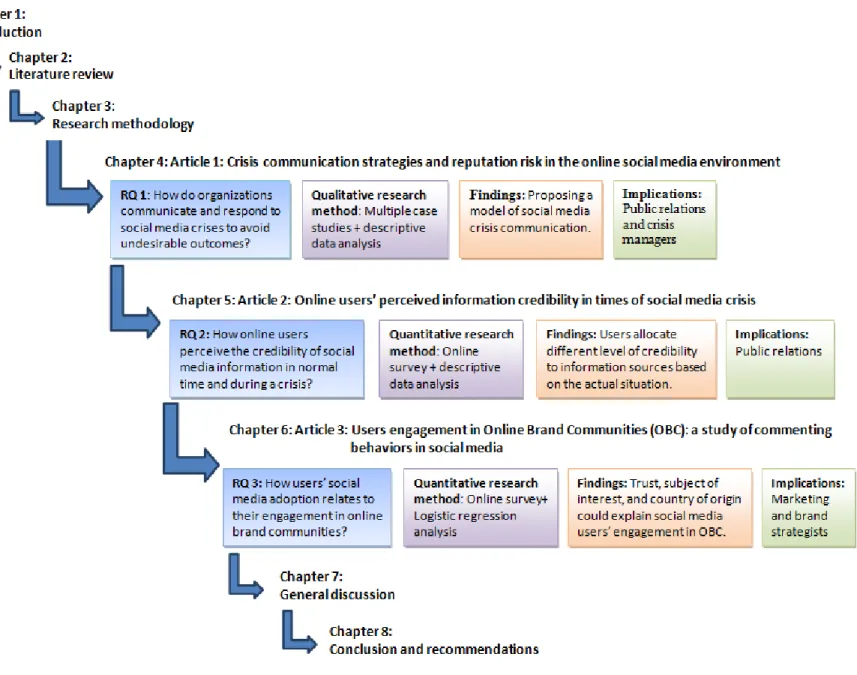
This dissertation is organized as follows: he first chapter of the dissertation explains the context and significance of social media, which have revolutionized the communication sphere among individuals and organizations due to its popularity and growing use. The second chapter includes a careful review of the related literature mainly focusing on six areas, including: Web 2.0 and social media, organizational crisis in social media environment, the credibility of social media information, reputation risk, crisis communication strategies, and users’ engagement in online brand communities. Each chapter begins with a brief introduction and ends with a conclusion on the examined subjects. The third chapter unfolds the research methodology and the three research questions. The research methodology includes a case study research to address the first research question that is: “how do organizations communicate and respond to social media crises to avoid undesirable outcomes?”. The methodology also includes an online survey addressing second and third research questions as: “how online users perceive the credibility of social media information in normal time and during a crisis”, and “how users’ social media adoption relates to their engagement in online brand communities?”. The fourth chapter entitled “crisis communications strategies and reputation risk in the online social media environment” carefully addresses the first research question and contributes to a better understanding of organizations crisis communication strategies in form of a published scientific article. The findings of this chapter result in proposition of a crisis communication model including the requirements of responding to a crisis in social media environment. The fifth chapter entitled “perceptions of information credibility during a social media crisis” addressed the second research question of the dissertation and contributes to understand the users’ perceived credibility of social media information in normal time compared to crisis time in form of an article. The results of this chap ter confirms that national press is the most credible information source in normal time, whereas online search engines (e.g. Google) perceived to be the most credible information source during a crisis. Chapter six titled “users’ engagement in online brand communities: a study of commenting behaviors in social media environment” addresses the third research question and explains the links between users social media adoption and their engagement in online brand communities. This chapter contributes to a better learning on driving factors of social media users’ comments
on brand posts in form an article. The results represent that users’ “online presence”, “social media activities”, “perception” and “topic of interest” can explains some of their commenting behaviors. Chapter seven summarized the general findings of the previous chapters. Chapter eight explains the theoretical and practical contributions of the dissertation. This chapter also includes practical recommendations for crisis managers and public relation to revisit their crisis communication strategies to properly respond to the risks associated with social media environment. This chapter includes recommendations for marketing strategists and brand practitioners to consider social media users’ activities as an explanation for their commenting practices in online brand communities. This chapter includes the limitations of current research and recommendations for further researches.
TABLE OF CONTENTS
DEDICATION ... iii ACKNOWLEDGEMENTS ... iv RÉSUMÉ... v ABSTRACT ... viii TABLE OF CONTENTS ... xiLIST OF TABLES ... xvi
LIST OF FIGURES... xviii
LIST OF SYMBOLS AND ABBREVIATIONS ... xix
LIST OF APPENDICES ... xx
CHAPTER 1: INTRODUCTION ... 1
CHAPTER 2: LITERATURE REVIEW ... 4
2.1 The Internet, Web 2.0 and social media ... 4
2.1.1 Social media classification ... 5
2.1.2 Social networking sites (SNS) ... 6
2.2 Social media use ... 7
2.2.1 Individuals use of social media ... 7
2.2.2 Organizations use of social media ... 9
2.3 Social media potential risks... 10
2.3.1 The credibility of social media information ... 11
2.3.2 Social media crisis ... 12
2.3.3 Reputation risk... 14
2.4 Crisis communication strategies... 15
2.5 Social media opportunities ... 21
2.5.1 Social media: a stage to engage ... 22
2.5.2 Online brand communities (OBC)... 24
2.6 Conclusion... 25
CHAPTER 3: RESEARCH METHODOLOGY... 27
3.1 Problem statement and research questions ... 27
3.2 Research method ... 29
3.2.1 Case study... 29
3.2.2 Online survey... 29
3.3 Research contributions ... 30
3.4 Research framework... 30
3.4.1 Article 1: Crisis communication strategies and reputation risk in the online social media environment ... 31
3.4.2 Article 2: Perceptions of information credibility during a social media crisis ... 31
3.4.3 Article 3: Users’ engagement in online brand communities: a study of commenting behaviour in social media environment... 32
CHAPTER 4: ARTICLE 1: CRISIS COMMUNICATION STRATEGIES AND REPUTATION RISK IN THE ONLINE SOCIAL MEDIA ENVIRONMENT ... 35
4.1 Introduction ... 36
4.2 Background ... 37
4.2.1 Social Media Crisis... 37
4.2.2 Crisis Communication Strategies and Social Media ... 38
4.2.3 Situational Crisis Communication Theory (SCCT) ... 39
4.3 Research Method ... 39
4.4.1 Mattel versus Greenpeace... 40
4.4.2 GAP’s New Logo ... 41
4.4.3 Nestlé versus Greenpeace ... 41
4.4.4 United Airlines Breaks Guitars ... 42
4.4.5 Domino’s Pizza YouTube Video... 43
4.4.6 Motrin Advertisement ... 44
4.4.7 JetBlue Valentine’s Day Flight ... 44
4.4.8 Taco Bell/KFC rats in Kitchen ... 45
4.5 Analysis ... 45
4.5.1 Social Media crisis ... 46
4.5.2 Crisis Communication Strategies ... 48
4.5.3 Crisis Outcomes... 50
4.6 Findings ... 51
4.7 Discussion and Conclusion ... 52
4.7.1 Limitations and Future Research ... 54
CHAPTER 5: ARTICLE 2: PERCEPTIONS OF INFORMATION CREDIBILITY DURING A SOCIAL MEDIA CRISIS ... 56
5.1 Introduction ... 57
5.2 Background ... 58
5.2.1 Online information credibility ... 58
5.2.2 Crisis communication in online environment... 60
5.3 Research methodology ... 61
5.3.1 Survey instrument... 62
5.3.2 Procedure ... 63
5.3.4 Data preparation and analysis... 64
5.4 Result and discussion ... 64
5.4.1 Online users’ social media engagement ... 65
5.4.2 Users’ perceived credibility of social media information in normal time ... 68
5.4.3 Users’ perceived credibility of social media information in crisis times ... 71
5.4.4 Users’ perception of crisis communication strategies ... 72
5.4.5 Users’ perception of crisis impact on organization ... 74
5.5 Conclusion... 75
CHAPTER 6: ARTICLE 3: USERS’ ENGAGEMENT IN ONLINE BRAND COMMUNITIES: A STUDY OF COMMENTING BEHAVIOR IN SOCIAL MEDIA ENVIRONMENT ... 77
6.1 Introduction ... 78
6.2 Background ... 79
6.2.1 Individuals and brands social media adoption... 79
6.2.2 Individuals engagement in Online Brand Communities (OBC)... 80
6.2.3 User-generated content (UGC) in the online social media environment ... 82
6.3 Conceptual Framework and Research Questions... 83
6.4 Methodology and data ... 84
6.4.1 The sample... 84
6.4.2 Dependent variables ... 85
6.4.3 Independent variables ... 86
6.5 Analysis and results... 88
6.5.1 Descriptive results ... 88
6.5.2 Logistic regression results ... 90
6.6 Discussion and conclusion ... 94
6.6.2 Limitations and further research... 96
CHAPTER 7: GENERAL DISCUSSION ... 97
CHAPTER 8: CONCLUSION AND RECOMMENDATIONS ... 100
8.1 Dissertation contributions ... 100
8.2 Recommendations for practical implications ... 101
8.3 Limitations and recommendations for further research ... 103
REFERENCES... 104
LIST OF TABLES
Table 2.1: Social media types and examples (Fraustino, Liu & Jin, 2012) ... 6
Table 2.2: Crisis communication models theories and models ... 21
Table 4.1: Case studies summary ... 39
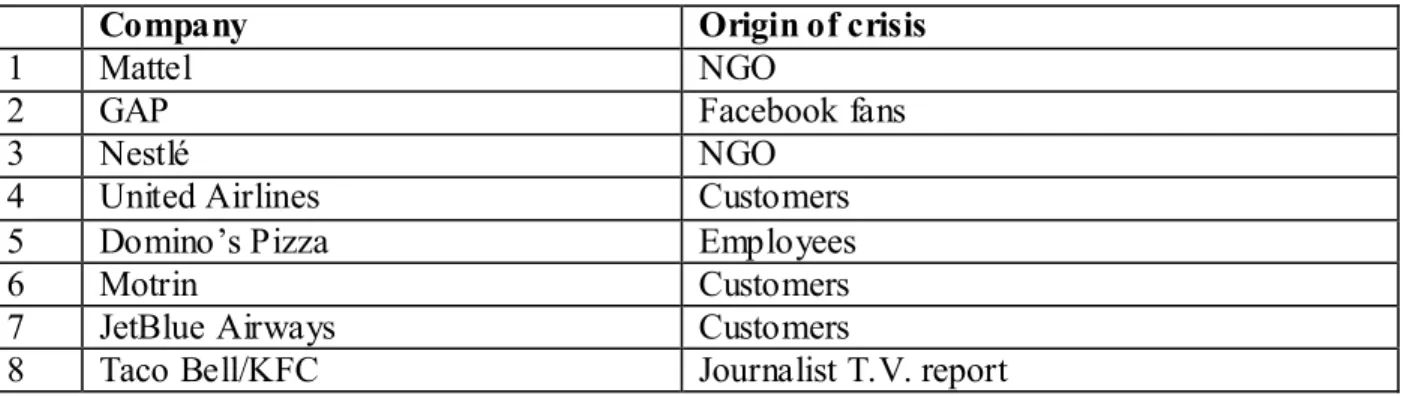
Table 4.2: Origins of Crisis ... 46
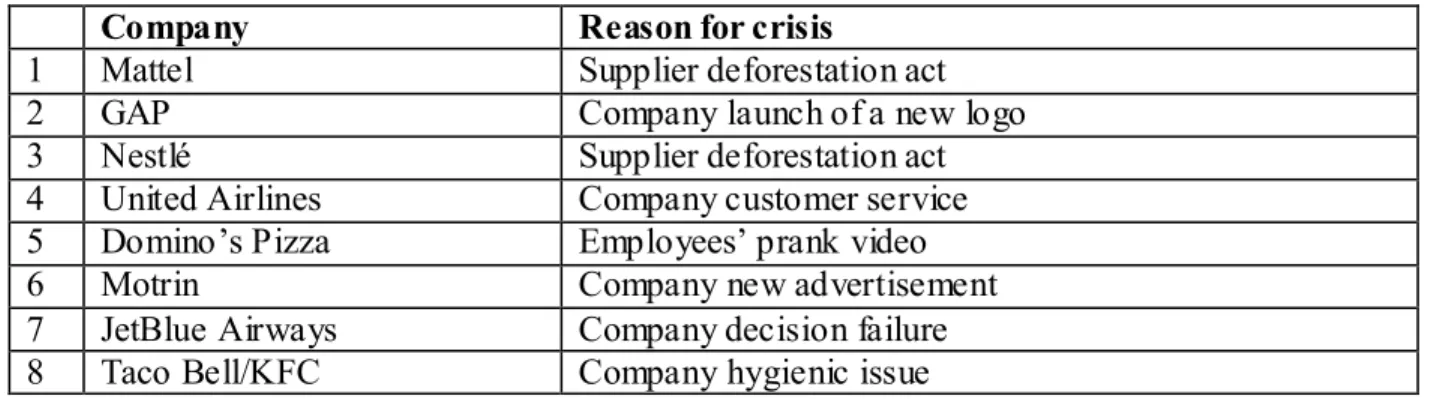
Table 4.3: Reasons for Crisis ... 47
Table 4.4: Channels of Information Diffusion ... 48
Table 4.6:Crisis Response Channels ... 49
Table 4.7: Crisis Responses ... 50
Table 4.8: Crisis Outcomes ... 50
Table 5.1: Classification of survey questions... 63
Table 5.2: Demographic information ... 64
Table 5.3: Users’ online presence ... 65
Table 5.4: Users’ level of social media activity ... 65
Table 5.5: Users’ perceived level of social media importance in personal and professional life .. 67
Table 5.6: Users’ perceived credibility of social media information in normal time ... 69
Table 5.7: Users’ perceived credibility of different information sources in normal time ... 70
Table 5.8: Users’ perceived level of importance for crisis communication strategies ... 73
Table 5.9: Users’ overall satisfactions about crisis communication strategies ... 74
Table 5.10: Users’ perceived level of crisis impact on organization ... 74
Table 6.1: Demographic information ... 85
Table 6.2: Dependent variables and their description ... 86
Table 6.3: Independent variables and their description... 87
Table 6.5: Descriptive statistics for user online presence ... 88
Table 6.6: Descriptive statistics for user social media activities... 89
Table 6.7: Descriptive statistics for social media user perception ... 89
Table 6.8: Descriptive statistics for user topic of interest ... 90
LIST OF FIGURES
Figure 2-1: Timeline of the launch dates of many major SNS and dates when community sites
re-launched with SNS feature (Boyd & Ellison, 2008) ... 8
Figure 2-2: Crisis situation model of SCCT (Coombs, 2007) ... 18
Figure 2-3: Blog-mediated crisis communication model (Jin & Liu, 2010) ... 19
Figure 2-4: Social-Mediated Crisis Communication Model (Liu, Jin, Briones, & Kuch, 2012) ... 20
Figure 3-1 : Framework for the dissertation guidance ... 33
Figure 3-2: Ph.D. dissertation structure ... 34
Figure 4-1: Social Media Crisis Communication Model ... 53
Figure 5-1: Percentage of users’ social media accounts ... 66
Figure 5-2: Reasons of users’ social media employ... 68
Figure 5-3: Users’ perceived credibility of different information sources in crisis time ... 72
Figure 5-4: Users’ perceived duration of crisis impact on organization ... 75
LIST OF SYMBOLS AND ABBREVIATIONS
BMCC Blog-mediated crisis communication modelCE Customer engagement
CEB Customer engagement behavior NCC Networked crisis communication NWOM Negative word-of-mouth
OBC Online brand community
SCCT Situational crisis communication theory SMCC Social mediated crisis communication model SNS Social networking sites
UGC User-generated content WOM Word-of-mouth
LIST OF APPENDICES
APPENDIX A – SURVEY AND QUESTIONNAIRE ... 120
APPENDIX B – CRISIS COMMUNICATION STRATEGIES WITH EXAMPLES ... 141
APPENDIX C – SOCIAL MEDIA CRISIS OUTCOMES WITH EXAMPLES ... 144
APPENDIX D – VARIABLES DESCRIPTION AND CORRELATION MATRIX I... 145
CHAPTER 1
INTRODUCTION
In recent years, the emergence and rapid expansion of Web 2.0 and social media is outstanding. The number of the world Internet users has reached to more than 3 billion (Internet World Stats, 2014) among which 74% are adult users of social networking sites (Pew Research Center, 2014) and 52% employ more than one social media platform (Duggan, Ellison, Lampe, Lenhart, & Madden, 2015). An eMarketer report predicts that the global social network audience will reach to 2.55 billion by 2017 (eMarketer, 2013). Social media are “activities, practices and behaviors among communities of people who gather online to share information, knowledge, and opinions using conversational media” (Safko & Brake, 2009, p.6). The adoption of social media is not limited to individuals. The 2014 Fortune 500 has totally embraced new communications tools in a way that 80% of the F500 are on Facebook, 83% using Twitter, and the use of LinkedIn is almost universal among them (97%) (Barnes & Lescault, 2014).
The growing use of social media has revolutionized the communication sphere among individuals and organizations. However, the use of the Internet and computer-mediated technologies such as social media are “double-edged” sword. On one hand, there are no limits of space, time, and content in online environment and whoever has the technical capacities to receive messages with a computer would be able to send them (Bucher, 2002). Online media have promoted the consumers of traditional media to the producers of online new media (Haas & Wearden, 2003; Metzgar, Flanagin, Eyal, Lemus, & McCann, 2003). There is no better way than through social media to spread messages, opinions, and thoughts to thousands of audiences through countless number of channels (O’Keefe, 2013). Nevertheless, the Internet has increased the risk of getting false information, rumors, and hoaxes (Bucher, 2002) due to the lack of professional gatekeepers who were monitoring the traditional media contents (Westerman, Spence, & Van Der Heide, 2012).
The diverse capabilities of social media have changed the paradigm of communication. The paradigm shift of communication could create new risks and opportunities for individuals and organizations. For example, social media might pose reputation risk to organizations (Aula,
2010). The battle between Nestlé1 and Greenpeace2 is an example of social media potentials that resulted in victory for one organization and defeat for the other. The story began on March 17, 2010, when Greenpeace launched an online campaign accusing Nestlé to buy palm oil for its popular chocolate bar -Kit Kat- from an Indonesian supplier –Sinar Mas – that clears vast areas of Indonesian forest for its plantations and destroys the natural habitat of the endangered orangutans. The campaign included a 60-second video of an office employee having a Kit Kat, which appeared to be a chocolate-covered ape finger. The video was uploaded on YouTube, and Nestlé asked YouTube to remove the video-clip, mentioning copyright concerns (Armstrong, 2010). Greenpeace re-posted the video-clip to Vimeo.com and used Twitter to spread the word about the Nestlé attempted censorship. Many Web users also re-posted the video on YouTube and other destinations on the Internet (Armstrong, 2010). Greenpeace encouraged its supporters to change their Facebook profile photos to anti-Nestlé slogans and to attack Nestlé`s Facebook page (Morgan, 2011). Nestlé’s Facebook team started threatening their Facebook fans to delete comments made by those using modified versions of their logo (Ridings, 2010). Twitter users joined the conversation, encouraging people to visit Nestlé’s Facebook comments. Negative Twitter comments appeared every 15 minutes (Ridings, 2010). The backlash continued to grow until Nestlé backed down and apologized on Facebook for deleting posts and being rude (CNN Money, 2011). Eventually, Nestlé declared its commitment to using only “Certified Sustainable Palm Oil” by 2015 when sufficient quantities should be available (Houpt, 2012).
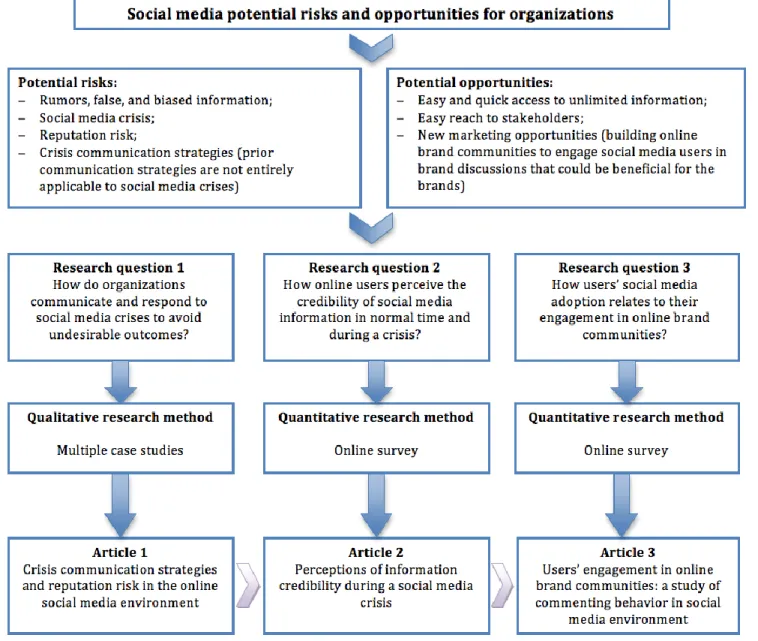
This dissertation aims to explore some of the potential risks and opportunities emerged with the evolution of social media through answering three inclusive research questions that concern individuals and organizations interactions in the online social media environment. First research question aims to explore the strategies through which organizations respond to social media crises to prevent undesirable consequences. This question is addressed through conducting an in-depth multiple case study analysis aimed at evaluating organizations crisis communication strategies in response to social media crisis. Second research question evaluates the perceived credibility of information that online users consume in the social media environment. Third question seeks for the determinant factors of individuals’ engagement in organizations online
1Multinational food and beverage company headquartered in Switzerland 2 Non-governmental environ mental organization
communities. These questions are addressed through conducting an online survey intended to evaluate users’ perceived information credibility and engagement behaviors in online social media environment. The results contribute to the growing literature of social media studies in communication research field in form of three original articles. One of the articles is published in “International Journal of Business and Social Science” and the other two are submitted to scientific journals. The findings of this dissertation are applicable for public relations to accurately incorporate social media in organization communication agenda. To avoid the undesirable outcomes of social media crisis by applying appropriate crisis communication strategies, and to engage social media users in their online discussions to benefit from the potential opportunities.
The rest of the dissertation is organized as follows: Chapter 2 reviews the prior literature on social media, social media use among individuals and organizations, potential risks associated with social media, crisis communication strategies and related theories, and social media potential benefits; Chapter 3 addresses the research methodology including problem statement and research questions, research method (case study and online survey), research contributions and research framework; Chapters 4 presents organizations’ crisis communication strategies in the online social media environment (article 1); Chapter 5 reviews the online users perception of information credibility during a social media crisis (article 2); Chapter 6 reports the determinants of users’ engagement in online brand communities (article 3); Chapter 7 discusses the general findings; the dissertation then concludes with chapter 8 that unfold the dissertation contributions, recommendations for practical implications, limitations of the present research and recommendations for future research.
CHAPTER 2
LITERATURE REVIEW
Social media are “the umbrella term that refers to social networking sites (like Facebook, LinkedIn, and Google Plus) as well as to information and media-sharing sites that users may not think of in terms of networking, such as Twitter, Instagram, and Tumblr” (Madden et al., 2013). To have a better grasp of social media risks and opportunities, this chapter begins with a review of the computer-mediate technologies and continues by discussing the new communication challenges and opportunities that organizations are confronted with, due to the online social media emergent.
2.1 The Internet, Web 2.0 and social media
Since March 1989, when Tim Berners-Lee invented the World Wide Web, there have been profound changes in the Internet application for communication means. The Internet, which has revolutionized the communications world, is “a world-wide broadcasting capability, a mechanism for information dissemination, and a medium for collaboration and interaction between individuals and their computers without regard for geographic location” (Leiner et al., 2012). The World Wide Web, which is different from the Internet, is defined as “a way of accessing information over the medium of the Internet. It is an information-sharing model that is built on top of the Internet” (Beal, 2010). Perhaps the most fundamental change in the Internet application is its evolution in to an interactive platform for communication purposes, rather than a static information archive. This stage that was first used in 2004 has been termed “Web 2.0”. Constantinides and Fountain (2008, p. 232) define Web 2.0 as:
“A collection of open-source, interactive and user controlled online applications expanding the experiences, knowledge and market power of the users as participants in business and social processes [...] Web 2.0 applications facilitates the flow of ideas and knowledge by allowing the efficient generation, dissemination, sharing and editing /refining of informational content”.
Web 2.0 is a platform for social media where “content and applications are no longer created and published by individuals, but instead are continuously modified by all users in a participatory and collaborative fashion” (Kaplan & Haenlein, 2010, p.61). Web 2.0 is categorized to: “blogs”,
“social networks”, “content communities”, “forums”, and “content aggregators” (Constantinides & Fountain, 2008).
One of the most successful manifestations of the Web 2.0 is social media, which is ranked among the most popular features on the Internet (Philips, 2009). Social media are built upon a fundamental characteristic of Web 2.0 (O’Reilly & Battelle, 2009). Web 2.0 rotates around “conversations, social interactions, and the formation of groups” that act on collective knowledge, whereas social media is focused on understanding and managing specific aspects of the conversation (Evans, 2012). While there is a lack of formal definition for social media (Xiang & Gretzel, 2010), they are defined as “a group of Internet-based applications that built on the ideological foundations of Web 2.0, and that allow the creation and exchange of User Generated Content” (Kaplan & Haenlein, 2010, p.61). Safko and Brake (2009, p. 6) indicate social media are “activities, practices and behaviors among communities of people who gather online to share information, knowledge, and opinions using conversational media”. A number of authors have referred to the timely and interactive attributions of social media communications that foster conversational exchange among producers and consumers of messages (Taylor & Perry, 2005; Seltzer & Mitrook, 2007; Wight & Hinson, 2009). In what follows, the classification of social media and a brief explanation for each group are presented.
2.1.1 Social media classification
Kaplan and Haenlein (2010) classified social media based on the two elements of media- related component (social presence and media richness), and social dimension (self-presentation and self-disclosure) as follows:
1. Collaborative projects (e.g., Wikipedia) that enables the creation of user-generated content by end-users;
2. Blogs (short for web logs) that “tend to be written in the style of a journal, with posts arranged in reverse chronological orders. Some blogs are little more than online dairies, while others are almost collections of essays on weighty topics like politics, religion, or health” (Dhar & Chang, 2009, p.300);
3. Content communities (e.g., YouTube) that largely focus on media content sharing (e.g., texts, photos, videos, PowerPoint presentations) between users;
4. Social networking sites (e.g., Facebook) that connect users by creating personal information profiles that include photos, videos, audio files, and blogs;
5. Virtual games world (e.g., World of Warcraft) that are platforms in which users can appear and interact in the form of avatar;
6. Virtual social world (e.g., Second Life) that are part of Internet-based social media, which allow users to interact with others in customized form of avatars in three dimensions real time environment.
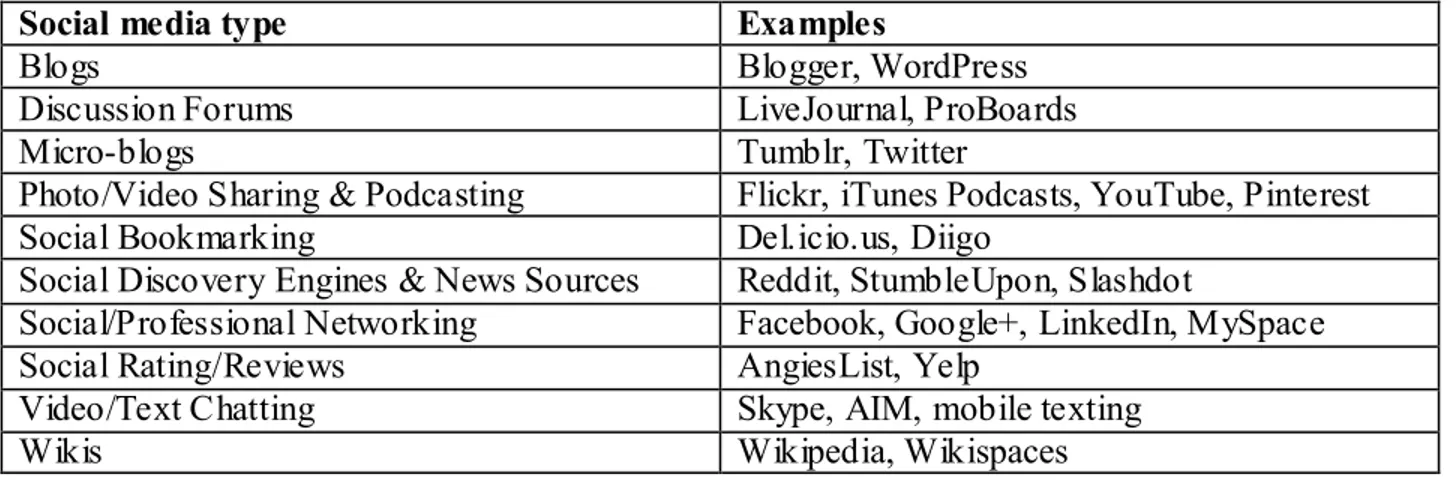
Fraustino, Liu, and Jin (2012) opted for a more detailed look on social media types. Table 2.1 outlines a variety of social media types and some popular example for each that are suggested by Fraustino et al. (2012)
Table 2.1: Social media types and examples (Fraustino, Liu & Jin, 2012)
Social media type Examples
Blogs Blogger, WordPress
Discussion Forums LiveJournal, ProBoards
Micro-blogs Tumblr, Twitter
Photo/Video Sharing & Podcasting Flickr, iTunes Podcasts, YouTube, Pinterest
Social Bookmarking Del.icio.us, Diigo
Social Discovery Engines & News Sources Reddit, StumbleUpon, Slashdot
Social/Professional Networking Facebook, Google+, LinkedIn, MySpace
Social Rating/Reviews AngiesList, Yelp
Video/Text Chatting Skype, AIM, mobile texting
Wikis Wikipedia, Wikispaces
The different categories of social media determine the types of their usage among individuals and organization. Each of social media platforms is associated with particular risks and opportunities. Since this dissertation largely focuses on social networking sites, next section is assigned to a more detailed explanation on social networking sites as the most popular category of social media.
2.1.2 Social networking sites (SNS)
Boyd and Ellison (2008) define social networking sites as:
“Web-based services that allow individuals to (1) construct a public or semi-public profile within a bounded system, (2) articulate a list of othe r users
with whom they share a connection, and (3) view and traverse their list of connections and those made by others within the system”.
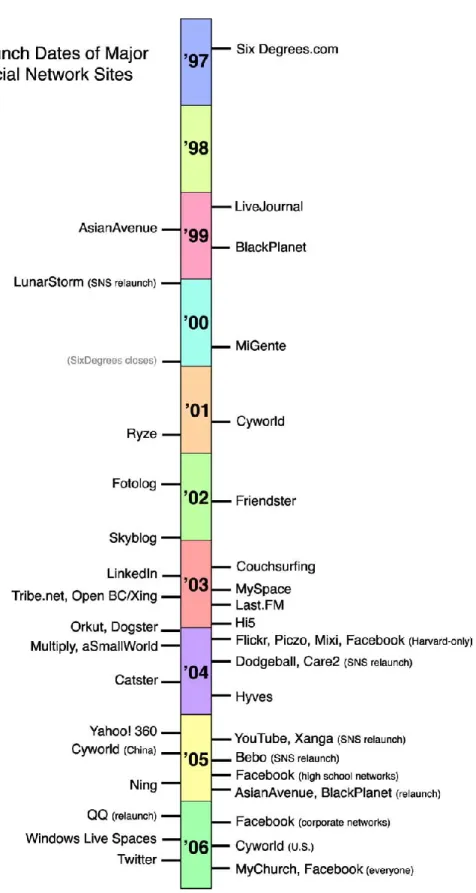
The first identifiable social networking site –SixDegrees.com- was launched in 1997 and allowed users to create profiles, list their Friends, and surf the Friends lists (Boyd and Ellison, 2008). Social networking sites are the most popular group of social media and the term social media and social networking sites are usually used interchangeably. Among all social networking sites, Facebook is the world most popular followed by Twitter, LinkedIn, Pinterest, and GooglePlus (eBizMBA, May 2015). Figure 2-1 represents the timeline of the launch dates of many major SNSs, and dates when community sites re-launched with SNS features. Due to the mass of social networking sites and the scope of this dissertation, all SNS are not reviewed here.
2.2 Social media use
For better or for worse, social media are powerful communication platforms that cannot be ignored. Social media have become part of daily practice for individuals and organizations for a variety of reasons that are discussed in this section.
2.2.1 Individuals use of social media
Individuals of different age and background increasingly embrace social media for a variety of reasons. For instance, the results of a study by Hargiatti (2007) explain that individuals’ gender, race, ethnicity, and parental educational backgrounds are all associated with their social media utilization. The results of a report by Pew Research Center (2014) reveals that 74% of online adults use social networking sites including 72% men, 76% women, 89% young adults (aged 18-29), 82% (aged 30-49), 65% (50-64), 49% (65+); and 73% have more than college education. Studies show that 52% of online adults use multiple social media sites and Facebook is the most popular site for those who only use one (Dugan et al., 2015). Findings of a study on American use of social media show that primary consideration of social media adoption for 66% of them is connections with family members and friends. 14% of users say that connecting around a shared hobby or interest is a major reason they use social media, and 9% say that making new friends is equally important to them (Smith, 2011).
Figure 2-1: Timeline of the launch dates of many major SNS and dates when community sites re-launched with SNS feature (Boyd & Ellison, 2008)
Online social media have also become increasingly popular as information sources (Kim, Yoo-Lee, & Joanna Sin, 2011). Individuals have become active information-seekers who search for variety of new sources of information rather than to be passive recipients of traditional media information (Stephens & Malone, 2009). People use social media for variety of reasons such as gaining news and information (Westerman, Spence, & Van Der Heide, 2012), searching, communicating with each other, and expressing their ideas and opinions (Tsimonis & Dimitriadis, 2014). However there are differences in social media usage. For example, social networking sites like Facebook are used for “everyday life information seeking”, Wikipedia is typically used in professional information seeking situations (Kim et al., 2011), and LinkedIn is used for job searching and professional networking activities (Kim, 2015).
Online users don’t need to search for information and news; they can select their sources of interest to follow on social media platforms (e.g., Twitter, Facebook, or LinkedIn) and kept informed of what they want to see and read (O’Keefe, 2013). Individuals also use social media for the purpose of gaining news and information in disaster and crisis times (Sutton, Paelen, & Shklovski, 2008; Spence et al., 2006;Westerman et al., 2014). Perhaps the attack of September 11, 2001, was the first major crisis in which the Web played an important role as source of information about crisis and Web users’ online communication in forums and chartrooms (Carey, 2002).
2.2.2 Organizations use of social media
Other than individuals, companies also increasingly employ social media for reasons like marketing and brand building activities (Gallaugher & Ransbotham, 2010), enhancing consumer relations from dialogue to trialogue (Magnold & Faulds, 2009), and customer engagement purposes (Tsimonis & Dimitriadis, 2014). Social media are communication tools through which messages could instantly disseminate to particular audiences (Avery et al., 2010). There is no better way than through social media to spread messages, opinions and thoughts to tho usands of audiences through countless number of channels (O’Keefe, 2013). That is why organizations are changing their communication strategies and trying to include social media in their communication settings to involve customers in online discussions (Dijkmans, Kerhof, & Beukeboom, 2015). One reason for brands to adopt social media is to access new audiences and reach a wider range of people (Tsimonis & Dimitriadis, 2014).
Kietzmann, Hermkens, McCarthy, & Silvestre (2011, p. 243) suggest a framework of social media building blocks that explains how firms should engage with social media and develop strategies to monitor, understand and respond to social media activities, which vary in terms of their function and impact. The seven functional blocks of social media are:
1. ‘Identity’ represents the extent to which social media users make their identities public; 2. ‘Conversations’ signify the extent to which users communicate with one another in social
media environment;
3. ‘Sharing’ stands for the extent to which users exchange, distribute, and receive content; 4. ‘Presence’ represents the extent to which users are aware of other users accessibility; 5. ‘Relationships’ stands for the extent to which users can be related to other social media
users;
6. ‘Reputation” is the extent to which users can identify the position of other users and themselves in social media setting;
7. ‘Groups’ represents the extent to which users can form communities and sub-communities (Kietzmann et al., 2011).
In a study of the Fortune 500 companies’ use of Twitter, Facebook, blogs and client hosted forums to interact with customers, Culnan, McHugh, & Zubillaga (2010) found out that in order to gain full business value from social media, organizations need to acquire implementation strategies base on “mindful adoption, community building and absorptive capacity”.
2.3 Social media potential risks
Social media are channels for a story to go viral in a short period of time (Veil, Sellnow, & Petrun, 2012). “Share” on “Facebook”, “re-tweet” on Twitter, “email this video” on YouTube are options that offer online social media users the ability of information diffusion that could result in different types of risks such as common example of illegitimate use such as spam (Grier et al. 2010; Wang 2010; Ratkiewicz et al., 2011 ) or the risk of false information. The dissemination of false information via Twitter during Chilean earthquake is an example that explains the situation. The Chilean earthquake occurred off the coast of the Maule region of Chile on February 27, 2010 and it reached a magnitude of 8.8 on the Richter scale and lasted for 90 seconds (Mendoza,
Poblete, B., & Castillo, 2010). In the hours and days after the earthquake, Twitter was used to tweet time-critical information and emerging topic such as tsunami alerts, missing and deceased people, available and interrupted services (Mendoza et al., 2010). In few hours, the topic of Chilean earthquake reached the level of “trending-topic” on Twitter (Castilo, Mendoza, & Poblete, 2013). Castillo et al., (2013) investigated how Twitter was used during the earthquake by collecting public tweets during February 27 and March 2, 2010. They figured out 1,181 confirmed true tweets versus 1,682 false rumors, such as death of a well-known artist, tsunami warning, water tower broke, looting in some districts, and volcano activation. Their findings indicated that when information from official sources was insufficient, several rumors posted and re-posted on Twitter and increased the sense of “chaos and insecurity” among local public (Castilo, Mendoza, &Poblete, 2011). In what follows, three risks associated with social media are discussed.
2.3.1 The credibility of social media information
Social media technologies enable individuals to become the source of online information and to share ideas and thoughts with others (Marken, 2007). However, there are major concerns about the credibility of information shared through social media channels (Sutton et al., 2008). The credibility of online sources of information is under question because anyone with access to a server can share information with no control (Johnson & Kaye, 1998). The online information lacks the professional gatekeepers who monitored the traditional media contents (Westerman et al., 2012). Therefore, it is more complex to identify the credibility of online media compared to traditional media as there is no control on published information in the online environment and consequently, online information is potentially “distorted”, “inaccurate”, “biased”, “misleading’, or even “false” (Flangain & Metzger, 2000; Metzger & Flanagin, 2013). Consequently, online users are faced with the challenges of the information overload and the necessity for examining the information credibility (Sundar, 2008). Westerman et al. (2012) indicate that consumers of online information are responsible about the perceived credibility of information they cons ume in social media environment.
Fogg and Tseng (1999, p.80) define credibility as “believability. Credible people are believable people and credible information is believable information”. In order to evaluate credibility, it is needed to assess the two components of credibility: “trustworthiness” and “expertise” (Fogg et
al., 2001). Credibility is a “perceived quality” (Fogg & Tseng, 1999) therefore, what is always meant by credibility is in fact the perception of credibility (Petty & Cacioppo, 1996). Few studies have examined people assessment of the credibility of online information. For example, the results of a study by Flangain and Metzger (2000) show that people perceive Internet information as credible as television, radio and magazines but not as credible as newspapers’ information. Castillo et al. (2011) assessed the credibility of a set of tweets based on an automatic method and found that credible news are disseminated through authors who have written a large number of messages before and have many re-posts. Westerman et al. (2012) found out that having too many or too few followers and followings on Twitter decrease perceived credibility of the source. Nevertheless, what is relatively less studied is how online users evaluate social media information in normal times compared to crisis times regarding the credibility and trustworthiness. This research work is amongst the premier that aims to address this research gap by evaluating users’ perceived information credibility in normal times compared to crisis times in online social media environment.
2.3.2 Social media crisis
Social media enable users to create and distribute information that could be true or false. If the viewership of these contents goes viral, spreading exponentially through social media, it could create a crisis (Veil et al., 2012). Fean-Banks (2007, p. 271) define crises as:
“Unplanned events that directly or potentially threaten our company’s reputations; the environment; the health, safety, or welfare of employees; and the health, safety, or welfare of citizens in communities surrounding our plants”.
A crisis is an unexpected event that creates high levels of uncertainty and threatens corporate main goals (Seeger, Sellnow &, Ulmer,2003) and organization’s reputation. Crisis impacts organization reputation and creates secondary reactions such as boycotting (Coombs, 2007; Dowling, 2000).
Due to the evolving of social media, individuals and communities could “create, share, and consume blogs, tweets, Facebook entries, movies, pictures” and conversations about companies and brands happen with or without their presence and permission (Kietzmann et al., 2011). The
open access given by social media enables individuals to create and distribute all types of contents. A crisis involving social media could originate from posting a video on YouTube, sharing a post on Facebook, tweeting on Twitter or writing a blog post. Owyang (2011) defines social media crisis as “an issue that arises in or is amplified by social media, and results in negative mainstream media coverage, a change in business process, or financial loss”. In the online environment, the crisis information can be shared, re-shared and reaches millions of people in the absence of traditional media gatekeepers (Veil et al., 2011). In social media environment, the true or false information quickly circulates and the crisis could occur quicker than before (Hosseinali-Mirza, de Marcellis-Warin, &Warin, 2015).
To conclude, an example of social media crisis that resulted in organization reputation damage is explained. In June 2005, Jeff Jarvis –journalist and blogger- complained about his new Dell computer in his blog, The Buzz Machine. His blog post (Jarvis, 2005) was:
“I just got a new Dell laptop and paid a fortune for the four-year, in-home service. The machine is a lemon and the service is a lie. I’m having all kinds of trouble with the hardware: overheats, network doesn’t work, maxes out on CPU usage. It’s a lemon”.
He represented his dissatisfaction through targeting the product, the service, marketing, pricing, and most importantly the Dell brand. The blog post represented customer dissatisfaction and a company who does not consider customer delight and its reputation is under q uestion. In response, the unhappy customers joined Jarvis on the blogosphere. Jarvis continued to circulate the criticism by triggering hundreds of bloggers to publicly complain about the service they have received from Dell’s technical support (Slide Share, 2010). As a result, an explosion of negative sentiment from consumers about their experiences and the negative buzz around Dell were posted everywhere and went viral. What happened to Dell is an example of social media crisis, which shows the extent and length of crisis range in social media environment. The crisis happened in 2005 in which social media platforms such as Facebook and Twitter were not as popular as today and consequently they are not involved in crisis creation and information diffusion.
2.3.3 Reputation risk
With the rise and quick expansion of social media, organizational reputation is more exposed to threats due to the fast circulation of information among social media channels. Social media allow for an extraordinary dissemination of messages at minimum cost, but they r emain mainly out of control, and might turn into negative exposure and threaten organizational reputation. Reputation is and continues to be one of the most important corporate assets, and also one of the most difficult to protect (Economist Intelligence Unit, 2005). Organizational reputation is a multidisciplinary subject of study. Fombrun (1996, p.72) defines reputation as “a perceptual representation of a company’s past actions and future prospects that describe the firm’s overall appeal to all its key constituents when compared to other leading rivals”. Reputation is stakeholders’ perceptions about an organization ability to create value relative to competitors (Fombrun & Shanley, 1990; Deephouse, 2000). The financial impact of a good or bad reputation is real but hard to measure (Warin, T., de Marcellis-Warin, N., Sanger, W., Nembot, B., & Hosseinali-Mirza, V., 2015). Chun (2005, p.105) regards reputation as:
“The summary view of the perception held by all relevant stakeholders of an organization, that is, what customers, employees, suppliers, managers, creditors, media and communities believe the organization stands for, and the associations they make with it”.
Coombs and Holladay (2012) argues positive collaboration and information about the organization build good reputation, while negative information is harmful to organizational reputation. In the social media context, reputation is defined as “the extent to which users can identify the standing of others, including themselves, in a social media setting” (Kietzmann et al., 2011, p.247)
Threats to reputation can destroy, literally in hours or days, an image or brand developed and invested in over decades (Larkin, 2003). According to Greyser (2009), reputational concerns come in different forms and from many publics. Some are unexpected, like the death of seven people in one day from Tylenol capsules; some are the result of long term problems, like the scandal of Arthur Andersen accounting firm; some other come from dissatisfied customers and the general public (Greyser, 2009). Reputation risk can also result from an organization’s own communication activities, including their reaction to claims presented in the social media (Aula,
2009). Kietzmann et al. (2011) argue that consumers are increasingly using social media websites to ‘create, modify, share, and discuss Internet contents’ that can significantly ‘impact a firm reputation, sales, and even survival’.
Social media might pose reputation risk to firms (Aula, 2010). Reputation risk is the chance of losing one’s reputation. It threatens corporations and influences their competitiveness, local positioning, trust and loyalty of stakeholders, media relations, and even the permit to exist (Rayner, 2004). According to Economist Intelligence Unit (2005) reputational risk emerges as the main concern for the majority of risk managers—ahead of regulatory risk, human capital risk, IT network risk, market risk, and credit risk. Due to the rise of social media, reputation risk is now the biggest risk concern, which enables immediate global communications that make it harder for companies to control how they are perceived in the marketplace (Deloitte, 2013).
Reputation can be enhanced or damaged among social media platforms (Jones et al., 2009). In order to impact online reputation, companies’ need to move toward engaging stakeho lders in online conversations, since well managed online conversation help companies to build and maintain “presence”, “reputation” and “brand image” (Jones et al., 2009). A favorable reputation might protect a company in times of crisis (Shamma, 2012). Dijkmans, et al. (2015) argue that “online reputation management involves interacting with people online, creating sharable content, monitoring what stakeholders3 are saying, keeping track of their dialogue, addressing negative content found online, and following up on ideas that are shared through social media”.
2.4 Crisis communication strategies
We live in the information age where the majority of all people around the world can communicate by messages from different sources, through different channels (Wahlberg & Sjöberg, 2000). One of these channels of communication is social media. When an incident hits an organization, the dissemination of online information among social media channels can create a crisis on one hand, and on the other hand it can help the organization to manage the crisis (Veil et al., 2012).
3 Those who ‘benefit from or are harmed by, and whose rights are violated or respected by corporate actions’ (Evan
Crisis communication strategies are of significant core to all crises (Valvi & F ragkos, 2013). In the process of crisis communication, organizations provide an explanation to public about what happened and offer a solution to the problem (Millar & Heath, 2003). During crisis, the Internet causes the loss of a certain amount of control organizations have over their communication channels and that is why organizations might have difficulties to be heard against other noises in online environment (Freberg, 2012). However, Internet-based technologies could be used in crisis time as the source of information and the channel of communication. September 11, 2001, is the first example of the Internet usage among public during the terrorist attack. During a crisis, organizations should decide how to communicate with their stakeholders to maintain their organizational image (Stephens & Malone, 2009). The speed of the information diffusion has additional importance during crisis, in which organizations are expected to provide credible information that stand against rumors and false noises to protect them and help stakeholders to have a valid picture of the situation (Osatuyi, 2013). During a crisis, social media can serve as a platform for online communication, acting as an informal communication channel through which personal or organizational information is conveyed, shared, and managed (Austin, Liu, & Jin, 2012). Some organizations employ the Internet in crisis communication strategies, but the majorities are hesitant to consider social media as an accurate and credible information source and prefer to use traditional public relations tactics (Perrry, Taylor, & Doerfel, 2003; Wright & Hinson, 2009).
Crisis response strategies are used to repair the reputation and to prevent more negative effects of the crisis (Dowling, 2000; Coombs, 2007). JetBlue’ response to its Valentine’s Day social media crisis is an example of an appropriate crisis response that addressed an issue that was almost as widely reported in the media as the airline's problems and resulted in issuing a Customer Bill of Rights (Hanna, 2008). Selecting the appropriate crisis response strategy is a function of crisis origin (external or internal), crisis information form (via which channel the message is conveyed, e.g., Tweet, press release, etc.) and crisis information source (who the information is sent by, e.g., journalists, bloggers, other organizations, etc.) (Jin & Liu, 2010; Liu et al., 2012). Inappropriate communication and response strategies accelerate social media crises (Ott & Theunissen, 2014). Post-crisis communication strategies are used to repair reputational loss and prevent reputational damage (Coombs & Holladay, 2005). Social media provide emotional support after a crisis
through enabling people to virtually stay connected, share information, and demand resolution (Chio & Lin, 2009).
2.4.1 Crisis communication theories
This section turns to a review of existing crisis communication theories, which are relevant to the scope of this dissertation. The selected theories are: Image repair theory, Situational crisis communication theory (SCCT), The Blog-mediated crisis communication model (BCCM), The Social-mediate crisis communication model (SMCC), and Networked crisis communication theory (NCC). A quantitative study of crisis communication research shows that Image repair theory and Situational crisis communication theory dominate the field of crisis communication research (Avery, Lariscy, Kim, & Hocke, 2010). The aforementioned theories are described as follows.
2.4.1.1 Image repair theory
Benoit (1997) built image repair theory based on earlier theories of “apologia” and “accounts”. The focus of the theory is on message options and what a corporation can say when facing a crisis. The theory offers five categories of image repair strategies including: “Denial”, “Evasion of Responsibility”, “Reducing offensive of Event”, “Corrective Action”, and “Mortification”. Despite that image repair theory is practical and dominant, it needs adaptations and expansions when applying to social media (Liu & Fraustino, 2014), considering that the model is linear and static (Gilpin, 2010; Seeger & Griffin, 2010).
2.4.1.2 Situational Crisis Communication Theory (SCCT)
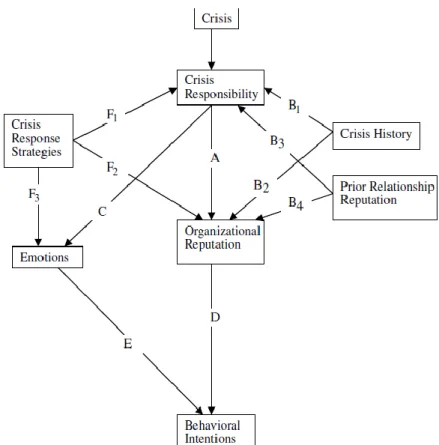
Situational Crisis Communication Theory (SCCT) provides a framework for understanding how to maximize the reputational protection by crisis communication and identifies how key features of crisis situations impact attributions about the crisis and organizational reputation (Coombs, 2007). The model includes steps in reputational threats evaluation in crisis situations and propositions for crisis managers to determine which crisis response strategy to apply to increase reputational protection. Coombs (2006) classifies crisis response strategies as “Deny”, “Diminish”, and “Deal” response options. Figure 2-2 represents crisis situation model of SCCT.
Figure 2-2: Crisis situation model of SCCT (Coombs, 2007)
The main focus of SCCT is on the organization concerns in crisis time (Liu & Fraustino, 2014) and research has yet to fully investigate the application of SCCT in social media environment (Coombs &Holladay, 2012; Schwarz, 2012).
2.4.1.3 Blog-Mediated Crisis Communication model (BMCC)
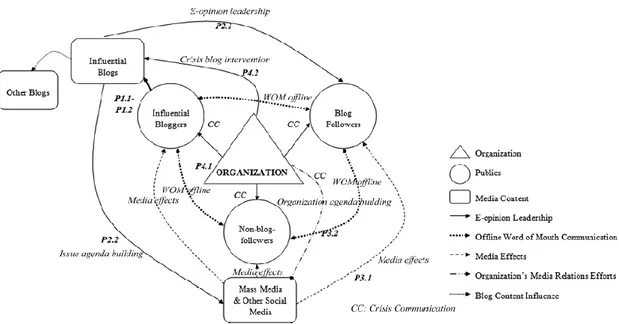
The Blog-mediated crisis communication model (BMCC) emerged as a response to the impact of blogosphere on public relations practices in order to help crisis managers monitor blogosphere and respond to influential bloggers (Jin & Liu, 2010). The model is meant to help public relations to navigate through the new emergent blogosphere and to respond when it is necessary. The model is represented in figure 2-3.
Figure 2-3: Blog-mediated crisis communication model (Jin & Liu, 2010)
Jin and Liu (2010) grounded their proposed model in opinion leadership, word-of-mouth communication, and rumor/crisis response research. The model later upgraded by changing blog-mediated crisis communication model to social-blog-mediated crisis communication model to embrace more requirements of corporate crisis communication in social media environment.
2.4.1.4 Social-me diated Crisis Communication Model (SMCC)
Social-mediated Crisis Communication Model (SMCC) emerged from an evaluation of BMCC through interviewing 40 communication professionals with the aim of adopting social media tools in to crisis communication strategies (Liu, Jin, Briones, & Kuch, 2012). The findings supported public increasingly uses of social networking sites like Facebook and Twitter instead of blogs, therefore the authors adjusted BMCC model to SMCC model based on their empirical research. The model includes five considerations: “crisis origin”, “crisis type”, “infrastructure”, “message strategy”, and “message form” that affect how organizations respond to crises via traditional media, social media and offline word-of-mouth (Liu et al., 2012). The model is represented in figure 2-4.
Figure 2-4: Social-Mediated Crisis Communication Model (Liu, Jin, Briones, & Kuch, 2012) SMCC is criticized for not being a comprehensive model and that it only focuses on reputation-management (Freberg, 2012).
2.4.1.5 Networked Crisis Communication theory (NCC)
The Networked Crisis Communication theory (NCC) “challenges classical crisis communication theories by showing that the medium used affects the impact of crisis communication” (Utz, Schultz, & Glocka, 2013, p.41). The main focus of the model is the effect of media type on crisis message effectiveness by contrasting the effects of medium (Facebook vs. Twitter vs. online newspaper) and crisis type (intentional vs. victim) using a single crisis scenario (Utz et al., 2013). The model indicates that crisis messages disseminated via social media result in different public responses compared to the same message are being distributed through traditional media (Schultz, Utz, & Göritz, 2011; Utz et al., 2013). Yet, the model lacks the point of how organizations could use social media to mitigate the negative outcomes such as boycott (Liu & Fraustino, 2014) and there is still a need for more compound models of crisis communication in social media environment (Utz et al., 2013). Table 2.2 shows the crisis communication theories that are selected and explained with regards to the scope of this research.