HAL Id: hal-01834324
https://hal.archives-ouvertes.fr/hal-01834324
Submitted on 25 Jan 2021
HAL is a multi-disciplinary open access
archive for the deposit and dissemination of
sci-entific research documents, whether they are
pub-lished or not. The documents may come from
teaching and research institutions in France or
abroad, or from public or private research centers.
L’archive ouverte pluridisciplinaire HAL, est
destinée au dépôt et à la diffusion de documents
scientifiques de niveau recherche, publiés ou non,
émanant des établissements d’enseignement et de
recherche français ou étrangers, des laboratoires
publics ou privés.
Deep circulation in the equatorial Atlantic Ocean
Yves Gouriou, Chantal Andrié, Bernard Bourlès, S. Freudenthal, Sabine
Arnault, A. Aman, Gérard Eldin, Yves Du Penhoat, François Baurand,
Francis Gallois, et al.
To cite this version:
Yves Gouriou, Chantal Andrié, Bernard Bourlès, S. Freudenthal, Sabine Arnault, et al.. Deep
circu-lation in the equatorial Atlantic Ocean. Geophysical Research Letters, American Geophysical Union,
2001, 28 (5), pp.819 - 822. �10.1029/2000GL012326�. �hal-01834324�
GEOPHYSICAL RESEARCH LETTERS, VOL. 28, NO. 5, PAGES 819-822, MARCH 1,2001
Deep Circulation in the Equatorial Atlantic Ocean
Y. Gouriou
1 , C. Andri•
2 , B. Bourl•s
3, S. Freudenthal
2, S. Arnault
2, A. Aman
4,
G. Eldin
5, Y. du Penhoat
5, F. Baurand
3, F. Gallois
I and
R. Chuchla
3
Abstract. In the Atlantic Ocean, the northward export of warm surface water is compensated by a southward flow of cold North Atlantic Deep Water (NADW). The NADW is transported southward along the American continental margin within the Deep Western Boundary Current (DWBC). Some tracer and float observations have shown that part of the DWBC water flows eastward along the equator. Here we present three meridional velocity sections which give an instantaneous image of the top-to-bottom zonal circulation along the equatorial Atlantic. They reveal the presence of Equatorial Deep Jets (EDJs) between lø30'N and 1ø30'S, alternating eastward-westward currents with short vertical scale, surrounded by columns of eastward currents (the Extra Equatorial Jets or EEJs) at 2øN and 2øS. In addition to direct velocity measurements, tracer distributions give indications of water-mass feeding of the EDJs and EEJs by the DWBC.
Ponte et al., 1990; Ponte et Luyten, 1990]. They showed the
presence of vertically alternating eastward and westward
currents with short vertical scale, the Equatorial Deep Jets
(EDJ). The sparse direct top-to-bottom velocity profiles
recorded in the western and central basins of the equatorial Atlantic have identified EDJs [Ponte et al. 1990; B6ning and
Schott, 1993; Gouriou et al., 1999], but their three-
dimensional description is far from complete. SOFAR floats tracked at 1800 m-depth evidence a 2-regime system within
the tropical band [Richardson and Fratantoni, 1999]: EDJs
between 2øN and 2øS, highly variable in time, and continuous eastward flowing Extra-Equatorial Jets (EEJ) on the northern and southern flank of the EDJs. Three top-to-bottom velocity
sections are presented here; they describe the zonal circulation
over the equatorial Atlantic with a high meridional resolution.
Data Introduction
In the Atlantic Ocean, the southward flowing DWBC transports the cold NADW (lower than 4øC below 1000 m), formed by convection in the northern polar and subpolar regions, along the continental margin of the American continent. This equatorward flow of deep water is compensated by a northward flow of warm surface water (0- 1000 m). This thermohaline circulation cell generates a net positive heat flux toward the northern hemisphere, and is a major component of the world climate system [Broecker,
1991]. The newly conveered NADW is characterised by
maximum concentration of chlorofiuoromethanes (CFCs)
[Weiss et al., 1985] at the density levels of the Upper NADW (UNADW) (around 1700 m-depth), originating in the
Labrador Sea, and of the Lower NADW (LNADW) (around
3800 m-depth), flowing from the Denmark Strait Overflow. High CFC concentrations indicate the NADW path, within the DWBC, from its origin to the equatorial region: part of the NADW flows southward in the southern hemisphere while the other portion splits off and extends eastward along the equator
[Weiss et al., 1985; Rhein et al., 1995; Andrid et al., 1998].
The complexity of the equatorial circulation was revealed by deep velocity profiles made in the three oceans [Firing, 1987;
•Institut de Recherche pour le D6veloppement Noum6a, New-
Caledonia.
2Laboratoire
d'Oc6anographie
Dynamique
et de Climatologie,
Universit6 de Paris VI, Paris, France.
3Institut
de Recherche
pour
le D6veloppement,
Plouzan6,
France.
4Universit6
de Cocody,
Abidjan,
Ivory-Coast.
5Laboratoire
d'Etudes
en G60physique
et Oc6anographie
Spatiales, Toulouse, France.Copyright 2001 by the American Geophysical Union.
Paper number 2000GL012326. 0094-8276/01/2000GL012326505.00
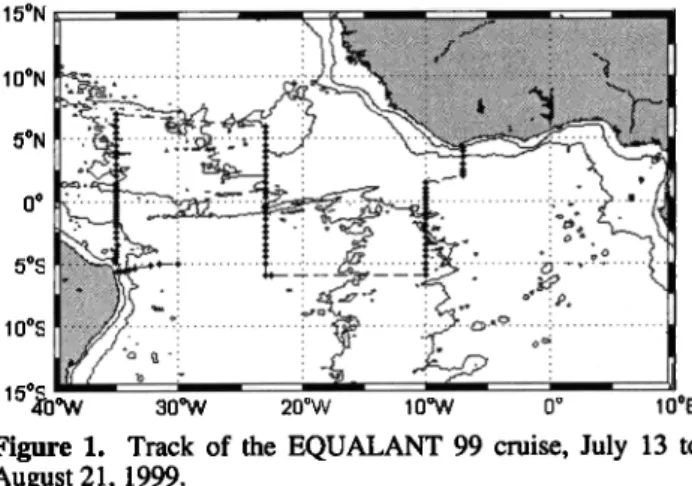
Data discussed in this paper were acquired during the
EQUALANT 99 (EQ99) cruise (July 13 to August 21, 1999) along the meridians 35øW, 23øW, and 10øW (Fig. 1). The velocity profiles were made using a technique that became widely used during the World Ocean Circulation Experiment: the Lowered Acoustic Doppler Current Profiler (LADCP)
[Fischer and Visbeck, 1993]. This current profiler, mounted on a rosette frame together with a conductivity-temperature-
pressure profiler (CTD), is lowered from the surface down to
the bottom of the ocean. As the LADCP has no pressure
sensor, the depth of each cell is determined by using the pressure time series given by the CTD measurements. CFCs samples (CFC-11 and CFC-12) were taken with a 24-81 bottle sampling rosette. The vertical sampling resolution of bottles was high (100 m-depth interval) around 1800 m and 3800 m,
i.e at the levels of the upper and lower NADW.
Result
One of the most striking features of the equatorial circulation is the vertical stacking of westward and eastward
Figure 1. Track of the EQUALANT 99 cruise, July 13 to
August 21, 1999.
820
GOURIOU
ET AL.: DEEP CIRCULATION
IN THE EQUATORIAL
ATLANTIC OCEAN
•ooo
....
,•'
•'•
:,OOOl...i•-•..-
•- ...
•.•'--
5000 / ; ; 10 W 0 •0 80 Zonal Velocity (cm/s) , b) F11(pmol/kg)-(23•W-2•S) , ,,,,,,,, ,, ,, ,,,,,,,,, 0 ' ' 0 0.1 0.2 0.3 ,••1500
2000
2000
• 3000
ooo
2500 • o • . -20 -10 0 10 20 Zonal velocity (cm/s) - (23 o W-2 o S) 5000 c) Fll (pmol/kg) - (35øW-0 ø)0
0.1
0.2
0 3
6•S 5•S 4•S 3•S 2•S 1•S
0•S I•N 2•N
3•N 4"N
5•N
7•N
1øøø1
"' ••
••l
• • ' ' '•' :-: ' :'""':
:•':•
'"
-
1500 ...2000
....
• 2000
3000Zonal velocity (cm/s) - (35 oW-0 •)
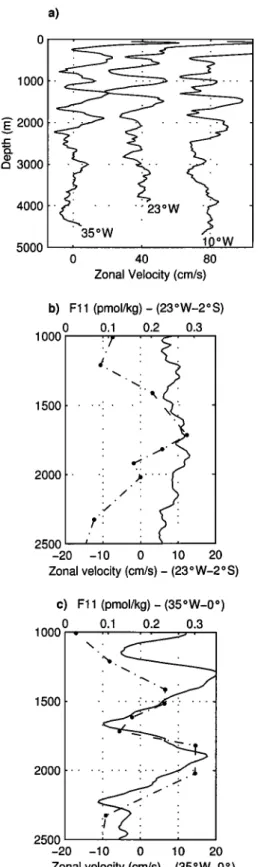
Figure
2. Ve•ical
profilesof CFC-11
and LADCP 5ooo
., ,' ,'...,
....
. ... 3o
c•s
measurements.
(as)_lDepth
profiles
of
the
zonal
component
of
velocity in cm , at 35øW-0 ø, 23øW-0 ø, 10øW-0 ø. Each
profile
has
been
shifted
by 40 cm s
'• from
the preceding
one.
Eastward (westward) currents are positive (negative). (b)
CFC-11 profile (dashed-dotted line) and zonal velocity profile
(solid line) at 23øW-2øS. (c) CFC-11 profile (dashed-dotted line) and zonal velocity profile (solid line) at 35øW-0 ø. The
detection limit for the CFC-11 measurements was about 0.009
pmol.kg
'•.
6os 5os zios 3os 2os 1os 0os 1ON 2ON 3ON 4ON
Plate 1. Latitude-depth section of the zonal component of
velocity,
in cm s
'•, along
35øW,
23øW,
and 10øW.
Eastward
(westward) currents are positive (negative). Contour interval
is 5 cm s
'•. Station
positions
are reported
on the top of every
GOURIOU ET AL.: DEEP CIRCULATION IN THE EQUATORIAL ATLANTIC OCEAN 821 currents between 500 m and 2500 m: the EDJs (Fig. 2a and
plate 1). They share common characteristics all across the basin: (i) they are confined between lø30'N and 1ø30'S, (ii)
their vertical scale (measured between consecutive maxima of
westward velocity) is about 500 m, and (iii) their maximum
zonal
component
reaches
25 cm s
'• (around
1250
m at 23øW).
The equatorial profiles display about 6 alternating eastward-
westward jets between 500 m and 2500 m at 35øW, 23øW, and 10øW (Fig. 2a). These quasi-synoptic measurements
provide new information on the zonal coherence of the jets
over the basin. The eastward flowing jet at 1000 m depth is traceable over the 25 ø of longitude of the measurements. In the upper part of the equatorial profiles, the 750 m westward flowing jet is clearly visible at 35øW and 23øW. Below 1000 m the jets are found at the same depth at 23øW and 10øW, at
1250 m, 1500 m, and 1750 m; whereas it looks like there is an
upward shift of those jets at 35øW (Fig. 2a). Despite the
global zonal coherence of the jets, the individual profiles
cannot be perfectly superimposed. It thus appears that the jets did not get established simultaneously (during the duration of
the cruise) across the basin, over the whole column of water.
At 23øW, a striking relationship exists between the velocity
of the jets and their latitudinal extension. The swiftest jet at
1200
m-depth
(-21 cm s
'•) has
the
largest
latitudinal
extension
(1ø30'N-1ø30'S). Gouriou et al. [1999] already noted that feature at 35øW, during a cruise made in May 1996. They described a westward jet at 1300 m depth, with maximum
velocity
(-25 cm s
'•) and maximum
latitudinal
extension.
But
it must be noted that at 10øW (Plate 1), the width of the
swiftest
jet (-28 cm s
'•) at 900 m-depth
is similar
to the
width
of the 1200 m westward jet.
Another remarkable feature of these sections is the ring of eastward flowing currents surrounding the EDJs at 2øN and 2øS (Plate 1): the EEJs. At 23øW, where neither boundary
currents nor continental masses alter the current structure, this
pattern completely surrounds the EDJs. In this ring, maxima of eastward velocity coincide with EDJ maxima of westward velocity at 500, 700, 1200 and 1800 m. The maximum meridional extension of the ring is found at 1200 m-depth (the
EEJs are centred on 2ø30'S and 2ø30'N), where the EDJ is the
swiftest. At 10øW the EEJs are clearly visible at 500 m-depth, and maxima are distinguishable at 1000 and 1300 m. On that section, north of the equator, the eastward flowing currents are only present in the top 1500 m, but the section was interrupted at lø30'N, to be continued north of 2øN along 7øW (Fig. 1). At 35øW, EEJs are clearly visible at 700 and 1000 m at the
same levels as westward EDJs. The eastward currents at 2øN
and 2øS around 800 m depth transport Intermediate Water to
the interior, and are called the Southern and Northern Intermediate Current [Schott et al., 1995; Boebel et al., 1999].
Similar currents were also evidenced in the equatorial Pacific [Firing, 1987]. The EQ99 sections show that the columns of eastward current extend at depth, and are not limited to the depth range of the Equatorial Intermediate Water mass.
The three velocity sections (Plate 1) give an improved understanding of the equatorial circulation hinted at by the float trajectories. The existence of EEJs had been previously
inferred from SOFAR floats [Richardson and Fratantoni,
1999] tracked at a mean depth of 1800 m, giving a crude
estimate of their width as 2 ø latitude, and of their thickness as at least 500 m. The northern EEJ was also evidenced at 1000
m depth by PALACE float trajectories [Molinari et al., 1999]. Our measurements bring new information concerning the
spatial structure of the EEJs: the vertical extension of the eastward current is very large (the entire water column) and cores of velocity maxima appear symmetrically about the equator, at the depth of the westward œDJs. Non-synoptic sections in the equatorial Pacific Ocean suggest the presence of elongated recirculation gyres, symmetrical around the equator [Firing et al., 1998]. The three quasi-synoptic sections made in the equatorial Atlantic strongly support this hypothesis. Furthermore they indicate that these recirculation patterns are reinforced at the depth of the westward flowing EDJs and associated eastward flowing EEJs, creating a vertical stacking of gyres. At first glance there does not appear to be any relationship between the intensity of the EDJs and
the EEJs. The swiftest EEJs are found at 500 m, at 2øN-23øW
(> 35 cm s
'•) and
at 2øS
- 10øW
(> 25 cm s'•).
At 23øW, we observe columns of westward currents at 3øS -
4øS and 3øN-4øN, and, poleward, columns of eastward
currents south of 4øS and north of 4øN. This succession of columns of eastward and westward flow with short meridional
scales is somewhat different from the large-scale circulation pattern deduced by Talley and Johnson [1994] from tracer distribution, giving a westward flows at 5-8øN and 15-20øS,
and an eastward flow, centred on 1-2øS, in between.
The CFC measurements, together with the LADCP ones, shed new light on equatorial circulation dynamics. Since the first CFC measurements in 1983 showing the CFC tongue at 1700 m centred on the equator [Weiss et al., 1985], Andrid et al. [1998] have shown the maximum CFC-11 concentration to be at 2øS. That southward position of the CFC-11 plume was confirmed during the EQ99 cruise and it coincides with the location of the EEJs (23øW-2øS at 1700 m) (Fig. 2b). This
observation confirms that the CFC enriched waters of the
DWBC directly feed the EEJs south of the equator, as
suggested from float trajectories [Richardson and Fratantoni,
1999]. At 35øW, the south-eastward flowing DWBC separates from the coast and is clearly visible at 3øS from 1300 m down to the sea-floor (Plate 1). It must be noted that the position of the DWBC at this longitude is highly variable, as it fluctuates
between 3øS and 1ø30'S [Rhein et al., 1995; Gouriou et al.,
1999]. The upper level of the NADW is thus advected eastward by the EEJs toward the interior of the basin. The absence of a CFC-11 enriched core in the northern EEJs may indicate that they are not directly fed by the DWBC at the western boundary. One reason can be that, in the northern
hemisphere, the southward flowing DWBC is tightly confined along the western boundary, making difficult any link with the
pure equatorial dynamics basin.
CFCs and velocity distributions confirm preceding observations of an eastward flow of the LNADW layer [Rhein et al., 1995; Andrid et al., 1999]. This flow is constrained by the bottom topography at 35øW, the so-called equatorial
channel between IøN and 3øS (Plate 1). At 23øW, the
eastward velocity core at 3800 m-lø30'S is linked to a CFC maximum (not shown) showing the eastward extension of the LNADW tongue. No CFC core is found at 10øW, south of the
equator; probably because of a blocking by the mid-Atlantic
ridge (Fig. 1).
A new feature concerning EDJs can be inferred from the comparison between the vertical distributions of CFC-11 concentrations and zonal velocities. At the equator, and for each section, we no longer observe the usual 1700 m CFC-11
maximum, characteristic of the UNADW within the DWBC in
within the EEJs, south of the equator (Fig. 2b). Actually, what we observe is an absolute minimum between two relative
maxima at 1500 m and 2000 m (Fig. 2c). The vertical CFC-11
profile then matches the zonal velocity profile: maxima of CFC-11 concentration are linked to the eastward flowing jets, while the 1700 m minimum is found at the depth of a westward flowing jet. Above 1400 m, the upper CFC-11
maximum does not coincide exactly with the maximum of eastward velocity, because this depth level is above the ventilated NADW and is CFC-11 depleted. The minimum of
CFC-11 concentration observed at 1700 m indicates that the associated westward flowing jet is fed with CFC-11 depleted
water, of eastern origin. Previous measurements made in
different years and at different seasons showed jets with
opposite directions [B6ning and Schott, 1993; Gouriou et al.,
1999]. But it could not be concluded from those
measurements whether this was due to in-place reversal or to
vertical propagation. The CFC distribution gives a time-
integrated view of the equatorial circulation. We are thus tempted to conclude that the minimum CFC-11 concentration at 1700 m, at the equator, indicates that the mean flow at this depth is predominantly westward; while the maximum CFC- 11 concentration at 2øS suggests continuous eastward current
at that latitude.
Conclusion
This study has shown how the improvement of current
measurement techniques and the use of tracer distributions can give new insights regarding equatorial circulation. However, measurements are too few for any definitive conclusion on the
mechanisms responsible for the EDJs: vertical propagation of linear waves [Eriksen, 1982; Muench et al., 1994], forcing by the DWBC [Kawase et al., 1992], or non-linear theory [Hua et al., 1997]. Annual and semi-annual variability of the zonal component of the velocity was recently observed in mooring
measurements below 1700 m in the central Atlantic [Thierry,
2000]. Thierry [2000] has shown that this variability could be forced by the fluctuations of the wind stress through the vertical propagation of Rossby waves, which originate in the eastern basin, below the thermocline. To our knowledge Global Circulation Model are far to reproduce the vertical stacking of the jets with the right vertical scale [BOning and Schott, 1993]; or when they do it, the results are subject to
some controversy [Suginohara et al., 1991; Weaver and
Sarachik, 1991]. It has been proposed that the equatorial currents, the EDJs and the EEJs act as a reservoir for the
DWBC waters [Richardson and Schmitz, 1993], but their residence time is not yet known. Thus further measurements
will be essential to understanding the role of equatorial dynamics in the temporal regulation of the large-scale
meridional overturning cell.
Acknowledgements. This work was supported by IRD (Institut de Recherche pour le D6veloppement), IFREMER (Institut Franqais de Recherche pour l'Exploitation de la Mer) and CNRS/INSU (Centre National de la Recherche Scientifique/Institut National des Sciences de l'Univers) as part of the Programme National d'Etude de la Dynamique du Climat and its CLIVAR/France subprogramme. We thank H.Mercier for comments on the manuscript and the officers and crew of the R/V Thalassa for their help and cooperation.
References
Andri6, C., J.F. Ternon, M.J. Messias, L. Memery, and B. Bourlb•s,
Chlorofluoromethane distributions in the deep equatorial Atlantic during January-March 1993, Deep Sea Res., Part I, 45, 903-930,
1998.
Boebel, O., R.E. Davis, M. Ollitrault, R.G. Peterson, P.L.
Richardson, C. Schmid, and W. Zenk, The intermediate depth circulation of the western South Atlantic, Geophys. Res. Letters,
26, 3329-3332, 1999.
B6ning, C.W., and F.A. Schott, Deep currents and the eastward salinity tongue in the equatorial Atlantic: Results from an eddy- resolving, primitive equation model. J. Geophys. Res., 98, 6991- 6999, 1993.
Broecker, W., The great ocean conveyor, Oceanography, 4, 79-89,
1991.
Eriksen, C.C., Geostrophic equatorial deep jets, J. Mar. Res., 40, suppl., 143-157, 1982.
Firing, E., Deep zonal currents in the central equatorial Pacific, J. Mar. Res., 45, 791-812, 1987.
Firing, E., S.E. Wijffels, and P. Hacker, Equatorial subthermocline currents across the Pacific, J. Geophys. Res., 103, 21,413-21,423,
1998.
Fischer, J., and M. Visbeck, Deep velocity profiling with self-
contained ADCPs, J. Atmos. Oceanic Technol., 10(5), 764-773,
1993.
Gouriou, Y., B. Bourl•s, H. Mercier, and R. Chuchla, Deep jets in the equatorial Atlantic Ocean, J. Geophys. Res., 104, 21,217- 21,226, 1999.
Hua, B.L., D.W. Moore, and S. Le Gentil, Inertial nonlinear equilibration of equatorial flows, J. Fluid Mech., 331, 345-371,
1997.
Kawase, M.L., M. Rothstein, and S.R. Springer, Encounter of a deep western current with the equator: a numerical spin-up experiment,
J. Geophys. Res., 97, 5447-5463, 1992.
Molinari, R.L., S.L. Garzoli, and R.W. Schmitt, Equatorial currents at 1000 m in the Atlantic ocean, Geophys. Res. Letters, 26, 361- 363, 1999.
Muench, J., E. Kunze, and E.Firing, The potential vorticity structure of equatorial deep jets, J. Phys. Oceanogr., 24, 418-428, 1994. Ponte, R.M., and J. Luyten, Deep velocity measurements in the
western equatorial Indian Ocean, J. Phys. Oceanogr., 20, 44-52,
1990.
Ponte, R.M., J. Luyten, and P.L. Richardson, Equatorial deep jets in the Atlantic Ocean, Deep-Sea Res., 37, 711-713, 1990.
Rhein, M., L. Stramma, and U. Send, The Atlantic deep western boundary current: Water masses and transports near the equator, J. Geophys. Res., I00, 2441-2457, 1995.
Richardson, P.L., and W.J. Schmitz Jr, Deep cross-equatorial flow in the Atlantic measured with SOFAR floats, J. Geophys. Res., 98, 8371-8387, 1993.
Richardson, P.L., and D.M. Fratantoni, Float trajectories in the deep western boundary current and deep equatorial jets of the tropical Atlantic, Deep-Sea Res. II, 46, 305-333, 1999.
Schott, F.A., L. Stramma, and J. Fischer, The warm water inflow into
the western tropical Atlantic boundary regime, spring 1994, J.
Geophys. Res., 100, 24,745-24,760, 1995.
Suginohara, N., S. Aoki, and M. Fukasawa, Comments on "On the inportance of vertical resolution in certain oceanic general
circulation models", J. Phys. Oceanogr., 21, 1699-1701, 1991.
Talley, L.D., and G.C. Johnson, Deep, zonal subequatorial currents,
Science, 263, 1125-1128, 1994.
Thierry, V., Observation et mod61isation de la vafiabilit6 saisonni•re dans l'oc•an Atlantique equatorial profond, Th•se de Doctorat, Universit• de Brest, 701, pp 211, 2000.
Weaver, A.J., and E.S. Sarachik, Reply, J. Phys. Oceanogr., 21, 1702-1707, 1991.
Weiss, R.F., J.L. Bullister, R.H. Gammon, and M.J. Warner,
Atmospheric chlorofluoromethanes in the deep equatorial
Atlantic, Nature, 314, 608-610, 1985.
Y. Gouriou and F. Gallois, IRD, B.P. A5, 98848 Noum6a cedex,
New-Caledonia (gouriou @ird.fr)
C. Andri6, S. Arnault, and S. Freudenthal, Universit6 de Paris VI,
LODYC boite 100, 4 place Jussieu, 75252 Paris, France.
B. Bourlb•s, F. Baurand, and R. Chuchla, IFREMER/IRD, B.P.70, 29280 Plouzan6, France.
A. Aman, Universit6 de Cocody, Abidjan, Ivory-Coast.
G. Eldin and Y. du Penboat, LEGOS/IRD, 14 av. E. Belin, 31401 Toulouse cedex 4, France.