ZIAD A. ELSAHN
SMOOTH UPGRADE OF EXISTING FTTH
ACCESS NETWORKS : SAC-OCDMA AND
DENSE SS-WDM SOLUTIONS
Thèse présentée
à la Faculté des études supérieures de l'Université Laval dans le cadre du programme de doctorat en génie électrique
pour l'obtention du grade de Philosophiae Doctor (Ph. D.)
DEPARTEMENT DE GENIE ELECTRIQUE ET DE GENIE INFORMATIQUE FACULTÉ DES SCIENCES ET DE GÉNIE
UNIVERSITÉ LAVAL QUÉBEC
2010
Such is the Bounty of Allah, which He bestows on whom He will: and Allah is the Lord of the highest bounty [Quran: 62-4]
IV
Résumé
Pour satisfaire les futures besoins de bande passante, les réseaux d'accès existants de fibre-au-domicile (FTTH) doivent être améliorés pour garantir au moins une connexion dédiée de 100 Mb/s par abonné. Étant donné que la durée de vie de l'infrastructure d'un réseau optique passif (PON) doit dépasser 25 ans, le remplacement des infrastructures existantes n'est pas désiré lors de l'amélioration du 'throughput' du réseau. Dans cette thèse, nous proposons des solutions peu coûteuses pour la prochaine génération des PONs utilisant l'infrastructure existante basée sur les coupleurs passifs. Les mises à jour nécessaires sont effectuées à base d'abonné permettant un déploiement progressif des clients à haut débit, sans affecter les anciens usagers. Dans notre étude, nous considérons deux types de solutions utilisant des sources de lumière incohérente.
La première approche que nous proposons est d'utiliser le codage spectral d'amplitude à accès multiple par répartition de codes (SAC-OCDMA) pour la prochaine génération des PONs. La performance des architectures basées sur des sources de lumière locales ou des sources centralisées sont examinées en fonction du taux d'erreur binaire (BER), du budget de puissance, et des exigences d'amplification. Nous avons, avec succès, démontré la liaison montante d'un 7x622 Mb/s SAC-OCDMA PON au-dessus d'un lien de 20 km, avec l'opération en mode rafale (burst-mode). Malgré les pertes supplémentaires dans les architectures avec des sources centralisées, nous avons atteint une transmission sans erreurs pour un système chargé, en utilisant un code correcteur d'erreurs (FEC) Reed-Solomon RS(255,239). En utilisant le récepteur 'burst-mode', nous avons atteint un rapport de perte de paquets (PLR) nul, pour un maximum de quatre usagers simultanés et plus de deux ordres de grandeur d'amélioration du PLR pour un PON chargé.
La deuxième approche que nous proposons est un chemin de migration du multiplexage par répartition temporel (TDM) vers le multiplexage dense de tranches de spectres (SS) par répartition en longueur d'onde (WDM). Nous utilisons un nouvel amplificateur optique réfléchissant à semi-conducteur (RSOA) auto-injecté, comme un transmetteur, et
un récepteur balancé récemment proposé pour atténuer le bruit d'intensité. Nous utilisons un réseau de Bragg (FBG) ayant une réflectivité de p% pour l'auto-injection, et nous optimisons sa réflectivité pour un compromis entre la puissance de sortie et l'effet de nettoyage du bruit. Nous avons découvert qu'en utilisant le FBG optimal (p = 18 ± 2%), on peut transmettre jusqu'à 4.5 dBm de puissance dans un canal de 25 GHz. Nous avons démontré expérimentalement une transmission SS-WDM dense à 1.25 Gb/s, et traité la possibilité d'avoir une unité de réseau optique (ONU) incolore en plaçant le FBG au nœud de distribution (RN). Une transmission sans erreurs a été réalisée sur un lien de 20 km pour l'auto-injection locale, alors qu'un plancher de BER autour de IO"9 â été
atteint pour l'auto-injection à distance. Pour un lien de 10 km, une transmission sans erreurs a été atteinte pour les deux cas. Le budget de puissance a permis jusqu'à 32 usagers d'être supportés au-dessus de l'infrastructure existante de PON sans amplification au terminal de ligne optique (OLT). A l'aide des simulations, nous avons estimé que la capacité peut être augmentée à 128 usagers lorsqu'un FEC est utilisé. Nous avons montré que, malgré les pertes élevées au RN, notre solution permet une plus grande efficacité spectrale que celle des SS-WDM PON traditionnels basés sur des rangées de réseaux à guide d'ondes (AWG).
V I
Abstract
To satisfy future bandwidth demands, existing fiber-to-the-home (FTTH) access networks must be upgraded to guarantee at least a 100 Mb/s dedicated connection per subscriber. Since the lifetime of the outside plant of a passive optical network (PON) is expected to be greater than 25 years, replacing the existing PON infrastructure is not desirable when upgrading the network throughput. In this thesis, we propose inexpensive solutions for next generation PONs using the existing passive splitter-based infrastructure. The necessary upgrades are made on a per subscriber basis allowing a gradual rollout of high bit rate clients without affecting the legacy PON users. In our study, we consider two different solutions using incoherent light sources.
The first approach we propose is to use spectral amplitude coded (SAC) optical code-division multiple-access (OCDMA) for next generation PONs. Both local sources and centralized light sources architectures are examined in terms of the bit error rate (BER) performance, the power budget, and the amplification requirements. We successfully demonstrated the uplink of a 7x622 Mb/s SAC-OCDMA PON over a 20 km link, with burst-mode operation. Despite the extra losses in centralized light sources architectures, we achieved error free transmission for a fully loaded system using a Reed-Solomon RS(255,239) forward-error correcting (FEC) code. Using the burst-mode receiver, we reported zero packet loss ratio (PLR) for up to four simultaneous users, and more than two orders of magnitude improvement in the PLR for a fully loaded PON.
The second approach we propose is a migration path from time-division multiplexing (TDM) to dense spectrum-sliced (SS) wavelength-division multiplexing (WDM). We use a novel self-seeded reflective semiconductor optical amplifier (RSOA) as a transmitter, and a recently proposed balanced receiver to mitigate the intensity noise. We use a p % reflective fiber Bragg grating (FBG) for self-seeding, and we optimize its reflectivity to tradeoff the output power versus the noise cleaning effect. We found out that using the optimum FBG ( p = 18 ± 2%), we can transmit up to 4.5 dBm of power within a 25 GHz
channel. We experimentally demonstrated a 1.25 Gb/s dense SS-WDM transmission, and addressed the possibility of colorless optical network unit (ONU) operation by placing the FBG at the remote node (RN). Error free transmission was achieved over a 20 km feeder for local self-seeding, whereas a BER floor around 10"9 was reported for the
remote self-seeding. For a 10 km feeder, error free transmission was achieved for both cases. The power budget allowed up to 32 users to be supported over the existing PON infrastructure without optical line terminal (OLT) amplification. Through simulations we estimated that the capacity can be increased to 128 users when a FEC is used. We showed that despite the high splitting losses at the RN, our solution achieves a higher spectral efficiency than that of traditional arrayed waveguide grating (AWG)-based SS-WDM PONs.
V l l l
Preface
Two chapters of this thesis consist of IEEE journal papers, which are fully presented. My contributions in these papers are detailed here.
Paper 1
Z. A. El-Sahn, B. J. Shastri, M. Zeng, N. Kheder, D. V. Plant, and L. A. Rusch, "Experimental demonstration of a SAC-OCDMA PON with burst-mode reception: local versus centralized sources," IEEE J. Lightwave Technology, vol. 26, no. 10, pp. 1192-1203, June 2008, [16].
This paper was accepted and published in 2008. It is presented in Chapter 4 as a solution for next generation PONs. This paper is a result of a collaborative work between Laval University and McGill University. The design of the burst-mode receiver was carried by Bhavin J. Shastri, Ming Zeng, and Noha Kheder from McGill University, under the supervision of Prof. David V. Plant. I proposed the SAC-OCDMA PON physical architectures and built the experimental setup. I performed the BER measurements with a global clock, and did the required characterizations. All other experiments reported in this article were also carried in our labs at Laval University using the setup I prepared. I participated actively in all the BER and PLR measurements, including those with the burst-mode receiver. I analyzed the results, performed the FEC simulations to fit the measurements, and analyzed the power budget for the proposed architectures. Finally, I wrote the paper, it was then revised by Bhavin J. Shastri, Prof. David V. Plant, and my supervisor, Prof. Leslie A. Rusch. This collaboration was very fruitful; it resulted in four different publications: two journal papers and two conference papers.
Paper 2
Z. A. El-Sahn, W. Mathlouthi, H. Fathallah, S. LaRochelle, and L. A. Rusch, "Dense SS-WDM over legacy PONs: Smooth upgrade of existing FTTH networks," accepted in IEEE J. Lightwave Technology, February 2010, [18].
This paper was submitted to the IEEE Journal of Lightwave Technology in June 2008 and was accepted in February 2010. It is presented in Chapter 6, as another alternative for future PONs. Serge Doucet (acknowledged in the paper) fabricated the FBGs we used; he is a research assistant in the research group of Prof. Sophie LaRochelle. I completed the experimental work presented in this paper. The balanced receiver used in this experiment was recently proposed by Walid Mathlouthi, whereas the idea of concentrating the power of a broadband source into a specific band was suggested by Dr. Habib Fathallah. I proposed accomplishing the self-seeding with a p % reflective FBG while directly modulating the RSOA. Optimizing the reflectivity of the FBG to balance the output power versus the noise cleaning effect was also my contribution. Further, I analyzed the results, performed the FEC simulations, and analyzed the power budget for both local and remote self-seeding. Finally, I wrote the paper, which was in turn revised by Prof. Leslie A. Rusch. The discussions with Walid Mathlouthi and Dr. Habib Fathallah contributed to the success of this work.
Acknowledgement
First, I would like to express my special thanks to my supervisor, Prof. Leslie A. Rusch, for her academic advice, constant encouragement, guidance, and support during my graduate study at Laval University. I am really grateful to her for contributing many suggestions and improvements. I feel honored to have been given the opportunity to contribute to research under her supervision. Also, I would like to express my gratitude to Prof. Hossam M. H. Shalaby and Prof. El-Sayed A. El-Badawy for their support during my M.Sc. degree at Alexandria University, and for encouraging me to continue my research here at the Centre d'Optique Photonique et Laser (COPL).
My appreciation also goes to my colleagues in our lab, and more specifically in our research group, for the friendly academic atmosphere, the useful discussions and their encouragement. I am not going to mention names not to forget anyone, but let me thank especially my co-authors: Prof. David Plant from McGill University and his research group, Walid Mathlouthi, Dr. Habib Fathallah, and Prof. Sophie LaRochelle. I really feel so proud working hand in hand with them throughout my Ph.D.
I would also like to thank my friends in Québec, mostly Robert Raad, Wissem Mbarek, Adel Ziadi and the others, for their sense of humor. Besides, my friends in Egypt are always in memory; I thank them all for the nice time we spent together on Skype, for their loyal listening ears and their kind words that kept me motivated. In addition, I cannot forget Dr. Mohamed Khelifi and his family for their warm welcome, for offering me a family-like environment, and for being so generous and kind to me.
Finally, I would like to pay my humble respects to my parents. I am extremely grateful to them to have sacrificed themselves to give me the finest education and the best in everything. From my early childhood, they raised me to love learning, and supported me to develop my interest in science and engineering. I would also like to thank them for their continuous support, for their patience, encouragement and extra care. The deepest thanks from my heart go to my precious wife who really changed my life to the best in
everything, and even changed my research from SAC-OCDMA to Dense SS-WDM. I would like to express my gratitude and appreciation to her for her kind support, for her tremendous care, for being my source of inspiration, and even more... To my parents, my wife and to all my family: Words do not exist to describe your importance in my life.
Ziad A. Elsahn February 2010
Xll
Table of Contents
Résumé iv Abstract vi Preface viii Acknowledgement ; xTable of Contents xii List of Figures xvi List of Tables xviii Acronyms xix
1. Introduction 1 1.1. Motivation 1 1.2. Objectives and Major Contributions 3
1.3. Thesis Organization 5 2. Passive Optical Networks for FTTH Access Networks 7
2.1. Introduction 7 2.2. Existing PON Standards 9
2.2.1. Physical Medium Dependent (PMD) Layer 11 2.2.1.1. Downstream and Upstream Traffic 12
2.2.1.2. Burst-Mode Receivers 13 2.2.1.3. Operating Parameters Used to Examine Next Generation PONs 14
2.3. Requirements and Needs for Future PONs 17
2.3.1. Long Reach PONs 18 2.3.2. Green PONs 19 2.3.3. Architectural Considerations for our Proposed Future PONs 19
2.4. Summary and Conclusion 20
3. Next Generation Passive Optical Networks 21
3.1. Introduction 21 3.2. Semiconductor Optical Amplifier as a Key Component 23
3.2.1. SOA and Reflective SOA Basics 24 3.2.2. Saturation Regime and Noise Cleaning Principles 25
3.3. OCDMA for Future PONs 27 3.3.1. Principle of Frequency Encoding in OCDMA Systems 28
3.3.2. Code Selection and MAC Layer Considerations 29
3.4. RSOA-Based ONUs for WDM PONs 30
3.4.1. Colorless ONU Operation 31 3.4.2. Remotely Pumped EDFAs 32 3.4.3. Self-Seeded RSOA Transmitters 33 3.5. WDM PONs over Single-Feeder Architectures 35
3.5.1. Downstream Remodulation Techniques 35 3.5.2. Subcarrier Multiplexing and Different Modulation Formats 36
3.6. Migration Path from TDM to WDM PONs 37
3.6.1. Architectural Considerations 37 3.6.2. MAC Layer Considerations 38
3.7. Conclusions 38 3.7.1. OCDMA for Future PONs 39
3.7.2. WDM for Future PONs 39
4. Experimental Demonstration of a SAC-OCDMA PON 41
4.1. Introduction 43 4.2. Proposed SAC-OCDMA PON Architectures 45
Table of Contents xiv
4.3. SAC-OCDMA Burst-Mode Receiver 48
4.3.1. Building Block Diagrams 50 4.3.2. Burst-Mode Receiver Functionalities 50
4.4. Experimental Setup and Results 52
4.4.1. Experimental Setup 52 4.4.2. Results and Discussions 53 4.5. Impact of PON Size on Local Sources versus CLS PON Architectures 63
4.6. Summary and Conclusions 65
5. On the Performance of Self-Seeded RSOA-Based Transmitters 68
5.1. Introduction 68 5.2. A Proof of Concept Self-Seeded RSOA Transmitter 70
5.2.1. Principle of Data Erasure and Rewrite Operations 70
5.2.2. Transmitter Architecture 71 5.2.3. BER Performance 73 5.3. Wavelength Coverage 74
5.3.1. BER Performance over a 40 nm Band 74 5.3.2. Noise Cleaning and Wavelength Dependence 76
5.4. Summary and Conclusions 80
6. Dense SS-WDM over Legacy PONs 82
6.1. Introduction 83 6.1.1. Related Work 84 6.1.2. Our Contribution 85 6.1.3. Multi-Channel Operation 87
6.2. Self-Seeded RSOAs: Impact on PON Architecture 88 6.2.1. Proposed Self-Seeded RSOA-Based Transmitter 89 6.2.2. Noise Cleaning in SS-WDM Using a Balanced Receiver 91
6.3. Dense SS-WDM over the Existing PON Infrastructure 93
6.4. Experimental Results and Discussions 95 6.4.1. Experimental Setup and FBG Characterization 95
6.4.2. Characterization of the Proposed Transmitter 97
6.4.3. Optimization of the BER Performance 98 6.4.4. Uplink/Downlink Transmission 100 6.5. Power Budget and Spectral Efficiency 101 6.6. Remote Self-Seeding and Possibility of a Colorless ONU Transmitter 103
6.7. Summary and Conclusion 105
7. Conclusions and Future Work 107 7.1. Summary and Conclusions 107 7.2. Future Research Avenues 110
xvi
List of Figures
Figure 1.1. Access network technologies: Market and technology overview 2
Figure 2.1. Basic architecture of FTTH access network 8 Figure 2.2. Traffic flow in PONs: (a) downstream, (b) upstream 12
Figure 2.3. Example of burst-mode receiver input signal 14
Figure 3.1. (a) Basic architecture of an SOA, (b) commercial SO As and RSOAs 24
Figure 3.2. Typical RTN measurement for the SOA-RL-OEC-1550 26 Figure 3.3. Basic idea of spectral amplitude coding for OCDMA 28 Figure 3.4. RSOA-based hybrid WDM/TDM PON with remotely pumped EDFA 33
Figure 3.5. RSOA-based SS-WDM transmitters: (a) direct filtering, (b) self-seeding 34
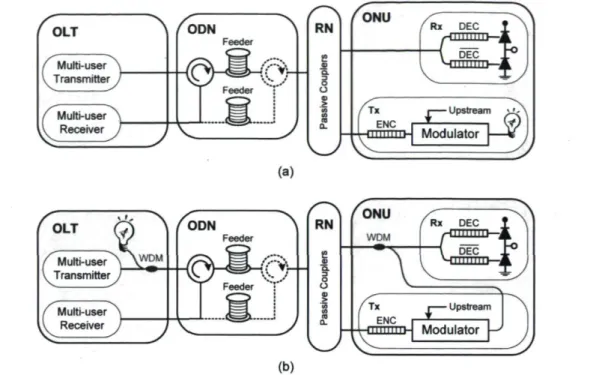
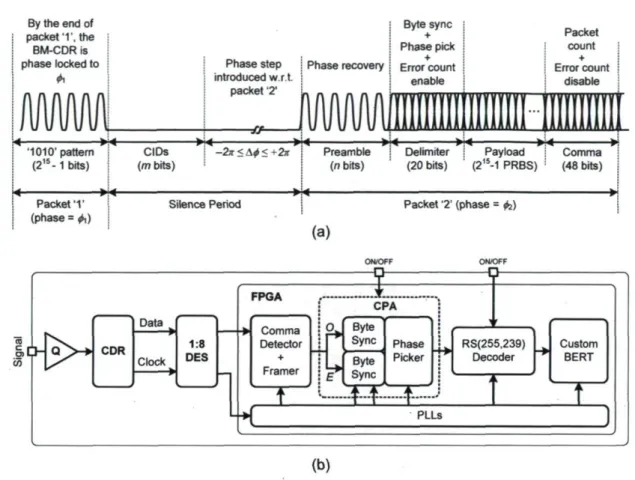
Figure 4.1. SAC-OCDMA PON physical architecture 46 Figure 4.2. (a) Typical burst-mode uplink test signal, (b) OLT burst-mode receiver 49
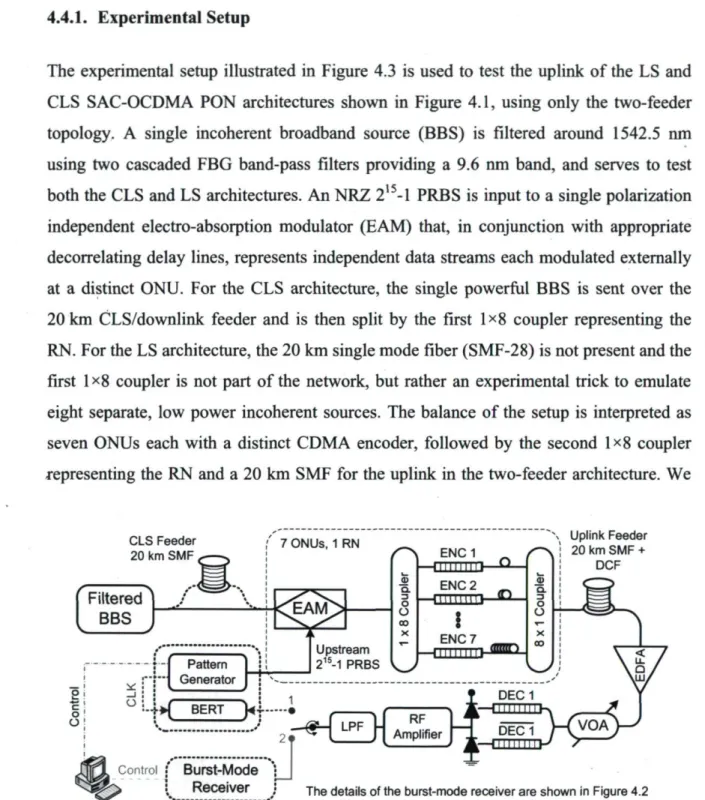
Figure 4.3. Experimental setup for a 7x622 Mbps SAC-OCDMA PON uplink 52
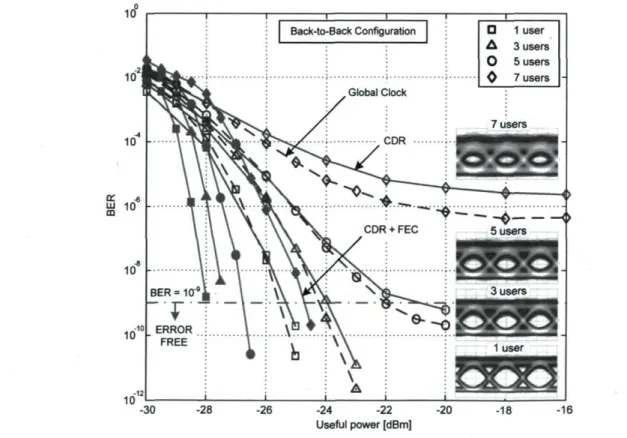
Figure 4.4. BER vs. useful power for back-to-back configuration 54
Figure 4.5. BER vs. useful power for LS architecture 55 Figure 4.6. BER vs. useful power for CLS architecture 56 Figure 4.7. BER vs. useful power for a single user and fully-loaded systems 57
Figure 4.8. Simulated and measured BER vs. useful power 58 Figure 4.9. PLR vs. phase difference without CPA for different number of users 59
Figure 4.10. PLR vs. number of users for different PON architectures 60 Figure 4.11. PLR vs. length of CID for different PON architectures 61
Figure 5.1. Principle of data erasure operation using a saturated optical amplifier 71
Figure 5.2. Proof of concept self-seeded RSOA transmitter 72 Figure 5.3. BER versus the received power at 1.25 Gb/s 73 Figure 5.4. Wavelength dependence of BER for our self-seeded RSOA transmitter 75
Figure 5.5. Back-to-back BER performance at 1530 nm 76 Figure 5.6. Input/output characteristics of the RSOA 77 Figure 5.7. RSOA input saturation power and the degree of saturation 78
Figure 5.8. RSOA input/output power measurements for different wavelengths 79
Figure 5.9 Residual output modulation and the degree of saturation 79
Figure 6.1. (a) The proposed self-seeded RSOA Tx, (b) Power spectral density 90
Figure 6.2. Experimental setup 91 Figure 6.3. Hybrid dense SS-WDM and TDM over the existing PON infrastructure 93
Figure 6.4. Characterization of the FBGs 96 Figure 6.5. Power spectral density for FBGs with different reflectivities 98
Figure 6.6. Back-to-back BER performance when using the three receiver options 99
Figure 6.7. Sensitivity vs. FBG reflectivity for the BR 100 Figure 6.8. BER performance at 1.25 Gb/s with local self-seeding and BR 101
Figure 6.9. Experimental setup for remote self-seeding 104 Figure 6.10. BER performance at 1.25 Gb/s with remote self-seeding and BR 105
XV111
List of Tables
Table 2.1. Selected characteristics of different versions of PONs 10 Table 2.2. Key PMD parameters of a 1.25 Gb/s uplink of a class B GPON 13
Table 2.3. Burst-mode transceiver comparison for 1.25 Gb/s 15
Table 4.1. Uplink power budget and link loss for both PON architectures 64
Acronyms
APD Avalanche Photodiode
APON ATM PON
ASE Amplified Spontaneous Emission ASK Amplitude Shift Keying
ATM Asynchronous Transfer Mode AWG Arrayed Waveguide Grating
BBS Broadband Source BEDFA Bidirectional EDFA BER Bit Error Rate BERT BER Tester
BIBD Balanced Incomplete Block Design BiDi Bidirectional
BPF Band Pass Filter BPON Broadband PON BR Balanced Receiver
CAPEX Capital Expenses CATV Cable Television
CDMA Code-Division Multiple-Access CDR Clock-and-Data Recovery CID Consecutive Identical Digits CIP Center for Integrated Photonics
CLK Clock
CLS Centralized Light Sources CO Central Office
Acronyms xx
CR Conventional Receiver CSF Channel Select Filter CW Continuous Wave
CWDM Coarse WDM
DBA Dynamic Bandwidth Allocation DC Direct Current
DCF Dispersion Compensation Fiber DDF Distribution Drop Fiber
DEC Decoder
DES Deserializer
DFB Distributed Feed-Back
DOCSIS Data-over-Cable Service Interface Specifications DR Degenerate Receiver
DSL Digital Subscriber Line
EAM Electro-Absorption Modulator EDF Erbium-Doped Fiber
EDFA Erbium-Doped Fiber Amplifier EFMA Ethernet in the First Mile Alliance
ENC Encoder
EPON Ethernet PON ER Extinction Ratio
ESA Electrical Spectrum Analyzer
FBG Fiber Bragg Grating FEC Forward-Error Correction FFH Fast-Frequency Hop FP Fabry-Perot
FSAN Full Service Access Network FSK Frequency Shift Keying FTTH Fiber-to-the-Home FTTP Fiber-to-the-Premise FTTx Fiber-to-the-x
GFP Generic Framing Procedure GPON Gigabit PON
HD High Definition HDTV HD Television HFC Hybrid Fiber-Coaxial HPF High Pass Filter
IC Integrated Circuit
IEEE Institute of Electrical and Electre IP Internet Protocol
ITU International Telecommunicatioi
LD Laser Diode
LED Light Emitting Diode LPF Low-Pass Filter LS Local Sources
MAC Media Access Control
MAI Multiple-Access Interference MQC Modified Quadratic Congruence
N/A Not Applicable NF Noise Figure
Acronyms xxii
NTT Nippon Telegraph and Telephone
OCDM Optical Code-Division Multiplexing OCDMA Optical CDMA
ODL Optical Delay Line
ODN Optical Distribution Network OLT Optical Line Terminal
ONU Optical Network Unit OSNR Optical SNR
P2MP Point-to-Multipoint P2P Point-to-Point
PD Photodiode
PLL Phase Locked Loop
PLM Power Leveling Mechanism PLR Packet Loss Ratio
PMD Physical Medium-Dependent PON Passive Optical Network
PRBS Pseudo-Random Binary Sequence PSD Power Spectral Density
QoS Quality of Service
R3T Round Robin Receiver/Transmitter
RF Radio Frequency
RIN Relative Intensity Noise
RN Remote Node
RS Reed-Solomon
RSOA Reflective SOA
Rx Receiver
SAC Spectral Amplitude Coding SCM Sub-Carrier Multiplexing SMF Single Mode Fiber SNR Signal-to-Noise Ratio
SOA Semiconductor Optical Amplifier SONET Synchronous Optical Network SS-WDM Spectrum Sliced WDM
TDM Time-Division Multiplexing TDMA Time-Division Multiple-Access TV Television
Tx Transmitter
UI Unit Interval US United States
USA United States of America
VOA Variable Optical Attenuator
WDM Wavelength-Division Multiplexing WDMA Wavelength-Division Multiple-Access
Chapter 1
Introduction
1.1. Motivation
Fiber-to-the-home (FTTH) is the end game for many service providers [l]-[5]. As more and more IP services are transported over broadband access networks, it is important to identify the technologies and architectures that will enable cost-effective transport of this traffic all the way to the home via an access network. As compared to other broadband access technologies such as digital subscriber line (DSL), and cable/modem, passive optical network (PON) technology seems to be the best solution to alleviate the bandwidth bottleneck in the access network [1], [6]-[8]. From a historical perspective, the
first bandwidth breakthrough in the access network was the arrival of DSL and cable based solutions (Figure 1.1). They provided nearly a 1000-fold increase in data rates over traditional 'dial-up' modems. With the arrival of FTTH access solutions, another 1000-fold increase in data rates over DSL was achieved.
In volume deployment ■ DSL Cable ■ FTTH-EPON In development ■ FTTH-GPON j i Future 0.75-1.5 Mb/s DSL EPON 2.5/1.25 Gb/s GPON Cable FTTH PON
Figure 1.1. Access network technologies: Market and technology overview [7], (EPON: Ethernet PON, GPON: gigabit PON).
Although several PON standards already exist with gigabit capabilities, the actual user bit rate is less than 100 Mb/s as users share the entire bandwidth using time-division multiple-access (TDMA). A typical gigabit symmetric PON for example, provides only 40 Mb/s for 32 customers and up to 80 Mb/s for 16 users.
From the other side, advances in cable networks allow similar bit rates to be supported [9]. Using higher order modulation formats and forward error correcting (FEC) codes, the existing DOCSIS1 2.0 standard provides 40 Mb/s for downstream and 30 Mb/s for
upstream. The new specifications, referred as DOCSIS 3.0, describe data rates of 160 Mb/s and 120 Mb/s for the downstream and upstream, respectively [10]. However,
Chapter 1. Introduction 3
the high attenuation in coaxial cables, compared to optical fibers, has limited their maximum reach to only a few kilometers. In practical systems, an optical fiber runs from the central office to the distribution node, and then the signals are dropped to the users through coaxial cables. Such systems are known as hybrid fiber-coaxial (HFC) networks [11].
It is clear that because of the limited bandwidth of a coaxial cable, the complexity of the cable systems is expected to be higher than that of PONs. However, when exploiting an existing cable-based infrastructure, the cost is not significantly high. On the other hand for green field deployment (i.e., new housing developments) of access networks, operators are encouraged to invest on a PON infrastructure.
Incorporating wavelength-division multiplexing (WDM) offers a good solution to increase the capacity of standard PONs, by assigning different wavelengths to different users [12]-[14]. Although WDM technology is mature for backbone networks, its price is still considered high for access networks. Therefore, there is still a need to find low cost solutions for WDM in FTTH access networks.
An alternative to WDM is the use of optical code-division multiple-access (OCDMA) to upgrade existing PONs. OCDMA is receiving considerable attention because it combines the large bandwidth of the fiber medium with the flexibility of the code-division multiple-access (CDMA) technique to achieve high-speed connectivity [15]. As there are no standards or commercial systems for OCDMA networks, the question of the best implementation, and indeed the suitability of OCDMA for PONs remains open.
1.2. Objectives and Major Contributions
While applications drive the development for faster and more efficient network technology, network technology also opens up the opportunity for the development of new applications. Applications that were not feasible or even imaginable a few years ago are now widely used. This increasing demand makes imperative the use of some new
technology that is not only capable of meeting today's demands, but is also flexible to accommodate tomorrow's growth.
In this thesis we focus on simple and inexpensive solutions for upgrading existing PONs without changing the outside plant and without altering the legacy PON users. The passive splitter-based PON infrastructure is still exploited, and the upgrades are made on a per subscriber basis allowing a gradual rollout of high bit rate clients. The contributions of this work are mainly proposing two new solutions for upgrading existing PONs using OCDMA and WDM, based on low cost incoherent sources.
Our first approach is to use spectral amplitude coded (SAC)-OCDMA for next generation PONs [16], [17]. We examine the relative merits (cost and performance) of both local sources and centralized light sources architectures. We experimentally demonstrate the uplink of a 7x622 Mb/s SAC-OCDMA PON with burst-mode operation. We analyze the power budget and study the amplification requirements for both architectures. The selection of appropriate light sources plays an important role in the power budget, and can help increase the link margin. Despite the extra splitting and propagation losses in centralized light sources architectures, we report error free transmission (over a 20 km link) for a fully loaded system when using FEC codes.
The other alternative we propose, is to use dense spectrum-sliced (SS)-WDM to upgrade existing PONs [18]. A reflective semiconductor optical amplifier (RSOA) is used as a transmitter. The RSOA is directly modulated and is self-seeded using a reflective fiber Bragg grating (FBG). The reflectivity is optimized to maximize the output power and for optimal noise cleaning. At the receiver side, a recently proposed balanced receiver is used to preserve the noise cleaning effect [19]. We experimentally demonstrate a 1.25 Gb/s transmission, where error free transmission is achieved over a 20 km feeder. We further investigate the possibility of colorless optical network unit (ONU) operation by placing the FBG at the remote node. The power budget and the spectral efficiency issues are also addressed, up to 32 SS-WDM users can be easily supported over the existing PON infrastructure. Through simulations we show that the capacity can be increased to 128 users when a Reed-Solomon RS(255,239) FEC is used.
Chapter 1. Introduction 5
1.3. Thesis Organization
Chapter 1 summarizes the motivation, the objectives and the main contributions of this research. Chapter 2 then presents an overview of PON standards, focusing on the physical layer gigabit capable PONs. Various PON standards are outlined and a technical comparison between Ethernet PON (EPON) and Gigabit PON (GPON) is presented. Further, the requirements and needs for future PONs are outlined.
In Chapter 3 we focus on next generation gigabit PONs. We report recently proposed OCDMA and WDM solutions to increase the per user capacity of existing PONs. We discuss their architectural considerations as well as the migration path towards future FTTH access networks. The basics of semiconductor optical amplifiers (SOAs), their noise cleaning capability and their benefits as key enablers in PONs, are also addressed. This chapter lays the groundwork for our contributions presented in the following chapters.
Our proposed physical architectures for the next generation SAC-OCDMA PONs are described in Chapter 4. Both local sources and centralized light source approaches are considered over single-feeder and two-feeder topologies. The operation and the functionalities of a burst-mode receiver (developed at McGill University) at the central office are also verified in our OCDMA system setup. The experimental results and the impact of the PON size on local sources versus centralized light sources PON architectures are presented as well.
Our examination of the performance of a self-seeded RSOA transmitter for SS-WDM PONs is reported in Chapter 5. The transmitter architecture and the bit error rate (BER) performance for different network configurations are presented. The wavelength coverage of the transmitter over the entire C-band is studied. We discuss the noise cleaning effect, the post-filtering effect, and we explain the wavelength dependence of the performance. We benefit from our results in this chapter, to propose (in the following chapter) a novel self-seeded RSOA transmitter that provides simultaneously noise cleaning and high output power.
In Chapter 6 we present our innovative method to upgrade existing PONs using dense SS-WDM over the legacy infrastructure. We outline our FBG-based self-seeded RSOA transmitter, as well as the challenges in combining noise cleaning to self-seeding. We further discuss the architectural aspects and the migration path from time-division multiplexing (TDM) to dense SS-WDM. We present experimental results of transmitter optimization and BER measurements. We further study the possibility of colorless ONU operation through remote self-seeding. The power budget and the spectral efficiency issues are also addressed. Moreover, we run FEC simulations (based on our measurements without FEC) to estimate the coding gain as well as the maximum network capacity that can be achieved.
Finally, the thesis is concluded in Chapter 7, where we also give the direction for future work and other research opportunities.
Chapter 2
Passive Optical Networks for FTTH Access Networks
2.1. Introduction
The increasing need for advanced telecommunication services presents an excellent opportunity for service providers. A single operator offering basic voice, data, and video services at a reasonable price is very likely to have a high penetration rate. Delivering advanced services in addition to the traditional ones attracts subscribers even more. Additionally, if the bandwidth capacity of the network is scalable, then the operator will be able to maintain those customers and grow revenue in the future, as new bandwidth-hungry applications are developed.
Fiber-to-the-Home (FTTH) has long been recognized as a technology that provides future proof bandwidth [l]-[8], but has generally been too expensive to implement on a wide scale. However, reductions in the cost of electro-optic components and improvements in the handling of fiber optics now make FTTH a cost effective solution in many situations. The transition to FTTH in the access network is also a benefit for both consumers and service providers because it opens up the near limitless capacity of the core long-haul network to the local user.
Passive optical networks (PONs) are identified as an economic and future safe solution to alleviate the bandwidth bottleneck in the access network [1], [2]. As the name implies, passive optical networks are typically passive, in the sense that they do not have active components for data transport.
Telecommunications and Internet Backbone Network
Figure 2.1. Basic architecture of FTTH access network (CATV: cable television, RN: remote node).
Typically, a PON has a physical tree topology with the central office (CO) located at the root and the subscribers connected to the leaf nodes of the tree, as shown in Figure 2.1. At the root of the tree is an optical line terminal (OLT), which is the service provider
Chapter 2. Passive Optical Networks for FTTH Access Networks 9
equipment. Multiple optical network units (ONUs) are connected to the OLT through a passive optical coupler, and may be at different distances.
Each ONU can serve a single or multiple subscribers. The ONU buffers data received from its attached subscribe^s) and may use priority queues, for different traffic classes. Due to the directional properties of the optical splitter/combiner, the OLT is able to broadcast data to all ONUs in the downstream direction. In the upstream direction, however, ONUs cannot communicate directly with one another. Instead, each ONU is able to send data only to the OLT. Thus, in the downstream direction the PON may be considered as a point-to-multipoint (P2MP) network, whereas for the upstream direction it may be viewed as a point-to-point (P2P) network.
While this thesis is concerned with next generation PONs, in this chapter we review the standards environment for today's first generation PONs. Understanding the current state of PON deployment will provide the context for development of the next generation requirements and constraints.
2.2. Existing PON Standards
The existing PON standards are the results of two different groups of network providers and equipment vendors; namely, the Full Service Access Network (FSAN)1 and the
Ethernet in the First Mile Alliance (EFMA)2. The standards represent the different views
and attitudes of these groups towards the problem and the possible future of the telecommunication market.
Although, in this thesis focus is oriented towards gigabit access networks, we will rapidly highlight the other flavors of PONs in this section [20], [21]. Selected characteristics of the different PON standards are summarized in Table 2.1. Asynchronous Transfer Mode (ATM) PON (APON) was initiated in 1995 by the FSAN group and standardized as ITU-T G.983. APON was the first PON based technology developed for FTTH
1 http://www.fsanweb.org 2 http://www.efinaalliance.org
Table 2.1. Selected characteristics of different versions of PONs.
APON/BPON EPON GPON
Standard ITU-T G.983 IEEE 802.3ah ITU-T G.984
Data Packet Cell Size S3 bytes (48 payload and 5 overhead) 1518 bytes Variable size from 53 bytes up to 1518
1.25 Gb/s downstream
Downstream configurable from 1.25 Gb/s to 2.5 Gb/s Data Rates Up to 1.25 Gb/s
622 Mb/s upstream Upstream configurable in 155 Mb/s, 622 Mb/s, 1.25 Gb/s, or 2.5 Gb/s Downstream Wavelength 1480 n m - 1500 nm 1500nm 1480 n m - I500nm Upstream Wavelength 1260 nm - 1360 nm 1310nm 1260 nm-1360 nm Traffic Modes ATM Ethernet ATM, Ethernet, TDM Maximum PON Splits 32 16 64 or even 128 Bit Error Rate (BER) - 10'2 10'°
Efficiency 72% 49% 94%
deployment as most of the legacy network infrastructure was ATM based. Since the services offered by this architecture include video distribution, leased line services, and Ethernet access, and to express the broadband capability of PON systems, APON was renamed as broadband PON (BPON). It was standardized by ITU-T recommendations G.983.1,G.983.2,G.983.3.
The progress in the technology, the need for larger bandwidths and the complexity of ATM forced the FSAN group to look for better technology. Gigabit PON (GPON) standardization work was initiated by FSAN in the year 2001 for designing networks over 1 Gb/s and up to 2.5 Gb/s. GPON enables transport of multiple services in their native format, specifically TDM and data. In order to enable easy transition from BPON to GPON, many functions of BPON are reused for GPON. In January 2003, the GPON standards were ratified by ITU-T and are known as ITU-T recommendations G.984.1, G.984.2 and G.984.3. The GPONs use the Generic Framing Procedure (GFP) protocol to provide support for both voice and data oriented services.
Chapter 2. Passive Optical Networks for FTTH Access Networks 11
Noticing that the majority of traffic in the network is data oriented and that efficient mechanisms enabling support for real time services were in place, the EFMA decided that the sophisticated functionality of the APON/BPON and GPON protocols was no longer needed. Instead, as the Ethernet protocol had became widespread and had a dominant role in the data oriented local and metropolitan networks, the EFMA decided to promote its functionality in PONs. The final version of the new protocol was accepted and released as IEEE 802.3ah in September 2004. The main goal was to achieve a full compatibility with other Ethernet based networks. Hence, the functionality of Ethernet's Media Access Control (MAC) layer is maintained and extensions are provided to encompass the features of PONs. The solution is simple and straightforward, and allows legacy equipment and technologies to be reused. EPON is largely a vendor-driven standard and it is fundamentally similar to APON, but transports Ethernet frames/packets instead of ATM cells.
2.2.1. Physical Medium Dependent (PMD) Layer
The PMD layer characteristics for GPON and EPON are quite similar [20]-[25]. We will state here the major differences other than the ones listed in Table 2.1:
■ GPON specifies a lower dynamic range for the OLT receiver, compared to EPON. This is due to the inclusion of a power leveling mechanism (PLM) in the GPON standard, through which the OLT can request ONUs, for whom the received power exceeds specific thresholds, to decrease the transmitter power.
■ EPONs can support up to 20 km of logical reach. GPONs can support up to 60 km, with 20 km maximum differential logical reach between the farthest and the nearest subscribers.
■ EPON uses 8B/10B encoding and the large burst overhead results in less complex OLT receiver.
GPONs can be classified into three different classes, namely, Class A, B, and C depending on the attenuation losses through the optical distribution network (ODN). An attenuation range of 5-20 dB, 10-25 dB, and 15-35 dB, for Class A, Class B, and Class C,
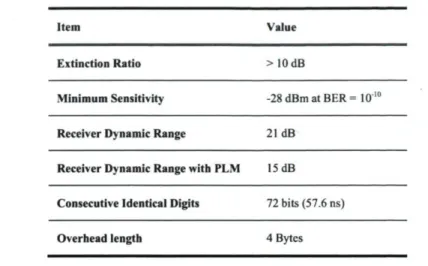
respectively is tolerated [21]. In this section we quickly review the main parameters of the PMD layer of a class B GPON (symmetrical link at 1.25 Gb/s), showing the major challenges in the design of upstream burst mode receivers at the OLT side.
2.2.1.1. Downstream and Upstream Traffic
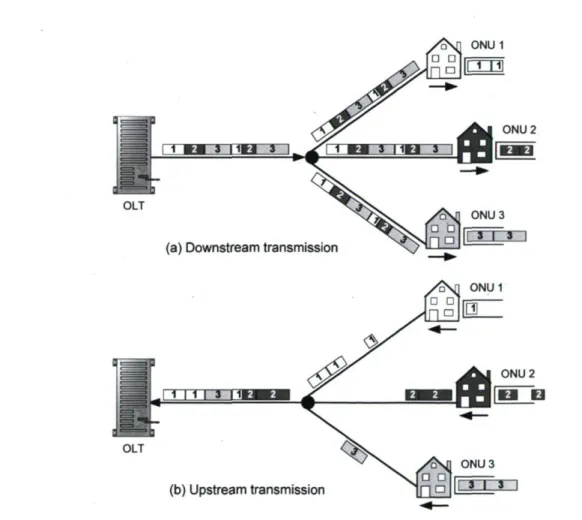
In a symmetrical GPON a continuous downlink in the wavelength band of 1480-1500 nm carries 1.25 Gb/s time-division-multiplexed (TDM) data from the OLT towards multiple ONUs [2]. A burst-mode link in the 1310 nm window collects all ONUs upstream traffic toward the OLT as variable-length packets at the same rate, in a time-division multiple-access (TDMA) scheme. This can be viewed in Figure 2.2. While waiting for its opportunity, an ONU buffers all incoming data. The contents of the queues are transmitted in a single burst using the whole available bandwidth of the channel upon the start of an allocated transmission window.
ONU 1
O B
(b) Upstream transmission
Chapter 2. Passive Optical Networks for FTTH Access Networks 13
Table 2.2. Key PMD parameters of a 1.25 Gb/s uplink of a class B GPON.
Item Value Extinction Ratio > 10 dB
Minimum Sensitivity -28dBmatBER = 1010
Receiver Dynamic Range 21 dB Receiver Dynamic Range with PL M 15 dB Consecutive Identical Digits 72 bits (57.6 ns) Overhead length 4 Bytes
Normally, the uplink is more difficult to design due to its bursty nature. The OLT receives packets from all active subscribers, with varying signal level and phase from packet to packet. The average signal level may vary 21 dB in the worst case from packet to packet (Class B). These packets are of variable length and are interleaved with a guard time of 4 B at 1.25 Gb/s (or 25.6 ns) as specified in G.984.2. Other important PMD specifications of such networks are listed in Table 2.2.
2.2.1.2. Burst-Mode Receivers
In [21], X. Qiu et al. developed a new upstream GPON OLT burst-mode receiver. Performance measurements on the new burst-mode upstream PMD modules complied with GPON uplink simulations. A receiver sensitivity of -32.8 dBm at a bit error rate (BER) of 10"10 was measured, combined with a dynamic range of 23 dB at a fixed
avalanche photodiode (APD) gain of 6. Full compliance was achieved with the recently approved ITU-T Recommendation G.984.2 supporting an innovative overall PLM.
The main challenges in the design of this receiver can be summarized in these points: ■ Optimizing the APD factor for achieving both high sensitivity and wide dynamic
range is not straightforward. The fast succession of upstream bursts do not allow for a change of the APD gain between bursts.
■ The receiver must provide fast but accurate threshold settings on individual incoming packets to perform dynamic level detection and amplitude recovery. ■ The receiver must quickly extract the decision threshold within a preamble length
of a few bytes at the beginning of each packet.
■ Due to the short guard time, the burst-mode receiver needs an active reset to erase the threshold of a preceding packet, [26].
■ As small amounts of optical power may be present during the guard time, it is difficult to distinguish between transmitted O's and the dark level during the guard time. Therefore, the receiver cannot know precisely when a packet ends and an external reset signal is necessary to signal the end of a packet.
■ A power level measurement circuit must be integrated, which allows the OLT to tell a specific ONU to either increase or decrease its launched power.
Figure 2.3 shows a typical burst-mode signal, which consists of a quick succession of packets [26]. Dark Level
V
Strong Packet Preamble Payload * — ■ / / - * Logic'1'" T'"
Decision Threshold \ Logic '0' Guard Time Weak Packet Preamble PayloadjTJlFIJL.
Figure 2.3. Example of burst-mode receiver input signal [26].
2.2.1.3. Operating Parameters Used to Examine Next Generation PONs
The main factors influencing the performance of PONs are the devices and materials used to build the network. The transmitter power and receiver sensitivity are two parameters that define the possible reach of the access network. In Table 2.3 typical parameters of commercially available burst-mode transceivers that support up to 1.25 Gb/s are shown.
Chapter 2. Passive Optical Networks for FTTH A ccess Networks 15
Table 2.3. Burst-mode transceiver comparison for 1.25 Gb/s.
Manufacturer/Model Receiver Sensitivity
mm max * Infineon Technologies AG V23870-G5131-x610 -1 dBm 4dBm -24dBm LuminentOIC2 SFFB-34-1250-BP-SCA-T -2 dBm 3 dBm -24 dBm Fiberxon FTM-97I2P-F20 2 dBm 7 dBm -30 dBm
In our proposals for next generation FTTH networks, we will try to respect GPON standards power budgets. In our experiments, we will always exploit the existing PON infrastructure,, assuming a typical 20 km feeder and passive splitters at the remote node
(RN). Via the available power budget, we will be able to calculate the maximum PON reach and/or the PON capacity.
We will concentrate on the design of the more challenging uplink, and the ONU transmitter. We will consider a user bit rate of 622 Mb/s and 1.25 Gb/s for our proposed SAC-OCDMA and dense SS-WDM solutions, respectively. These bit rates comply with the GPON uplink line rates. In Chapter 4, we will examine the performance of our proposed SAC-OCDMA PON in burst-mode operation. In Chapter 6 we will study the performance of our proposed dense SS-WDM PON in continuous mode, but over the existing PON infrastructure.
2.2.2. Gigabit PON Market Overview
With the market for high-speed broadband access continuing to accelerate, the future for gigabit PON is bright [1], [7], [8], [27], and [28]. According to the FTTH council, the number of the worldwide FTTH subscribers reached more than 28 million by the end of June 2008. This represents more than 23% increase in less than six months. The Asian market accounted for 80% of the total FTTx subscribers, with Japan still leading the way.
1 http://www.infineon.com 2 http://www.luminentoic.com 3 http://www.fiberxon.com
However, FTTH customer growth rates in Europe (32% growth) and in the United States (38%) were higher than that in Asia1. As a result, the market for PON hardware is
forecast to grow sharply. Worldwide OLT and ONU PON equipment revenue reached more than $2.2 billion in 2008. PON manufacturer revenue is forecast to grow at a rapid compound annual growth rate of 23% between 2008 and 2013, as the shift from copper to fiber based broadband access drives growth in this market around the world2.
In Japan the transition from DSL to FTTH has begun very early. NTT the major carrier in Japan began deploying EPON based FTTH in 2003. For the first time, in the first quarter of 2005, the number of new FTTH subscribers was greater than that of new DSL subscribers according to the Japanese Ministry of Internal Affairs and Communications. With 13.1 and 6 million subscribers, respectively, Japan and South Korea were home to the largest number of ultra-high-speed Internet users in the world in 2008. There was a sharp rise in FTTx subscribers in South Korea (800,000 new customers) and in Japan (close to 1.8 million) in the first half of 2008. Despite high growth rates and other impressive figures, Asia is slowly losing ground to Europe and North America. On the operator front, NTT still had the largest subscriber base worldwide, with more than 9.5 million FTTx customers.
In North America there were about 150,000 Fiber-to-the-Premise (FTTP) subscribers and a million homes passed by late 2004. These are mostly deployments by the small operators. However, carriers such as Verizon, SBC and others, are looking to GPON to advance their FTTH rollout efforts. It is expected that nearly 78 million US consumers will have broadband access by 2010.
In Europe there is a considerable early FTTP deployment (about 400,000 FTTP subscribers in 2003). In 2004 Sweden had the highest FTTx penetration worldwide. Growth had also been particularly substantial in Belgium, Switzerland, and Germany. In 2008 six countries accounted for 83% of the total number of subscribers in Europe: Sweden, Italy, Norway, France, Denmark, and the Netherlands.
1 R. Montagne, "The global FTTH/B panorama shifts," February 2009 (http://lw.pennnet.com)
2 Infonetics, "GPON market share race heats up, Motorola challenging Alcatel-Lucent," March 2009
Chapter 2. Passive Optical Networks for FTTH Access Networks 17
2.3. Requirements and Needs for Future PONs
We are entering a new high-definition-(HD)-video-cenrric world that will enable new applications and services including HDTV, video on demand, video conferencing, high-quality interactive video gaming, and others [29]-[31]. Video-centric services demand not only a high speed connection but also a high quality of service (QoS). In addition, there has been a trend in traffic patterns to shift from being bursty and highly asymmetric to becoming steadier and more symmetric. This is being driven by the increase in peer-to-peer applications and the constant streaming data rates required for video signals. To
satisfy these future demands, it is expected that dedicated and symmetric data rates of 100 Mb/s and greater per subscriber will be required [5]. This places challenges on the development of future access networks since any long-term infrastructure should be capable of supporting large symmetric data rates with high QoS.
When building a PON infrastructure, analysis by Corning has shown that the installation for the outside plant costs about 60% with the remaining 40% required for the service equipment [5]. Therefore the lifetime of the outside passive plant should be greater than 25 years to justify the installation costs and maximize savings in operational expenses. The costs and disruptions associated with installing additional fiber plant should be kept to a minimum. Keeping these constraints in mind, we can estimate possible evolution paths for existing and future PONs. Later in this thesis we present two newly proposed future-proof solutions to smoothly upgrade the existing TDM PONs using the legacy PON infrastructure.
Lowering the per-subscriber cost of FTTH systems is another key issue that should be considered for next generation PONs [8]. It has a dollar-for-dollar impact on the cost of the overall system and helps the technology penetrating more into the market. This is driven by the technological advances in chip integration solutions, and by volume manufacturing [32], [33]. Not only advances in optical transceivers are needed, but also advances in cable management technology, outside plant cabinet technology and fiber performance technology are required [2].
2.3.1. Long Reach PONs
In practice most commercial GPON systems conform to the class B+ specification that allows a maximum optical loss budget of 28 dB; this is often used to deploy a split size of 32 and reach of up to 20 km. Recently, research has focused on extending the reach of GPON via mid-span optical amplifiers or transponders [34]. This concept has recently been standardized in ITU-T Recommendation G.984.6.
Operators value greatly the passive nature of the access network enabled by the PON architecture, and it is not the intention of PON reach extension to move away from this. Nevertheless, having the option of an active mid-span reach extender can provide several benefits mainly reducing the number of central offices [35]. Clearly, there are significant capital and operational costs associated with building a central office. Moreover, deploying a full OLT in a street cabinet is not recommended. An attractive alternative could therefore be a simple mid-span PON extender box deployed in a street cabinet (or underground footway box). To offer benefits over the street-based OLT approach, the PON extender should be compact, low-power, and cost-effective and require minimal configuration and management.
Semiconductor optical amplifiers (SOAs) are attractive candidates for GPON reach extension because of their high gain, low noise figure (NF), low polarization dependent loss, and fast gain dynamics allowing them to operate in burst-mode for the upstream. Moreover, they can be designed to provide gain in the wavelength bands used by GPON. Other attractive advantages of SOAs for this application include their small size, high reliability and low power consumption. Recently, an all-optical GPON reach extender prototype has been developed by a team at Motorola [34]. The prototype was tested in the field and is now ready for commercialization and deployment extending the physical reach of existing GPONs to 60 km and supporting 128 split. Research efforts are trying to push these numbers to 100 km and 512 split for 10 Gb/s next generation PONs. We will not be examining range extension, but we will examine the fundamental power budgets in our systems to determine either their maximum reach or capacity.
Chapter 2. Passive Optical Networks for FTTH Access Networks 19
2.3.2. Green PONs
Currently, energy consumption is becoming an environmental and therefore social and political issue. In particular, for network operators it is also of an economical concern, since the energy consumption contributes to operational expenditures. The access network part is a major energy consumer in communication networks, since it usually contains a huge number of distributed active network elements. Unlike DSL, cable networks and other access technologies, FTTH based PONs are able to deliver high access bit rates in a more energy efficient way due to their passive nature. However, the need for higher bit rates for next generation PONs will linearly increase the energy and power consumption [36]. Therefore the need for new low power consumption, high speed equipment is necessary. The energy consumption of FTTH access networks has been studied extensively in [37], [38]. Guidelines for choosing the suitable FTTH strategy concerning energy and power consumption issues prior to the network planning and actual deployment are presented. Although we will not be studying the power and energy consumption of our proposed PONs, it is good to mention that PONs are energy efficient and preserve the green nature of the environment compared to other access technologies.
2.3.3. Architectural Considerations for our Proposed Future PONs
Concerning our proposed solutions for next generation PONs, we consider exploiting the existing outside plant for gradual upgrades from TDM to SAC-OCDMA or to dense SS-WDM as will be discussed in Chapter 4 and Chapter 6, respectively. We target low cost solutions by using incoherent light sources instead of laser sources. In order to support future bandwidth-hungry applications, we demonstrate user bit rates of 622 Mb/s and 1.25 Gb/s for our OCDMA and SS-WDM PONs, respectively. Furthermore, our solutions exploit the 1550 nm band (reserved for video distribution) and therefore can co-exist with the legacy PON users, creating a smooth migration path from TDM to future PONs without altering the existing systems. Moreover, we consider our next generation FTTH networks to be attractive as they provide pay-as-you-grow updates.
The architectural aspects of our proposed PONs, the power budget analysis, the spectral efficiency and the bandwidth usage issues, as well as the maximum PON reach/capacity will be examined later through Chapter 4 and Chapter 6.
2.4. Summary and Conclusion
Having briefly discussed the standards for existing FTTH access networks, we have been motivated by the urgent need for upgrading the legacy PONs to meet for future needs and bandwidth demands. In this chapter, we have also outlined the basic needs and general requirements for future PONs, showing the needs for our proposed PONs. We next review in Chapter 3 recent research in next generation PONs, focusing on OCDMA and WDM solutions. In the following chapters we present our contributions for gradually upgrading legacy PONs to SAC-OCDMA or to dense SS-WDM PONs.
Chapter 3
Next Generation Passive Optical Networks
3.1. Introduction
Bandwidth demand is expected to grow rapidly as high-quality multimedia applications begin to be used in daily life. A typical service configuration for the home includes several high-quality video streams for broadcast and video on demand sessions, a number of multimedia communication sessions, high-bandwidth peer-to-peer sessions, online gaming, and web surfing. The bandwidth required for this service set can range from tens of megabits per second to 100 Mb/s and beyond depending on the quality requirements for multimedia streams. To provide users with a multimedia experience comparable or
superior to the current TV experience, it is envisioned that Internet-based multimedia streaming service will support HDTV quality for media broadcasting, and standard TV quality for multimedia communication sessions. Considering that the typical HD media stream requires up to 20 Mb/s, access network bandwidths of 50-100 Mb/s are considered minimal to accommodate future broadband Internet traffic [1].
To provide the required bandwidth as a universal service, service providers need to upgrade their access network. In other words, they need to migrate from TDM to other multiplexing techniques such as wavelength-division multiplexing (WDM), sub-carrier multiplexing (SCM) and optical code-division multiplexing (OCDM). Sharing the PON architecture using wavelength-division multiple-access (WDMA) is a highly efficient method [12]-[14]. In this scheme, each subscriber is virtually point-to-point connected through a dedicated wavelength to the OLT. While several schemes of WDM PONs have been proposed, the cost of the system has been of main concern. Further, the wavelength management of the ONU transmitters is a significant burden for network operators. Wavelength-independent ONU transmitters are required if WDM is to be used in the access network [39].
Another alternative for upgrading existing PONs is to use SCM by assigning a different radio frequency (RF) channel for each subscriber [5]. The TDM PON infrastructure and the passive splitters already installed at the RN would not need to be upgraded. In contrast, deploying WDM requires that these couplers be replaced by arrayed waveguide gratings (AWGs). Another possibility for future PONs is to use OCDMA to increase the capacity of the existing PONs, which would not require a RN upgrade. In such systems, users simultaneously share the same bandwidth using orthogonal codes. Although this solution is still under research and in its infancy compared to WDM, it offers several advantages and can be interesting for future PONs, in the long term. Hybrid solutions combining different multiple-access techniques have also been proposed for PONs. For example using TDM over WDM allows several users to share the same wavelength on a TDMA basis [14], [40]-[42]. Combining SCM with WDM is another option for future PONs [43], [44]. Using OCDMA over WDM for gigabit symmetric PONs was also proposed for next generation PONs [45].
Chapter 3. Next Generation Passive Optical Networks 23
In this chapter we present some of the recent research and the state of the art for future PONs. We focus on both OCDMA and WDM solutions for gigabit capable PONs. In the case of WDM, we are particularly interested in spectrum-sliced WDM (SS-WDM) systems as a low cost solution for PON upgrade.
We start by introducing semiconductor optical amplifiers as key enablers for next generation FTTH access networks. Focus is oriented towards the physical layer; however, we highlight the important aspects of the MAC layer and discuss the possible upgrades to be considered for next generation PONs. We next review various proposals for OCDM, WDM and SS-WDM, often exploiting SOAs. Finally, we end the chapter with a summary and conclusion to anticipate what we propose in the following chapters and to justify our choice of the different technologies for OCDMA and WDM.
3.2. Semiconductor Optical Amplifier as a Key Component
Due to advances in optical semiconductor fabrication techniques, device design and packaging technologies, the semiconductor optical amplifier (SOA) and the reflective SOA (RSOA) are showing great promise for use in evolving optical communication networks. They can be used as a general gain element, but also have many other functional applications including modulation, switching, and wavelength conversion. Semiconductor amplifiers have been the subject of much research, especially in WDM PONs [39]-[44], [46]-[48]. Their major advantages include:■ low fabrication cost, small size, easy integration, wide bandwidth, fast response, and wavelength transparency;
■ SOAs used at the ONU side can accomplish both modulation and amplification functions;
■ intensity noise can be suppressed by the gain compression effect of the gain-saturated SOA (useful in various next generation PON scenarios);
■ in SCM schemes, the unnecessary residual downlink at each ONU is suppressed by the high pass filter (HPF) effect of RSOA; and
■ the modulation speed of commercially available devices can reach up to 5 Gb/s in wide wavelength bands in the range of 50-100 nm [39].
3.2.1. SOA and Reflective SOA Basics
Semiconductor optical amplifiers are essentially laser diodes, without end mirrors, which have fiber attached to both ends [49]. They amplify any optical signal that comes from either fiber and transmit an amplified version of the signal out of the second fiber. A schematic diagram of an SOA is shown in Figure 3.1 as well as commercial SOAs and RSOAs in different packages. The device is driven by an electrical current. The active region in the device imparts gain, via stimulated emission, to an input signal. The output signal is accompanied by noise. This additive noise, also called amplified spontaneous emission (ASE), is produced by the amplification process.
Current
Output signal and noise
Input signal
SOA from CIP in a butterfly package
Output facet RSOA from CIP in butterfly and TO-CAN packages — Active region
and waveguide Input facet
(a) (b)
Figure 3.1. (a) Basic architecture of an SOA, (b) commercial SOAs and RSOAs in butterfly and TO-CAN packages [http://www.ciphotonics.com].
Typically SOAs are constructed into small packages, and they work for 1310 nm and 1550 nm systems. In addition, they can be bidirectional, making the reduced size of the device an advantage over erbium-doped fiber amplifiers (EDFAs). However, the drawbacks of SOAs as compared to EDFAs include high-coupling loss, polarization dependence, and a higher noise figure.
Chapter 3. Next Generation Passive Optical Networks 25
Recent designs include anti-reflective coatings, tilted waveguide and window regions to eliminate end-face reflection almost perfectly. This effectively prevents the amplifier from acting as a laser. By simply replacing one of the facets by a perfectly reflecting mirror the SOA is transformed to an RSOA. To perform as an external modulator, the current is modulated so that the RSOA reflects the light coming from the fiber into it again for transmitting a T and blocks the reflection for a '0'. Similar modulation is achievable with an SOA, in transmission rather than in reflection. An RSOA senses the signal that arrives to it by a voltage variation in its terminals, and modulates the signal in amplitude through the control current, exactly as in an SOA.
One of the attractive RSOAs available in the market is the SOA-RL-OEC-15501 from
CIP (Center for Integrated Photonics). This RSOA has very low front facet reflectivity (<10~5), and is ideal as a reflective, colorless amplifying modulator in WDM PON
schemes. Key specifications include a small signal gain of 20 dB typical over a wavelength range from 1530 to 1570 nm, gain ripple of 0.5 dB, polarization dependent gain of 1.5 dB, and a modulation data rate of up to 1.5 Gb/s (other specifications can be found in the datasheet available online at the CIP website).
3.2.2. Saturation Regime and Noise Cleaning Principles
The gain saturation in semiconductor amplifiers is caused by the carrier-density depletion and fast phenomena such as carrier transport in multiple layers and intra-band carrier dynamics in the device [50]. In the saturation regime the output power is almost constant regardless of the input power; the gain is high and constant in the linear region and then starts to decrease as the input power is further increased.
It is well known that a semiconductor amplifier operated well into gain saturation can significantly reduce the intensity noise due to the so-called "amplitude squeezing" effect. This squeezing effect cancels the photon bunching of the chaotic light by limiting excess photon generation [51], [52]. The other mechanism contributing to the noise cleaning in
4 8 12 16 Electrical frequency [GHz]
Figure 3.2. Typical RIN measurement for the SOA-RL-OEC-1550 (BBS: broadband source, BPF: band pass filter, DC: direct current, EDFA: erbium-doped fiber amplifier, ESA: electrical spectrum analyzer,
PD: photodiode, VOA: variable optical attenuator).
SOAs and RSOAs is their high-pass filtering (HPF) effect which can suppress low frequency noises. This HPF effect is due to the self-gain modulation [44]. A typical relative intensity noise (RIN) measurement for the SOA-RL-OEC-1550 is shown in Figure 3.2. The experimental setup used for the characterization is also illustrated. A broadband source (BBS) and a 30 GHz wide band pass filter (BPF) were used to be consistent with the results presented in Chapter 5. The center wavelength of the BPF was tuned to 1550 nm and the variable optical attenuator was adjusted to make sure that the RSOA is deeply saturated. The depth of the HPF effect depends on the amount of gain saturation and the cut-off is governed by the carrier lifetime. Because the carrier lifetime in RSOAs is shorter than in SOAs due to the higher internal photon density caused by their double pass gain, we expect more HPF effect in RSOAs and thus more noise reduction compared to SOAs.
Using SOAs to achieve noise cleaning in incoherent SS-WDM systems has been studied extensively by different research groups [53]-[56]. Different schemes have been proposed and successfully demonstrated, including the use of an SOA in conversion at the receiver side. It was also reported that filtering a noise-cleaned signal degrades the performance. However, using wide filters can mitigate to a certain extent this degradation, at the expense of the spectral efficiency. In [19], Mathlouthi et a i , recently proposed a balanced
Chapter 3. Next Generation Passive Optical Networks 27
receiver for SS-WDM systems that avoids filtering and therefore preserves the noise cleaning when gain-saturated SOAs are used at the transmitter side. In Chapter 6, we present a new dense SS-WDM PON architecture over the legacy infrastructure, using this novel receiver together with a proposed self-seeded RSOA transmitter.
Less research has been conducted for the use of gain-saturated SOAs in SAC-OCDMA systems [57], [58]. In [57], McCoy et a i , proposed to use one SOA per frequency bin to achieve noise cleaning in SAC-OCDMA systems. This solution is not cost effective and was not examined in the laboratory. Recently, noise cleaning in SAC-OCDMA systems was reported using one SOA per user [58]. The low complexity receiver reported in [59] was used in the experiment to avoid filtering the desired user at the receiver side.
3.3. OCDMA for Future PONs
Optical CDMA networks are now receiving more and more attention because they combine the large bandwidth of the fiber medium with the flexibility of the CDMA technique to achieve high-speed connectivity [15], [60]. The essence of OCDMA is that multiple users can share the whole bandwidth simultaneously. In such systems, each user is assigned a unique code from a set of codes having good auto-correlation and cross-correlation properties [61]-[63]. Each transmitter imprints a particular code onto the bit sequence to be sent. At the receiver side, a matched filter is used to distinguish the desired user from others, and the data is recovered.
Since OCDMA allows high spectrum utilization efficiency, simple network control, and improved security, it is considered a promising technology for optical access networks and a good solution for next generation PONs [64]-[66]. Optical CDMA also allows asynchronous transmission, completely decentralized and uncoordinated transmissions among users. Furthermore, the soft capacity of CDMA systems permits growing the client base beyond the nominal maximum capacity (while accepting some quality of service degradation) without extensive upgrades to the infrastructure.
Among different OCDMA flavors, SAC-OCDMA deserves close attention because of its ability to suppress the multiple-access interference (MAI) using balanced detection [67]-[70]. Furthermore, the most obvious choice of the optical source in SAC-OCDMA is an incoherent broadband source which is inexpensive compared to coherent light sources, and provides comparable performance [71]. For these reasons, and others to be introduced in the next pages, in this thesis we only examine SAC-OCDMA as an OCDMA PON solution. Challenges remain, as the performance of SAC-OCDMA is degraded by the intensity fluctuations arising from the beating between different spectral components, which we call intensity noise or simply beat noise [69]-[72].
3.3.1. Principle of Frequency Encoding in OCDMA Systems
Zacarrin and Kavehrad first described and demonstrated the idea of frequency encoding in OCDMA, in other words SAC-OCDMA [67], [68]. The block diagram of their proposed system is shown in Figure 3.3. At the transmitter side, a spectral amplitude encoder is used to selectively block or transmit certain frequency components according to the spreading code. At the receiver side, a balanced receiver filters the incoming signal with the same spectral amplitude filter used at the transmitter as well as its complementary filter. For an unmatched transmitter, half of the transmitted spectral components will match the direct filter and the other half will match the complementary filter (In the case of m-sequence or Hadamard codes). Since the output of the balanced receiver represents the difference between the two photodetector outputs, unmatched
Diffraction Grating Mask Mirror Wavelength Wavelength

![Figure 2.3 shows a typical burst-mode signal, which consists of a quick succession of packets [26]](https://thumb-eu.123doks.com/thumbv2/123doknet/5533176.132277/40.904.153.731.542.791/figure-shows-typical-burst-signal-consists-succession-packets.webp)
![Figure 3.4. RSOA-based hybrid WDM/TDM PON with remotely pumped EDFA [83].](https://thumb-eu.123doks.com/thumbv2/123doknet/5533176.132277/59.910.118.802.282.522/figure-rsoa-based-hybrid-wdm-remotely-pumped-edfa.webp)