The World Book of Family Medicine – European Edition 2015
93 – About Quaternary Prevention: First, Do No Harm.
Towards patient-doctor relationship-based care
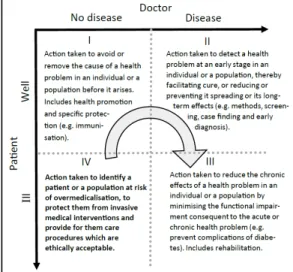
Clinical prevention, under the influence of public health, has been organised in a chronological manner since the middle of the 20th century. A paradigm shift from a chronological to a constructivist relationship-based preventive pattern of care (1) offers new insight into the practice of doctors, and brings to light the concept of quaternary prevention, a critical look at medical activities with an emphasis on the need not to harm. Quaternary prevention addresses the fundamental question of what constitutes too much or too little medicine. It is the fourth form of disease prevention, but also the fourth frame of action for family doctors.Figure 1. Four fields of the patient-doctor encounter based on relationships. The doctor looks for diseases. The patient could feel ill. Timeline is obliquely oriented from left to right, from alpha to omega, from birth to death. Anyone will become sick and die, doctors as well as patients (Jamoulle 1986).
The shift from time-based prevention towards a relationship-based organisation offers new perspectives into a physician’s work. He or she observes him- or herself, and questions the ethical limits of their activities. In this sense, quaternary prevention is aimed more at the doctor than the patient. Moreover, the four definitions of prevention published in the WONCA Dictionary of Family Medicine (2) offer a structured way to discuss the activities of family doctors, including ethical
considerations on the patient-doctor encounter. Quaternary prevention, also known as P4, is a new term for an old concept: first, do not harm. This concept enforces disciplines and attitudes such as evidence-based medicine, quality assurance, defensive medicine, avoiding abusive nosographic diagnoses and ethical issues including those linked to a heartsink patient.
1
Marc Jamoulle, MD
Marc Jamoulle, MD
Family doctor, Department of General Practice, University of Liege, Belgium
Wonca International Classification Committee & Wonca Informatics Working Party Member
The World Book of Family Medicine – European Edition 2015
Quaternary concept expanding worldwide
Disseminated by the colleagues of the WONCA International Classification Committee (WICC), the P4 concept is now widely recognized in Europe, Canada, South America and Asia. Astonishingly, quaternary prevention has lain dormant for two decades. With the expansion of Internet and social networks and facing the worldwide over-diagnosis movement, family doctors are now recently jostled with the idea. Endorsed by the Society of Brazilian Family and Community doctors (SBMFC), Quaternary prevention has been proposed as a core concept of the Brazilian health system (3) and has induced an international move in the whole of South America. Following the Quaternary Prevention Workshop during the WONCA Europe Basel Conference in 2010, the Swiss journal Primary Care published a paper on P4 in 6 languages (4). During the WONCA World Conference in Prague in 2013, a P4 seminar was organized with speakers from New Zealand, China, Iran, the UK and Belgium (5) and a poster was translated in French, Spanish, Portuguese, Vietnamese, Thai and Chinese (6) followed by a publication in the Hong Kong journal of family doctors. And during the recent P4 seminar in Lisbon WONCA conference in 2014, the tiny room was crowded with enthusiastic young doctors while the WONCA past president Richard Roberts was presenting the idea as seminal for the future of WONCA.
Figure 2. The patient-doctor relationship is at the origin of the four types of activities. The arrow shows that the P4 attitude is impacting all the activity (Jamoulle & Roland 1995)(Wonca dictionary 2003).
The enthusiasm generated around this topic shows that the P4 concept is used as a framework for a multifaceted repositioning of current questions and limitations of medical practice: disease invention, Attention Deficit
Hyperactivity Disorder market extension, transformation of symptoms into disease, osteoporosis marketing, breast cancer epidemiology and screening, incidentaloma issues, flu & HPV immunisations, drug marketing in mental health, hypertension or dyslipidaemia, as well as empathy and communication or the value of the symptoms including when medically unexplained.
And this list is not exhaustive. Quaternary prevention involves the need for close monitoring by the doctor himself, a sort of permanent quality control on behalf of the consciousness of the harm they could, even unintentionally, do to their patients. Quaternary prevention is about understanding that medicine is based on a relationship, and that this relation must remain truly therapeutic by respecting the autonomy of patients and doctors. P4 attitude acts as a response to the family doctor facing over-medicalisation, as a resistance, a rallying cry against the lack of humanity of whole sectors of medicine and their institutional corruption(7).
A growing P4 network
The P4 network has now members in Brazil, Argentina, Uruguay, Bolivia, Ecuador, Peru, Canada, Iran, China, India, Thailand, Vietnam, Belgium, France, Germany, Italy, Spain and England expressing through websites, Facebook and Twitter. After the 2013 Curitiba Meeting in Brazil, members of the Brazilian P4 group have written the Curitiba Manifesto on quaternary prevention (8). For information about quaternary prevention-related events, links, bibliography and slides, have a look at the WONCA International Classification Committee website under the
The World Book of Family Medicine – European Edition 2015 Quaternary Prevention rubric (www.ph3c.org/P4 ).
Take home messages
Prevention is not always better than cure.
Prevention is a co-construction between patient and doctor. Ecology of health care requires a mastery of do's and don'ts. Medicine can be dangerous for your health.
First do no harm.
Original abstract
http://www.woncaeurope.org/content/ws-057-about-quaternary-prevention
References
1. Jamoulle M. Information et informatisation en médecine générale [Computer and computerisation in general practice]. In: Les informa-g-iciens. Presses Un. Namur, Belgium: Presses Universitaires de Namur; 1986:193–209.
2. Bentzen N. Wonca Dictionary of General/Family Practice. Maanedsskr. Copenhagen; 2003.
3. Norman AH, Tesser CD. Prevenção quaternária na atenção primária à saúde: uma necessidade do Sistema Único de Saúde [Quaternary prevention in primary care: a necessity for the Brazilian Unified National Health System]. Cad Saúde Pública / Ministério Da Saúde, Fundação Oswaldo Cruz, Esc Nac Saúde Pública. 2009;25(9):2012–2020. Available at:
http://www.ncbi.nlm.nih.gov/pubmed/19750388
4. Kuehlein T, Sghedoni D, Visentin G, et al. Quaternary prevention: a task of the general practitioner. Prim Care 2010. 18:350–4. http://www.primary-care.ch/docs/primarycare/archiv/fr/2010/2010-18/2010-18-368_ELPS_engl.pdf 5. Jamoulle M, Tsoi G, Heath I, Mangin D, Pezeshki M, Pizzanelli Báez M. Quaternary prevention, addressing the limits of
medical practice. Wonca world conference Prague 2013 Retrieved from
http://www.ph3c.org/PH3C/docs/27/000322/0000469.pdf
6. Jamoulle M, & Roland M. Quaternary prevention. From Wonca world Hong Kong 1995 to Wonca world Prague 2013. In Wonca world conference Prague 2013 (Poster). Retrieved from http://www.ph3c.org/PH3C/docs/27/000284/0000435.pdf (available also in Chinese, Thai, Vietnamese, French, Spanish & Portuguese on www.ph3c.org/P4 )
7. Jamoulle M. Quaternary prevention, an answer of family doctors to overmedicalization. Int J Health Policy Management. 2015 Feb ;4(2):61–4. http://www.ncbi.nlm.nih.gov/pubmed/25674569"
8. Silva André Luiz da, Mangin Derelie, Pizzanelli Miguel, et al. Manifesto de Curitiba: pela Prevenção Quaternária e por uma Medicina sem conflitos de interesse. Rev Bras Med Família e Comunidade. 2014;9(33):371–374.
doi:10.5712/rbmfc9(33)1006.