HAL Id: hal-01211456
https://hal.archives-ouvertes.fr/hal-01211456
Submitted on 6 Oct 2015
HAL is a multi-disciplinary open access
archive for the deposit and dissemination of
sci-entific research documents, whether they are
pub-lished or not. The documents may come from
teaching and research institutions in France or
abroad, or from public or private research centers.
L’archive ouverte pluridisciplinaire HAL, est
destinée au dépôt et à la diffusion de documents
scientifiques de niveau recherche, publiés ou non,
émanant des établissements d’enseignement et de
recherche français ou étrangers, des laboratoires
publics ou privés.
A Fully Distributed TDMA based MAC Protocol for
Vehicular Ad Hoc Networks
Mohamed Hadded, Anis Laouiti, Rachid Zagrouba, Paul Muhlethaler, Leila
Azouz Saidane
To cite this version:
Mohamed Hadded, Anis Laouiti, Rachid Zagrouba, Paul Muhlethaler, Leila Azouz Saidane. A Fully
Distributed TDMA based MAC Protocol for Vehicular Ad Hoc Networks. [Research Report] Inria
Paris Rocquencourt. 2015. �hal-01211456�
A Fully Distributed TDMA based MAC Protocol for
Vehicular Ad Hoc Networks
Mohamed Hadded
∗†, Anis Laouiti
∗, Rachid Zagrouba
†, Paul Muhlethaler
‡and Leila Azouz Saidane
† ∗TELECOM SudParis, CNRS Samovar, UMR 5157, France†RAMSIS Team, CRISTAL Laboratory, 2010 Campus University, Manouba, Tunisia ‡INRIA, BP 105. 78153 Le Chesnay Cedex, Paris-Rocquencourt, France
{mohamed.hadded, anis.laouiti}@it-sudparis.eu, [email protected], [email protected],
Abstract—The Vehicular Ad-Hoc NETwork (VANET) consists
of a set of vehicles moving on roads which can communicate with each other through ad hoc wireless devices. VANET has attracted a lot of attention in the research community in recent years with the main focus on its safety applications. One of the challenges for vehicular network is the design of an efficient Medium Access Control (MAC) protocol due to the hidden node problem, the high speed of the nodes, the frequent changes in topology, the lack of an infrastructure, and various QoS requirements. Motivated by this observation, we design a fully distributed and location-based TDMA scheduling scheme for VANETs networks, named DTMAC. The main goal of this work is to propose a MAC protocol that can provide fairness in accessing the transmission medium, as well as reduce access collision and merging collision under various conditions of vehicular density without having to use expensive spectrum and complex mechanisms such as CDMA or OFDMA. An analytical model of the average access collision probability and throughput are derived which can be used to evaluate the performance of DTMAC protocol as well as to validate the simulation results under different traffic conditions.
Keywords—VANET, MAC Protocol, collision-free, TDMA, Fully Distributed, Scheduling Scheme.
I. INTRODUCTION
Increasing road traffic accidents in the world have moti-vated the evolution of Intelligent Transportation Systems (ITS) and other applications to improve road safety and driving comfort. A communication network, called Vehicular Ad-hoc NETwork (VANET) in which the vehicles are equipped with wireless devices has been developed to make these applications possible. In a VANET, communications can either be Vehicle To Vehicle (V2V) or Vehicle To Infrastructure (V2I) [1]. Based on these two types of communications, a VANET can support a wide range of applications for safety (such as dangerous situation detection), for infotainment (such as Internet access and data exchange) and for traffic management (such as vehicle traffic optimization).
Motivated by promising applications of VANET network, The Federal Communication Commission (FCC) [2] has es-tablished a wireless protocol similar to WiFi, called Dedicated Short Range Communications (DSRC) [3] in order to make V2V communication an effective reality. The DSRC radio technology is defined in the frequency band of 5.9 GHz with a total bandwidth of 75 MHz. This band is divided into 7 channels of 10 MHz for each one. These channels comprise one Control CHannel (CCH) reserved for the exchange of
periodic and high priority messages and 6 Service CHannels (SCHs) dedicated to data transmission.
Since the safety applications in VANET network have strin-gent QoS requirement, an efficient Medium Access Control (MAC) protocol that can provide a broadcast service with bounded access delays and minimum transmission collision is required. Recently, MAC protocols, notably those that are based on the TDMA technique are used to enable multiple vehicles to use the same frequency channel without interfering with other vehicles [1]. The TDMA principle consists in allocating the bandwidth to all the vehicles by dividing the time into different frames and each frame is divided into several time slots. Each vehicle can access the channel during its dedicated time slot to send data messages, while it can only receive during the time slots reserved for other vehicles. However, many issues arise due to the high vehicle mobility in VANETs which can affect the performance of these proto-cols. Therefore, the scheduling mechanisms in TDMA based MAC protocols should take into consideration the mobility features of VANETs so as to avoid collisions. In this paper, we propose a completely Distributed and infrastructure free TDMA based MAC protocol (DTMAC) which exploits the linear feature of topology in VANET network. This protocol is based on VeMAC protocol which has been recently proposed for VANET network. DTMAC uses the vehicular location information sufficiently to help the vehicles access the channel in an efficient way, so as to solve the collision problem caused by high mobility of nodes and to reduce the access delay.
The rest of the paper is organized as follows. In Section 2, we review related work. Section 3 describes the system models and presents the TDMA problems that may occur in a fully distributed VANET due to the high mobility of nodes. Section 4 describes our TDMA based MAC protocol, called DTMAC and how it solves the hidden node problem without having to use complex wideband mechanisms such FDMA or CDMA. An analytical model for the average access collision probability and throughput are presented in Section 5. The parameters tuning problem of DTMAC is formulated as a multi-objective optimization problem in Section 6. Finally, conclusions and future work are reported in Section 7.
II. RELATED WORK
Generally, MAC protocols fall into one of two broad cat-egories: based and free. In contention-based protocols, each node can try to access the channel when
it has data to transmit using the carrier sensing mechanism [4]. The IEEE 802.11p [5], which is the emerging standard deployed to enable vehicular communication, is a Contention-based MAC protocol, using a priority-Contention-based access scheme that employs both Enhanced Distributed Channel Access (EDCA) and Carrier Sense Multiple Access with Collision Avoidance (CSMA/CA) mechanisms [6]. Since the IEEE 802.11p stan-dard is a Contention-based MAC, it cannot provide reliable broadcast mechanism with bounded communication delay. This disadvantage is particularly important in VANETs which are specially designed to improve road safety.
In Contention-free MAC protocols, only one vehicle can access the channel at any given time. Therefore, these proto-cols provide collision-free transmission with bounded access delay for real-time applications. In [7], the authors propose Dedicated Multi-channel MAC (DMMAC) protocol which is an alternative to the IEEE 802.11p standard. DMMAC has an adaptive broadcasting mechanism providing collision-free and delay-bounded transmissions for safety applications under various traffic conditions. The DMMAC architecture is similar to IEEE 802.11p with the difference that, the CCH Interval is divided into an Adaptive Broadcast Frame (ABF) and a Contention-based Reservation Period (CRP). The ABF period consists of time slots, and each time slot is dynamically reserved by a vehicle as its Basic Channel (BCH) for collision-free delivery of safety messages or other control messages. DMMAC implements a dynamic TDMA mechanism for BCH reservation based on the distributed access technique R-ALOHA (Reliable R-ALOHA [8]). The length of the ABF frame is not uniform in the entire network. Each vehicle dynamically adjusts its ABF length according to its neighbors. Omar et al. developed and evaluated in [9], [10], [11] a contention-free multi-channel MAC protocol proposed for VANETs. In contrast to DMMAC, VeMAC is completely contention-free. This protocol supports efficient one-hop and multi-hop broadcast services on the control channel with-out the hidden terminal problem caused by node mobility. These broadcast services are presented in [12] for ADHOC MAC. VeMAC reduces the merging collision rate by assigning disjoint sets of time slots to vehicles moving in opposite directions (Lef t, Right) and to Road Side Units (RSUs). An efficient MAC approach called, ATSA [13] which is an improvement of the previously proposed MAC protocol based on the VeMAC protocol is named the Decentralized Adaptive TDMA Scheduling Strategy DATS [14]. Like VeMAC, ATSA divides the frame into two sets of time slots Lef t and Right. However in ATSA, when a vehicle accesses the network, it chooses a frame length and competes for one of the time slots available for its direction. Moreover the frame length is dynamically doubled or shortened based on the binary tree algorithm, and the ratio of two slot sets is adjusted to decrease the probability of transmission collisions.
The design of distributed TDMA based MAC protocols for VANETs should consider mobility (i.e., the slots scheduling mechanism should be periodically aware of the neighbors’ slot allocation), scalability (i.e., they should scale under different traffic load conditions), and fairness (i.e., all the vehicles have equal access to the medium during a fixed time interval), Packet loss (i.e, hidden nodes and access collision) [1]. In this paper, a distributed and infrastructure free TDMA based MAC protocol (DTMAC) is proposed to address above problems. In
DTMAC, the road is dissected into small fixed areas in which the time slots will be reused between them in such a way any vehicles in different adjacent areas access to the channel at the same time and thus no interference will occur.
III. SYSTEM MODELANDTDMAPROBLEM STATEMENT
A. System Model
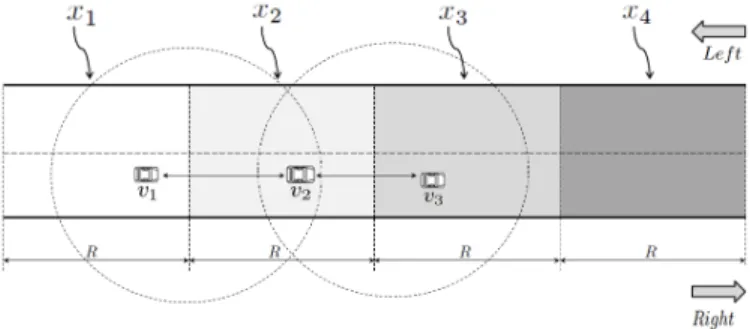
The VANET network in highway scenario consists of a set of vehicles moving in opposite directions and under different traffic conditions (speed, density). DTMAC is based on the assumption that each vehicle in a VANET is equipped with a GPS (Global Positioning System) or a GALLILEO receiver that also allows it to obtain an accurate real-time three-dimensional geographic position (latitude, longitude and altitude), direction, speed and exact time. Moreover, the syn-chronization among vehicles may be performed by using GPS timing information. Each road is dissected into small fixed areas (see Figure 2). Note that the area size depends on the transmission range of vehicles (around 1000 m). DTMAC is based on VeMAC protocol, such that the channel time is par-titioned into frames and each frame is further parpar-titioned into two sets Lef t and Right. In the next section, we will explain in details the slot scheduling mechanism in DTMAC and we will show how this protocol can provide an efficient time slot utilization for the participating vehicles while minimizing transmission collisions due to the hidden node problem.
B. TDMA Problem Statement
When a distributed scheme is used to allocate a time slot, two types of collision can occur [15]: access collision between vehicles trying to access the same available time slots, and merging collisions between vehicles using the same time slots. When the traffic density is high, the rate of access and merging collisions will increase rapidly which will lead to inefficient channel utilization and high access delay for safety application.
An access collision problem occurs when two or more
vehicles within the same two-hop neighborhood set attempt to access the same available time slot. This problem is likely to happen when a distributed scheme is used. On the other hand, merging collisions occur when two vehicles in different two-hop sets accessing the same time slot become members of the same two-hop set due to changes in their position. Generally, in VANETs, merging collisions are likely to occur in the following cases:
• Vehicles moving at different speeds.
• Vehicles moving in opposite directions.
• There are RSUs installed along the road.
Figure 1 shows an example of the second case of the merging collision problem, when vehicle B in the first two-hop set moving in the opposite direction to vehicle E in the second two-hop set is using the same time slot as B. Since B and E become members of the same two-hop set, a collision occurs.
Fig. 1. Merging collision problem.
IV. DISTRIBUTED AND INFRASTRUCTURE FREETDMA
BASEDMACPROTOCOL
A. DTMAC Preliminaries
We propose a completely distributed and infrastructure free TDMA scheduling scheme which exploits the linear feature of topology in VANET network. Indeed, the vehicles motions in highway environment are linear due to the fact that their movements are constrained by the road topology. Our scheduling mechanism is also based on the assumption that each road is dissected into small fixed areas, denoted by
xi, i = 1, . . . , N (see Figure 2).
The time slots in each TDMA frame are equally partitioned into two sets Lef t and Right, associated with the vehicles that are moving on the left and right direction, respectively (see Figure 3). Moreover, the Lef t and Right sets are further divided into three sets associated with vehicles in three con-tiguous areas: S0, S1 and S2, receptively (see Figure 3). Each
frame consists of a constant number of time slots, denoted by
T and each time slot is of a fixed time duration, denoted by s.
Each vehicle can detect the start time of each frame as well as the start time of a time slot. In the studied VANET network, all vehicles are equipped with a Global Position System (GPS) and thus the one-Pulse-Per-Second (1PPS) signal that a GPS receiver gets every second from GPS satellites can be used for slot synchronization.
Fig. 2. The partition of the studied highway into N areas.
To prevent the collision on the transmission channel, our TDMA scheduling mechanism requires that every packet trans-mitted by any vehicle should contain additional information,
Fig. 3. TDMA slots scheduling principle.
called Frame Information (FI). The FI consists of a set of ID Fields (IDFs) of size equal to the number of time slots per frame, T . Each IDF is dedicated to the corresponding time slot of a frame. The basic FI structure is shown in Figure 4. Each time slot is dynamically reserved by an active vehicle (the vehicle whose communication device is working) for collision-free delivery of the safety messages or other control messages. The Node ID field contains the ID of the vehicle that is accessing this slot. Each vehicle is identified by its MAC address as well as an integer number. The Status field contains the status of each slot which indicates whether the slot is Idle, Busy or Collides. Finally, the Type field indicates the type of the packet transmitted by the corresponding vehicle, i.e. periodic information or event-driven safety messages.
B. TDMA slot scheduling mechanism
Our distributed TDMA scheduling mechanism uses the vehicular location information sufficiently to help the vehicles access the channel in an efficient way. As in VeMAC protocol, the channel time is partitioned into frames and each frame is further partitioned into two sets Lef t and Right. Furthermore, each half frame is partitioned into three sets of time slots
S0, S1, and S2. These sets are associated with vehicles moving
in the areas xi, xi+1, and xi+2, respectively. As shown
in Figure 2, by dividing the time slots reserved for each direction into three sets, the vehicles v1and v3that are moving
within the two areas x1 and x3, respectively, can not transmit
simultaneously to the vehicle v2 because they are accessing
disjoint sets of time slots. Therefore, our TDMA scheduling mechanism can decrease the rate of collision due the hidden node problem in VeMAC caused by node mobility. In each area, the vehicles access to the time slots associated to their locations and mobility direction with the same probability. In the next, we assume the following notations:
• Si(x): The set of time slots associated to the direction
and the area in which the vehicle x is traveling.
• N (x): The set of neighbors1 of vehicle x on the transmission channel.
1The set of neighbors is the set of vehicles that are moving within the same
Every active vehicle in the network should allocate a fixed slot in the frame for safety messages or other control packets delivery. It is obvious that a vehicle’s slot cannot be reused by any neighboring vehicles within the same area as well as in the adjacent areas, otherwise collisions will occur. The goal of this work is to propose an efficient slot reuse algorithm along the road without having to use expensive spectrum and complex wideband mechanisms such FDMA or CDMA. In fact, the three subsets of time slots will be reused between neighboring areas in such a way any vehicle in different adjacent areas access to the channel at the same time and thus no interference will occur.
Fig. 4. Frame Information (FI) structure.
Suppose an active vehicle x needs to acquire a time slot on the transmission channel. The vehicle x starts listening to the channel during the set of time slots reserved for its direction and for its area in which is traveling, Si(x).
• Each vehicle that hears exactly one node transmission in a time slot reserved to its location and mobility direction, it will set the status of the slot to busy and record the ID of the vehicle accessing the channel at this time slot in the corresponding Node ID field.
• Each vehicle that receives multiple FIs from different vehicles during the same time slot, it will consider that the slot is occupied by more than one vehicle and sets its status as collide.
• If the vehicle does not hear anything during a specific time slot, it will set its status as free.
At the end of the frame, the vehicle x can determine the set
N (x) and the set of busy slots in Si(x) used by each vehicle
i ∈ N(x), denoted by P (x). In order to avoid any collision
problem, this set of time slots are prohibited from being reused by any other vehicle in neighboring areas. Therefore, the vehicle x can determine the set of available time slots V (x) and then attempts to allocate one of them randomly, say time slot k.
Algorithm 1 outlines the details of the frame information formation. In the algorithm, i is the index of the area on which a vehicle is traveling. If no other vehicle is moving in the same area of vehicle x attempts to acquire a time slot k, then no access collision happens. In this case, the attempt of vehicle x is successful and all nodes i∈ N(x) add vehicle x to their sets
N (i) and record that vehicle x is using time slot k. However,
if at least one node within the same area of vehicle x accesses
Algorithm 1FI formation Input
Si(x) : the set of time slots that the vehicle x can reserve.
αi, βi: are the index of the first and the last slot of the set
Si(x), respectively.
1: foreach slot index s = αi to βi do
2: if only one vehicle j is heard in the slot s then
3: F I[s].N odeID← j 4: F I[s].Status← Busy
5: else
6: if more than one vehicle are heard in the slot s then
7: F I[s].Status← Collide
8: else// Anything is heard in the slot s
9: F I[s].Status← F ree
10: end if
11: end if
12: end for
time slot k, then all the transmissions fail and the time slot k is not acquired by any of the contending vehicles. In this case, the vehicle x will discover that its attempt was unsuccessful as soon as it receives a packet from any node i∈ N(x) indicating that vehicle x /∈ N(i). Vehicle x then re-accesses one of the time slots in V (x), and so on until all nodes i∈ N(x) indicate that node x ∈ N(i) and announce the time slot accessed by vehicle x. However, when accessing collision happens among the vehicles that are moving in the same area, the probability of access collision in the next reservation is maximized since the choice of each colliding vehicle x will be limited in the new set V (x). In order to ensure channel access continuity, each vehicle should determine the expected available time slots on the set of time slots associated with the next area before leaving its current area in which is traveling. In fact, when a vehicle is using a given time slot in the set Si, it should allocate an
available time slot on the set S(i+1)%3 as its future time slot
before leaving its current area (i.e., distxmod R≈ 0), where
distx is the distance traveled by the vehicle x and R is the
communication range. Algorithm 2 outlines the details of the slot reservation. It is executed by each vehicle which needs to reserve a time slot.
Algorithm 2Slot reservation
1: Determine driving direction and area xi.
2: Determine the set of time slots Si associated with the area
xi.
3: Determine the available time slots V .
4: if V ̸= {⊘} then
5: Randomly reserve an available time slot k.
6: end if
7: ifAll the received FIs in the next frame indicate that the slot k has been reserved by the vehicle x then
8: Successf ul← 1
9: else// There is other vehicle within its area xi reserving
the same slot k
10: Successf ul← 0
11: Release the time slot k
12: Go back to 4
V. ACCESS COLLISION PROBABILITY AND THROUGHPUT ANALYSIS
In this section, the model of the average access collision probability and throughput are derived. In this work, we assume that the VANET scenario taken into account is a two-way hightwo-way of length equal to L. We assume that every area in the road has a unique index number such as 1, 2, . . . , N . The probability which the vehicle in the i− th area decides to access the available j − th time slot reserved for its
direction and location is denoted by pij. Such as the probability
of the vehicle in the fourth area accessing the 7-th slot is denoted by p47. First of all, we calculate the access collision
probability where a vehicle appears in every area tries to access an available time slot.
• Ai: Actual number of active vehicles in a given area
xi.
• T : Number of time slots.
• Paci: the access collision probability of the vehicle in
area xi accessing channel.
• αi, βi: The indexes of the first and the last time slots
reserved for the area xi.
The access collision probability of a vehicle in area A1 can
be founded as: Pac1= 1− Pnac1 (1) Pnac1= β1 ∑ j=α1 p1j∗ A1 ∏ k=2 (1− p1j) (2)
where Pac1 denotes the access collision probability in area x1
and in a given time slot, while Pnac1 denotes the non-access
collision probability in area x1 and in a given time slot.
Based on the above derivation, the expression of total access collision probability of the vehicle in all locations can be given by: Pact= 1− Pnact (3) Pnact= N ∑ i=1 Pnaci= N ∑ i=1 βi ∑ j=αi pij∗ Ai ∏ k=2 (1− pij) (4)
where, Pactrepresents the total access collision probability
of the vehicle in the studied highway accessing the chan-nel, Pnactrepresents the total non-access collision probability
of the vehicle in the studied highway accessing the channel.
Paver−ac= T1 ∗ Pnact (5)
Paver−acrepresents the average access collision probability
of the vehicle in the studied highway accessing the channel.
The throughput estimated by the average rate of mes-sages successfully transmitted over the channel. The average throughput is obtained by:
T Haver= CT ∗ Pnact (6)
where, T Haver denotes the average throughput, C denotes
the total channel capacity of the bandwidth. VI. DTMAC QOS OPTIMIZATION
The channel time is partitioned into frames and each frame is divided into T slots. Moreover, the road is dissected into
N small fixed areas. This means that, there may exist access
collision when multiple vehicles try to access to the same time slot at the same time. We are motivated to design an optimal TDMA based MAC protocol with minimal access collision probability and high throughput. According to (4) and (6), we can note that the access collision probability and the throughput are dependent on the input parameters of DTMAC (i.e., T, N, αi and βi). We are motivated to optimize
the parameters of DTMAC to design an optimal TDMA based MAC protocol with minimal access collision probability and high throughput. Therefore, the DTMAC QoS optimization can be formulated as multi-objective optimization problem whose inputs are the DTMACs parameters and whose objectives are: Reducing the access collision probability, and maximizing the throughput;
The objective functions and the constraint conditions of the optimization problem can be written as:
(1) Objective functions:
First objective:minimizing the access collision probability
Pact= 1− N ∑ i=1 Pnact= 1− N ∑ i=1 βi ∑ j=αi pij∗ Ai ∏ k=2 (1− pij)
Second objective: maximizing the average throughput
T Haver=CT ∗ Pnact (2) Constraint conditions: (s.t.) βi ∑ j=αi pij = 1 ∀ i = 1 . . . N 0≤ pij ≤ 1 ∀ i = 1 . . . N, ∀ j ∈ [αi, βi] αi< βi< T ∀ i = 1 . . . N VII. CONCLUSION
The Design of efficient TDMA based MAC protocols is an important issue in VANETs due to the rapid changes in network topology and the lack of infrastructure. In this paper, we propose a completely distributed and infrastructure free
TDMA scheduling scheme, named DTMAC which exploits the linear feature of topology in VANET network. The ways that slots are scheduled and reused between vehicles are designed to avoid the transmission collision caused by the hidden node problem. Analytical models of the average access collision probability and throughput are proposed. Moreover, the parameters tuning of DTMAC is formulated as a multi-objective optimization problem in order to find the optimal parameters that optimize the QoS of DTMAC protocol in terms of access collision and throughput. In our future work, we will evaluate the performance of DTMAC in realistic VANET mobility scenarios by using SUMO/MOVE and ns2 and we will provide simulations results and analysis. Moreover, we plan to compare the simulation results founded by ns2 with those that will be founded by the analytical model.
REFERENCES
[1] M. Hadded, P. Muhlethaler, A. Laouiti, R. Zagrouba, and L. A. Saidane, “Tdma-based mac protocols for vehicular ad hoc networks a survey, qualitative analysis and open research issues,” IEEE Communications
Surveys Tutorials, vol. PP, no. 99, 2015.
[2] Federal Communications Commission, FCC 99-305, FCC Report and
Order Std., Oct. 1999.
[3] D. Jiang, V. Taliwal, A. Meier, W. Holfelder, and R. Herrtwich, “Design of 5.9 ghz dsrc based vehicular safety communication,” IEEE Wireless
Commun, vol. 13, no. 5, pp. 36–43, Oct. 2006.
[4] F. Ye, R. Yim, J. Zhang, and S. Roy, “Congestion control to achieve optimal broadcast efciency in vanets,” in IEEE International Conference
on Communications (ICC), Cape Town, South Africa, May 2010, pp.
1–5.
[5] 802.11p-2010, IEEE standard for information technology -
Telecom-munications and information exchange between systems - local and metropolitan area networks - specific requirements part 11 : Wireless LAN medium access control (MAC) and physical layer (PHY) and physical layer (PHY) specifications amendment 6 : Wireless access in vehicular environments Std., 2010.
[6] R. Uzc´ategui and G. Acosta-Marum, “Wave: A tutorial,” IEEE
Com-munications Magazine, vol. 47, no. 5, pp. 126–133, May 2009.
[7] N. Lu, Y. Ji, F. Liu, and X. Wang, “Dmmac : A dedicated multi-channel mac protocol design for vanet with adaptive broadcasting,” in
IEEE Wireless Communications and Networking Conference (WCNC),
Sydney, Australia, Apr. 2010, pp. 1–6.
[8] F. Borgonovo, A. Capone, M. Cesana, and L. Fratta, “Rr-aloha, a reli-able r-aloha broadcast channel for ad-hoc inter-vehicle communication networks,” in IEEE IFIP Annual Mediterranean Ad Hoc Networking
Workshop (Med-Hoc-Net), Baia Chia, Italy, 2002.
[9] W. Zhuang, H. A. Omar, and L. Lio, “Vemac: A novel multichannel mac protocol for vehicular ad hoc networks,” in IEEE Conference on
Computer Communications Workshops (INFOCOM WKSHPS),
Shang-hai, China, Aug. 2011, p. 413418.
[10] H. A. Omar, W. Zhuang, and L. Li, “Evaluation of vemac for v2v and v2r communications under unbalanced vehicle traffic,” in IEEE
Vehicular Technology Conference (VTC Fall), Qubec City, Canada, Sep.
2012, pp. 1–5.
[11] ——, “Vemac: A tdma-based mac protocol for reliable broadcast in vanets,” IEEE Transactions on Mobile Computing, vol. 12, no. 9, pp. 1724–1736, Sep. 2013.
[12] F. Borgonovo, A. Capone, M. Cesana, and L. Fratta, “Adhoc mac: new mac architecture for ad hoc networks providing efficient and reliable point-to-point and broadcast services,” Wireless Networks, vol. 10, no. 4, pp. 359–366, 2004.
[13] Y. Weidong, L. Pan, L. Yan, and Z. Hongsong, “Adaptive tdma slot assignment protocol for vehicular ad-hoc networks,” Journal of China
Universities of Posts and Telecommunications, vol. 20, no. 1, pp. 11–18,
Feb. 2013.
[14] W. Ke, Y. Weidong, L. Pan, and Z. Hongsong, “A decentralized adaptive tdma scheduling strategy for vanet,” in IEEE Wireless Communications
and Networking Conference Workshops (WCNCW), Shanghai, China,
Apr. 2013, pp. 216–221.
[15] F. Borgonovo, L. Campelli, M. Cesana, and L. Fratta, “Impact of user mobility on the broadcast service efficiency of the adhoc mac protocol,” in IEEE Vehicular Technology Conference, vol. 4, Dallas, TX, USA, May 2005, pp. 2310–2314.