Tomul LVI ŞtiinŃe Economice 2009
ROBUST RECOVERY OF THE RISK NEUTRAL PROBABILITY DENSITY FROM OPTION PRICES
Gabriel TURINICI*
Abstract
We present in this paper a robust numerical procedure that allows extracting the risk neutral probability density data from a set of quoted European option prices. The procedure does not use any specific evolution model for the underlying; the probability density is the solution of a fitting problem to which we add a penalty term to ensure smoothness of the result. We give some examples from FOREX markets.
Key words: mathematical finance, risk neutral probability density, calibration JEL classification: C63, G13, F31
1. Introduction
We consider in this work a traded financial product (be it a stock, a commodity or a FOREX rate) upon which several European options are defined and traded. We denote by
S
t the price of the underlying and byC
(
K
l,
T
l)
the today price of the European optionof strike
K
l and maturityT
l written on this underlying (“l” ranges from 1 to L). We refer the reader to [Hull 2006, Rebonato 2004] for basic notions on financial options and their pricing.We also consider an investor that wants to estimate its risk exposure to the underlying
t
S
and needs to this end the risk-neutral probability densityp
( t
s
,
)
associated toS
t; we do not enter here into the details of the definition ofp
( t
s
,
)
(cf. again to references above for details) but we want to recall thatp
( t
s
,
)
is not the real-world probability density ofS
t reaching “s” at time “t”, but is a mathematical object that has important properties in the pricing of derivatives products written onS
t.Let us denote by “r” the interest rate that will be supposed constant; by its own defini-tion, the risk neutral probability density has the very important property that the price of any
* Gabriel TURINICI ([email protected]), PhD, Professor of Applied Mathematics, “Université
Paris Dauphine”, Paris, France. Affiliated with the CEREMADE laboratory, Applied Mathematics and Computer science (MIDO) Department at the Université Paris Dauphine and with INRIA Rocquencourt, GIP-ANR and mis-cellaneous research organisations.
derivative
C
(
K
l,
T
l)
onS
tis the actualization of the expectation value of the contract at its maturity, expectation written with respect to the risk-neutral probability. This translates into mathematical formulas:L
l
ds
T
s
p
K
s
e
T
K
C
l l rT l l l(
)
(
,
)
,
1
,...,
)
,
(
=
−∫
−
+=
(1)where we recognize in
(
s
−
K
l)
+the payoff of the European option. Our problem is how torecover
p
( t
s
,
)
from quoted pricedC
(
K
l,
T
l)
in a robust manner, that is, when prices)
,
(
K
lT
lC
only change slightly one wantp
( t
s
,
)
to vary with small amounts; the robustness is a required ingredient for all inverse problems (of which the present one is an example), cf. [Turinici 2009], for a related example on local volatility surface calibration.2. The construction of the functional to minimize
A close look at the formula (1) shows that there are a finite number of constraints (L) and an infinite number of unknowns i.e. all the possible shape parameters of the func-tion
p
( t
s
,
)
. Therefore in general there is no unique solution to this problem, and the question is how to choose a solution that has optimal properties among all possible solu-tions. Many approaches may prove useful; we document below one approach that gives satisfactory results in practice.Note also that, since the constraints are only imposed at some maturity times
T
l we cannot recover information onp
( t
s
,
)
for times which are between two consecutive timesT
l; we reformulate thus our problem as: for a fixed timeT
find the bestp
( T
s
,
)
which satisfies
J
j
ds
T
s
p
K
s
e
T
K
C
j rT j,
)
(
)
(
,
)
,
1
,...,
(
=
−∫
−
+=
(2)and is as smooth as possible. We will measure smoothness in terms of the first derivative, i.e. among all
p
( t
s
,
)
that satisfy (2) we choose the one that minimizes the norm of this first derivative: 2 0( , )
min
pp s T
ds
s
∞
∂
∂
∫
(3)With these provisions the problem to solve is a quadratic optimization problem (cf. [Bonnans et. al. 2006]) for how to solve such an optimisation problem) under linear con-straints. We can also remember that
p
( T
s
,
)
being a probability density is has to always be positive and sum up to one and introduce further constraints accordingly.In order to compute the solution to the problem (2)+(3) we described
p
( T
s
,
)
by its values on a gridS
min,
S
min+
∆
S
,
S
min+
2
∆
S
,...,
S
max ,N
S
S
S
=
max−
min]
,
[
S
minS
max is a range of points that cover all possible values relevant for the evolution ofS
t. On this grid the computation of the integrals in (2) is replaced by a summation and the derivatives in (3) are approximated by a finite difference formula)
(
)
,
(
)
,
(
)
,
(
S
o
S
T
s
p
T
S
s
p
s
T
s
p
+
∆
∆
−
∆
+
=
∂
∂
(4)4. Results and conclusions
We analysed the results of the proposed procedure on a set of data from the FOREX markets.
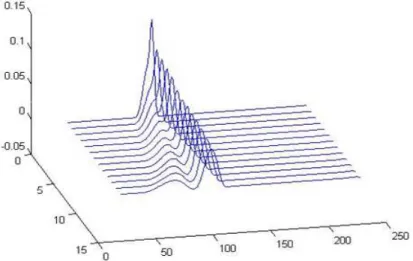
The first example was a JPY/USD exchange rate where we used option data from Ta-bles 1,2,3 of [Turinici 2008 p 93]. The result is given in Fig.1. As mentioned above, only data at maturity times quoted on the market can be recovered. But we can also interpolated between the data to obtain a guess for the probability density at any point in time; this inter-polation is given in Fig. 2. Note that the procedure is capable to retrieve fine details of the probability density data (e.g, convexity information, local minima etc); one notes that in this case (cf. another example later) the probability density surface has an intriguing form with two branches, we refer the reader to a future work for the theoretical explanation and the practical consequences of this fact.
Figure no. 1. The recovered risk-neutral probability density for the JPY/USD example. Strike is the Ox axis, time the Oy axis and the probability density function the Oz axis
Figure no. 2. The recovered risk-neutral probability density for the JPY/USD example, interpo-lated surface version. Strike is the Ox axis, time the Oy axis and the probability density function
the Oz axis
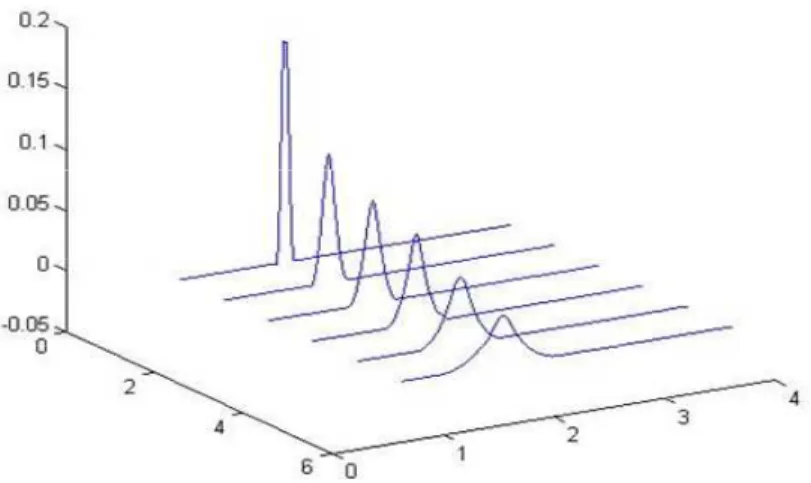
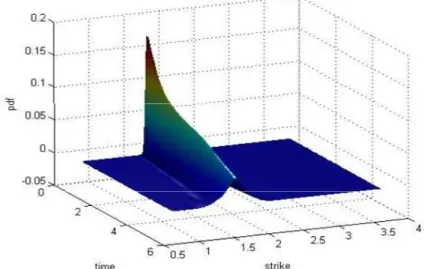
As a second example we took a USD/EUR exchange rate from [Turinici 2009 p 1-17] (Tables 1 and 3). Again the result is satisfactory and the form of the resulting surface is smooth, cf. Figures 3 and 4.
Figure no. 3. The recovered risk-neutral probability density for the EUR/USD example. Strike is the Ox axis, time the Oy axis and the probability density function the Oz axis
Figure no. 4. The recovered risk-neutral probability density for the EUR/USD example, interpo-lated surface version. Strike is the Ox axis, time the Oy axis and the probability density function
the Oz axis
References
Bonnans, J.F., Gilbert J.C., Lemaréchal C. and Sagastizábal C.A.. Numerical optimization. Universitext. Springer-Verlag, Berlin, second edition, 2006. ISBN 3-540-35445-X. Theoretical and practical aspects.
Hull J. Options, Futures, and Other Derivatives. Prentice Hall, sixth edition, 2006.
Rebonato, R. “Volatility and Correlation: The Perfect Hedger and the Fox” Wiley, 2nd edition, 2004 Turinici, G. “Calibration of local volatility using the local and implied instantaneous variance”
J.Computational Finance, p1-17 1:2009 preprint available at http://hal.archives-ouvertes.fr/hal-00338114/fr/ retrieved July 15th 2009
Turinici, G. “Local volatility calibration using an adjoint proxy” Review of Economic and Business