Montpellier, 6-8 juin 2018
1
Turning managers into management designers: an
experiment.
Damart, sébastien
Université Paris-Dauphine, PSL Research University, CNRS, UMR, DRM, 75016 PARIS, FRANCE
[email protected] David, Albert
Université Paris-Dauphine, PSL Research University, CNRS, UMR, DRM, 75016 PARIS, FRANCE
Klasing Chen, Milena
SNCF, Dir. Système & Techno Ferroviaire, Innovation et Recherche, Dir. Scientifique Laousse, Dominique
SNCF, Dir. Système & Techno Ferroviaire, Innovation et Recherche, Dir. Scientifique Résumé :
Management, as it has been materialized through management principles, systems, techniques or practices, is the product of a design activity: managerial “objects” can be described and labeled and the process of their invention can be analyzed. The objective of this paper is not to state if and to what degree management can be designed, but, much more precisely and modestly, to analyze how managers within an organization can be turned into management designers. In other words, how can we organize a group of managers who decide to take management as an innovation field, i.e. a target for a design activity? In order to explore this question, we - the authors of this paper - designed an experiment: about ten managers were proposed to form a group and to take part to a workshop. Four half-day sessions took place. This paper proposes an analysis of this experiment. In order to understand the specific nature of this experiment, we first need to understand how management has been designed up to now. Literature review will analyze which kind of actors have been inventing management
Montpellier, 6-8 juin 2018
2 throughout its history and make hypothesis on which design goals were at stake and under which design regimes. With respect to the specific goal of our experiment —turning managers into management designers— and to the specific design regime we want to experiment — innovative design— we will then detail our methodology. We detail the process as it happened, at each phase of the workshop, and comment on the logics of each step. Finally, we discuss the nature of the process and conclude on the effects of the experiment in turning managers into management designers.
Mots-clés : Management innovation, management design, innovative design, management designers
Montpellier, 6-8 juin 2018
3
Turning managers into management designers: an
experiment.
INTRODUCTION
Management, as it has been materialized through management principles, systems, techniques or practices, is the product of a design activity: managerial “objects” can be described and labeled and the process of their invention can be analyzed (Birkinshaw et al., 2008; David, 2018), management has engineers (Hopf, 1940), makers (Clutterbuck and Crainer, 1990), inventors and innovators (Hamel, 2006). Managing is designing (Boland and Collopy, 2004), managers do not only act depending contextual factors, they “shape and reshape the contextual factors of their realm of work, seeking to improve outcomes” (Jelinek, 2004). If, as Jelinek suggests, we, as researchers, consider managing as designing, we have to jump into how actors deliberately design management. This has, according to her, important consequences on our own position, as management researchers: “Yet refocusing our attention to deliberate design (even the deliberate creation of circumstances to support emergent design, chaotic design, and fortuitous juxtapositions) might well refresh our understanding and potentials is the new context of our times. We [researchers] need, I think, to manage our design process too, building in the “innovation buffer” of time, resources, and attention to create the organizational contexts for now, rather than for yesterday and yesterday’s challenges” […] In short, considering management as design invites us to redesign our understanding of management, our theory of managing, and our management of theory (Jelinek, 2004: 118-119). Weick (2004) also insists on what inspires management designers and calls for a design regime more in line with contemporary times: “If managers keep imposing machine metaphors and mechanistic assumptions onto events in an effort to stabilize them, predict them, and control them, then categories, stereotypes, schemas, routines, and formalizations seem like useful tools […]. If managers need to understand and coordinate variability, complexity, and effectiveness, then they need to create designs that mix together perceptual and conceptual modes of action or move back and forth between these modes or rely on multiple compoundings of abstraction. Designs that fit these requirements are best
Montpellier, 6-8 juin 2018
4 achieved if design is recast as designing that uses transient constructs, bricolage, and improvisation” (Weick, 2004: 47). Hatchuel (2002) elaborates on Simon’s concept of bounded rationality and proposes a new concept of expandable rationality to characterize innovative design processes: “human agents are limited decision makers but ‘good’ natural designers (including social interaction as a design area). [They] have a surprising and infinitely expandable ability to create stories, forms, and concepts”(2001: 270). What could, then, improve the innovation capabilities of an group of actors? Hatchuel suggests three complementary directions: (1) Improving concept expandability, i.e. learning to manipulate concepts that correspond to non countable sets or perceptual structures (Simon and Chase 1973)–in some way all schools of Art try to do that; (2) Designing new learning devices: new prototyping, virtual mock-ups, video aided rehearsals, cooperation aiding software, etc. and (3) Looking for new forms of social interaction in design: for example, involving users or other stakeholders in the design process.
Applying these perspectives and directions for improvement to a particular class of objects to be designed, i.e. management, and if we focus on innovative design, i.e. creative design processes in management, what experiment could we imagine and implement so that managers could become creative designers of management?
This paper tells about an experiment we have conducted in a large organization, with managers that were interested in considering management as an innovation field. Following Hatchuel’s recommendations, we have built a protocol to train managers to manipulate managerial concepts in an expansive logic, using new learning devices, with new forms of interactions. Hence, the objective of this paper is not to state if and to what degree management can be designed, but, to analyze how managers within an organization can be turned into management designers. How can we organize a group of managers who agree to take management a target for a design activity? What happens when managers experience such a “R&D in management” activity (David, 2013; David and Hatchuel, 2007a)? How do they integrate both what is management in general and how they experience management in their own practical context (O’Connor, 2011)? Can reflexive practitioners (Schön, 1983) be turned into conceptive managers?
In order to explore this question, we - the authors of this paper - designed an experiment with eleven managers. They were proposed to form a group and to take part to a workshop. Four half-day sessions took place. During the first phase, presentations on management history and
Montpellier, 6-8 juin 2018
5 the key concepts of management theory and practice were shared and discussed. A second phase consisted in integrating the content of presentations and discussions with the participants’ experience of management. A third phase then allowed participants to elaborate, discuss and confirm both a conceptual architecture of management as they now thought and lived it and potentially innovative directions for a later workshop with the objective of collaboratively designing innovative management concepts and practices.
In order to understand the specific nature of this experiment, we first need to understand how management has been designed up to now. Literature review will analyze which kind of actors have been inventing management throughout its history and make hypothesis on which design goals were at stake and under which design regimes. With respect to the specific goal of our experiment —turning managers into management designers— and to the specific design regime we want to experiment — innovative design— we will then detail our methodology: choice of participants, organization of contents and discussions for each phase, empirical material collected and the way it will be analyzed, making of the knowledge base mutualized at stages 1 and 2, elaboration of the conceptual projectors used at phase 3, elaboration of innovative proposal at the end of the process. Third, we will detail the process as it happened, at each phase of the workshop, and comment on the logics of each step. Fourth, we will discuss the nature of the process and conclude on the effects of the experiment in turning managers into management designers.
1. LITERATURE REVIEW
1.1. THREE PERSPECTIVES IN THE HISTORY OF MANAGEMENT DESIGNING
A short detour through the pioneering history of developing ideas and practices in management is helpful. It provides answers to the following questions: who were the designers of new management practices? Through what processes have management ideas and practices been designed? What were the managerial objects coming out of these design processes? The historical detour below shows that management designing can be read through the prism of three perspectives: management designing as systematizing practices and methods, management designing as translating society ideals, and management designing as generating ontologies.
Montpellier, 6-8 juin 2018
6 1.1.1. Management designing as systematizing practices and methods
The history of contemporary management in France and the US has largely relied on major and numerous contributions of mechanical engineers. In a large part, the desire of these engineers/managers of the second half of the 19th century and the first half of the 20th century was the improvement of the functioning of production lines and the systematization and professionalization of management techniques.
Litterer (1961) showed that in the second half of the 19th century, factories in both the USA and Europe employed the highest skills, not to design new products but to make the production lines work better. The author refers to the numerous academic and professional publications of the end of the 19th century (specialized journals in production engineering, a discipline that has been existing since the middle of the 19th century), which pose the premises of scientific management as later developed by Taylor, or systematic management — detecting best practices and turning them into standards— as developed at Du Pont. Numerous markers attest that this decade was decisive in the active will to professionalize the management activity, to lay down fundamental principles, moving from an empirical to a structured, systematic approach. The activities of the Taylor Society or the American Society of Mechanical Engineers (ASME) demonstrate the desire to equip the discipline with a structured body of principles (Brown, 1925; Sinclair, 1980).
1.1.2. Management designing as translating society ideals
The role of business leaders in the development of management ideas and practices is indisputable (Chandler, 1977). However, as noted by Galbraith (1955) and Kroos (1970), business leaders have generally been more concerned with active practicing than with the development of abstractions, the premises of new management practices. The history of management ideas has, however, been marked by the many contributions of activist managers concerned with a concrete translation of societal ideals into the activities and practices of management and organization. In a study of Henry Dennison's contributions in the 1920s, Bruce (2015) characterizes managerial activism. It is a combination of the will to theoretically problematize management, putting management practices into critical perspective and injecting some ideals on human relations. The approaches of the activist managers were translated —particularly in the 1920s— by the speeches of these managers in different academic media but also by the conception and implementation of management practices
Montpellier, 6-8 juin 2018
7 ahead of their times compared to the contemporary practices: practices of corporate governance and dialogue between managers and workers (H. Dennison), social protection systems and fight against alcoholism at the workplace (S. Rowntree), etc. To some extent, all major contributions to the development of ideas in management have been the translation of ideals. F.W. Taylor's principles of scientific management were concrete translations of an ideal of functioning of our society based on faith in science (Willmott, 1984). Drucker’s MBO (management by objectives and self-control) was the incarnation of Drucker’s ideal of the responsible manager, a form of managerial extended autonomy under co-designed shared rules (David, 2018; Waring, 1991).
1.1.3. Management designing as generating ontologies
The history of the development of ideas in management is incomplete if no mention is made of contributions relating to producing ontologies of social interaction. These ontologies have a property of generating managerial ideas and practices.
Summarizing Follett's main contributions, Lawrence (1995) demonstrates that the conflict approach in organizations he developed with Jay Lorsch was entirely indebted to Follett's contributions. He describes the theoretical framework developed by Follett as an ontology of the management of organizations. First, Lawrence says, differences between contributors to performance in organizations are at the source of any value creation. It is also an element at the heart of the theoretical edifice constructed by Follett: the valuing of differences which do not lead to uniformity but rather to unity, is at stake in any process of integration. In order for unity to become a unity of effort, the separation that results from the respect for the differences in each component of the organization must “be coordinated”. Second, Lawrence insists on the systemic nature of Follett's analysis. There is a constant interpenetration of ideas between people, which makes impossible any analysis that would lead to the partitioning between the organizational and its environment. This is why organizational differentiation takes place, each of the components of the organization being inseparable from its sub-environment. Likewise, any analysis that would separate the components of the organization would be irrelevant. This is the reason why the degree of integration is directly dependent on the degree of differentiation. The concept of total situation or total environment is directly derived from this systemic approach.
Montpellier, 6-8 juin 2018
8 1.2.MANAGEMENT DESIGNING AND MANAGEMENT INNOVATION
A study of management designing activities necessarily refers to management innovation literature. We can, as a first approach, use the definition proposed by Birkinshaw et al. (2008). They define management innovation as any structure, management practice, process or technique, presenting a new character compared to the state of the art and able to further organizational goals. Practices, processes and structure are probably the items that are most often cited by articles dealing explicitly with managerial innovation (Vaccaro et al., 2012). In some definitions, the scope is defined by exclusion of what is not the domain of management innovation. It is, in this case, any non-technological innovation related to the social, technical and management system of the organization (Damanpour et al., 1989; Georgantzas and Shapiro, 1993; Van De Ven and Poole, 1995).
In order to broadly encompass the different forms of management innovation, we will borrow from de Vaujany (2006) the notion of “object” and then speak of a "managerial object" to designate what a supposed management innovation is about. As an extension of the work of the Scientific Management Center of the Ecole des Mines de Paris in the 1980s and 1990s, the author defines the notion of “management object” as any sign, technique or local and elementary know-how whose purpose is to guide or facilitate collective and micro-social action. The notion of object contains enough ambiguity —in the meaning of Giroux (2006)’s pragmatic ambiguity— to include the notions of process, structure, practice, technique, rule, tools, etc., provided that these objects influence or support, deliberately or not, any collective action.
1.2.1. Management innovation designing as a process impacted by organizational forces Management objects are artifacts that are always shaped by an organizational context (Ansari et al., 2014). For instance, in the early 2000s, Walston et al. (2001) showed how the hospital sector has implemented BPR (Business Process Reengineering) approaches and how this management method has been substantially modified —compared to what the inventors of the method proposed— in order to adjust to the values and practices of the sector. More generally, the literature shows that the processes of adoption of management innovations consist of series of transformations and modifications of management objects to adapt them to a given organizational context (Ansari & Zajac, 2010 ; Mamman, 2009). In other words, to understand the process of designing managerial object necessarily includes a more or less
Montpellier, 6-8 juin 2018
9 hidden process of re-appropriation. This process is structured by organizational forces that impact the form ultimately taken by the management object. For instance, Zbaracki (1998) shows that the uses of Total Quality Management (TQM) in five organizations, after a phase of rhetoric followed by “reality clash”, finally significantly moved from TQM as it is proposed in its original form. Many management innovations have the property of containing a certain form of ambiguity that allows this process of transformation, and finally adoption to occur.
1.2.3. Management innovation designing as a process of assemblage
Other studies show the generic nature of management objects, especially when these objects intrinsically consist of philosophies, postures or principles (Teixeira Lopes and Queiroz Barbosa, 2013). Management objects differ in the kind of assemblage they are made of (Adam-Ledunois and Damart, 2017). Currie (1999) analyzes five management innovations — meaning novelties compared to the state of the art— by highlighting, behind the apparent novelty characteristic, conceptual recurrences and identical delivered messages. Thus, TQM, ABC (activity-based costing) and BPR (business process reengineering) methods share a process or global approach: these objects are only supposed to work if the entire organization is concerned. The TQM approach is consistent with this logic: all components of the organization must adopt TQM for TQM to work. BPR consists of an integral redesign (from a blank sheet of paper) of the organization. ABC indicates that managers need to identify upstream cost drivers across the organization to understand costing activities. In addition, the BPR, JIT (Just-In-Time) and TQM methods are based on the idea of a change in management philosophy: continuous change and rupture. Finally, the five innovations studied have in common that they consider the need for top down, “led from above” management. In other words, these methods share similar combinations of different conceptual bricks. Some research also shows that successful management innovations have this decontextualized character, which ensures wider dissemination (Thomas, 2003).
1.2.4. Management innovation: a process combining organizational context and external pressures
Understanding how management innovations raise requires going beyond the strict perimeter of the organization in which innovation is considered. Birkinshaw et al. (2008) model
Montpellier, 6-8 juin 2018
10 management innovation as a four-step process composed of motivation, invention, implementation, theorization and labeling. The process is not iterative and at each stage, different iterations involving internal actors and external actors occur. The phase of invention is of particular interest to us. It concerns the phase during which management practices vary, either deliberately or randomly. Internal actors can invent management according to three types of processes: problem-driven search, idea linking and trial and error. They can initiate a process of finding solutions to a problem (the M-form was a response to the problem posed by the complexity of General Motors in 1920). They can also attempt connections between new ideas (proposed by external actors) and experimentations of change in the organization. Finally, the internal actors can invent management by trial error without having formalised some upstream objectives of wanting to solve a problem. The external actors proceed according to the following 3 processes: idea contextualizing, idea refining, and idea linking (already described above). Idea contextualizing is about anticipating new ways of working that correspond to an analysis of threats and opportunities. Idea refining involves a process of ideation and trial error in a conceptual area. We also find this central distinction between external and internal actors/sources of management invention in David & Hatchuel (2007)’s work analyzing the origin of management inventions, and making a difference between inventions coming from the organizations themselves or from the academy. The authors identify four prototypical situations corresponding to the crossing of two dimensions: validation or invention of a management model, and origin in the organization or the academy. Though a configuration out of the four resulting ones suggests the possible development of management models outside any organizational context, the effective diffusion, adoption and implementation of management innovations requires contextualization, i.e. deep interactions between the managerial object at successive stages of its design and the possible or real contexts within which it takes sense.
1.3.MANAGEMENT DESIGNING AND DESIGN THEORIES
Many authors describe management as an intrinsic activity of design: it is an activity of dialogue between problems and competences, time and resource constraints and it thus requires attitudes similar to those required in traditional design processes (Bason, 2012; Winch, 2008). In addition, managers' constant stimulation and facilitation of interactions and behaviors within their organizations ultimately implies a systematic remodeling of the
Montpellier, 6-8 juin 2018
11 conditions under which the work is done (Jelinek, 2004). The manager is, by definition, a designer of his/her activity at the same time as he/she models the processes he/she is in charge of and the conditions in which these processes take place.
Our paper analyzes an experiment that places managers in a situation of designing management objects. The analysis puts into perspective the position of the managers as well as the design approach and design regime in which they are placed. Traditionally, three (four) design regimes have been distinguished: the “wild” design regime of the inventor-entrepreneur, the rule based design regime (“with recipes” or “systematic”), and the innovative design regime (Le Masson and Weil, 2008). In what follows, we return to these regimes and articulate them with the detour previously made by different traditions of management design.
1.3.1. Wild design for managerial objects
A first design regime is wild design. Some individuals conceive new objects in an innovative way, without any formalized or systematic guidance. This scheme is largely based on a mix of intuition and trial and error procedures. Conceptual models are generated, depending on the problems encountered. This scheme corresponds to ill-structured innovation management functions. As a result, there are no plans to repeat design and innovation operations: the design of a new object is concomitant with the design of the design process (Le Masson and Weil, 2008). It is possible to have a very pragmatic reading of the design of objects of management and to postulate that a large number of methods and practices were conceived following a wild design regime. This is the case, for example, for the design process of a management system to support the decentralization of large business structures (management by objectives) or for the design of a production planning method to take into account of a parsimonious use of resources (just-in-time). In fact, in the course of history and even today, new management practices have rarely been conceived within organizational functions specifically dedicated to management design: no department is called “R&D in management” department. We find few examples of management practices based on design recipes and rules. Hence, major management inventions seem to have emerged within a “wild” design regime. This is also true for the invention of smaller range management practices by creative, reflexive managers in their own and specific context (Cunliffe, 2001). This is also an opportunity for these managers, when they get inspired by management innovations outside
Montpellier, 6-8 juin 2018
12 their organization, to import values and some management philosophies into management activities. Such imports are also made in a “wild” way, often escaping any kind of explicit design rule.
1.3.2. Management design in rule-based design regime
The second design regime is the rule-based design regime (with recipes or systematic). In this regime, it is necessary to distinguish the designers of design rules (the engineers) and the users of these rules (the technicians). The making of the rules requires gathering a large amount of knowledge and mobilizing specific and rare skills. The application of design rules by technicians does not require such inputs of knowledge and skills. The regime leads to design more than one new object. It allows the design of families of new objects. As such, the regime is expansive (Le Masson and Weil, 2008). This property is interesting if we consider the parallel with the invention of management methods. It is obvious that management has rarely been invented using processes based on formalized design rules. Literature even values “bricolage” as a natural way of life for organizations (Duymedjian and Rüling, 2010). However, several researches show the properties of generation and expansion of management. Follett's ontological contributions can be taken again as an example. The framework for analyzing management practices that Follett has built is based on the theoretical framework she has developed to propose a vision of democracy and the processes of social interaction. Follett seems to apply in a systematic and expansive way the reasoning used on the social question to deduce what we could, today, qualify as good management practices or at that time, “principles of administration”. The Follettian vision of management would thus be directly the product of a specific instantiation —the context of management in a company— of principles and concepts associated with a more general category of thought, compared to the more precise management questions she previously developed (Damart, 2013). This constitutes an expansion of the fields on which ideas and concepts apply. The reading of management objects as coming from a conceptual expansion approach is the one adopted by David (2018). For instance, Management By Objectives can be described as inherited from a series of breakthroughs that marked out the emergence of new management models (systematic management, separation of planning from execution activities, etc.).
Montpellier, 6-8 juin 2018
13 1.3.3. Management design in innovative design regime
Innovative design regime is when the identity of objects to be designed is not stable —the contrary of rule-based design— AND there is some systematic joint exploration of conceptual and knowledge spaces —the contrary of the wild design regime. Hence, this regime precisely consists in systematically revisiting the identity of objects (Le Masson and Weil, 2008). The way of reasoning of an innovative design regime is different from that of the rule-based design regime. The C/K theory provides a possible formalization of innovative design way of reasoning: an axiomatic that is a possible support for a systematic exploration and structuring of the unknown (Agogué et al., 2013). The parallel between this design regime and what would be innovative design reasoning for a management object is, here too, interesting. First, as underlined earlier, management concepts have a generative power. An application of innovative design reasoning to management as a body of generative concepts, is therefore relevant. Second, we have shown that some of the management design activities identified in history produced ontological objects, which is compatible with an innovative design regime, in which ontologies, or identities, are voluntarily not stabilized. If one conceives of management under this design regime, a contribution of knowledge in the history of the development of ideas in management is important: it provides concepts with expansion properties. However, the contribution of knowledge also concerns the context in which one wishes to conceive management. It is then the articulation of historical management concepts with some form of experience and incarnation of management that becomes interesting.
2. THE EXPERIMENT
We organized a workshop on management innovation composed of three phases, as can be seen in Table 2, and we will describe them further down. The goal of the workshop was to bring managers together to discuss management innovation inside the firm. The firm in which these workshops took place was SNCF, the French national railway operator, with a long history of providing public service.
2.1.BACKGROUND OF THE EXPERIMENT
The workshop took place at SNCF in the following context. In recent years, at SNCF, about eighty occurrences of a device called “Lab” have been implemented by the 'Innovation and
Montpellier, 6-8 juin 2018
14 Research' department, based on the DKCP method (Elmquist and Segrestin, 2009) that has been adapted to the industrial needs. Table 1 gives the detail of the different “Labs” and their goals. They constitute the components of SNCF's innovation program over several years.
Table 1: Innovation workshop types at SNCF WORKSHOP
TYPE THEMES PARTICIPANTS TIMEFRAME GOAL
Lab Companywide
questions
80-100 experts from inside and outside the firm
10 months – 1 year Explore an innovation field Minilab Social or technical questions concerning one department 30-40 experts from inside and outside the firm
4-6 months Propose an innovation roadmap for a department Spotlab Working on innovations for a given territory 30-40 experts, mainly from outside the firm
4 months Propose innovations for a territory Interlab Collaboration between two or more firms 30-40 experts from the involved firms
4 months Propose a joint research program for two firms Some aspects of the experiment we analyze in this article are not unprecedented within SNCF. Company members have already worked on management innovation. For example, a virtual place called “community of managers” (a forum for dialogue and advice for SNCF managers) has been created. Different actors of SNCF have seized questions of management transformation following a neither totally top down nor totally bottom up logic. The effectiveness of these managerial devices is not known but at least, their existence reflects concerns and appetite for managerial transformation, probably scattered and distributed in this large size company. However, early discussions with members of these groups showed some frustration about how to innovate in management, with the idea in mind that firm transformation and management transformation are intertwined.
Our experimentation involves SNCF managers and researchers in a perspective whose definition is not far from that of collaborative research. Collaborative research is based on situations in which field actors and researchers share a mutual interest both for the evolution of practices within the organization and for the dissemination of the resulting analytical
Montpellier, 6-8 juin 2018
15 frameworks. It is therefore a question of proposing explanations of the real while putting them to the test of changes that the researcher helps to initiate (Pasmore et al., 2008). In the case analyzed in this article, the collaboration ultimately questions the capacity of practitioners to integrate a conceptive approach to management in a collaborative research perspective (Bartunek and Rynes, 2014; Romme et al., 2015).
2.2.METHODOLOGICAL DESCRIPTION OF THE WORKSHOP
The method used during our workshop is based on C-K theory (Hatchuel and Weil, 2009) and derived from the DKCP method (Elmquist and Segrestin, 2009). Like in the DKCP method, we had a first phase of definition (D), done by the project group, in which the workshop’s goal, perimeter and participants were defined by the project team. We then had a knowledge phase (K), in the first and second sessions, through the position paper presentation and the presentation of managerial innovations inside SNCF in the second session. The third and fourth sessions were dedicated to conceptual exploration, and were therefore the C phase. The goal was not to launch managerial innovation projects and build a roadmap, but to create a shared vision of what managerial innovation could represent for SNCF. Therefore, the P phase was not relevant for our experiment, since the P phase is normally a project or proposition phase, in which an innovation roadmap is built.
The group was formed by co-optation in a “sampling by judgment” logic, with the objective of having a diversity of professional profiles but also a shared appetite for management innovation. More precisely, participants of the workshop were mainly from the “top-middle managers”. They were chosen due to their history of working in innovation projects with the innovation and prospective team and for their useful knowledge of questions both from operations managers (groups’ dynamics, motivation, etc.) and from top management (strategic declination). Besides the project team, composed of 2 researchers in management and innovation and 2 applied researchers of SNCF’s innovation and prospective team, the group was composed of 11 managers coming from different departments of the firm (HR, Marketing, Operations, Real Estate, Maintenance, Innovation and Quality) and one manager.
Montpellier, 6-8 juin 2018
16 Table 2: Workshop phases
S1 – KNOWLEDGE SYNTHESIS
S2 – USE CASES S3&S4 – VISION & POSSIBLE TRAJECTORIES 1. Presentation of the preliminary knowledge synthesis 2. Discussion around surprises / main points 3. New questions
1. Identification of use cases at SNCF
2. Defining potential use cases
1. Identification of
experimental projects inside SNCF
2. Elaborating directions for managerial innovation inside SNCF
The three phases of our workshop, which can be seen in Table 2, were:
- Session 1 - Preliminary knowledge synthesis: For this first session, a knowledge synthesis was presented by two of the authors, who are researchers in management and innovation. It contained the history of management innovation and a series of “management essentials”. 11 historical changes in management were discussed, amongst which we can cite Taylor’s work, total quality management and project management. The preliminary synthesis was sent to the participants before the session. During the first session, the authors presented their vision of management history and opened the discussion on the subject with the group. The group was invited to react by pointing out its main surprises as well as the points they found would be structuring to work on managerial innovation based on their experience of management;
- Session 2 – In the second session, there was a presentation of initiatives inside the firm to innovate in management. Following this presentation, participants were encouraged to reflect on their own use cases and if innovation could be relevant for their practices inside the firm. They therefore started reflecting on potential changes of their managerial practices. As a result of this session, participants proposed 31 expressions, meaning 31 series of questions and reflections about potential needs for managerial change;
- Sessions 3 and 4 – Building a common vision and a pitch: Thanks to qualitative double coding, these 31 expressions were classified into 10 different themes, from which we elaborated 4 different exploratory conceptual axes (Hooge et al., 2017) for
Montpellier, 6-8 juin 2018
17 the creativity phase of the workshop. Based on the 4 axes participants were encouraged to propose concepts linked to innovation management. The goal of these exploratory axes was to guide participants in their exploration, indicating the direction in which explorations should be conducted.
Sessions took place from May 2017 to September 2017, with a one-month interval to let participants mature ideas and questions according to their own managerial practice. It also allowed the project team to process information from one session to the next. During the sessions, the researchers had several interactions with participants. First, they presented inputs on innovation management theory. They also asked some participants to present their innovation management practices. Furthermore, they interacted with participants by asking them to interpret the knowledge presented and by guiding the interactions through questions and reinterpretations. Figure 1 summarizes the successive phases of the experiment as it took place.
Figure 1: Successive phases of the experiment
Figure 2 illustrates the design reasoning used and the group’s expected evolutions through the sessions using a C-K framework (Hatchuel and Weil, 2009).
Montpellier, 6-8 juin 2018
18 Figure 2: Design reasoning in the different phases of the workshop using C-K
framework
The materials used or collected during our experiment are, consequently composed of: - the preliminary knowledge synthesis containing the fundamentals of management; - the presentations done during the different sessions;
- the notes taken by all four authors of this paper during each one of the sessions; - the synthesis of the content of each session;
- the post-its written by all participants in the third phase;
- the discussions that took place after the post it session, as traced by the authors notes; - the propositions for future innovative explorations that emerged from the process. The analysis of the collected data will be discussed in the next session.
3. DATA ANALYSIS
3.1. ANALYZING THE COMMENTS BY PARTICIPANTS AFTER THERE WERE EXPOSED TO MANAGERIAL KNOWLEDGE (SESSIONS 1 AND 2)
31 different comments were made by the group after they listened to presentations on the history of management thought and practice and the key concepts that marked out this history. These comments ranged from parallels between the presentations and participants’ context (“Management by objectives is applied inside the firm, but not the way it was presented”) up to surprises about the presented themes (“I always thought I was the only one having these
difficulties, but I see I am just an ‘average manager’”), passing through the themes the
managers wanted to discuss in a workshop on management innovation (“We need to discuss
Montpellier, 6-8 juin 2018
19 Double coding by the researchers of the 31 comments made by the group after these presentations produced 10 themes. Ranked by decreasing frequency, we found:
i. Responsibility, autonomy, deviant behaviour and the manager’s position (13
occurrences)
ii. Managing conflicts, managing teams with different profiles and status, relationship
between managers and managed (6 occurrences)
iii. Learning and teaching how to manage and accompanying changes (4 occurrences)
iv. Difficulty to make management evolve (3 occurrences)
v. Difficulty to generalize experiments (3 occurrences)
vi. Motivation, leadership and what defines “average managers” (2 occurrences)
vii. Fear, violence and managerial cowardice (2 occurrences)
viii. Existence of explicit managerial philosophy and doctrine (2 occurrences)
ix. How productivity is conceptualized (1 occurrence)
x. Spaces where to learn how to manage (1 occurrence)
The participants were volunteers to take part to the workshop and, as a consequence, they were placed in a reflexive situation on their own experience as managers. In this perspective, we can notice that the more frequent theme is about responsibility, autonomy, deviant behaviour and the manager’s positioning, which are key parameters of manager’s values and identity. The second most frequent theme is about managing conflicts and diversity, and relations with subordinates, which are the key dimensions of a manager’s everyday life. We can notice that no comment is explicitly made about the participants’ supervisors or hierarchy, as if they first perceived themselves as leaders and not subordinates.
All of these themes can be related to concepts and situations that were explicitly documented during researcher’s presentations:
- Responsibility and the manager’s position in the hierarchy with respect to his/her main missions: notably Drucker’s responsible manager and the MBO system, but also with respect to testimonies from top managers that implemented liberation management (“entreprise libérée”) - Existence of explicit managerial philosophy and doctrine: definitions and ethics of management
by Fayol, Barnard, Drucker; liberation management testimonies.
- How productivity is conceptualized: notably Taylor and scientific management, but also Mayo’s key conclusion that productivity is also a social construct,
Montpellier, 6-8 juin 2018
20
- Motivation: mainly through Maslow’s and Mc Gregor’s contribution to Fayol’s theory of what is a good top manager and, more recently, the concept of liberation management by Peters or Getz
- Managing conflicts and diversity: notably Follett’s theory of integration
- Difficulty to make management evolve: mainly Lewin’s “unfreeze-change-refreeze” model of change and Leonard Barton’s concept of core rigidities
- Fear, violence and managerial cowardice: cowardice is one among logical contraries of responsibility; the notions of fear and violence come from comments on theories of leadership malfunctions (Kets de Vries and Miller) and moral harassment in the workplace (Irigoyen) - Learning and teaching how to manage is more globally related to the researcher’s presentations:
the participants realized that management was something that could be learned and taught, because the presentations formed a big, wide, dense picture of the art and science of management.
- Spaces where to learn how to manage was directly inspired by combining a presentation of innovative spaces (fab labs, maker spaces, living labs, spaces dedicated to creativity) and theme #8 on learning and teaching how to manage
- Difficulty to generalize experiments came from a discussion about the diffusion of management
innovations, especially Taylor’s scientific management and Drucker’s MBO, but also the
scalability of liberation management.
On the one hand, participants were exposed to knowledge about the history of management theory and practices and to the main contemporary innovative transformation and were then asked to react with respect to their own experience and understanding of management. On the other hand, grouping the comments into larger themes was made by the researchers, with the whole picture (the management knowledge base) in mind. Hence, this is no surprise that connections can be made between these themes and the key concepts and theories of management. But, from a methodological standpoint, we thus verify that participants, after this first phase of the workshop, share a conceptual architecture of management that builds on the fundamentals of the discipline, with a level of reflexivity that comes from relating the fundamentals to their own knowledge and experience.
Montpellier, 6-8 juin 2018
21 3.2. ELABORATING THE 4 CONCEPTUAL PROJECTORS, AND WHAT THEY INSPIRED TO THE GROUP
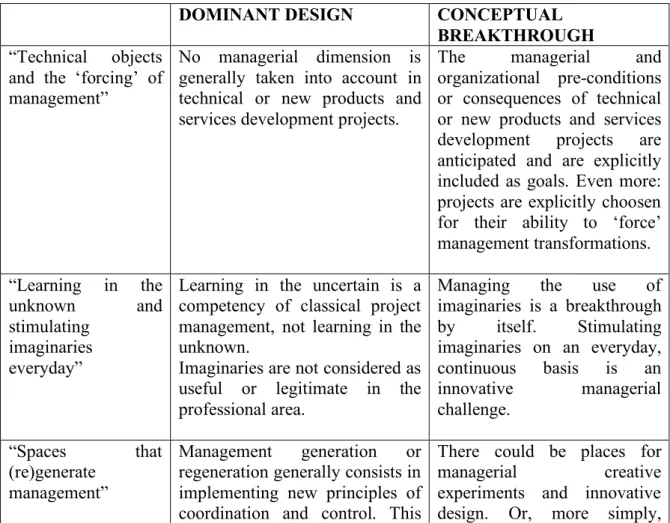
Neither the 31 comments, nor their summary into 11 themes are relevant starting points for the creativity phase. A preliminary work was necessary: designing conceptual expressions that would both include the very content of comments and themes and guide the exploration of more unknown management territories, as seen from the participants. As underlined in the “methodology” section, this design task was accomplished by the research team. 4 conceptual expressions or exploration axis were formulated through inductive reasoning from comments and themes. These conceptual expressions are not representative in the classical meanings of “synthesizing the contributions” or “reflecting the majority of suggestions”. They rather handle a different dimension: there are made for supporting unprecedented explorations, beyond established management practices, with the full participation of the managers involved in the experiment. Here are the four conceptual expressions elaborated by the researchers, which we will refer to as exploratory conceptual axis:
1. “Technical objects and the ‘forcing’ of management”
2. “Learning in the unknown and stimulating imaginaries everyday” 3. “Spaces that (re)generate management”
4. “Lateral management and the creation of links”
The first conceptual axis —technical objects and the ‘forcing’ of management”— is based on a combination of themes i —responsibility, autonomy, deviant behaviour and the manager’s positioning—, iv —difficulty to make management evolve— and ix —how productivity is conceptualized. It questions if management could be designed or ‘forced’ by a technical project. Some insights were given during the first stage of the workshop, about innovative products or services that implicitly required managerial and organizational evolutions. This conceptual axis reformulates the question in the case of technical projects that would deliberately be chosen for their ability to require managerial innovations.
The second axis —learning in the unknown and stimulating imaginaries everyday— mainly stems from themes v —difficulty to generalize experiments—, vi —motivation, leadership and what defines “average managers”— and viii —existence of explicit managerial philosophy and doctrine. Its goal is to generate discussions on how managers could create a new managerial philosophy within a firm, how they could federate their teams around a common vision and how this vision could be built and maintained on an everyday basis.
Montpellier, 6-8 juin 2018
22 The third axis combines themes i —responsibility, autonomy, deviant behaviour and the manager’s position—, iv — difficulty to make management evolve—, v —difficulty to generalize experiments— and x — spaces where to learn how to manage. Its goal is to discuss how management could be regenerated and if particular spaces should be created to allow this regeneration.
Finally, the fourth axis combines themes ii — managing conflicts, managing teams with different profiles and status, relationship between managers and managed—, vi — motivation, leadership and what defines “average managers”— and vii — fear, violence and managerial cowardice. It discusses the nature of relationships and the possibility of a management that would be more courageous, more based on lateral integration and able to generate respectful, non-violent relationships. Table 3 summarizes the four axes as well as the conceptual breakthrough and dominant design it challenges.
Table 3: Exploratory conceptual axes: dominant design and value potential
DOMINANT DESIGN CONCEPTUAL
BREAKTHROUGH “Technical objects
and the ‘forcing’ of management”
No managerial dimension is generally taken into account in technical or new products and services development projects.
The managerial and
organizational pre-conditions or consequences of technical or new products and services development projects are anticipated and are explicitly included as goals. Even more: projects are explicitly choosen for their ability to ‘force’ management transformations. “Learning in the unknown and stimulating imaginaries everyday”
Learning in the uncertain is a competency of classical project management, not learning in the unknown.
Imaginaries are not considered as useful or legitimate in the professional area.
Managing the use of imaginaries is a breakthrough by itself. Stimulating imaginaries on an everyday, continuous basis is an innovative managerial challenge. “Spaces that (re)generate management” Management generation or regeneration generally consists in implementing new principles of coordination and control. This
There could be places for
managerial creative
experiments and innovative design. Or, more simply,
Montpellier, 6-8 juin 2018
23 can be the role of consultants,
functional services, or it can progressively come through HR turnover and the arrival of managers with different education and skills. But the idea that management could be designed in “spaces” seems nonsense.
spaces that would have the property of transforming managerial knowledge and relations.
“Lateral
management and the creation of links”
The traditional large organization is vertically integrated. Lateral
links that would be
spontaneously generated by the actors are considered as unofficial and correspond to the informal part of the structure.
Lateral would be first. Integration is taken over by the actors themselves while designing and steering projects and collective action. Managing is managing energies and motivations, keeping the system able to generate all the necessary links —including reciprocal esteem, friendly and respectful relations, etc.
A certain amount of overlap between the themes is intentional, so that a diversity of possible entrees into management questions was possible. If we take theme i as an example, the first axis could lead participants to only consider how managers could lose their autonomy because of the constraints imposed by the technical project and how deviant behaviours would be necessary to cope with this. By re-introducing the theme in the third axis, we made sure participants also considered that they could create autonomy by designing spaces in that purpose.
3.3.GENERATING CONCEPTUAL DIRECTIONS FROM THE 4 THEMES
The post it session generated 87 post it, as simultaneously inspired by the four themes. Stepwise ascendant regrouping of the post-it let appear 12 subsets. Each of them was labelled with a conceptual expression that both summarized their content and expressed a potential for innovative exploration. Figure 3 shows the 12 subsets.
Montpellier, 6-8 juin 2018
24 Figure 3: the wall of post it and the 12 emerging subsets.
Let us comment each of them:
1. Ni Dieu ni manager (Neither God nor manager)
This formulation is derived from the well-known “neither God nor master” anarchist claim. “No God” means no absolute reference, no risk of excessive devotion and blind respect of principles. Of course “No God” does not mean no belief or no values at all. “No manager” is about who coordinates and controls. “No manager” mainly means that I am able to manage myself or we are able to manage ourselves. A more radical understanding is considering that no management, and not only no managers, is required, leading us towards a pure market view of coordination.
2. Ré-enracinement et reconnexions (re-grounding and re-connecting)
Re-grounding and re-connecting are two conditions for action to be collective and full of sense. It has to do with “why” and “with whom”. It talks about managerial energy and the sources of individual and organizational capabilities. It deals with rhythms, intensity, acceleration, and slowing down, breaks, pauses, in brief, an ecology of managerial work.
3. (Sug)gestion
This is playing with words: “gestion” in French is a synonym for “management” and “suggérer” means “to suggest”. This concept is all about how management can suggest and
Montpellier, 6-8 juin 2018
25 not command: a subtle management that never has to impose. A way to get people doing what you wish they did, which is a sophisticated way to manage. Hence, a capability to suggest would be a key ingredient a good management. A complementary understanding of the concept is to consider the content of what is being suggested, i.e. suggestions themselves understood as ideas for possible discussions or decisions. A good management is, then, a creative management with respect to amount, quality and relevance of suggestions for thought and action.
4. #M@nager
Digital communication systems have changed part of the way organizations, teams, individual can produce and share knowledge. They create opportunities to enhance managerial capabilities, though it also happens that they only amplify existing malfunctions. The #m@nager formulation evoques the “manager 2.0” or “the augmented manager” and questions how management basics are re-questioned by digital systems like social networks, digital conversation devices or coordination platforms. The combination of # and @ suggests that ‘manager’ is a key word (#) and that conversations are or can be addressed to him or her (@). A more radical understanding is considering that human manager could be replaced by m@nager or IA manager.
5. Des projets techniques labos de management (Technical projects as management labs) Key innovations, be they product, service or process innovations, have consequences, or prerequisites, on organization and management systems. This concept of technical projects as management labs points out the possibility to ex ante consider a technical project for its ability to change management. In addition, the “lab” dimension is key: not only projects are identified as being able to “force’ management doctrines and practices, but also the time of the project is time for managerial design and experimentation.
6. Le manager conteur (the manager as a story-teller)
This is about managers as story-tellers, about sense-making and leadership. This concept explores vision, strategy-making, motivation and being able to embed everyday life at work into an inspiring story, including sustaining team motivation during hard times.
7. Le marché du management (the management market)
The manager makes a choice within a market of resources, knowledge and competences, i.e. capabilities. He or she should have more degrees of freedom in order to responsibly and
Montpellier, 6-8 juin 2018
26 autonomously manage, like in liberation management practices, where each and every one can design and launch a project and “go to the market” to get the necessary capabilities.
8. Le manager, un humain comme les autres (the manager, a human among humans) Managers also have their frailties. They can fail, make mistakes, be clumsy. They also have feelings, they need understanding and empathy. This is the contrary of the “providential man or woman”. This concept also addresses the manager’s loneliness vs being a team and acting together as a more collective and helpful body.
9. Les exutoires du management (Outlets of management)
Pressure can be high and managers might need specific moments and places where conversations on management would be possible, including laughing, criticizing, feeling free to share what is on their minds. Not only to decrease pressure: also to cultivate some kind of managerial “community of practice”.
10. Des liens qui libèrent (ties/links that liberate)
In French, “liens” is for ties or links. This semantic ambiguity is inspiring. With respect to “ties”, the concept is formulated in an apparently contradictory way. Ties generally constrain, force, imprison. With respect to “links”, imagination is rather driven towards friendship, mutual assistance, shared responsibilities and trust. These ties or links can be strong or weak: literature in management mentions “the force of weak ties”.
11. Penser en dehors de la « boîte » (Thinking out of the box)
This is a play on words in French: “box” is literally a box, but it is also a familiar word for “company” or “firm”. Hence, thinking out of the box means thinking out of the usual frames, but it also means thinking outside the company, the organization you are working in. The concept addresses how managers could think differently and how it would be helpful to travel out of the company to be able to do so.
12. Fort… tu seras (Strong, you will be)
This sentence is taken from Star War’s Jedi Master Yoda: this is how he speaks. The sentence is not as powerful as “let the Force be with you”, but beyond the origin of the expression, this concept illustrates a typical scene where the manager would be like a knight on a mission for superior interests and the common good. It also discusses the need for managers to be strong and to be able to cope with difficult and touchy challenges.
Montpellier, 6-8 juin 2018
27 4. DISCUSSION AND CONCLUSION
This paper is exploratory research. We designed and conducted an experiment: we wanted to see if reflexive managers, i.e. managers that are known for their ability to talk about their own management experience and practice, could be taken one step further and turned into management designers.
Many options were possible. Focusing on comparing management innovative design with product and service innovative design, we could have organized an innovation workshop on a smaller innovation field than management taken as a whole, for instance “innovative management of absentees” or “how to innovatively coordinate a great number of collaborators with only virtual communication links”. Meanwhile, we felt that management was a special field. Not because managers would lack established or contextual knowledge or experience — they in fact know a lot— but because management is not usually taken as a central, explicit innovation field: it is even sometimes considered as an “art” that can hardly be learnt..In other words, the innovative design regimes at stake in management within an average large company are far from systematic design.
4.1.LINKING THE TWELVE CONCEPTUAL DIRECTIONS TO MANAGEMENT FUNDAMENTALS The experiment produced several types of elements:
- Elements that trace the way participants did contextualize (and not “apply”) the systematic knowledge that was presented at sessions 1 and 2 with respect to their managerial experience (the 31 comments)
- Four conceptual themes that inspired twelve innovative conceptual directions. The addition of these 4 themes and the 12 conceptual directions forms a conceptual map: as seen by the participants, innovative management is to look for with these 4 themes and in these 12 conceptual directions.
Elaborating from data analysis presented in the previous section, Table X links each of the twelve conceptual directions that result from the workshop to key managerial concepts. Inductive coding reveals five key concepts: identity, command and control, autonomy, connections, regenerating management. The latter is a “meta” concept: it is about regenerating management, which means revisiting identity, command and control, autonomy and connections.
Montpellier, 6-8 juin 2018
28 Table 3: list of conceptual directions
CONCEPTUAL
DIRECTION KEY SYNTHETIC DESCRIPTION KEY ASSOCIATED MANAGEMENT CONCEPT
Neither god nor
manager Who is the boss (and what freedom do I have)? Command and control (seen from subordinates) Autonomy
Re-grounding and
re-connecting
Where am I acting from, thanks to what connections? (+ “re”= redo from start, reset)
Regenerating management Identity (Roots) Connections (to the ground, to things, to the context)
(sug)gestion Having things done through suggestion and not command. A vision of learning through responsible delegation of power.
Command and control (through a softer leadership) #m@nager The manager as a key actor within a
network of managers, supervisors and subordinates
The “augmented manager” as key actor that could be assisted by AI
Connections (@) Identity (#)
Command and control Identity (AI)
Technical projects as management labs
Restoring a managerial interpretation of technical projects – Turning technical project into generators of management.
Regenerating
management (thanks to technical projects) The manager as
a storyteller
Designing an adventure, which is the essence of enterprise.
Re-designing managing path under tough times
Identity (the manager as incarnating an enterprise) Identity (the manager as captain)
The management
market The wise and responsible manager makes his/her market out of a variety of resources Autonomy (in collecting resources) The manager, a
human among humans
The manager is no god, a leadership fueled by a mix of managerial skills, including accepting frailties and failures
Identity (the human manager)
Outlets of management
Coping with —and liberating oneself of— the constraints, dilemmas, blind spots of managerial systems Identity (preserving one’s identity) Autonomy (possibility to escape) Ties/links that liberate
Managing…”with a little help from my friends”. Delegation, trust, mutual assistance
Connections (to others) Thinking out of
the box What management journeys outside the usual frames, outside the company? Regenerating management (thanks to external knowledge) Strong, you will
be
Accepting and assuming responsibilities Identity (the responsible, resilient manager)
Montpellier, 6-8 juin 2018
29 Analyzing table 3, we can sum up the participants’ vision of management and the associated forthcoming challenges:
- Identity —roots, the # of social networks, the manager as incarnating an enterprise, the human manager, the responsible, resilient manager
- Command and control —as managers or as subordinates of supervisors, or suggested through a softer leadership
- Autonomy —with respect to hierarchy, in collecting resources, possibility to escape - Connections —to roots (identity), to things, to the context, to others (ties, @)
- Regenerating management — re-grounding, reconnecting, using technical projects, thanks to external knowledge.
4.2.CONTEXTUALIZED CONCEPT GENERATION
We have experimented the first step towards what could be an innovative design regime in management. We combined a form a systematic logic with inductive, creative reasoning. The systematic side: panorama of managerial knowledge presented at sessions 1 and 2, systematic collection of comments during the first contextualization phase, systematic collection of ideas —post it— during the second contextualization phase, then systematically grouped after a stepwise ascending classification procedure. The creative, inductive side: elaboration of the four starting themes, induction of the twelve conceptual directions from subsets of post-it. Figure 4 summarizes the successive phases of the experiment as it finally took place.
Montpellier, 6-8 juin 2018
30 Figure 4: Successive phases of the experiment
Starting point: choosing management as the Innovation field
Exposition to systematic management knowledge (intensive knowledge sharing)
First contextualization phase
(the 31 comments integrating management knowledge with managerial experience)
First contextualized concept generation (designing the four conceptual themes)
Second contextualization phase
(generating 87 post-it as inspired from the four themes) Second contextualized concept generation (inducing 12 conceptual directions from subsets of post-it)
Resulting conceptual architecture
(the 4 conceptual themes and the 12 conceptual directions)
We started from established management theories in use (a history of management ideas, theories and practices). Participants reacted to these theories with respect to their own experience, thus bridging a potential gap with their own contextual management theories in use. From these comments, four conceptual themes were elaborated and submitted to the participants’ inspiration. From their contributions, twelve conceptual directions emerged. This process is very different from a classical brainstorming session, and also very far from a problem-solving logic. Contextual concept generation is probably the heart of the design reasoning that took place: it corresponds to the way O’Connor (2012) asserts that the reflective practitioner —in her research: the executive MBA or executive PhD student— incarnates a dynamic process, the contextualized generation of new managerial knowledge — in her words, “recovering the lost foundations of the field”.
Montpellier, 6-8 juin 2018
31 4.3.FROM THE REFLECTIVE PRACTITIONER TO THE CONCEPTIVE MANAGER
We can say that managers participating to the workshop are now in a cognitive position to design management.
First, the conceptual architecture that came out the workshop is their common, participative production. This architecture is not that of existing management: it includes concepts with no corresponding established knowledge. Hence, it is able to create cognitive tensions that mobilize imaginaries. This is why it carries an innovation potential.
Second, it was produced throughout a careful, stepwise, systematic process based on contextualized concept generation. In other words, an expansive logic guided the whole process, far beyond classical divergent thinking protocols or creative problem-solving approaches. The conceptual architecture produced does not only have a value potential: because it is natively contextualized, it has a higher robustness to generate effective managerial projects.
Third, the group itself during the workshop experimented a protocol that all of them had already lived during innovation workshops dedicated to products and services, but not with management as an innovation field. The workshop resulted in an important shift in knowledge, that we could note ∆K, a renewed conceptual architecture (∆C), but the participants were changed as actors (A) as well: some kind of ∆A occurred.
At this stage of our research, applying innovative design methods to management innovation, we have experimented a methodology that could consider management as the innovation field and turn managers into potential management designers. That point is key both for scholars to use management theories in a design perspective and for managers to consider a learning by designing approach to management. Further experimentation will confirm the reality of this shift of managers from designers of their managerial contexts to more innovative management designers.