O
pen
A
rchive
T
oulouse
A
rchive
O
uverte
(OATAO)
OATAO is an open access repository that collects the work of some Toulouse
researchers and makes it freely available over the web where possible.
This is
an author'sversion published in:
https://oatao.univ-toulouse.fr/23615Official URL :
https://doi.org/10.6036/MN8063
To cite this version :
Any correspondence concerning this service should be sent to the repository administrator:
Grubessich, Tomas and Stegmaier, Raul and Viveros, Pablo and Kristjanpoller, Fredy and
González-Prida, Vicente and Pérès, François Methodological proposal in order to increase
the organizational learning based on experts’ knowledge and information systems in the field of
asset management and maintenance. (2016) Dyna Management, 4 (1). 1-14. ISSN 2340-6585
OATAO
Open Archive Toulouse Archive Ouverte
METHODOLOGICAL PROPOSAL IN ORDER TO INCREASE THE
ORGANIZATIONAL LEARNING BASED ON EXPERTS’
KNOWLEDGE AND INFORMATION SYSTEMS IN THE FIELD OF
ASSET MANAGEMENT AND MAINTENANCE
Tomás Grubessich1, Raúl Stegmaier1, Pablo Viveros1, 2, Fredy Kristjanpoller1, 2, Vicente González-Prida2,4 y François Pérès3 1Universidad Federico Santa María, Avenida España 1680, Valparaíso, Chile. [email protected]
2Universidad de Sevilla. Escuela Superior de Ingeniería. Avda. Camino de los Descubrimientos, s/n. Isla de la Cartuja, 41092
España. Tfno: +34 954487215.
3Toulouse University, École nationale d'ingénieurs de Tarbes ENIT- INPT. Avenue d'Azereix 47. 65016 Tarbes, France. 4UNED. Dpto. de Lógica, Historia y Filosofia de la Ciencia. Paseo de Senda del Rey 7. 28040 Madrid. España, tfno: 913987202
DOI: http://dx.doi.org/10.6036/MN8063
PROPUESTA METODOLÓGICA PARA AUMENTAR EL APRENDIZAJE
ORGANIZACIONAL EN BASE AL CONOCIMIENTO DE EXPERTOS Y A
LOS SISTEMAS DE INFORMACIÓN EN LA GESTIÓN DE ACTIVOS Y
MANTENIMIENTO
.
ABSTRACT:
This paper deals with the formalization of knowledge of an organization, the structuring of a suitable logic sequence and the processing to achieve the applicability of this knowledge in the practical field for the organization. All this is done through a methodological proposal that allows increasing the organizational knowledge, which is based on the information found in the organization’s computer systems as well as on the knowledge and experience of experts, generating significant synergies. The motivation to develop this paper comes from the need to align organizational goals with the knowledge of the people and data in information systems related to the field of asset management and maintenance.
This methodological proposal uses a recursive process of knowledge generation, where the iteration of processes and the permanent consultation regarding compliance with the objectives, generate a cyclic process whose results are materialized in a conceptual model that contains qualitative and quantitative information, in order to increase the understanding of the system.
Key Words: Conceptual Model, Transformation of Data into
Information, Understanding of Complex Systems.
RESUMEN:
El presente artículo trata acerca de la formalización del conocimiento de una organización, la estructuración de una secuencia lógica apropiada y el tratamiento para lograr la aplicabilidad de los conocimientos en el terreno práctico para la organización. Todo ello se realiza a través de una propuesta metodológica que permite aumentar el aprendizaje
organizacional, fundamentándose tanto en la información que se encuentra en los sistemas computacionales, como también en los conocimientos y experiencia de los expertos, generando importantes sinergias. La motivación para realizar este artículo radica en la necesidad de alinear los objetivos de la organización con los conocimientos de las personas y la data presente en los sistemas de información, todo lo anterior en el campo de la Gestión de Activos y Mantenimiento. Esta propuesta metodológica utiliza un proceso recursivo de generación de conocimiento, donde la iteración de los procesos y la consulta permanente respecto al cumplimiento de los objetivos, genera un proceso cíclico cuyos resultados se materializan en un modelo conceptual que contiene información cualitativa y cuantitativa, con el fin de aumentar la comprensión del sistema.
Palabras Clave: Modelo Conceptual, Transformación de Datos en Información, Comprensión de Sistemas Complejos.
1. INTRODUCTION AND PROBLEM STATEMENT
Now days there is a broad consensus on the importance of the information related to the operation of the organization in its own management, which has led to the creation of various tools that support in this line [1, 2]. Tools with databases that handle large amounts of information from different areas have emerged, such as ERP and other software that are more specialized on the different workspaces. As an example, the following table 1 shows some of the trends that the information systems have taken in different areas of the organizations:
Types of Information Systems Areas in which it operates
Traditional Enterprise Resource Planning (ERP)
Financial accounting Management accounting Human resources
Supply chain management Project management
Manufacturing resource planning (MRP II) Production, Inventory and purchasing Management
Warehouse Management System (WMS) Supply chain, control the movement and storage of material within a warehouse Customer relationship management (CRM) Sales, marketing, customer service, and
technical support
Supply Chain Management (SCM) Optimization of the Supply Chain Supplier Relationship Management (SRM) Supplier Management
Computerized Maintenance Management
System (CMMS) Maintenance Management
Enterprise Asset Management (EAM) Asset Management
Business intelligence (BI) Process, strategic and knowledge management
Table. 1. Information system trends in different areas of organizations
Another factor that every day has taken on greater significance is the recognition of the importance that the organizational learning has as a mean to maximize performance. Due to the large numbers of definitions for this concept, the organizational learning will be understood for the purpose of this study as “an organization that is able to create, acquire and transfer knowledge as well as to modify its behavior in order to reflect new knowledge and insights” [3]. In this context, efforts have been made to promote the transfer of tacit knowledge of people [4] to the rest of the organization to achieve greater effectiveness and efficiency in usual activities and in the decision-making processes [5, 6, 7, 8]. On the other hand it has been noted that, given the complexity of productive systems and the increasing amount of data, it is difficult to reach a level of knowledge that facilitates the process of decision making and to achieve a greater efficiency and effectiveness in the management of the organization. This is clearly reflected in the lack of clarity of the effects that certain decisions would have in the system, such as:
• the changes in operational policies, • investment in new equipment, • new inventory policies, • among many others.
When there is no clear effect of some of the decisions mentioned, it is because a sufficient level of understanding has not been reached.
It is in this line that different methodologies aimed at managing and analyzing large amounts of information to better understand the systems have been created, among which stand:
• Knowledge Discovery in Data Base [9], • Decision Support System [10, 11, 12, 13], • Data Mining [14],
• Among others.
These methodologies are able to reach a high impact on the organizations, but they have a strong focus on information systems.
The above factors have been observed by the authors in different organizations in the field of asset management and maintenance very strongly and with peculiarities. When different methodologies are applied [15, 16, 17, 18], problems arise from the different views between external experts and members of the organization. Many of these problems are due to the knowledge of the organization are scattered in inaccessible sources; also the knowledge doesn’t have a clear structure; and the knowledge isn’t in a friendly format to be transmitted and understood easily. This causes that projects related to asset management and maintenance need to go through a process where definitions are set and the information is obtained from data processing, for then starting applying the methodology itself. Given this context and understanding the difficulties faced by organizations in management and administration of data, and the creation and transfer of knowledge from expert contributors, which as a result leads to poor performances and often unassertive decisions, a methodological proposal for the analysis and the increase of the level of understanding a system is presented under a comprehensive and flexible approach. The increased level of understanding system has a focus on:
• Detecting relevant knowledge,
• Understanding functional relationships,
• Obtaining useful results for the activities performed by the organization.
All the above must be developed in a clear, inclusive and constantly validated process to be effective progress and impact in achieving the goal set to increase the level of understanding of the system and translate it into a practical way for the organization. The final result must have a comprehensive approach in order to use it in the ways considered necessary.
2. 2. OBJECTIVES AND STRUCTURE
In this context, a need to create a methodological proposal to guide the process of: • Formalizing the knowledge of the organization,
• Structuring an appropriate logical sequence,
• Treatment to achieve applicability of knowledge in the practical field of the organization is set.
This proposal must allow exploiting synergies produced by combining the information contained in the information systems of the company, with the knowledge from the experts of the organization, in order to substantially increase the level of understanding of the system studied under a holistic view of the entire system. This proposal is also focused on its application for complex systems, characterized by a large number of functional relationships, a low predictability to changes in key variables, a high interaction of different areas of the organization, a possible presence of industrial assets complex in technology and/or dimensions, among others. It’s in this type of systems where proposals like the one desired give an essential support and allow facing a lot of tasks successfully.
The conditions that propitiate the development of such initiatives can be proactive within the organization, or they may also arise as a necessity came from other projects that require a high level of knowledge. Some of these projects can be:
• Changing operational criteria related to decision making, • Redistribution available resource on the system,
• Improving reaction times to changes in the environment, • Incorporating the risk factor in making operative decisions, • Among others.
All this looking for the improvement of key indicators of performance defined for the system. Furthermore, it is likely that as the level of understanding increases, changes to established indicators are done, either in its conceptual definition, the way of building it or the way of inferring the state of the system, making them even more representative. It is important to know that when you want to increase the level of understanding of a particular system comes a series of difficulties, among which are:
• The various inner visions, often opposite to what is globally profitable for the business, which is reflected in local performance indicators (local optima),
• Operational criteria and practices that oppose and hinder the collaborative work, and as a result, the overall results.
The problems on the implementation of the activities are usually identified but the assumptions of causes from each expert can be very different and even contradictory. The information required from the systems is disseminated in various databases, which does not assure you in any case the completeness and quality of the same. Actually, according to the experience of the working team, the database generally does not have the entire required field in order to have a correct analysis. Another frequent scenario is that there are organizations that are not even aware of all the information collected in different processes. This is why a methodological proposal of work that allows increasing the level of knowledge must have several features that ensure the compliance with its objective, among which stand:
• Based on a cyclical process with feedback, where both the expert knowledge and valuable information that can be extracted from information systems are strengthening. This cyclical process must have all the necessary validations and it will stop only when the level of understanding of the system that fulfills the objective is reached,
• The results of this methodological proposal approach must be easily explained to those involved and they must contain the most relevant concept of the system, describing them both qualitatively and quantitatively, • The methodological proposal must include all the agents and information systems relevant for the system.
Being sure about this will only be possible when a satisfactory explanation of what happens in the system can be given.
3. METHODOLOGICAL PROPOSAL
To explain in a more friendly way the functioning of the methodological proposal, this will be divided into: the key stages that generate the cyclic process; and the step by step implementation process.
3.1. Key stages of the cyclic process
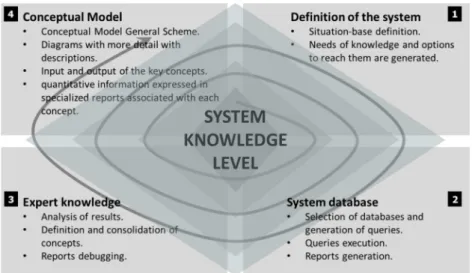
The methodology of work proposed consists of a virtuous cycle that is separated into four areas, generating a spiral progress as the level of understanding the system increases. This idea is based on the Spiral Model for Software Development [19], which consists of a series of iterations that groups a set of activities. As more operations are made, it is possible to increase the progress to the level of development of the objective desired. In the case of the methodological proposal, each repetition covers four areas. A brief description of every one of them is given below; understanding that in each one of them there will be qualitative and quantitative information:
• Definition of the system: Here the conceptual model based solely on the expert’s knowledge is defined and the needs of knowledge and options to reach them are generated step by step.
• System Database: The main objective is to respond to all the principles in a qualitative and quantitative way based on historical information from the entire database necessary to incorporate.
• Expert Knowledge: Experts receive reports on the results of the postulates which are analyzed to obtain conclusions regarding the investigated concepts. Here is objectively defined which concepts are consolidated (unquestionable), which ones must be discarded and which ones must go deeper on further research.
• Conceptual Model: Here the consolidation of the knowledge generated is presented. It is constituted of several parts. A general scheme is easily understood; diagrams with more detail with descriptions, input and output of the key concepts, and quantitative information expressed in specialized reports associated with each concept.
Figure 1: Scheme of the development of Conceptual Model System
The Figure 2 describes the same scheme incorporating activities to be performed:
Figure 2: Scheme of the development of Conceptual Model System with their activities
3.2. Step by step implementation process
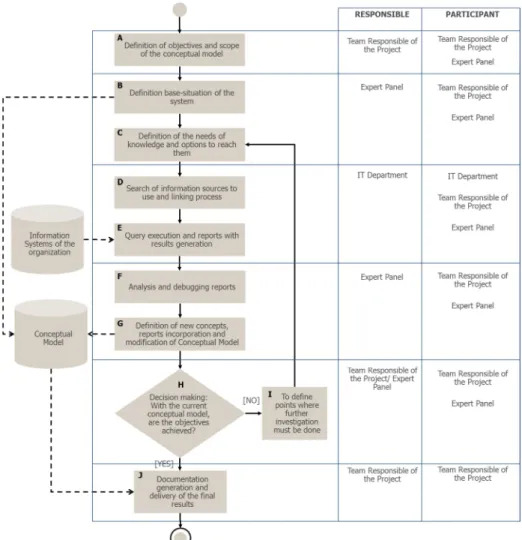
For a better understanding of the 3 step by step process implementation of the proposal, the following Figure 3 presents a diagram using of the notation of the Business Process Model and Notation method (BPMN) [20]. With this a higher level of detail is achieved and it is easy to understand this implementation process.
II
Conceptual Model Definition of the systemII
Conceptual Model General Scheme. Situation-base definition.
Diagrams with mor ail with
descriptions.
Analysis of results.
SYSTEM
KNOWLEDGE
LEVEL
Needs of knowledge and options
to reach them are generated.
System database
El
Definition and consolidation ~
concepts.
=---Selection of databases and generation of queries. Queries execution. Reports debugging.
II
Conceptual ModelDefinition of new concepts, reports incorporation and
modification of Conceptual Model
El
E>pert koowledgetl
Analysis and debugging
reports
Reports generation.
II
Definition of the systemDefinition of objectives and scope of the conceptual model
To define points where further investigation
must be done
Elsystem database Query execution and
reports with results
generation
Definition of the needs
of knowledge and options to reach them
Search of information sources to use and
Figure 3:Suggested process for developing the conceptual model using the notation BPMN
To be successful in the implementation of this methodological proposal is advisable to generate a specific project, which involves the definition of objectives, scope and objectives deadlines, together with the formation of a team responsible of the project. In addition, under the logic of the project it is much easier to quantify the needs of resources required. According to the experience of the authors in general the major resources required for such projects have to do with the hours of dedication of the members of the project and the external experts who are working. There could also be difficulties do evaluate the acquisition of new information systems, when the current system do not respond to the requirements of the organization, but such cases correspond to new independent projects. That is why the main resource requirements, has to do with the dedication of people to the project.
Two key pillars have been added to the methodological proposal represented through BPM for understanding and usage of the same, one is referred to as “Responsible” agent and the other as “Participant” agent. The first one specifies the agent or agents that respond to the proper development of the activity. As a project, the main responsible will always keep that role, however, depending on the activity, other agents (Participants) will have a preponderant role either because of their knowledge and experience, because of the decisions making involved, or just because of the access to information they have. In the case of participant agents, it must be specified who is playing a major role as support or evaluator in the development of the activity, hence is essential his or her active participation.
Before starting the description of the process, three participant agents, the project team, the panel of experts and the Department of Information Technology (DTI) will be taken into consideration. This recommendation of three players involved arises from the experience in the application of the methodological proposal, but it may vary from case to case,
Information Systems of the organization • Conceptual Model
I
ADefinition of objectives and scope of the conceptual model
I
•
B
Definition base-situation of the
- -
systeml
C Definition of the needs ofknowledge and options to reach them
!
D
Search of information sources to use and linking process
l
E-• Query execution and reports with results generation
I
•
F
Analysis and debugging reports
l
G Definition of new concepts,
- - reports incorporation and modification of Conceptual Model
I
'
H Decision making: With the current conceptual model, are the objectives
achieved?
I
•
J Documentation
---+ generation and delivery of the final
results
I
0
RESPONSIBLE PARTICIPANT
Team Responsible of Team Responsible of the Project the Project
Expert Panel
Expert Panel Team Responsible of the Project Expert Panel IT Department IT Department Team Responsible of the Project Expert Panel
Expert Panel Team Responsible of the Project Expert Panel
Team Responsible of Team Responsible of
the Project/ Expert the Project
Panel
[NO] I points where To define Expert Panel
-
furtherinvestigation must be done
Team Responsible of Team Responsible of the Project the Project
being simpler or more complex depending on the situation. In addition, it also arises from the responsibilities in the activities of the process proposed and the work of support required. Anyways, it must be understood that this process is a guide which can be modified and adjusted according to the emerging needs. A brief description of each of these agents is given below:
• Team Responsible of the Project: This team is made of the people the organization has given the task of increasing the level of knowledge of a given system. Some possible projects that require increasing the level of knowledge of the system are: systems modeling, improvement projects, failure analysis, etc. Whatever the origin of the project, the most relevant for the team is to define the system to be analyzed and scope in deepening the knowledge required to be generated. This is the key because it determines when the project has reached the expected result so there is no need to continue repeating the methodological proposal. It will also be essential in case that the level of knowledge required is not achieved as it will specify the grounds and constraints faced in this regard. This agent has a coordinating role between the different areas that interact in the system; therefore they must assure a fluent communication between the different agents. It is highly recommended that this team is made up of people who do not have a deep knowledge of the system being studied, because that includes an objective view and with a focus on the objectives sought. It is equivalent to the look of the moderator requested in the technical analysis of maintenance type Root Cause Analysis (RCA) or Reliability Centered Maintenance (RCM) [15].
• Expert Panel: The panel of experts must be defined by the organization and it must be composed of the people with relevant knowledge of the system under study who possess knowledge and experience for the definitions of the lines of study, research, definition of principles, understanding of the data existing in information systems and to validate the developments related to the conceptual model. They come from different areas of the organization, and may even be external to it, as in the case of external expert on specific issues. Each expert has his own perspective of the system, whether technical, management or practice; of day-to-day or analysis from pure data; from how it should operate at how it is done in practice; each of these perspectives involves people of different backgrounds, ages and experiences. Creativity and involvement is expected, since it depends heavily on them the degree of success of the project
• IT Department: People with a high level of knowledge of the information systems managed by the organization in every area must participate. It is fundamental that people in this group have a global view of all sources of information and, in the case of unknowing a particular information system, to know with whom to interact in order to obtain the required. They must also possess the necessary skills to produce reports of varying complexity in their development, and a clear vision to show in a friendly way such reports in order to be easily understood by the rest of the team.
A brief description of each of the processes defined in BPM is shown, with special emphasis on the activities, participants and required information.
Process A, Definition of objectives and scope of the conceptual model: In this activity, it must be specified what
is sought with the conceptual model, which should involve responding to what for, so it is easier to determine when the target is achieved and that way the project can be finished. It is important to determine the system under study with its respective boundaries and areas involved. The work team, the expected deadlines of the project and the required resources are also established. The project team is who must ensure the proper behavior of this activity and the panel of experts defined by the organization must be actively involved in its development.
Process B, Definition base-situation of the system: Having objectively defined the system under study and the
project objectives, especially linked to the desired level of knowledge of the system, the events that occur within the system are defined in the first instance. What is sought is to create the foundations of the conceptual model through the knowledge of the expert panel, determining the initial key concepts. Thus, a first overview of the associated processes, of agents that interact with the system, of technical specifications and of operating criteria relying on process flows, documentation and experience takes place. At this early stage of definition, the following research questions must be answered:
• Who: It identifies the area, department or office that is responsible for carrying out each identified event. • Why: It refers to the causes that boost the activation of activities.
• When: Knowing the causes which impel activities, it is described when these conditions and their characteristics are given.
• How: It aims to describe conditions and features under which the activity is performed, identifying resources and time mainly associated.
• What for: The implications of the events are set, describing the possible expected results both qualitative and quantitative.
• How Much: What will be measured, how it will be measured and how can this information be obtained from the available information systems must be established.
Once the base situation is defined and there is a consensus in the expert panel, this information must be documented in the repository of information named Conceptual Model System. The definition of the base situation corresponds to a first approach to the conceptual model, which is why it is expected to be composed of:
• A general scheme in which the main concepts are defined by the relationships between them and the system. • Documents with information of each of the points discussed in the general treatment. Part of the information that these documents must contain are: description with more detail of each item; variables and key indicators of the concepts; sources of information related to the concepts; etc.
• Technical support documents when the information is sought in a more detailed way. Some of these documents are: drawing, process diagrams, technical specifications of equipment, etc.
Process C, Definition of the needs of knowledge and options to reach them: On this stage the principles that will
guide the process of the research of knowledge of the system must be formulated, in order to increase the level of understanding of it. The first main principle established in this investigation is that with the concepts defined in the scheme presented in the base-situation, the most significant part of the activities and events that occur within the system are being represented. This principle, which is done by default, must be constantly reviewed, because if at some point it is concluded that some of the concepts are needless or that other concepts must be incorporated, it would mean a significant change in the conceptual model, so it should be treated as soon as possible. Then a process of questioning all the concepts in the conceptual model must start. Some of these questions may target research in order to validate some features of the concept, while others may seek to deepen their level of understanding. Whatever the case, each of these questions must be represented as postulates for research, that is, they must be set in a purposeful way, linked to one or more concepts of the conceptual model explicitly, be specific, related to observable and measurable terms, and that presumably is deemed that itself has the means to answer them. With all the principles defined, the needs of knowledge are open in all the areas considered relevant.
Process D, Search of information sources to use and linking process: In this activity the team from the
Department of Information Technologies of the organization should be integrated, who will be responsible for the tasks of select, transform, debug, and link information sources required to respond to the principles proposed in the previous activity. The participation of the project team and the expert panel is essential to keep focus on the lines of research and the proposed principles. The tasks proposed that must be developed in this activity correspond to:
• Definition of relevant database: it responds to which are the sources of information used to work in order to meet the requirements.
• Transformation and debug of the original information: the conditions under which the information should be available to make it usable for study are set.
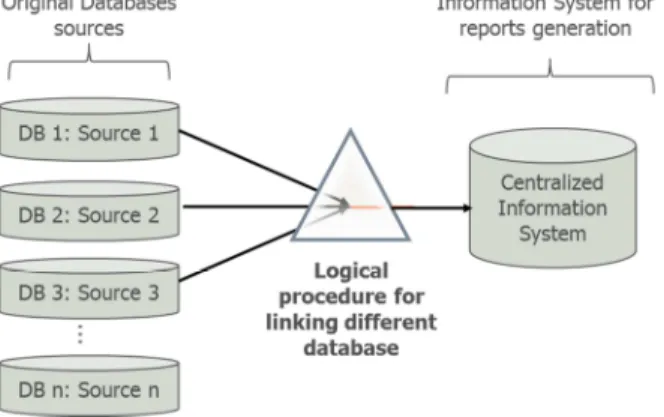
Regarding linking databases, the process by which databases are created with a greater number of relevant fields, being this database constructed from linking different sources of information, in which a more complete and centralized information system is obtained, with all fields that are deemed necessary focused on the principles and lines of research is established. There may be the need to generate a unified database able to represent the behavior of the entire system, which has the advantage of making all queries and reports from a single source. Another advantage is the elimination of duplicity and to speed up the responses times. However, in general the centralization of databases is not easy to achieve given the differences that occur in the various sources. One way of solving this difficulty is through applications that
track data required from the different database. The Figure 4 represents the linking of different database through a logical procedure that keeps the integrity of the information.
Figure 4:Linking database through a documented procedure
It is essential in this activity that people with extensive knowledge of current information systems participate, because in the case of not having a global vision, there could be key sources of fundamental information that are not considered due to ignorance.
Process E, Query execution and reports with results generation: With the information system cleared, processed
and linked, the execution of queries can be done. These queries will be the base information to respond the principles set and to increase the level of understanding of the system. The IT Department must be in charge of developing this task and it must ensure that the information given contains the proper level of detail in order to get the best response to the principles set. To make this task easy, it could be very useful to start with a general description of the results and proceed to increase the level of detail in the analysis done. In turn, graphs, tables and figures can be very useful.
Process F, Analysis and debugging reports: With the reports from the above process, the panel of experts must
discuss this information, trying two fundamental points: to debug the reports to reflect the concepts ideally pursued with a sufficient level of detail, and reports must express quantitatively and understandably friendly the answers to the principles expressed above. It is very likely that during the development of this activity new concerns and inconsistent information appear. This information must be presented and the respective justifications and their possible implications for the conceptual model must be sought in parallel. This may require additional efforts to develop the project.
Process G, Definition of new concepts, reports incorporation and modification of Conceptual Model: The
panel of experts must conclude about the reports and information released in the previous activity, concluding about the veracity of each postulate, expanding the description of each concept and associating to each concept quantitative information from reports released. The important on this stage is to conclude about the information that will be part of the conceptual model of the system. Finally, all the information, analysis, reports and generated dossiers are analyzed and integrated in the conceptual model, increasing the level of knowledge the system.
Process H, Decision making: With the current conceptual model, are the objectives achieved?: With the
updated conceptual model according to the new knowledge generated, the project team together with the expert panel, must decide whether there is enough knowledge according to the objectives of study of the system. This decision is directly related to the project scope, but in turn, it can be concluded that in order to achieve the objective of the project it is necessary to extend the scope of the system, covering new areas, adding more experts or people from the IT department in the organization or analyzing even other relevant processes among many others. It is also possible to conclude on the need to make major changes to the entire conceptual model, making a refocusing using a new perspective. On the other hand, it must be noted that this decision can be made in previous processes, by detecting the need for major changes, which would be very useful for the development of the process. This decision is very important because it can involve a considerable increase in time and resource requirement for the project, impacting directly in accomplishing the goals within the deadline.
Original Databases sources
~
DB 1: Source 1 DB 3: Source 3Cos
n: Source njInformation System for reports generation
Centralized Information System
Process I, To define points where further investigation must be done: In case that, due to the previous decision,
it is decided that the conceptual model still does not meet the requirements, the points of the analysis in which it must be worked and deepened to increase the level of knowledge the system must be defined. It is essential to always keep in mind the objective and scope of the project at this point. Then, you must return to the activity of defining principles and lines of research in order to repeat the process recursively until the objectives set for the project are achieved. Then it must be returned to the process C.
Process J, Documentation generation and delivery of the final results: In the case that, due to the decision made
above, it is considered that the conceptual model meets the level of depth required by the objectives and the scope of the project, final documents related to the work done must be established. The results obtained can be separated into two categories: those aimed at the objectives of the project and related valuable knowledge. Both are closely related, but it is important to make the distinction as the first category aim to meet the objective of the project, while the other one make up the conceptual model of the system that will be the source of knowledge that will guide the process of decision making and any analysis. It is in this conceptual model where the formalization of knowledge is done, structuring appropriate logical sequence and treatment to achieve applicability of knowledge in the practical field for the organization. In the next section will show what you expect to find in a conceptual model as proposed, its different sections, features and potential transforms it into an ideal tool to promote organizational learning
4. CONCEPTUAL MODEL
At the end of the processes described, it is expected to obtain a Conceptual Model as the main result of the work done. It is in this Conceptual Model where knowledge has been formalized, a logical sequence has been structured, and the proper treatment for the knowledge to be usable profitably for the organization has been given. It is expected that every decision making related to the system pass by the conceptual model system, being the basis for understanding the impact of decisions that will be taken. Thus the conceptual model will become a fundamental tool for the General Management, giving clear and precise fundamentals for the next steps to execute related to the system. On the other hand, it facilitates the induction of new members of the organization to understand the system more thoroughly and in less time, while favoring continuity in operating criteria and methodologies. Also it is the responsibility of the General Management to define who will have access to the conceptual model, establishing different levels of access, restrictions and privileges, and above all, who are responsible for update both the sources of information, such as the revision of the model itself, for determining when the conceptual model fail to represent the system, so detecting this will be essential to avoid making bad decisions based on an outdated model.
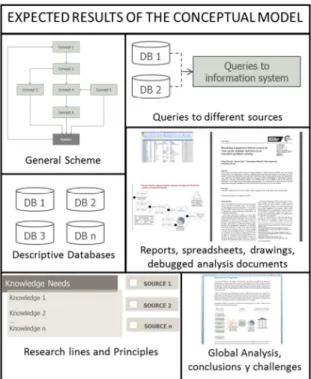
As mentioned before, the Conceptual Model consists of a series of elements, from general schemes that facilitate the understanding of the system through a general diagram, to more complex analysis generated by queries to information systems through technical information of processes and equipment, plans and reports, among other elements. Each Conceptual Model is particular for every case, so they may vary from case to case. However, what could be the basic elements of a Conceptual Model grouped in their main areas is shown below in the Figure 5, as an example:
Figure 5:Suggested elements of the Conceptual Model
As it can be seen, the Conceptual Model brings together different perspectives of analysis, from qualitative and quantitative information, historical information and knowledge of experts, complex analysis and friendly conceptual visions to understand the concepts defined as key in a short period of time. All these features make the Conceptual Model a source of knowledge, identifying potential for improvement and detection of exceptional opportunities for the organization. A brief description of each group shown in the deliverable of the conceptual model is made below.
General Scheme: It corresponds to the visualization of the most relevant concepts identified for the system under
study. It is wanted to be simple and to show in a friendly way the most important concepts and their interactions, so that anyone can quickly understand the approach that has research. It must also provide guidance for possible investigations developed and some of the factors to consider.
Lines of Research and Principles: With the key concepts defined and outlined, together with the experts of the
organization, the relevant principles to increase the level of knowledge of the system and the lines of research to assist in the understanding of it can defined. To the extent that more operations of the methodology are performed, part of the principles will be solved becoming new concepts or strengthening the existing ones, while new more precise assumptions with refined knowledge involving will appear. On the side of the lines of research, a valuable knowledge is generated directly giving the possibility of detecting new lines of research or deepen the existing ones.
Descriptive Database: From the most relevant concepts expressed through the general scheme of the system, it can
be possible to select databases of information systems in the organization that are useful for purposes of the conceptual model. It must be noted that the databases that come directly from the information system are identified without making changes in it, so to have a description of the concepts that arise directly from the data of the organization. The advantage of proceeding this way is to have a direct view of the concepts of interest from the information systems of the organization, which ought to be very easy to update as time passes.
Consulting Sources of Information: It is both, queries generated in computer language to the information systems
and the use of any information source (digital or physical) that the organization has. These queries must be upgradable, either through the computer language or through defined specific procedures. The result of these consultations must be refined and with all fields to meet the analysis required by the conceptual model.
Reports, Spreadsheets, drawings with analysis released with experts: With the information gathered from the
various sources of information known, the procedure is performed to obtain the desired knowledge. For this it is taken as a focus the principles and lines of research, and a response to these requirements are given. Here a number of documents such as presentations, spreadsheets, reports, drawings, technical information, among others groups. What
EXPECTED RESULTS OF THE CONCEPTUAL MODEL
General Scheme
~~
~~
Descriptive Databases Knowledge Needs Knowledge 1 Knowledge 2 Knowledge n@--
:
@--
:
Queries to information systemQueries to different sources
:...-=.::
----
.·
-Reports, spreadsheets, drawings,
debugged analysis documents SOURCE 1
SOURCE 2
SOURCE n
Research lines and Principles Global Analysis,
matters is that all this generated information must be updatable either automatically or through a procedure, so it is feasible to do these tests at different times and verify the system behavior.
Synthesized global analysis, conclusions and challenges: These elements are of great importance because they
carry all the knowledge generated and set it in a useful and friendly way to the organization. It corresponds to the synthesis of all the work done and gives definitions for the next steps, either to fulfill the objectives of the study of the system, or for more specific investigations of the defined concepts.
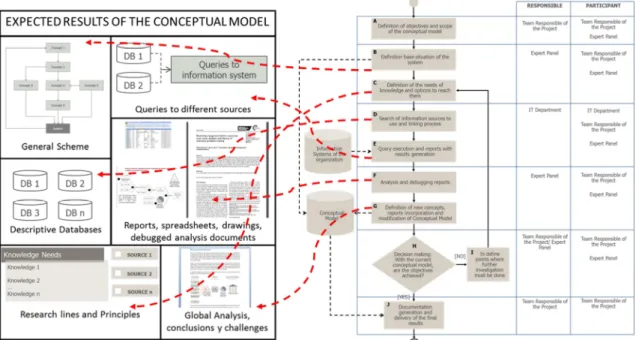
It is true that in the process of the methodological proposal there are some activities specially in charge of generating the Conceptual Model; however it is useful to appreciate how every activity contributes in this aspect. The Figure 6 helps to have this vision.
Figure 6:Direct relationship between the process of the methodological proposal and the deliverables of the
conceptual model
Thus, it is possible to verify and better understand how each process of the methodological proposal helps to formalize knowledge, a logical structure and provide treatment to apply this knowledge in a practical way to the reality of the organization. From the Conceptual Model, countless initiatives may arise towards improving the efficiency and effectiveness of the organization. Some of these initiatives may target changes in the operational criteria, investment decisions in the production process, changes in the criteria of planning and programming activities, reorganization of different functional areas, changes in the criteria for subcontracting and bidding projects, among many others. In short, to increase the level of knowledge of a system gives the basis to make better decisions, to direct efforts where it is more appropriate and taking the proper measures to elicit the desired. The probability of success of all the initiatives of the organization should tend to increase. As next challenge, this proposal will be implemented in a real case, to check that the above is achievable in practical terms, and thus also gauge the potential of this type of initiative in the organization.
5. CONCLUSIONS
This paper presents a methodological proposal which aims to increase the organizational learning from the experts’ knowledge of the organization and from the existing information systems. This objective responds to the need to:
• Formalize the knowledge of the organization, • Structure an appropriate logical sequence
• Make the treatment to achieve applicability of knowledge in the practical field of the organization EXPECTED RESULTS OF THE CONCEPTUAL MODEL
General Scheme
~~
~~
Descriptive Databases Knowledge Needs_,
_
,
_
,
r==='i
_
-;-
-~ : Queries to" -~ : information system ~ -•
Reports, spreadsheets, d~iigs,
debugged analysis docum/nts
•-Research lines and Principles Global Analysis, •-conclusions y challenges - -'
-
~
-... : ..,, ,,...
....
--...,_
-
-r ' \ '~
---.,
: ' '..
.,
.... I ~ I I I I .-I RESPONSIBLE PARTICIPANT
.
Odinobondobjectrvesandscope TeamRespcns,tileol Team Respons,bleololtheo:;,nceptualmodel theProjea the Project
._
...
•
Demrbonbase-SltuabOnofthe--
T e . m ~ o l -- .,..,, theProject-
C I""'""'""
Defirvbonoftherlffllsol-
knowledgeandopborlstore.ch--
I rr_, ITDepartment _ 0Se1Jrctool111forrr11Jboosourcesto useandlinbngprooess Team~bled I '""""" E""'""'""
-• Qoe,y ~ and reportS with
-
·--f--
TeamRespons,bleol-
AnalyslsanddebugglngreportS thePro)m I._
....
- G DefinrtiOnolnewconceptS, -- reportSIOCOrp0QtlOnand modoflC:MIOndConoeptullModel II Team Responsibleol TeamResponsibled
H
..
~,..,,
the Pro.Jed Deasiol'lmaklng: Wlththecurrent [HCJ I ''"""' ~...tiefe._
....
--"""""'· aretheob)«:ti'ves ...,,-
-
""""
""""""""
J
-
Team the Responsibled Project Team Respomibled the Project---+ oef'rY:/:ird-.e"tinai
,-..
The main feature of this proposal is that its purpose is to maintain an overview of the system, relying on both experts and information systems, achieving significant synergies and ensuring a proper conduct of the study. In addition, the presented iterative process is helpful, allowing progress orderly and comprehensively expanding the understanding of the system. It is essential to note that the results of this proposal are consolidated into a conceptual model composed of several partial results ranging from an overview, technical documents, and consultations to the information systems of the organization, reports with the main results, and qualitative and quantitative information, among others. In other words, it is possible to go through all the information considered relevant in a friendly, understandable and flexible way. This methodological proposal responds particularly to some conflicts detected by the authors in the field of asset management and maintenance and tries to support the process of definition of the main concepts, reach the desirable information and support a friendly structure to transfer knowledge to the whole organization. To implement this methodology, it is recommended to be under a project outline, a process consisting of several activities and people in charge. The reason why this is suggested is that a very necessary logic of objectives and scope is proposed for this type of study, in addition of defining key milestones and people in charge to ensure the proper development of the activities. When applying the methodological proposal it is essential to correctly select the experts of the organization and the members of the IT department. These agents will be the ones who will provide knowledge and information that enable progress and objectives achievement. On the side of the project team, to have prior knowledge of the system is not needed, the most important work to be performed is to maintain an unbiased view of the development of the project and that directly points the goals set. In case of failure to maintain this position, you run the risk of deviating from the main goal or focusing the efforts on issues that are irrelevant to the project objectives.
When the project is run, it is possible that significant changes at various stages (iterations) may be carried out, which should be treated as part of the normal development of the project since the degree of knowledge of the system will always grow, which is rightly what is searched. It is also possible that the system is redefined repeatedly or that new experts are incorporated. The key of this process is that at each repetition the results are validated with the panel of experts.
Another important achievement is to unify knowledge and points of view of the different agents of the system. With this, a common language, a disciplined methodology of work and evidently the consensus between the parts involved in the project desired is achieved. Even if this goal is not achieved, some points of divergence will be identified, which is already very valuable to decide how to act under different scenarios.
Finally, with the conceptual model the objective of formalizing the knowledge of the organization, structuring an appropriate logical sequence and treatment to achieve applicability of knowledge in the practical field of the organization is reached, and gain greater advantage from the General Management, to all members of the organization, generating significant synergies and positive changes at all levels. From the conceptual model many initiatives may arise towards improving efficiency and effectiveness. Some of these initiatives may point to changes in operational policies, investment decisions in the production process, changes in the criteria for planning and scheduling activities, among many others.
BIBLIOGRAPHY
[1] Park Y, An empirical investigation of the effects of data warehousing on decision performance, Information & Management (43) 2006, pp. 51–61.
[2] Chang Sh, Yen D, Chang I, Jan D, Internal control framework for a compliant ERP system, Information & Management (51) 2014, pp. 187-205.
[3] Garvin D, Building a learning organization. Harvard Business Review 1994 January 1999: 20. [4] Polanyi M, The Tacit Dimension. University of Chicago Press, London, Routledge, 1966.
[5] Li X, Shao Y, Study on Knowledge Sharing Behavior Engineering, Systems Engineering Procedia (4) 2012, pp. 468-476.
[6] Zhao Y, Wang G, Bao Z, Pan Q, A Game between Enterprise and Employees about the Tacit Knowledge Transfer and Sharing, International Conference on Applied Physics and Industrial Engineering (24) 2012, pp. 1789-1795.
[7] Al-Qdah M, Salim J, A Conceptual Framework for Managing Tacit Knowledge through ICT Perspective, The 4th International Conference on Electrical Engineering and Informatics (ICCEI 2013), pp. 1188-1194.
[8] Zhong H, Ozsoy E, Nof S, Co-Insightsframeworkforcollaborativedecisionsupportandtacitknowledgetransfer, Expert Systems With Applications (45) 2016, pp. 85-96.
[9] Nemati H, Steiger D, Iyer L, Herschel R, Knowledge warehouse: an architectural integration of knowledge management, decision support, artificial intelligence and data warehousing, Decision Support Systems (33) 2002, pp. 143-161.
[10] March S, Hevner, A., Integrated decision support systems: A data warehousing perspective, Decision Support Systems (43) 2007, pp. 1031-1043.
[11] Anaby-Tavor A, Amid D, Ficher A, Bercovici A, Ossher H, Callery M, Desmond M, Krasikov S, Simmonds I, Insights into enterprise conceptual modeling, Data & Knowledge Engineering (69) 2010, pp. 1302-1318.
[12] Guillemette M, Laroche M, Cadieux J, Defining decision making process performance: Conceptualization and validation of an index, Information & Management (51) 2014, pp. 618-626.
[13] Hong K, Kim Y, The critical success factors for ERP implementation: an organizational fit perspective, Information & Management (40) 2002, pp. 25-40.
[14] Marbán O, Mariscal G, Segovia J, A Data Mining & Knowledge Discovery Process Model, Data Mining and Knowledge Discovery in Real Life Applications, Julio Ponce and Adem Karahoca (Ed.), 2009, ISBN: 978-3-902613-53-0.
[15] Viveros P, Zio E, Nikulin C, Stegmaier R, Bravo G, Proceedings of the Institution of Mechanical Engineers, Part O: Journal of Risk and Reliability, February 2014; vol. 228, 1: pp. 93-111.
[16] Khare V, Bandyopadhyay P, Waldo M, Automotive Field Failure Analysis based on Mileage – Feasibility & Benefits, 2012, pp. 1 – 8. [17] Lawless J, Hu J, Methods for the estimation of failure distributions and rates from automobile warranty data, University of Waterloo,
1995, pp. 4 – 5.
[18] Neely A, Performance measurement system design: a literature review and research. International journal of operations & production management, 15(4) 1995, 80-116.
[19] Boehm B, A Spiral Model of Software Development and Enhancement, TRW Defense Systems Group, 1987. [20] Object Management Group, Business Process Model and Notation, Version 2.0.2, 2013.