Open Archive TOULOUSE Archive Ouverte (OATAO)
OATAO is an open access repository that collects the work of Toulouse researchers and
makes it freely available over the web where possible.
This is an author-deposited version published in :
http://oatao.univ-toulouse.fr/
Eprints ID : 18546
To link to this article : DOI:10.1007/s00264-015-3008-z
URL :
http://dx.doi.org/10.1007/s00264-015-3008-z
To cite this version : Toulemonde, Julien and Ancelin, David and
Azoulay, Vadim and Bonnevialle, Nicolas and Rongières, Michel and
Mansat, Pierre Complications and revisions after semi-constrained
total elbow arthroplasty: a mono-centre analysis of one hundred
cases. (2016) International Orthopaedics, vol. 40 (n° 1). pp. 73-80.
ISSN 0341-2695
Any correspondence concerning this service should be sent to the repository
administrator:
[email protected]
Complications
and revisions after semi-constrained total elbow
arthroplasty:
a mono-centre analysis of one hundred cases
Julien Toulemonde1 & David Ancelin1 & Vadim Azoulay1 & Nicolas Bonnevialle1 &Michel Rongières1 & Pierre Mansat1
Abstract
Background The complication rate after total elbow arthroplasties is higher than for other arthroplasties.
Purpose The purpose of this study was to evaluate the com-plications and revision rate after 100 semi-constrained total elbow arthroplasties from various types of aetiologies per-formed in our university hospital.
Methods One hundred linked semiconstrained total elbow arthroplasties were performed and were reviewed with 24-months minimum follow-up. Indications were rheumatoid arthritis (45), trauma (33), revisions (16) and others (6). Results At five years average follow-up (range, 2–11), the complication rate was 37 %. Most frequent complications were ulnar nerve involvement (9 %) and triceps insufficiency (7 %). Five implants were aseptically loosed. The infection rate was 4 % with loosening of the implant in two. Four frac-tures were observed, including three at the ulna and one at the
humerus proximal or distal to the stem. The radial nerve was injured in two cases. Failure of the locking system of the prosthesis was noted in one case and a fracture of the ulnar component was found in another patient. A revision surgery was performed in 13 cases (13 %). At follow-up 94 prostheses were still in place and the survival rate was 98 % at five years and 86 % at ten years.
Conclusion Total elbow arthroplasty remains a difficult pro-cedure with sometimes a high rate of complications necessi-tating revision procedures. Selection of the patients, a rigorous surgical technique, and a systematic follow-up are prerequisite to limit this incidence.
Type of study/level of evidence: Therapeutic IV Keywords Total elbow arthroplasty . Survival rate . Complications . Revisions . Loosening
Introduction
Total elbow arthroplasty (TEA) has been used in various types of indications with satisfactory results. However, complications are more common than after other arthroplasties [1]. An explanation is related to the fact that the elbow joint is a superficial joint, with relatively little soft-tissue envelope. The main indications concern rheum a t o id a r t h r i t is , o f t e n in p a t i e n t s wi t h irheum rheum u n e -compromised medical status, or post-traumatic arthritis, often with multiple previous operations performed. Furthermore, the elbow joint can be considered as a weight-bearing joint with a resultant force that can range from one to three times body weight that accounts for the high loosening rate seen in the early constrained arthroplasties. Gschwend et al. [2], in their systematic re-view, analysed 828 procedures. Of these, 43 % had
* Pierre Mansat [email protected] Julien Toulemonde [email protected] David Ancelin [email protected] Vadim Azoulay [email protected] Nicolas Bonnevialle [email protected] Michel Rongières [email protected]
1 Département d’Orthopédie et Traumatologie – Urgences Mains,
Hôpital Pierre-Paul RIQUET, Hôpital Universitaire de Toulouse, Place du Dr Baylac, 31059 Toulouse Cedex, France
complications. In recent years, there have been many ad-vances in prosthetic design and surgical technique. The goal of our study was to evaluate the complications and revisions rate after 100 semi-constrained total elbow arthroplasties performed from various types of aetiologies in our university hospital.
Patients and methods
A prospective cohort study was conduced in our depart-ment since July 1997. All patients who underwent a Coonrad-Morrey TEA from July 1997 to March 2008 re-gardless of indication were included in this study. Only two experienced surgeons performed the surgery (MR; PM). A minimum of two-year follow-up was necessary for the patients to be included. Institutional review board approval was not required at the time the patients were included in the study, but all patients had given their agreement to use their clinical and radiographic data for this study.
Ninety-one consecutive patients (100 elbows) were includ-ed. There were 74 women and 17 men with a mean age at the time of the operation of 63±14 years (range, 22–90 years). Thirty-eight patients (45 elbows) had inflammatory arthritis, 32 (33 elbows) a traumatic condition—18 acute fractures of the distal humerus, ten nonunion of the distal humerus, and five post-traumatic arthritis—and 15 (16 elbows) a revision procedure. In six cases the prosthesis has been performed for another aetiology.
The Coonrad-Morrey prosthesis (Zimmer, Warsaw, Indiana) was used in all patients. During the study period, two surface preparations were used for the ulna component, i.e. from 1997 to 2001, the polymethyl-methacrylate (PMMA) precoated ul-nar component was used in 41 elbows, and from 2002 to 2008, the titanium plasma-spray coating ulnar component was used in 59 elbows.
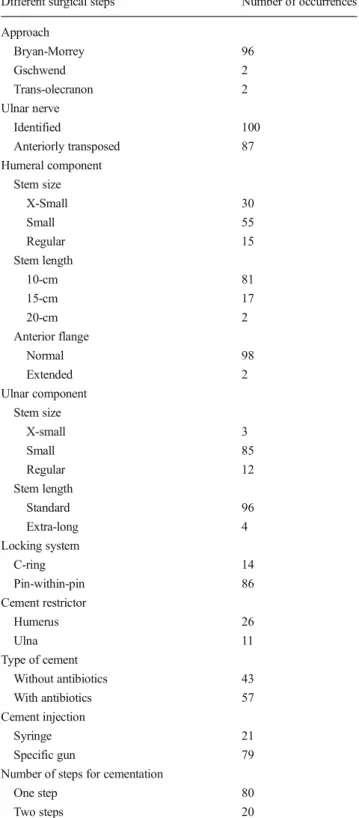
Operative procedure and post-operative management A standard procedure was performed for all primary surgeries [3], whereas specific steps were necessary in revision cases [4]. The different surgical steps are summarized in Table1. Average time of surgery was 144±41 minutes on average (range, 60–360). An antibiotics prophylaxis of 48 hours was systematically prescribed. It was prolonged in ten cases be-cause of suspicion of deep infection. An anterior splint was performed with the elbow in extension for two days, and the patients were allowed to start moving their elbow according to their pain level. No therapy was prescribed. The patients were discharged from the hospital after five to seven days (range, 5–26 days) according to the wound aspect with the elbow protected with a sling. The patients were encouraged to move
their elbow avoiding all weight lifting during the first three months. Recommendations were then given related to limitation of weight lifting, e.g. no more than 1 kg on a repet-itive basis or 5 kg on a single event.
Table 1 Different surgical steps of the 100 total elbow arthroplasties Different surgical steps Number of occurrences Approach Bryan-Morrey 96 Gschwend 2 Trans-olecranon 2 Ulnar nerve Identified 100 Anteriorly transposed 87 Humeral component Stem size X-Small 30 Small 55 Regular 15 Stem length 10-cm 81 15-cm 17 20-cm 2 Anterior flange Normal 98 Extended 2 Ulnar component Stem size X-small 3 Small 85 Regular 12 Stem length Standard 96 Extra-long 4 Locking system C-ring 14 Pin-within-pin 86 Cement restrictor Humerus 26 Ulna 11 Type of cement Without antibiotics 43 With antibiotics 57 Cement injection Syringe 21 Specific gun 79 Number of steps for cementation
One step 80 Two steps 20
Follow-up evaluation
An evaluation of the pre-operative medical history of each patient was performed, and each had a physical examination. Pre-operative anterior-posterior and lateral radiographs as well as at the time of the latest follow-up were reviewed. None of the patients were lost for follow-up. The results of the pre-operative and post-pre-operative clinical evaluation were rated using the Mayo Elbow Performance Score (MEPS) [3]. The quick-DASH score was also used to evaluate the post-operative functional results [5]. The cement technique was assessed on the immediate post-operative radiographs of both the ulnar and the humeral components [6]. Implant loosening was assessed on radiographs and was graded on a scale of 0 to 4, as previously described [7]. Bushing wear was assessed on anterior-posterior radiographs made at the time of the latest follow-up and was graded as none, partial or complete [7]. Statistical analysis
Analysis of the data was done with the use of statistical software that allowed analysis of each variable separately and to study their interrelationship. Comparisons between different groups were performed with use of the Student’s t test, Mann–Whitney U test or Kruskal-Wallis test. The chi-square test was used to compare categorical values. The level of significance was set at p<0.05. Survival 'free of revision surgery' was estimated as a function of time since it was the index procedure with the use of the Kaplan-Meier method with 95 % confident interval.
Results
Overall results
At five-year average follow-up, up to 11 years, the MEPS increased from 30±18 points pre-operatively to 85±15 points
(range, 30–100) post-operatively (p<0.001, Student’s t-test). According to the MEPS, results were rated as excellent in 55 cases, good in 26, fair in 12, and poor in seven. The satisfac-tion rate was 81 %. The quick-DASH score reached 40±24 points (range, 0–97) at final follow-up. Better results were obtained in rheumatoid arthritis (90±13 points and 41±18 points, respectively) compared to trauma (80±17 points and 44±29 points) or revisions (80±12 points and 40±22 points) (p=0.002, Kruskal-Wallis test) (Table2).
Complications
There were 37 (37 %) complications. Younger age was corre-lated significantly with occurrence of complications (59±13 versus 66 ± 14 years—p=0.016, Mann–Whitney U test), whereas follow-up was not (p=0.293, Mann–Whitney U test). Number of previous operations before TEA also had no sig-nificant influence (p=0.347, Mann–Whitney U test). Duration of surgery for TEA was correlated with occurrence of compli-cations (135±34 vs 159±47 min—p=0.008, Mann–Whitney U test) (Table3).
The most common complication was ulnar nerve involve-ment observed in nine cases, all having been anteriorly trans-posed at surgery. None of these patients had pre-operative symptoms. Ulnar nerve involvement was mainly limited to numbness in the fifth finger in eight cases and to motor and sensitive deficit in one case. The radial nerve was involved in two cases after a revision procedure. In the two cases the involvement was definitive.
Weakness of the triceps was diagnosed in seven cases, in all cases after a Bryan-Morrey approach. It was more frequent in a traumatic context or revision procedures among patients having already presented a trans-tricipital approach. However, in all cases, triceps weakness was well tolerated and none required surgical revision.
Five cases of aseptic loosening were observed, one on the humeral side, two on the ulnar side, and two on both sides
Table 2 Overall clinical and functional results of the 100 total elbow arthroplasties related to aetiology
Etiology N F/u (months) MEPS (points) DASH (points) Ext/flex Pron/Sup Complication Revision RA 45 62 90 41 108° 140° 15 (33 %) 7 (15 %) Trauma 33 49 80 44 96° 138° 12 (36 %) 2 (6 %) Fract 18 42 78 50 96° 135° 3 1 NU 10 41 88 36 112° 154° 5 1 PTA 5 89 72 46 64° 117° 4 0 Revision 16 62 80 40 98° 133° 10 (62 %) 4 (25 %) Others 6 61 93 25 102° 143° 0 0 Stats NS NS P=0.02 NS NS NS NA NA RA rheumatoid arthritis, Fract acute fracture, NU nonunion, PTA post-traumatic arthritis, F/u follow-up, NS non significative, Ext/flex extension/flexion, Pron/Sup pronation/supination
(Fig.1). Incidence was more frequent on rheumatoid pa-tients, with no statistical difference between etiologies. F o l l o w - u p d i d n o t i n f l u e n c e t h e l o o s e n i n g r a t e . Loosening of the ulna component with PMMA coating was more common (p = 0.021, Mann–Whitney U test). No case of complete radiolucency was found around the more recent titanium plasma-spray coating ulnar component. However, follow-up was longer for the PMMA coating component (p < 0.001, Mann–Whitney U test) (Table 4). There was no statistical correlation between the quality of the cement technique and the presence of lucent lines around the humeral component or the ulnar component.
Wound complication was noted in three cases, which re-solved with a local treatment. A deep infection was diagnosed in four cases with loosening of the prosthesis in two. In three cases it concerned a rheumatoid patient whereas in one case it was secondary to a revision procedure. Cement without anti-biotics was used in three.
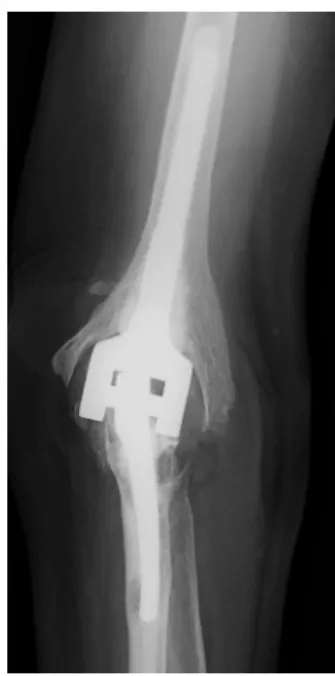
There were three cases of ulnar fracture distal to the pros-thesis and one case of humeral fracture proximal to the stem, all occurring after a fall (Fig.2). In none of the cases the implant was loose. A locking pin failure at the level of the
hinge was observed in one case of nonunion of the distal humerus with valgus deformity eight years after the initial surgery (Fig. 3). One case of ossification into the brachialis muscle was observed after a TEA performed for fracture. Finally, there was one case of fracture of an extra-small ulnar component in a juvenile rheumatoid arthritis patient (Fig.4). The quality of the cement technique was not adapted because of the narrow medullary canal. The fracture appeared four years after the initial procedure at the junction between the stem and the metaphyseal part of the component. Revision
Thirteen of the 37 (35 %) complications required a revision surgery 52±39 (range 2–122) months on average after the ini-tial procedure. Revision was more frequent in younger patients (51±12 vs 65±13 years old—p=0.002, Mann–Whitney U test), and after TEA performed for revision of a previous TEA, or for rheumatoid patients, compared to patients treated for trauma (p=0.154, Mann–Whitney U test). Revision was not correlated with follow-up (p=0.238, Mann–Whitney U test).
In three cases the prosthesis has to be removed to treat a deep infection and the elbow was left in resection. In three other cases the prosthesis had been changed on both sides in one case, and only at the ulna in two cases to treat aseptic loosening of the components. A simple debridement with prosthesis retention was performed in one case of acute infec-tion with success. An osteosynthesis was performed on the humeral side in one case, and on the ulnar side in another case to treat a peri-prosthetic fracture with well-fixed component
Table 3 Complications and revision rate after 100 total elbow arthroplasties according to the aetiology
Aetiology Rheumatoid arthritis
Trauma Revision Other
Total number 45 33 16 6 Follow-up (months) 62 49 62 61 Complication 15 12 10 0 Ulnar nerve 5 2 2 Triceps weakness 0 5 2 Loosening 3 1 1 Fracture 1 0 3 Infection 3 0 1 Radial nerve 0 2 0 Implant fracture 1 0 0 Axle failure 0 1 0 Ossification 0 1 0 Wound / haematoma 2 0 1 Revision 7 2 4 0 Ulnar nerve 0 1 0 TEA removal 3 0 0 TEA revision 3 0 0 Debridement 0 0 1 Osteosynthesis 0 0 2 Axle change 0 1 0 Wound closure 1 0 0 Ossification removal 0 0 1
Fig. 1 Polyethylene bushing wear with lucent lines around polymethyl-methacrylate ulnar component 11 years after the initial procedure for post-traumatic arthritis
(Fig.5). The broken pin had been changed without revision of the prosthesis. An ulnar nerve neurolysis was required in one case because of painful dysesthesiae. A simple wound closure was performed under local anaesthesia in one case. Finally, removal of an ossification at the proximal radio-ulnar joint was indicated in one case to restore forearm rotation.
Survival analysis
At the last follow-up, 94 prostheses were still in place. The survival rate was 98 % at five years (95 % confident interval, 87.1–99.7 %) and 85.9 % at ten years (95 % confident inter-val, 69–94 %) if we consider all implant revisions, septic and aseptic, as an end point. The survival rate was 98.1 % at five years (95 % confident interval, 87.1–99.7 %) and 92.4 % at ten years (95 % confident interval, 78–97.6 %) if we consider only revisions for aseptic loosening as an end point.
Discussion
Complications after total elbow arthroplasty have been largely published and are well recognized [1, 2, 8–10]. In 2005, reviewing a total of 3,618 total elbow arthroplasties, Little et al. [8] reported a complication rate of 33 %. In 2011, Voloshin et al. [9], describing the outcome of 2,938 total el-bow procedures, found a complication rate of 24.3±5.8 %. It was greater for primary total elbow arthroplasty for post-traumatic arthritis (37.5±9.2 %) than for rheumatoid arthritis (24.3±5.8 %) or acute distal humerus fracture (21.5±9.2 %). The overall complication rates in the linked and unlinked groups were 25.9±8.4 % and 27.2±6.2 %, respectively. The complication rate observed in our series is comparable to re-sults published in different recent meta-analyses. However, it was lower than results published by Gschwend et al. [2] who reported a 43 % complication rate with 18 % revision rate. Since that time, reliability of total elbow arthroplasty has im-proved as well as the surgical technique and patient selection.
Fig. 2 Peri-prosthetic humeral fracture proximal to the stem of the prosthesis
Fig. 3 Locking pin failure eight-years after the initial procedure for distal humerus nonunion
Table 4 Lucent lines around the humeral and ulnar components according to follow-up and component coating according to Schneeberger et al. [7]
Lucent lines Follow-up None Type 0 Type I Type II Type III Type IV Humerus 58 months 80 2 11 2 1 4 Ulna 79 1 8 4 2 6 PMprecoat 80 months 28 0 3 2 2 6 Ti coating 43 months (p<0.001) 51 1 5 2 0 0
Younger age and aetiology was correlated with the occur-rence of complications. Rheumatoid arthritis remains the main indication of total elbow arthroplasty [11,12]. However, indi-cations have expanded to traumatic conditions, like acute frac-ture in elderly patients [13], distal humerus nonunion [14], or post-traumatic arthritis in younger patients [7,14–16]. As the number of total elbow arthroplasty procedures increased, the number of revision cases increased proportionally. In our series complications and revisions rates were more fre-quent after revision procedure than after others indications.
In literature, complication rate was similarly higher after a revision procedure. However, complications were usually more frequent after post-traumatic arthritis in young pa-tients than for rheumatoid papa-tients [9,15,16].
Ulnar nerve involvement was the most frequent compli-cation in our series with a 9 % rate. It was greater than results published by Little et al. [8] (5 %) and Voloshin et al. [9] (2.9 ± 2.4 %). In all cases it was associated with anterior transposition of the nerve. It was mainly observed in rheumatoid patients. If some authors advocated routine anterior transposition of the nerve, our results could not confirm this assumption. Most authors agreed that the nerve should be transposed only if there are pre-existing deficits or if its path is compromised or if the nerve is unstable after insertion of the prosthesis. Radial nerve in-volvement was iatrogenic in the two cases observed in our series, in the context of revision surgery. In both cases it was related to humeral cortex penetration and direct injury to the nerve. Throckmorton et al. [17] have outlined the need to expose systematically the radial nerve when doing a revision surgery and not just feel the nerve to protect it against instruments violation or thermal injury by extrava-sation of cement.
Triceps weakness was observed in 7 % of the cases in our series. It is greater than results published by Little et al. [8] (3 %) and Voloshin et al. [9] (2.4 ± 2.4 %). All cases were noted after a Bryan-Morrey approach. However, in literature there was not a statistically significant difference in the incidence of triceps-related complications between TEAs performed using Bryan-Morrey, Gschwend or v-inverted approaches. The only predisposing factor outlined in our study was a previous surgery that has involved tri-ceps tendon insertion. In these cases, tritri-ceps could be left intact on the olecranon [18] if possible or protected post-operatively by an immobilization during the healing period.
Aseptic loosening was observed in 5 % of the cases. Loosening rate was between 5.1±3.4 and 9 % in the different meta-analyses [8,9]. In a comparative study, Little et al. [19] have shown, in rheumatoid arthritis, better survival rate with the Coonrad-Morrey semi-constrained total elbow arthroplasty compared to two unlinked implants. They con-cluded that component linkage with the Coonrad-Morrey im-plant prevented dislocation without increasing the risk of loos-ening. The same results were found by Plaschke et al. [20] with 90 % five-year and 81 % ten-year survival rates, with a higher revision rate for the unlinked design and primary TEA due to fracture sequelae. In our series, incidence of loosening was correlated to follow-up and to aetiology, with greater in-cidence in rheumatoid patients. The survival rate, whatever the etiology, was 98.1 % at five years and 92.4 % at ten years if we consider only revisions for aseptic loosening as an end point. In the study of Gill and Morrey [11], the
Fig. 4 X-small ulnar component fracture in a juvenile rheumatoid arthritis patient four years after the initial procedure
Fig. 5 Osteosynthesis of a humeral fracture proximal to the stem of the prosthesis without removing the implant
survival rate was 94 % at five years and 92 % at ten years. In the study of Aldridge et al. [21], the average survival rate of the Coonrad implant or Coonrad/Morrey total elbow arthroplasty was 17.5 years.
Ulnar stem loosening has been shown to be one of the long-term failure modes of the Coonrad-Morrey total elbow arthroplasty [22]. Loosening seemed to occur more often in the ulnar than the humeral stem [12]. Loosening of the ulna component with PMMA coating was more common. No case of complete radiolucency was found around the more recent titanium plasma-spray coating ulnar component. Hildebrand et al. [22] noted increased osteolysis around ulnar stems rela-tive to humeral stems, with a rate of 32 % at 50±11 months follow-up. Osteolysis was associated with the type of coating used on the ulnar stem, but was also found more often in elbows with trauma sequelae as opposed to elbows with rheu-matoid arthritis. More recently, the results of three types of ulnar stems used in the Coonrad-Morrey total elbow arthroplasty were analysed [23]. The implant covered with PMMA had the highest failure rate in comparison to the new implant introduced in 2002 confirming our results. The sur-vival rate at seven years was 83 versus 100 %.
Deep infections have been reported to be higher after TEA than after other arthroplasties. We reported an incidence of 4 % in our study, whereas it was 8.1 % in the report of Gschwend et al. [2], 5 % in a review by Little et al. [8] and 3.3±2.9 % in the meta-analysis of Voloshin et al. [9]. It seems that the incidence has decreased since the first reports but still stays higher than for other joint surgeries. Selection of the patient, preoperative infectious assessment, discontinuing dis-ease modifying anti-rheumatic drugs in the rheumatoid pa-tients at least four weeks before surgery, systematic antibiotics prophylaxis, use of antibiotics impregnated cement, appropri-ate surgical technique preserving soft tissues, and rigorous postoperative wound management can explain this evolution. However, TEA remains an at risk procedure because of the particular characteristics of the elbow joint, the status of the patient and the type of indications.
A peri-prosthetic fracture has been observed in four cases, proximal or distal related to the stem of the prosthesis. In three cases, the fracture occurred after a revision procedure that could have weakened the cortical bone. In the other case, it was on a rheumatoid patient with osteoporosis and poor bone quality. The implants were well fixed in all cases. Implications of treatment and results naturally follow from the fracture type and location, the stem status, and the bone quality. If the stem is not involved, discussion is often made between conservative treatment and ORIF. If the stem is involved, and if it is well-fixed, the same treatment can be applied; if the stem is loose revision to a long-stemmed implant must be preferable [24].
Bushing wear is a specific complication of the Coonrad-Morrey TEA , sometimes with axle failure [25,
26]. Lee et al. [27] underlined the risk factor of this
feature: young age (lesser than 60 years old), marked distorted joint and marked varus or valgus deformity pre-operatively. The presence of substantial mal-rotation of components at the time of implantation, even without deformity, can also contribute to increase bushing wear. Wright and Hastings [28] have identified post-traumatic arthritis, supracondylar nonunion, male sex, young age, and high activity level as associated factors of bushing wear. These investigators have implicated failure of the BC^ ring, which allowed the axis pin to back out as an additional factor of accelerated bushing wear. Since 1998, the C-ring locking system has been changed to a pin-within-the pin system, which so far has given satisfactory results. However, one case of this new locking system failed in our series and has been changed [24]. If severe bushing wear is observed without implant loosening iso-lated bushing exchange can give satisfactory results [25].
Conclusion
In spite of several improvements in surgical technique within the last decade, including improvement of implant reliability, complication and revision rates after TEA were not uncom-mon and remained higher than all major joint arthroplasties. Younger patients, post-traumatic and revision aetiologies were particularly at risk for occurrence of complications. Information must be given to the patient before deciding on a TEA. Careful selection of the patient, pre-operative planning and assessment, as well as rigorous surgical technique by an experienced surgeon with elbow surgery and systematic follow-up are pre-requisites to decrease this incidence.
Funding source None.
Compliance with ethical standards
Conflict of interest The authors declare they have no competing interests.
References
1. Kim JM, Mudgal CS, Konopka JF, Jupiter JB (2011) Complications of total elbow arthroplasty. J Am Acad Orthop Surg 19:328–339
2. Gschwend N, Simmen BR, Matejovsky Z (1996) Late complica-tions in elbow arthroplasty. J Shoulder Elb Surg 5:86–96 3. Morrey BF, Adams RA (1992) Semiconstrained arthroplasty for the
treatment of rheumatoid arthritis of the elbow. J Bone Joint Surg Am 74:479–490
4. King GJ, Adams RA, Morrey BF (1997) Total elbow arthroplasty: revision with use of a non-custom semiconstrained prosthesis. J Bone Joint Surg Am 79:394–400
5. Matheson LN, Melhorn JM, Mayer TG, Theodore BR, Gatchel RJ (2006) Reliability of a visual analog version of the Quick DASH. J Bone Joint Surg Am 88:1782–1787
6. Cil A, Veillette CJH, Sanchez-Sotelo J, Morrey BF (2008) Linked elbow replacement: a salvage procedure for distal humeral non-union. J Bone Joint Surg Am 90:1939–1950
7. Schneeberger AG, Adams R, Morrey BF (1997) Semiconstrained total elbow replacement for the treatment of post-traumatic osteoarthrosis. J Bone Joint Surg Am 79:1211–1222
8. Little CP, Graham AJ, Carr AJ (2005) Total elbow arthroplasty: a systematic review of the literature in the English language until the end of 2003. J Bone Joint Surg (Br) 87:437–444
9. Voloshin I, Schippert DW, Kakar S, Kaye EK, Morrey BF (2011) Complications of total elbow replacement: a systematic review. J Shoulder Elb Surg 20:158–168
10. Krenec L, Farng E, Zingmond D, SooHoo NF (2011) Complication and revision rates following total elbow arthroplasty. J Hand Surg [Am] 36:68–73
11. Gill DR, Morrey BF (1998) The Coonrad-Morrey total elbow arthroplasty in patients who have rheumatoid arthritis. A ten to fifteen-year follow-up study. J Bone Joint Surg Am 80:1327–1335 12. Mansat P, Bonnevialle N, Rongières M, Mansat M, Bonnevialle P (2013) Eleven-year experience with the Coonrad-Morrey total el-bow arthroplasty: 78 consecutive total elel-bow arthroplasties reviewed with 5 years average follow-up. J Shoulder Elb Surg 22: 1461–1468
13. Mansat P, Nouaille Degorce H, Bonnevialle N, Fabre T, the SOFCOT (2013) Total elbow arthroplasty for acute distal humeral fractures in patients over 65 years old—Results of a multicenter study in 87 patients. Orthop Traumatol Surg Res 99:779–784 14. Barthel PY, Mansat P, Sirveaux F, Dap F, Molé D, Dautel G (2014)
Is total elbow arthroplasty indicated in the treatment of traumatic sequelae? 19 cases of Coonrad-Morrey® reviewed at a mean follow-up of 5.2 years. Orthop Traumatol Surg Res 100:113–118 15. Celli A, Morrey BF (2009) Total elbow arthroplasty in patients
forty years of age or less. J Bone Joint Surg Am 91:1414–1418 16. Throckmorton TW, Zarkadas PC, Sanchez-Sotelo J, Morrey BF
(2010) Failure patterns after linked semiconstrained total elbow arthroplasty for posttraumatic arthritis. J Bone Joint Surg Am 92: 1432–1441
17. Throckmorton TW, Zarkadas PC, Sanchez-Sotelo J, Morrey BF (2011) Radial nerve palsy after humeral revision in total elbow arthroplasty. J Shoulder Elb Surg 20:199–205
18. Prokopis PM, Weiland AJ (2008) The triceps-preserving approach for semiconstrained total elbow arthroplasty. J Shoulder Elb Surg 17:454–458
19. Little CP, Graham AJ, Karatzas G, Woods DA, Carr AJ (2005) Outcomes of total elbow arthroplasty for rheumatoid arthritis: com-parative study of three implants. J Bone Joint Surg Am 87:2439– 2448
20. Plaschke HC, Thillemann TM, Brorson S, Olsen BS (2014) Implant survival after total elbow arthroplasty: a retrospective study if 324 procedures performed from 1980 to 2008. J Shoulder Elb Surg 23: 829–836
21. Aldridge JM III, Lightdale NR, Mallon WJ, Coonrad RW (2006) Total elbow arthroplasty with the Coonrad/Coonrad-Morrey pros-thesis. A 10- to 31-year survival analysis. J Bone Joint Surg (Br) 88: 509–514
22. Hildebrand KA, Patterson SD, Regan WD, MacDermid JC, King GJ (2000) Functional outcome of semiconstrained total elbow arthroplasty. J Bone Joint Surg Am 82:1379–1386
23. Jeon IH, Morrey BF, Sanchez-Sotelo J (2012) Ulnar component surface finish influenced the outcome of primary Coonrad-Morrey total elbow arthroplasty. J Shoulder Elb Surg 21:1229–1235 24. Mansat P (2014) Periprosthetic fractures in the upper limb. In:
Bentley G (ed) European instructional lectures, European instruc-tional lectures 14. doi:10.1007/978-3-642-54030-1_11. © EFORT 2014
25. Pham TT, Bonnevialle N, Rongières M, Bonnevialle P, Mansat P (2014) Mechanical failure of the Coonrad-Morrey linkjed total el-bow arthroplasty : a case report. Orthop Traumatol Surg Res 100: 831–834
26. Plaschke HC, Thillemann T, Belling-Sorensen AK, Olsen B (2013) Revision total elbow arthroplasty with the linked Coonrad-Morrey total elbow arthroplasty: a retrospective study of twenty procedures. Int Orthop 37:853–858
27. Lee BP, Adams RA, Morrey BF (2005) Polyethylene wear after total elbow arthroplasty. J Bone Joint Surg Am 87:1080–1087 28. Wright TW, Hastings H II (2005) Total elbow arthroplasty failure
due to overuse, C-ring failure, and/or bushing wear. J Shoulder Elb Surg 14:65–72