UNIVERSITÉ DU QUÉBEC À MONTRÉAL
EFFICIENT RESOURCE ALLOCATION ALGORITHM FOR DENSE FEMTOCELL NETWORKS
THE SIS
PRESENTED
ASAPART~LREQUIREMENTOF
MASTER DEGREE IN COMPUTER SCIENCE
BY
MOHAMED SLIM BEN A YED
UNIVERSITÉ DU QUÉBEC À MONTRÉAL Service des bibliothèques
Avertissement
La diffusion de ce mémoire se fait dans le respect des droits de son auteur, qui a signé le formulaire Autorisation de reproduire et de diffuser un travail de recherche de cycles supérieurs (SDU-522 - Rév.01-2006). Cette autorisation stipule que «conformément à l'article 11 du Règlement no 8 des études de cycles supérieurs, [l'auteur] concède à l'Université du Québec à Montréal une licence non exclusive d'utilisation et de publication de la totalité ou d'une partie importante de [son] travail de recherche pour des fins pédagogiques et non commerciales. Plus précisément, [l'auteur] autorise l'Université du Québec à Montréal à reproduire, diffuser, prêter, distribuer ou vendre des copies de [son] travail de recherche à des fins non commerciales sur quelque support que ce soit, y compris l'Internet. Cette licence et cette autorisation n'entraînent pas une renonciation de [la] part [de l'auteur] à [ses] droits moraux ni à [ses] droits de propriété intellectuelle. Sauf entente contraire, [l'auteur] conserve la liberté de diffuser et de commercialiser ou non ce travail dont [il] possède un exemplaire.»
UNIVERSITÉ DU QUÉBEC À MONTRÉAL
ALGORITHME EFFICACE D'ALLOCATION DE RESSOURCES POUR LES RÉSEAUX FEMTO-CELLULE DENSES
MÉMOIRE PRÉSENTÉ
COMME EXIGENCE PARTIELLE DE LA MAÎTRISE EN INFORMA TIQUE
PAR
MOHAMED SLIM BEN A YED
1 dedicate my thesis work to the four pillars of my /ife, my loving parents and my dear brother and sister. Without you, my /ife wouldfall apart. Mom, you have given me so much, thanks for y our faith in me, and for teaching me that 1 should never surrender. Daddy, y ou a/ways told me to "reach for the stars." 1 think 1 got my first one, thanks for inspiring my love for transportation. My Brother and sister, I might not know where the life's road will take me, but walking with you, through this journey has given me strength. A special feeling of gratitude to ali of y ou, who se words of encouragement and push for tenacity ring in my ears.
REMERCIEMENTS
The work which has been the object of this thesis was completed within the TRIME laboratory at the UQAM University. First of ali, a special thanks and appreciation to Professor Wessam Ajib and AbdellatifObaid who agreed to supervise me during this project. I can't ever find the appropriate words to thank them for their passion, help and support. I do also appreciate my dear friend Elmahdi Driouch for gui ding me via his precious advices during the who le master pro gram. A special feeling of gratitude to both of my directors and to all the member of TRIME laboratory for pushing and encouraging me to successfully finish my research project.
TABLE OF CONTENTS
LIST OF FIGURES ... oo··· ..•. oo .... ··oo· ... ·ooo· ... ···ooo··· ooooooooo··· ···ooo····. vi LIST OF TABLES ... 0 ••• • • • 0 0 00 • ••• • • • • oo ... 0 • •• • •• 000 .ooo .. 0 •• •• • ·ooooo .•. 0 •• ooooo 00 0 • •••• • • • • • • • o 0 0 •• • • vii LIST OF ALGORITHMS ... ooo···ooo···o·ooooo···oo···· viii ABBREVIA TI ONS AND ACRONYMS ... oooo ...•... o •...• o. 0. ooo ...•...• ooo ... ix RÉSUMÉ ... oo .• o.·oo •••...••.• oo ••••.• oooooo···o•oooooo ••..•..• o.oooo ••.• o.ooo••ooo ••...••..• oooo .... xi ABSTRACT ... o.oo· ...• o .•. o .. ooo· ... o .• o··· ..•... ooo· ...• o. ·o·o·· ... ··o· ... xii INTRODUCTION ... 0 • ••• • •• o .••... ·o .•. 0 • ••• • oo .••...•...••• 00 ••• •••• •••• ··oo .••••... 00 0 • •••• • • • • • ••• • • 0 0 • • •• 1 CHAPTERI
BACKGROUND INFORMATION AND DEFINITIONS ... o oo. oooooo···· .•.•...• ooooo ••.... 8 1.1 LTE and LTE-A ... o···o·o···oo·o···ooo··· 8 1.2 Backhaullink ... 0 0 • • • • • • •• ·o. ooo ... ·ooo· ...•. 8 1.3 Macrocell base station (MBS) ... ·o· ... o·o·o ... oo·oo· ... ooooooo··· 9 1.4 X2 Interface ... 0 0 0 . . ... .. ... . . 0 0 • • • • • • • • • • • • • • 0 0 •• • •• •• • • • 0 0 • • • • • •• •• • •• • •• • • 0 0 0 0 •• •• •• • • 9 1. 5 Outage ratio or outage probability ... 0 • • • • • • • • • • • • • • • 0 0 • • • • • • • • • • 0 0 • • • • • • • • • • • • • • • • • • 0 0 0 • • •••• • • 9 1.6 Quality of Service (QoS) .... oo.ooo···oo .. o •.. o.oo····ooo···o .. ··· 9 1.7 Signal to interference plus noise ratio (SINR) ... oo···oooooooo···oooo···· 10 1. 8 Spectral efficiency ... 0 • • •••• 0 0. 0 ... . . .. .. . .... . .. . ... ... ... . . . .. . . .. . . .. . .. . . . .... . . 0 0 0 0 • ••• • 10 1.9 User satisfaction ratio ... oo·o .. ···o···o··· 10 1.10 Base station cooperation ... 0 . . . .. .. . . .. .. . . ... . . .. . .. . . .. .. . 0 •• • ••• • 10 1.11 Cognitive radio (CR) ... o .. oo ... o ... o ... o .. ·o·o·o .... o oooooooo ... ooo ... 11 1.12 Frequency Reuse (FR) ... 11 1.13 Han do ver. ... 0 0 • • • • • • • • 0. 0 . .. .. .. . .. . . ... . . .. .. . . ... . .. . ... . .. . . .. . . .... . .... . . .. . . .. . . 0 • • • • • • 12 1.14 Load balancing ... 0 ••• • • • •• 0 . .. . . . .. . . .. .. .. . . . .. . ... . . ... . . .. ... . . 0 .. . 0 . . . _ . 0 • • • • 12
1.15 Proportional Fair (PF) ... 13
1.16 Radio Resource Management (RRM) ... 13
1.17 Coherence Time ... 13
1.18 Orthogonal Channels ... 13
1.19 Physical resource block (PRB) or re source block (RB) ... 14
1.20 Sniffing capability ... 14
1.21 Transmission Time Interval (TTI) ... 14
CHAPTERII REVIEW OF THE LITERA TURE AND MOTIVATION ... 15
2.1 Load management based approach ... 16
2.2 Power control based approach ... 18
2.3 Frequency reuse based approach ... 23
2.4 Advanced sensing capability based approach ... 28
2.5 Improved feedback reporting and FBS cooperation based approach ... 33
2.6 Motivation and contribution ... 36
CHAPTERIII SYSTEM MO DEL ... 39
3.1 System modeling ... 39
3.2 Signal and radio propagation model ... 41
3.3 Optimization problem ... 45
3.4 Performance Metric ... 46
CHAPTERIV PROPOSED SOLUTION ... 48
4.1 Scenario ... 48
4.2 Base station assignment strategy ... 49
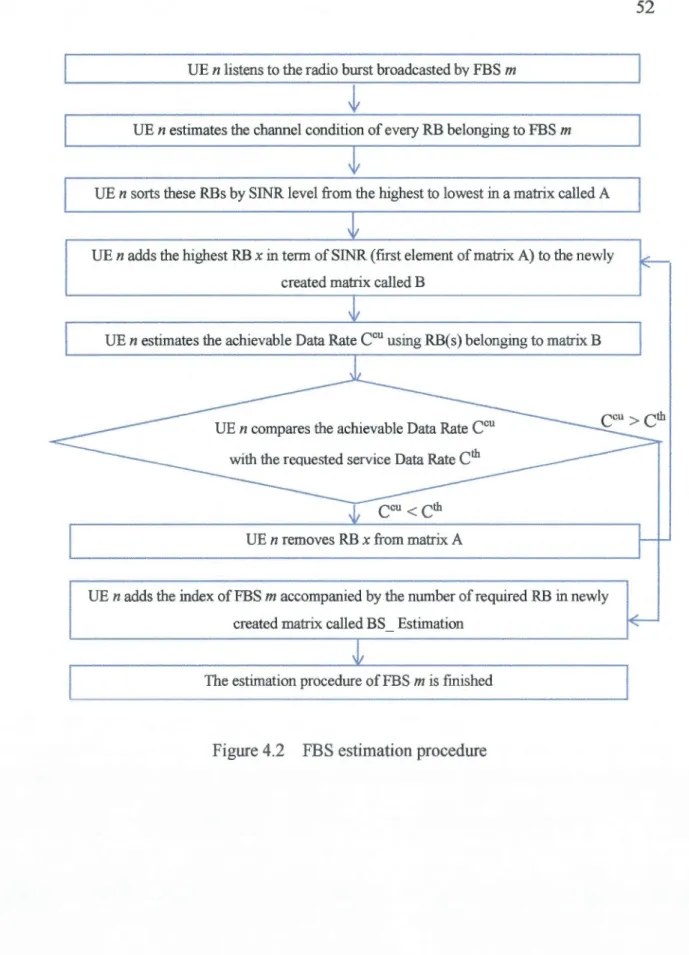
4.2.1 FBS estimation procedure: ... 50
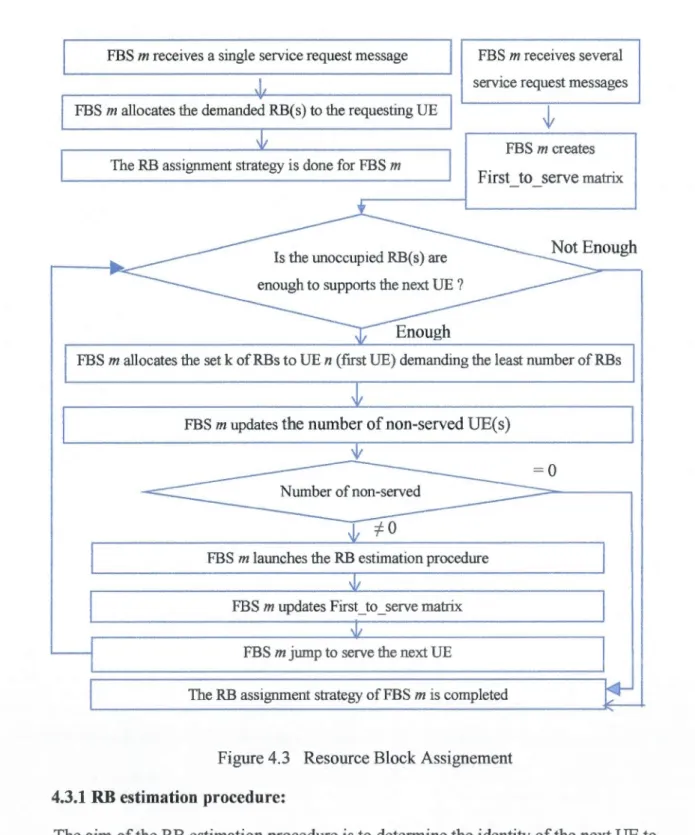
4.3 Resource Block assignment strategy ... 53
CHAPTER V
SIMULATION P ARAMETERS & RESULTS DISCUSSION ... 59
5.1 Simulation parameters ... 60
5.2 Results discussion ... 61
CONCLUSION ... 66
LIST OF FIGURES
Figure Page
A Femtocell base station deviee (Samsung, 2009) ... 3
B Comparison between FBS and M-BS (Forbes et al, 2008) ... 4
1.1 Fractional Frequency Reuse (FFR) concept ... 12
3.1 Dual strip path loss model ... 40
4.1 UE is estimating the SINR level ofRBs belonging to neighboring FBSs ... 49
4.2 FBS estimation procedure ... 52
4.3 Resource Block Assignement ... 55
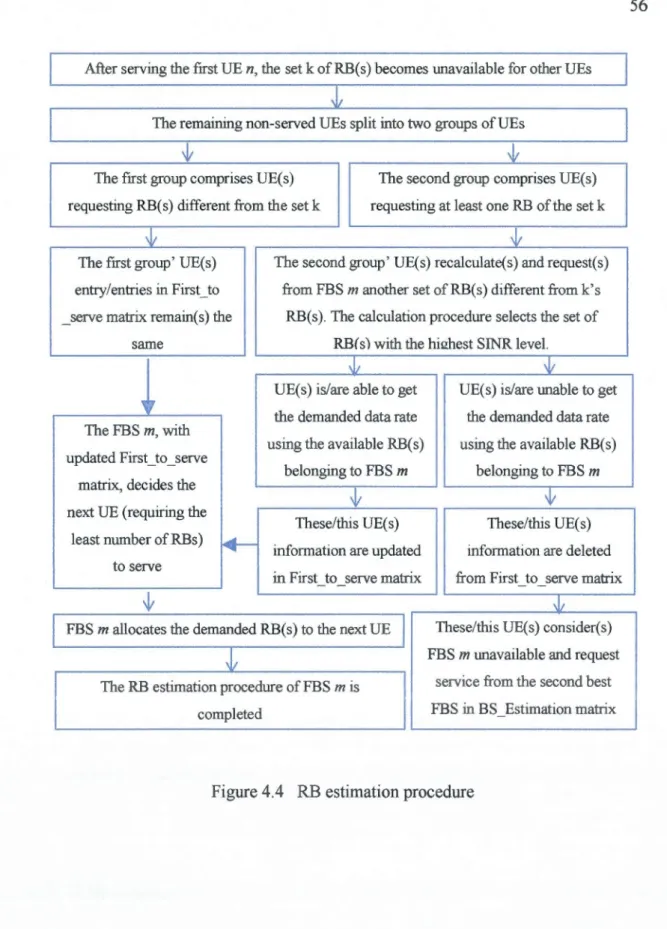
4.4 RB estimation procedure ... 55
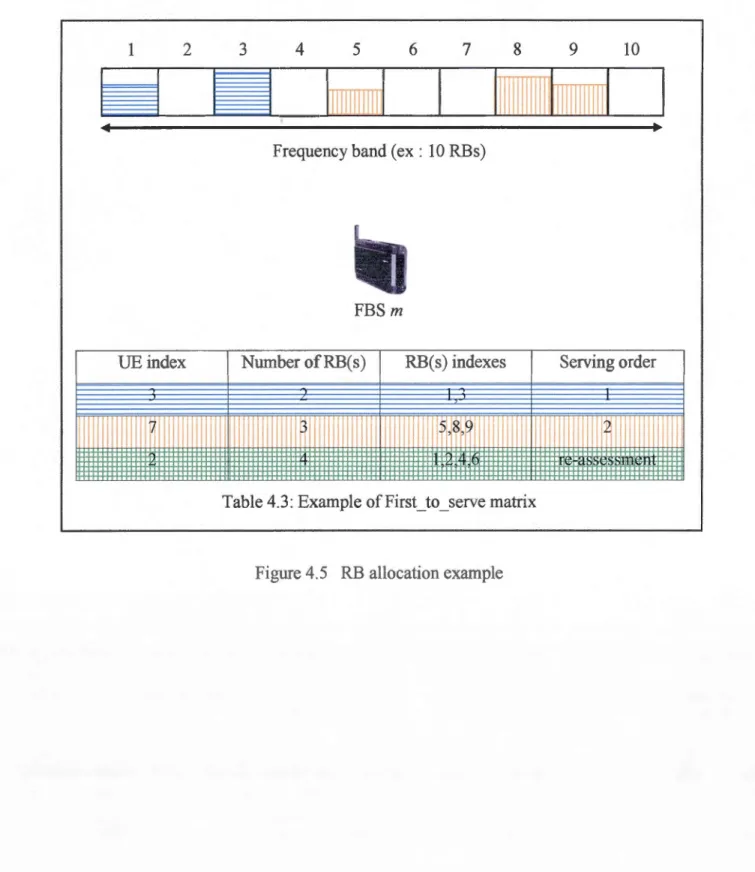
4.5 RB allocation example ... 58
5.1 SINR approach versus gain approach with120 UEs ... 63
LIST OF TABLES
Table Page
4.1 Example ofmatrix A or B ... 50
4. 2 Example of BS _Estimation matrix ... 51
4.3 Example ofFirst_to_serve matrix ... 58
LIST OF ALGORITHMS
Algorithm Page
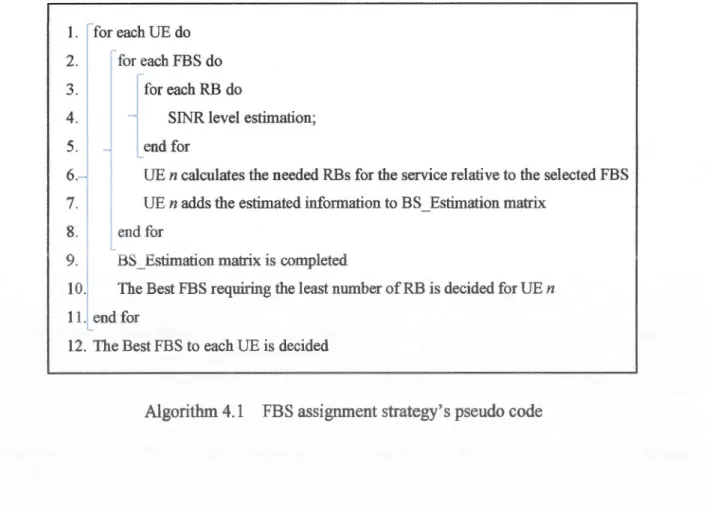
4.1 FBS assignment strategy's pseudo code ... 51
ADSL BS BW
CR
CSG
EDGE EV-DO FBS FR FFRGPRS
GSM
HSDPA
HSPA
HSUPA
LTE LTE-AABBREVIATIONS AND ACRONYMS
Asymmetric digital subscriber line
Base station
Bandwidth
Cognitive Radio
Closed Subscriber Group
Enhanced Data Rates for GSM Evolution
Evolution-Data Optimized
Femtocell Base Station
Frequency Reuse
Fractional Frequency Reuse
General Packet Radio Service
Global System for Mobile Communications
High Speed Downlink Packet Access.
High Speed Packet Access
High Speed Uplink Packet Access.
Long Term Evolution
MBS M-LWDF OFDMA OSG PC
PF
QoS RA RB/PRBRNC
RRM SFR SINR TTI UE UMB UMTS WAP WiMAX WLANMacrocell Base Station
Maximum Largest Weighted Delay First
Orthogonal Frequency Division Multiple Access
Open Subscriber Group
Power Control
Proportional Fair
Quality of Service
Resource Allocation
Resource Block 1 Physical Resource Block
Radio Network Controller
Radio Resource Management
Soft Frequency Reuse
Signal to Interference and Noise Ratio
Transmission Time Interval
User Equipment 1 Mobile Station Ultra Mobile Broadband
Universal Mobile Telecommunications System
Wi-Fi Access Point
Worldwide Interoperability for Microwave Access or 802.16e
Wireless Local Area Network
RÉSUMÉ
La couverture d'intérieur pauvre et la basse capacité d'utilisateur représentent deux défis importants pour les opérateurs cellulaires. Plusieurs solutions (telles que les antennes distribuées) ont été proposées pour résoudre ces problèmes. Cependant, aucune de ces solutions ne fournit le niveau désiré de l'évolutivité et elles manquent l'aspect pratique. Pour ces raisons, une solution attrayante caractérisée par sa faible puissance et son prix faible connue sous le nom de femto-cellule a été introduite pour offrir une meilleure capacité et couverture d'utilisateur. Malgré tous les avantages provoqués par l'intégration de cette nouvelle technologie femto-cellule, plusieurs nouveaux défis ont émergé. Ces défis sont principalement présentés dans deux genres d'interférences ; connu comme interférence cross-ti er et interférence co-ti er. Tandis que l'impact d'interférence cross-tier (provoqué en partageant le spectre de fréquence) peut être réduit en mettant en application des algorithmes efficaces de réutilisation de fréquence, l'interférence co-tier continue à présenter un défi difficile pour les opérateurs et les chercheurs dans le domaine de réseaux cellulaires. Le déploiement non planifié et mal organisé des stations de base femto-cellule a comme conséquence une réduction radicale de la capacité d'utilisateur qui peut mener à une déconnexion des utilisateurs. L'impact de l'interférence co-tier devient plus provocant dans un déploiement dense des femto-cellule où les utilisateurs demandent des services en temps réel (par exemple, taux de données constant). Afin de réduire l'interférence
co-tier, plusieurs solutions ont été proposées dans la littérature comprenant des
algorithmes de contrôle de puissance, des techniques de détection avancées et des schémas d'allocation de ressources intelligentes. Dans ce projet, nous proposons une
stratégie intelligente d'attribution des fréquences avec une stratégie avancée
d'association de station de base femto-cellule pour les réseaux femto-cellule basés sur
L TE. L'objectif des deux stratégies proposées est d'atténuer l'interférence co-tier et de
réduire la probabilité de panne des utilisateurs en augmentant le nombre d'utilisateurs
actifs par station de base femto-cellule. Nous montrons par simulations l'efficacité de
ABSTRACT
Poor indoor coverage and low end-user capacity represent two major challenges for cellular operators. Several solutions (such as Distributed Antennas) are proposed to alleviate the se burdens. Y et, neither of them delivers the desired lev el of practicality and scalability. For these reasons, a low-cost low-power attractive solution known as femtocell is introduced to offer better end-user capacity and coverage. Despite all the benefits caused by the integration of femtocell technology, several new challenges come to light. These challenges are mainly presented in two kinds of interferences; known as cross-layer interference and co-layer interference. While cross-layer interference impact ( caused by sharing the frequency spectrum) can be reduced through implementing effective frequency reuse algorithms, co-layer interference continues to present a difficult challenge for cellular operators and researchers. The unplanned and unorganized deployment of femtocell base stations results in a drastic reduction of the end-user capacity that may leads to an end-user disconnection. The impact of co-layer interference becomes more challenging in dense femtocell deployment scenario with users requesting real ti me services ( e. g., constant data rate). In or der to mitigate the co-layer interference, several solutions are proposed in the literature including power control algorithms, advanced sensing and reporting strategies and intelligent resource allocation schemes. In this project, we propose an intelligent frequency assignment strate gy coup led with advanced femtocell base station assignment strategy for L TE based femtocell networks. The combined effort of the two strategies ai ms to mitigate the co-layer interference and to reduce the outage probability of end-users by increasing the number of active users per femtocell base station. Finally, we show through simulations the effectiveness of our proposed solution.
Key words: femtocell base station, interference management, resource block
INTRODUCTION
In cellular networks, it is estimated that around 2/3 of caUs and over 90% of data services occur indoors (Zhang and de la Roche, 2010). Other surveys reveal that 45% of households and 30% of businesses offices experience poor indoor coverage issues (Chambers, 2007). Therefore, cellular operators aim to provide decent indoor coverage for voice, video and high speed data services, which are becoming increasingly important.
Additionally, decent indoor coverage and good service quality help operators to generate additional revenues and to improve the subscriber loyalty. Therefore, providing good indoor coverage, especially, for high speed data services become a serious challenge for operators (Zhang and de la Roche, 2010). In order to efficiently deliver high-speed data services to an indoor mobile user, using base stations (BSs) located far away (a few kilometers) from the user is not the best method to follow (Boccuzzi and Ruggiero, 2011 ). This is inefficient because of the propagation path loss ofthe outerwalls ofthe premises as well as the inter-floor loss (Boccuzzi andRuggiero, 2011).
Furthermore, this increasing demand for higher data rates, higher speed, and higher accuracy in wireless communication systems lead the researchers and the industrials to develop and deploy new mobile communication standards such as
WiMAX (Worldwide Interoperability for Microwave Access), HSDPA (High Speed
2
tenn evolution), EV-DO (Evolution-Data Optimized) and UMB (Ultra Mobile Broadband). Another competitor, known as the Wi-Fi mesh networks, is designed to ensure high data rate services in a more distributed fashion (Claussen, 2007). Despite the fact that Wi-Fi networks are not able to offer high mobility and coverage similar to that supported by cellular systems, cellular systems need to offer services roughly comparable to those provided by Wi-Fi networks inside home and office environments in order to present a real competition (Ahson and Ilyas, 2011).
In order to enhance the capacity of mobile cellular networks, numero us attempts try to reduce cell sizes and transmit distances, reusing spectrwn, and enhancing spectral efficiency (Alouini and Goldsmith, 1999). However, achieving these goals in micro networks necessitates installing added network infrastructure which requires more expenses (Ahson and Ilyas, 2011). The wireless capacity of cellular networks have been growing about one million times over the last 50 years, thanks to three different factors: better transmitter/receiver efficiency, larger spectrum, and larger number of cells (Moray, 2008). Besides, according to the same reference, the growth in tenn of capacity caused by transmitter/receiver efficiency and larger spectrum corresponds to 20 times and 25 times, respectively, comparing to the original state; whereas, the capacity growth resulted from using a larger number of cells corresponds to 2000 times. Furthennore, predictions for the year 20 15 demonstrate that the growth in capacity will continue to be, mostly, the result of adopting small cell deployments strategy (Moray, 2008), where femtocell technology is expected to play an important role.
A femtocell unit represents a low-power base station communicating in a licensed spectrum and functioning with the operators' approval. It off ers both improved indoor coverage and increased end-user capacity to mobile users within the home or office environment. Besides, it helps achieving improved voice and broadband services
3
in a low-cost fonn factor (Boccuzzi and Ruggiero, 2011). Figure A shows an example offemtocell base station (FBS).
Figure A Femtocell base station deviee (Samsung, 2009)
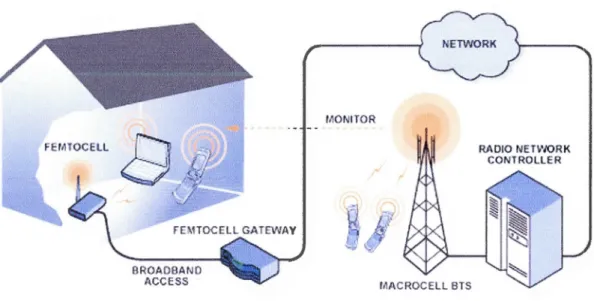
The FBS is connected to the mobile operator' s network through a standard consumer broadband connection, such as ADSL (asymmetric digital subscriber line), cable or optical fiber, as shown in Figure B. Data to and from the FBS is transmitted over the IP network (Saunders et al. 2009). By operating in an authorized frequency band, the operator can control the communications made within the licensed band. In addition, the operators can ensure a certain level ofQuality of Service (QoS) to mobile users occupying the licensed band (Boccuzzi and Ruggiero, 2011). For scalability and security problems, numerous researches, such as (Lan Wang et al., 2009), suggest adding a new deviee known as femtocell Gateway (see Figure B) to improve the mobility management in dense femtocell deployment scenario.
FEMlOCELL FEMTOCELL GATEWAY BROAOBAr~O ACCESS MONITOR RADIO NETW'ORK CONTROLLER
Figure B Comparison between FBS and M-BS (Forbes et al, 2008)
4
The FBS unit looks very similar to an ordinary Wi-Fi access point in terms of shape and size (as shown in Figure A). Y et, the FBS unit incorporates the functionality of the usual Macrocell Base Station (MBS). In other words, it integrates the Radio Network Controller (RNC) and all the core network elements (Zhang and de la Roche, 2010). As a result, the FBS does not need a cellular core network. It only needs to be connected to the mobile opera tor' s core network via a data connection or a cable to the Internet network (Zhang and de la Roche, 2010).
The FBS implements cellular technologies such as GSM (Global System for
Mobile Communications) 1 GPRS (General Packet Radio Service) 1 EDGE (Enhanced
Data Rates for GSM Evolution), UMTS (Universal Mobile Telecommunications
System) 1 HSP A (High Speed Packet Access) 1 LTE (Zhang and de la Roche, 201 0).
Femtocell units can be classified into different categories (home FBS, operator
5
Equipments (UE) connected at the same time (four active mobile users in a residential setting, and eight to 16 active users in enterprise settings). The FBS allocates the different sections of the bandwidth between active UEs. For instance, home mobile users need a high data rate services with short coverage while enterprises requires that FBSs support more simultaneous active users with larger coverage area and acceptable data rate services.
Since both FBS and MBS use the same spectrum to assign frequency resources to their users, UEs from both sides are going to experience severe mutual interference when they are located in an overlapping coverage area. The deployment configuration and parameters of FBSs are directly related to the severity of interferences that affect the system performance ( outage ratio ofUEs, system capacity, end-user capacity, etc.).
In (3GPP, 2008), three major FBS deployrnent's parameters are identified: channel allocation strate gy ( dedicated versus co-channel), femtocell access control (open access versus closed access) and transmit power adjustment (fixed power allocation versus adaptive power allocation).
Two different strategies can be followed by operators to assign the licensed spectrum between MESs and FBSs. Each one has its benefits and drawbacks: A) First, in an orthogonal deployment (known also as dedicated channel deployrnent), a fraction of the spectrum is occupied by the macrocell mobile users and the other fraction is occupied by the femtocell mobile users. In an orthogonal deployrnent, cross-layer interferences (interferences between the two-tier macrocell and femtocell) are neglected, and FBSs only need to avoid interference from other FBSs. However, orthogonal deployment results in an inefficient usage of the radio spectrum. Bence, applying such strategy is expensive and undesirable for cellular network operators (Zhang and de la Roche, 2010). B) Secondly, in a co-channel deployment, both
6
macrocell mobile users and femtocell mobile users reuse the same radio spectrwn.
Despite the increase of interferences among femtocell mobile users and macrocell mobile users, adopting this strategy can seriously improve the spectral efficiency (bit/s/Hz). Yet, it consequently necessitates the integration of more complex interference mitigation techniques. After all, thanks to the higher frequency reuse, co-channel deployment appears to be the favorite approach for the majority of operators (Zhang and de la Roche, 2010).
Furthermore, opera tors can choose between adopting CSG ( closed subscriber
group) or OSG (open subscriber group) access strategy. Likewise, each strategy has its
own benefits and drawbacks: A) First, OSG represents the usual manner in which MBSs operate. In this strategy, all deployed FBSs are accessible to every neighboring subscriber registered with the cellular network operator (that offers the FBSs units). OSG allows any macrocell UE located in overlapping coverage area to perform a soft handover (access to the neighboring FBS), in order to avoid being affected by severe
interferences, and to be served by the FBS instead ofMBS. In other words, The FBS is offering services to any mobile user within its coverage area, such as nearby pedestrians. By having access to the FBS, visitors are allowed to access ail the cellular services. However, the number of simultaneous UEs that can be serviced is limited by the broadband connection bandwidth, amount of interferences and the FBS unit
configuration (Boccuzzi and Ruggiero, 2011). Therefore, the adoption of the open access method will decrease the existing interferences in overlapping coverage area as
weil as the outage probability of macrocell visitors. It will also increase the available bandwidth per macrocell user (visitor), achieves a better overall system throughput and coverage. Yet, OSG can decrease the available bandwidth per femtocell subscriber, increase the number ofhandoffs and increment signaling (Ang-Hsun et al., 2010).
7
The CSG strategy, can be considered as the most favorable solution to femtocell subscribers ( owners of the FBS unit), in which a limited number of mobile us ers has access to the FBS. The remaining un-serviced mobile users are going to experience potential interferences once they combine two conditions: be close to femtocell and be
positioned in poor macrocell's coverage areas. Besides, when an un-serviced UE is
located near a FBS and transmits at high power to reach a far MBS, femtocell
subscriber with weak signais may experience sever interferences (Saunders et al. 2009).
That kind of interference is greater in CSG mode than in OSG mode (Ang-Hsun et al.,
2010). In addition, CSG needs complex and precise power control algorithms that tunes
the transmission power of FBSs dynamically ( depending on the surrounding
environment ). These algorithms allow to avoid the leakage of power (excessive power)
outside the premises of the home or the office and to reduce the interferences in
overlapping coverage area. For simplicity reasons, we adopt OSG access strategy in
this project.
Our work can be divided into several sections: a) First, we provide the readers
with a set of definitions and background infonnation that facilitate the comprehending
task of our thesis. b) Second, we in elude a comprehensive review of the studied
literature followed by our motivations. c) Third, we present a detailed description of our system model followed by the optimization problem and the perfonnance metric.
d) Fourth, we present our proposed solution that comprises the two assignment
strategies. e) Fifth, we introduce the simulation parameters and discuss the obtained
results. Finally, we wrap up our work with a conclusion that comprise our future work
CHAPTERI
BACKGROUND INFORMATION AND DEFINITIONS
In this chapter, we provide the readers a general explanation of severa! technical terms that are going to be mentioned in the following chapters. These scientific terms belong most/y to the wireless communication dictionary.
1.1 LTE and LTE-A
Long-Term Evolution (LTE), known also as 4G, is a wire]ess communication standard that offers both higher capacity and better mobility to end-users compared to the previous cellular standards. It is built over previous standard network technologies. It takes advantage of different radio interfaces combined with core network enhancement to help the end-user achieving better capacity (3GPP, LTE, 2008). LTE Advanced (LTE-A) system is an upgraded version of LTE system. It concentrates mainly on further improving the end-user capacity (Wannstrom et al., 2012).
1.2 Backhaullink
The backhaullink is the portion of network that covers the intermediate links connecting the core network and the small sub-networks
9
1.3 Macrocell base station (MBS)
An MBS transmits/receives radio signais to/from UEs in order to establish connections between these UEs and the cellular network. The MBS allows mobile users to send/receive voice calls, video calls, texts, emails and pictures, to surf the web, and to stream TV shows. MBSs are linked to each other through backhaullink. The cell is the coverage area supported by the MBS. Whenever a mobile station moves from a cell to another, the new BS softly takes care of the current service with no connection breakage (Vodafone, 2013).
1.4 X2 Interface
X2 is a novel interface introduced in L TE network. It enables a peer to peer communication between adjacent BSs in order to support the execution of handover procedure and to ensure a swift coordination of radio resources. This interchange of information among BSs assists the execution of the following functions: handover, load management, coordinated multi-Point transmission and reception, network optimization, mobility optimization and general management (Cambridge, 2010).
1.5 Outage ratio or outage probability
It is the percentage of UEs wh ose service data rate is lower than the minimum
rate requirement. It can be represented as the probability that the signal-to-interference
plus noise ratio (SINR) of a received signal is under a certain predefined threshold.
1.6 Quality of Service (QoS)
QoS represents a bunch of methods used to manage and enhance the service
quality offered to clients. It helps the monitoring of estimated bandwidth, the
identification of network state variations (for instance congestion) as well as the prioritization of a specifie type of traffic over another. It assists network resources to
10
be shared more efficiently and improves the handling of mission-critical applications.
For instance, it manages time-sensitive multimedia and voice application traffic in a way that guarantee for a specifie type of traffic to receive higher priority, greater
bandwidth, and Jess delay than best-effort data traffic.
1.7 Signal to interference plus noise ratio (SINR)
In communication systems, the received signal is weaker than the original
transmitted signaL In addition it is added to the noise created by the circuit components
at the receiver side. To measure the link quality, communication systems usually utilize
the signal to noise ratio (SNR). This ratio represents the power of signal over the
generated noise. In cellular networks, the background noise is weaker than the
interferences created by neighboring mobile users. As a result, cellular systems use a
modified link quality indicator ratio that includes the interference. It is known as SINR.
1.8 Spectral efficiency
Spectrum efficiency, or bandwidth efficiency, measures the efficiency of
utilizing a limited frequency spectrum by the physical layer or media-access-control (MAC) layer. This perfonnance metric represents the information rate that can be transmitted over a certain predefined bandwidth.
1.9 User satisfaction ratio
It is the percentage ofQoS-satisfied users compared to the total number ofusers requesting services.
1.10 Base station cooperation
The base station cooperation technique is able to enhance the system performance through converting the destructive interferences into constructive signais. It can be performed in an architecture that consists of cellular communications and
- --
-11
indoor wireless internet access at the same time. In order to exchange information and intelligence between the BS and the internet access points, a high-speed wired backbone is required (Hongyuan Zhang et al., 2004).
1.11 Cognitive radio (CR)
The cognitive radio represents a newly intelligent radio/network technology. It 1s capable of enhancing the radio operating behavior, automatically sensing and determining unoccupied channels within the wireless spectrum as well as changing the transmission parameters in order to allow interference-free alongside communications. Cognitive radio encloses both adaptive radio technology (which enable the automatic monitoring and calibration of system behavior) and Software Defined Radio (SDR) technology ( wherein intelligent software replaces the conventional hardware components) (Steenkiste et al., 2009).
1.12 Frequency Reuse (FR)
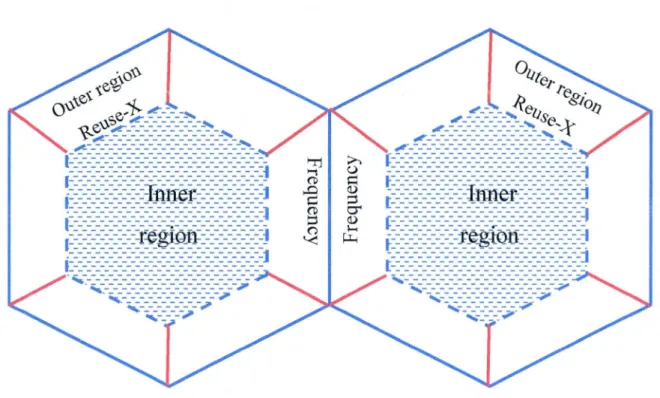
In cellular network, adjacent cells must use different frequency bands to avoid interferences. Y et, this condition does not apply to far cells. This capability of reutilizing frequencies can improve both coverage and capacity. It is known as Frequency Reuse (FR) (Javvin, s. d). The Fractional Frequncy Reuse (FFR) represents an interference management technique in which cellular cells are split into inner regions and outer regions as shown in Figure 1.1. UEs at inner region, known also as cell center region, have access to all available frequency channels (Reuse-1) due to the fact ofbeing so close to the BS. Whereas UEs at outer region, known also as cell edge region, have access only to a portion of all available frequency channels (Reuse-X), in which that portion must be different of adjacent cells (Ali et al., 2009).
12
Figure 1.1 Fractional Frequency Reuse (FFR) concept
1.13 Handover
The inter-cell handover is the procedure responsible for transferring an ongoing communication from a frequency channel offered by a BS to another channel offered by another BS. However, when the user equipment keeps the same BS and switches
between frequency channels the procedure is called intra-cell handover. The soft
handover is a special handover where the transfer of ongoing communication from one
BS to another is performed without interruption. Renee, the UE must be connected at
least to two or more BSs at the same time.
1.14 Load balancing
The load balancing is a technique that distributes the total system workload
13
increased throughput, and reduced response time. In a WLAN network, one efficient
way to redu ce the network congestion is distributing us ers' sessions among
neighboring Access Points (AP) with overlapping coverage. This task is achievable by
integrating load balancing capability in each access point of the WLAN network
(Juniper, 2013). By using AP equipped with load balancing ability, one can guarantee
that the wireless load is divided among APs evenly which avoid overloading any AP.
1.15 Proportional Fair (PF)
Maximizing the total throughput and ensuring a minimum level of service to
every user are the two concems that a PF scheduler algorithm considers to determine
the next user that is going to receive the service. It represents a compromise between
maximum throughput and user fairness (Kushner and Whiting, 2004 ).
1.16 Radio Resource Management (RRM)
The aim of RRM technique is to efficient! y utilize the limited radio frequency
resources and radio network infrastructure by applying several techniques and
algorithms that control the system parameters (Salem, 2011) (Cisco, 2010).
1.17 Coherence Time
The coherence time represents the duration m which the condition of communication channel is not varying.
1.18 Orthogonal Channels
Neighboring end-users that utilize orthogonal sub-channels do not interfere with each other.
14
1.19 Physical resource block (PRB) or resource block (RB)
In LTE OFDMA (Orthogonal Frequency Division Multiple Access) based system, the least amount of frequency resource that can be allocated to end-user is represented by the physical resource block (PRB)/resource block (RB) (TELETOPIX, n. d). Each RB consumes 180 KHz in frequency domain and a 0.5ms intime domain. The BS is the entity responsible of allocating these RBs to UEs requesting services. The LTE bandwidth corresponds to the total number of available RBs (for instance 20MHz ofbandwidth supports 100 RBs) (TELETOPIX, n. d).
1.20 Sniffing capability
The sniffing capability mainly helps BSs to become self-configurable in a way that a void using noisy channels. It enables BSs to perform handovers, cell planning and synchronization automatically (Picochip, 2008). In femtocell networks, this capability helps each FBS to detect neighboring FBSs.
1.21 Transmission Time Interval (TTI)
The TTI represents the duration of transmission on the radio link. It is relative to the size of data transferred from the network layer to the radio link layer (ATDI, 2008). ln LTE network, the TTI duration is equal to lms (ATDI, 2008). It consists of two slots ( oflength Tsiot each) known also as sub frames.
CHAPTERII
REVIEW OF THE LITERA TURE AND MOTIVATION
Despite al! the benefits that accompany the integration offemtocell technology, operators still struggle to overcome the challenges caused by unorganized and unplanned integration of FBSs into an existing organized cellular network. These challenges are main/y represented by severe interferences and unbalanced traffic load among FBSs and MESs. Therefore, researchers are given the task of solving these challenges. ln arder to achieve such goal, femtocells' researchers main/y focus on mitigating occurring radio frequency interferences through load management algorithm, efficient resource allocation algorithms, FBSs cooperation and enhanced feedback reporting solutions, advanced sensing solutions, frequency reuse and power control schemes. These radio frequency interferences are divided into two main categories: cross layer interferences (that happen between the two tiers, in other words, between femtocell and macrocell) and co-layer interferences (known also as intra-femtocell interferences that happen between FBSs). Depending on how the proposed
solutions are going to solve the occurring interferences, we classified the studied articles into severa! groups. Therefore, in this chapter, we revisit the published femtocell 's research works and we show the uncompleted work. At the end of this chapter we briejly present the motivations of our work and we summarize our contributions.
16
2.1 Load management based approach
In order to ensure high system efficiency and reduced interferences, several
researchers concentrate on creating load management algorithms. These algorithms take into account the current load of each BS to ens ure an efficient scheduling of traffic load and UEs. These algorithms intend to improve the total system capacity and reduce the outage probability ofUEs resulted from overloaded BSs.
In (Heng Zhang, et al., 2010), the authors achieve a distributed Joad balancing by adding new network entities defined as an automatic network management module (a function entity added in BS) and an autonomie load balancing control loop. The autonomie load balancing is responsible of calculating the expected cellular coverage patterns relative to the load conditions and geographie distribution of traffic Joad. According to the authors, previous researches tried to reduce the handover probability of UEs toward highly loaded cells while simultaneously increase the handover probability of UEs toward lightly loaded cells. Y et, they declare that their proposed solution outperforms previous works (in term of balancing the traffic load and minimizing overlapping areas) thanks to better use of LIE features, su ch as the adjustment of BS' antenna's bearn coverage as well as the consideration of UE's
handover triggering strategy that bases on the current load of BSs. However the
proposed solution demands the addition of complexes modules as weil as the change
of bearn radiation pattern to every deployed eNBs which does not represent a
cast-effective solution.
In (Chung-Hsin, 2011) the authors propose a new scheme to balance the traffic
load among FBSs while ensuring at the same time the requested QoS to the moving
UEs. In other words, such method can increase the Call success probability of e:xisting
17
as UE mouvement' s prediction, QoS satisfaction and load balancing between neighboring FBSs to make the best possible handover decisions. More precisely, the authors calculate the weight of each UE connected to an overloaded FBS using three different parameters: the remaining time index (measuring how long the UE is going to remain under the coverage area of its current serving FBS), mobile station satisfaction index (responsible of choosing the appropriate FBS for each UE), and FBS load balance indexes (selecting the future/target FBS with the best system balance). Finally, through simulations, the authors show that the consideration of traffic load balancing and mobile stations movement prediction can improve the average data throughput of mobile stations. However, the previous works, mentioned in the beginning of the article, such as power based and handover based solutions can be applied in fully distributed way; yet, the suggested proposition is clearly a centralized solution that lacks the scalability and the practicality of the two previous, mentioned, works.
In (Chang Soon et al., 2011) the authors propose a load control strategy with virtual coverage adjustments for downlink transmission. The coverage area of both serving macrocell and target cell can virtually change by tuning the handover thresholds. In other words, by reducing the handover' s threshold values, the virtual coverage area of current/serving macrocell becomes smaller while, alternatively, the virtual co vera ge area of neighboring cells, macrocells and ferntocells, becomes larger. Therefore, the transfer ofmacrocell' UEs to adjacent cells becornes more frequent and quicker, while the transfer of adjacent-cells' UEs to the current/serving cell becornes less frequent and slower. As a result, the addition of femtocells to the two-tier network helps rnacrocells to avoid being overloaded through lessening the traffic load handled byMBSs.
18
Regardless of ali the benefits resulted from integrating load management algorithms to the system, the above mentioned solutions in most cases require a central coordinator or any kind of added hardware that organize the exchange of information between deviees in a centralized way. However centralized solutions Jack the leve! of practicality and scalability that current operators expect. For instance, the change of FBS antenna coverage range physically or virtually without informing the neighbors or reporting to central coordinator, in dense femtocell deployment, may lead to a reduction in system performance; for example a reduction in UEs SINR level for those situated between two FBSs without being able to establish a connection with any of them.
2.2 Power control based approach
Severa! researchers aim to reduce cross layer or co-layer interferences via proposing power control algorithm that adjust, for each FBS, the power allocated to the frequency channels that interfere with neighboring FBSs. Sorne researchers propose solutions that perfonn autonomously while others prefer to integrate intelligence/information sharing strategy among neighboring FBSs in order to further reduce the generated interferences.
In (Tian et al., 2010), the authors propose a fully distributed resource allocation algorithm. The proposed solution aims to optimize the resource allocation on both femtocell and macrocell tiers. In addition, the proposed algorithm aims to maintain a balance between two competing interests; improving the L TE network capacity while ensuring a certain level of faimess among UEs. The proposed solution dynamically allocates resources among DEs in a way that outperforms conventional round robin solution in term of capacity. By comparing the proposed algorithm to our work, we both proposed a fully distributed algorithm that does not require adding any new
-1 1
19
hardware components or changing the behavior of existing macrocell network, we both choose to simulate our solution using realistic parameters and a sophisticated path loss model in LTE based network (Dual strip model Versus WINNER 2). The authors choose to focus on improving system capacity while we choose to reduce the outage probability of UEs requesting real time services.
In (Bennis et al., 2011 ), the authors pro vide the readers of this article with an overview of the BeFEMTO project followed by an implementation of interferences mitigation techniques such as RRM and power control algorithm. Their proposed radio resource management algorithm starts by determining to each femtocell UE the appropriate transmission parameters (number ofRBs, modulation/coding schemes and the transmission power). Afterward, the algorithm allocates to each served UE more available RBs. In addition, the authors suggest increasing the number ofRBs allocated to each UE while decreasing their power leve! in order to reduce the generated interference on each RB. According to the authors, the proposed RRM (Ghost) performs better than the conventional RRM (that limits the number of assigned RBs for each UE) in term of decreasing the outage probability of UEs. Moreover, the authors propose a novel distributed learning method that could speed up the sharing process of acquired intelligence between neighboring F-BSs. Despite the fact that the proposed radio resource management algorithm succeeded to reduce the generated interference in each assigned RB by increasing the number of RBs assigned to each mobile user while reducing their power leve!, such strategy may increase the waiting time of new mobile users requesting services from neighboring busy F-BSs and lead to UEs starvation.
In (Stocchi et al., 2011 ), the authors propose a novel algorithm that foc uses on mitigating co-layer interference at downlink transmission. The proposed algorithm offers self-configuration and self-optimization capabilities. It combines three different
20
schemes; flexible spectrum usage, power control and initial spectrum selection. It aims to ensure for UEs with poor condition a high cells throughput and improved performance. In arder to achieve these goals the authors divide their proposition into four main sections called priority chunk selection, additional spectrum selection, scheduling and transmission, and SINR estimation collection. First, they propose to split the total system bandwidth into orthogonal portions with identical number ofRBs. Next, each portion is assigned to a single FBS that has the priority to transmit on it.
Y et, each FBS can transmit on other portions of the bandwidth prioritized to other neighboring FBSs when it requires more bandwidth. However, a FBS is only allowed to use other FBSs' prioritized portions of bandwidth wh en ail of its priority portion' s RBs are already used. The usefulness of prioritizing portion of bandwidth to FBSs becomes clear when a new FBS is switched-on for the first time. It guarantees for that particular FBS a portion of bandwidth with law level of interference. In addition, in case of high traHie load, a power control scheme is utilized in arder to avoid each FBS to genera te high interferences to the others due to the fact of utilizing ali the frequency spectrum's RBs. By comparing this article with our proposed solution; we assume better, more realistic and certified 3GPP path loss madel know as dual strip with bath indoor and outdoor mobile users.
In (Seokhyun and Joonyoung, 2011), the authors proposed a centralized-based coordinated scheduling strategy that concentrates on mitigating cross layer
interferences between macrocell UEs and femtocell UEs in downlink transmission. To
achieve that goal, the authors propose a multi-cell coordination scheme. This scheme
benefits from using a list of dominant interferers and channel quality information
(reported by UEs) combined with two separate power control mechanisms, namely,
self-power control and user-requested power control. While the impact of
cross-interference on the users is the main focus of this work, the authors decide to evalua te
21
throughput and 5% worst femtocell-user's throughput. Through simulation, the results prove that the coordinated scheduling can improve the 5% worst user throughput, especially for macrocell MSs by reporting few (or several) dominant interferer, which can be done periodically to the serving BS. Moreover, the user-requested power control shows superior results compared to the self-power control in term of improving the 5% worst macrocell user throughput at a slight Joss in 5% worst femtocell user throughput while maintaining almost the same average throughput both in macrocell and femtocell.
In (Genet al., 2012), the authors discuss a distributed algorithm that combines power control and scheduling for the downlink transmission. They concentrate on reducing the outage ratio ofUEs as well as the average power consumption in densely deployed femtocells networks. Furthermore, it considers the variety of users' link qualities and exploits the multiuser diversity when scheduling users in the available resource blocks (RB) in LTE based systems. Their proposed algorithm performs in autonomous manner to provide the optimal solution that utilizes local information (UE's channel quality and the iterative power values). In brief, their proposed algorithm involves three stages: the pre-bandwidth allocation, scheduling policy of each FBS and power control based on the locallink infonnation. After categorizing all UEs into two separate groups: cell edge UEs and cell center UEs, the pre-allocation stage is executed. It is responsible for allocating an interference limited frequency spectrum to each FBS. Afterward, in order to reduce the power consumption at the FBS level, the authors apply a distributed power control algorithm. Through simulation, the
authors demonstrate that their proposed distributed algorithm could improve the system
performance in terms of outage ratio and scheduling faimess. Compared to our
proposition, we both propose autonomous distributed systems that take advantage of
the current channel quality of each UE in densely deployed femtocell environment and
22
In (Nomikos et al., 2012), the authors propose a cooperation framework for LTE-A based Femtocells networks. It aims to reduce cross layer interferences, experienced by Femtocell UEs and caused by MBs, and to enhance the SINR level of macrocell UEs positioned close to FBSs. According to the authors, the proposed framework ensures an efficient cooperation strategy among FBSs and MBSs via wireless links by integrating a relaying capability into deployed FBSs. Besides, thanks to the exchanged context information of underutilized FBSs the proposed framework is capable of serving macrocell UEs located close to FBSs. The intervention of the authors in this article can be summarized into three stages; First, helping the unorganized FBSs deployment to mitigate cross layer interferences through decreasing MBSs' transmission power and enhancing the SINR level of macrocell UEs. Second, servicing macrocell UEs only over wireless relay links when a two-hop transmission is selected in order to avoid adding burden to the already constrained femtocell backhaullink. Third, taking advantage of opportunistic path selection procedure (that guarantees the best transmission quality to the macrocell UEs at the downlink) in order to enhance macrocell UE' data rate. In brief the proposed framework aims to reduce the average transmission power of M-BSs incurring less interference to femtocell mobile users and provide macrocell mobile users with better-quality links through hybrid-access underutilized F-BSs. Which will enhance their SINR and protect them from interference by other F-BSs that are currently serving their own mobile users. However, the cooperation among FBSs and MBSs cornes with the cost of increased system overhead.
During our work different projects are investigated. The other researchers mostly aim to optimize UEs capacity, reduce the outage probability, maintain fairness among UEs or protect macrocell UEs from interferences. In order to reach their desired goals different architectures are proposed; centralized, distributed and cooperative. First, in power control solution, centralized architectures show impressive results
-23
thanks to the knowledge of the current power leve! allocated to each RB assigned to each UE instantly. Yet it lacks the level of practicality and scalability founded in autonomous 1 distributed solutions. Despite that fully distributed architectures deliver the desired level of practicality, scalability and self-tuning capability, they perform worse than centralized solutions due to performing the power control strategy locally. In order to fill the gap between the two architectures, other researchers propose cooperative solutions that perfonn in distributed way. In cooperative solutions, FBSs share their knowledge with each other. These solutions, such as (Nomikos et al., 2012), perform better than fully distributed solutions and deliver the desired level of practicality and scalability, yet they use complex algorithm and cause a considerable system overhead due to the instant exchange of intelligence (list of interferers, channel quality, etc.) between FBSs. Due to the fact of concentrating only on reducing co-layer interferences in our work, we decide not to add a power control algorithm at the time being. However, we propose in the future work to develop a power control mechanism that works in a distributed and cooperative manner with reduced system overhead by portioning the whole femtocell network within the macrocell into femtocell clusters. This solution will reduce the amount of infonnation shared between FBSs by assigning a leader to each femtocell cluster and performing power control algorithm in centralized manner at each femtocell cluster.
2.3 Frequency reuse based approach
Other researchers aim to reduce the existing interferences through applying frequency reuse schemes. In these schemes, numerous projects choose to divide the cell coverage into inner region and outer region and make FBSs autonomously allocate orthogonal frequency channels to UEs.
24
In (Poongup et al., 2010), the authors propose an interference management scheme for LTE based femtocell network utilizing fractional frequency reuse. The
main idea is to allocate to FBSs frequency channels different from those currently used in macrocell sub-region. The proposed solution benefits from utilizing fractional
frequency reuse to evade the use of noisy channels and increase the frequency diversity.
In (Kan Zheng et al., 2010), the authors concentrate on reducing co-layer interferences by proposing an interference coordination scheme. Their interference coordination strategy is expressed in an optimization problem that attempts to enhance
the cell throughput and the fairness among UEs. First, they assign to each FBS a
frequency carrier different/orthogonal to those assigned to its neighboring FBSs or a
frequency carrier experiencing the least level of interferences. Second, each FBS try to utilize more frequency carrier to improve the system spectrum efficiency. The
measurement of co-layer interferences is calculated through FBSs and UEs combined effort.
In (Saha R.K, 2011 ), the authors propose a resource scheduling algorithm that aims to optimize the spectral efficiency in LTE-A based networks. Their proposed solution combines the implementation of an interference coordination strategy with a fairness optimized mechanism (that reserves a nwnber RBs to be utilized only by macrocell UE in every TTL ). In order to avoid cross layer interferences, RBs allocations among macrocell UEs and femtocell UEs are al ways orthogonal. Y et, when
RBs are allocated to femtocell UEs via the PF scheduler they can be reutilized again.
However, as soon as the RB is assigned to a macrocell UE, this RB becomes restricted
to otherUE.
In (Lin Yang, et al., 2011), first, the authors compare both orthogonal and
25
orthogonal allocation of RBs in tenn of spectral efficiency and achievable network
capacity. Second, they comprehensively analyze possible cross layer interference
scenarios. Next, the authors investigate an intelligent allocation strategy of frequency
resources. As a result, the authors propose a semi-static allocation scheme that intends
to reach the best compromise among interference cancellation and spectrum efficiency interests. This scheme takes advantage of applying a hybrid shared/partitioned
spectrum usage that depends on FBS's location based measurement.
In (Zhen et al., 2011), the authors evaluate the downlink performance ofthree
different systems ( distributed antenna system, uncoordinated femtocells system and the
proposed centralized joint scheduling system) in tenn of spectral efficiency. The
distributed antenna system is proved to be inappropriate for in-building high-data-rate
services. On the other hand, femtocell system reaches better overall throughput as well
as a larger number of simultaneous services UEs than distributed antenna systems due
to FBS capability ofreusing the spectrum. Y et, because ofhigh co-layer interferences,
uncoordinated femtocell system experiences SINR deterioration. For these reasons, the
authors propose a centralized joint scheduling solution. The proposed solution takes
advantage of reducing the resource block consumption per each UEs in order to
maximize the number of simultaneous services UEs under the predefined QoS requirement.
In (Gen et al., 2011), the authors propose a two-phase traffic aware adaptive resource allocation scheme under LIE context. It intends to mitigate the co-layer femtocell interferences while guaranteeing a minimum level of QoS to UEs located in highly dense femtocell deployment regions. Therefore, they propose an optimization problem that aims to guarantee the required QoS demanded by UEs' services and to minirnize the power consumption. The authors choose to divide the UEs into two types (cell-center user and cell-edge users) by calculating their current SINR level. Next,
26
they consider two resource allocation strategies; long period allocation strategy and short period allocation strategy. In order to eliminate severe interferences, a quasi-orthogonal bandwidth is assigned to FBSs during the long period allocation strategy. While, in order to balance the traffic load a short period allocation strategy is applied to coordinate the frequency resource allocation among neighboring FBSs.
In (Maqbool et al., 2011), the authors evaluate the performance of frequency reuse based interference avoidance strategy using dual stripes model and 5x5 Grid model to simulate urban environment within L TE networks. In this article, the authors propose an FFR based frequency planning strategy. The proposed strategy splits each cell area into two regions. Inner regions take advantage of frequency reuse 1 while outer regions are restricted only to frequency reuse 3. In this scheme, underlay FBSs autonomously allocate orthogonal channels to UEs in a way that inner and outer UEs are orthogonal to each other. Besides, a sniffing capability is integrated to each deployed FBS in order to identify the status of each deployed FBS, whether it belongs to inner region or outer region, in distributed way. Using this ability, every FBS becomes capable ofmeasuringthe signal power received over every frequency channel instead of depending on centralized reporting system. As a result, this capability allows each FBS during powering up procedure to sniff ali the frequency channels and transmit over the frequency channel(s) with the least total received power.
In (Bouras et al., 2012), the authors investigate the interference mitigation techniques in femtocell/macrocell networks and propose a frequency reuse selection mechanism that aims to maximize end-user throughput and satisfaction ratio while reducing cross layer interferences at the same time. Every macrocell coverage area is divided into inner region with reuse factor 1 and outer region with reuse factor 3. The estimation of frequency needed by each region depends on inner cell radius and subcarrier allocation. The frequency allocation procedure for femtocell is performed
27
according to FBS's positions. Each FBS selects a frequency band different/orthogonal to frequency channels already assigned to macrocell UEs positioned in the same coverage area. The proposed mechanism computes the total throughput of the cell as weil as user satisfaction ratio for each pair of radius and frequency. Afterward, it selects the optimal frequency allocation scheme. Inner cell radius and the number of subcarriers to be allocated in each region are selected in a way to maximize the UE satisfaction ratio.
In (Selim et al., 2012), the authors propose a soft and partial frequency reuse strategy for interference management in LTE femtocell networks. It exploits a macrocell frequency allocation schemes to mitigate cross layer interferences through Soft Frequency Reuse (SFR) scheme. In addition, it requires no coordination between MBSs and FBSs to perfonn. Before integrating FBSs, the SFR splits the macrocell coverage area into center and edge regions and di vides the en tire frequency band of the system into three equal sub-bands. During the first ti me slot of L TE frame, the entire frequency band is accessed only by center macrocell UEs (Reuse-1 ). While, the second time slot is always reserved for edge macrocell UEs. At each sector, edge macrocell UEs have the capability to access only one of the three frequency sub-bands (Reuse-3). Compared to the center region, edge region transmission power is three times stronger. After integrating FBSs to network, FBSs are classified into center FBSs and edge FBSs. FBSs positioned at any sector are restricted to utilize sub-bands assigned to edge macrocell UEs ofthat sector. Similarly, by dividing the entire bandwidth into three sub-bands, the center FBSs of every sector have on1y access to a single sub-band different from what already assigned to center FBSs in neighboring sectors. While edge FBSs have access to the other two frequency sub-bands.
In (Wei et al., 2010), the authors propose a resource allocation scheme for two-tier OFDMA-based femtocell networks. Both energy efficiency and interference
28
mitigation are considered in the proposed scheme. Macrocell UEs are considered prior to femtocell UEs. The proposed solution comprises three major stages; allocating
sub-bands to UEs using cross layer interference coordination strategy, protecting edge
macrocell UEs' performance and improving the energy efficiency under QoS
requirements. The proposed solution starts by splitting cells' coverage into outer
regions and inner regions. Next, sub-bands are allocated to macrocell UEs using SFR
strategy. Then, the frequency band is divided into three portions. Then, only a single
portion of the frequency band is allocated to FBSs and their UEs when they are
positioned within inner regions, while the whole band is accessible to FBSs and their
UEs when they are located in outer regions. Afterward, in order to maximize the energy
efficiency of the whole networks under QoS requirement, the authors calculate the
optimal frequency band allocation ratio, which guarantees for both macrocell UEs femtocell UEs to reach their demanded data rate.
The majority of the works mentioned in this section implement the same
concept that aims to split UEs into classes based on their current location and whether they belong to macrocell or femtocell network. Next, they divide the whole frequency band into severa} portions and assign them to FBSs and MBSs with different probability in a way that reduces cross-layer interferences. These frequency reuse
solutions represent an effective and simple way to eliminate cross layer interferences.
Since our research focus mainly on reducing co-layer interferences and for simplicity reason, we decide not to integrate frequency reuse strategy.
2.4 Advanced sensing capability based approach
Other researchers choose to improve the sensing capability of FBSs' antenna by integrating cognitive radio features into deployed FBSs. Others prefer to focus on improving the interference recognition and coordination strategies that help BSs to
29
share sorne sort of intelligence, such as a list of interferer or UEs' channel quality ( to create local interference graphs ), in or der to avoid allocating noisy channels to UEs.
In (Gür et al., 2010) the authors propose a femtocell-based cognitive radio architecture that enables an opportunistic access to the broadband wireless systems. This architecture adds an infrastructure-based overlay cognitive network model to the existing femtocell networks in order to deliver additional efficient dynamic spectrwn access and management. The UEs are divided into two classes of mobile users; primary users (macrocell UEs) and secondary users (femtocell UEs). The key advantage of using cognitive FBSs is to discover and detect spectrum opportunities more efficiently and allocates them to the secondary UEs.
In (Attar et al., 2011), the authors start by clarifying the advantages of incorporating cognitive radio capabilities into FBSs. Next, they discuss the ability of cognitive FBSs, with improved sensing capability, at exploiting their knowledge of the radio scene to cleverly allocate resources and reduce severe co-layer interference. In addition, the authors also discuss the important role of radio scene analysis and argue the expected benefits of integrating cognitive BSs to LTE network. Next, due to the distributed nature of femtocell networks, the authors formulate the Co-layer interference problem into either a coalition formation game or a game with correlated equilibrium. The main idea of this work is to prove the importance and the capability of incorporating a cognitive radio technology to the existing femtocell-based cellular network to reduce severe interferences.
In (Harjula et al., 2011) the authors considera situation wherein macrocells' UEs are threatened by FBSs integration and their resulted interferences. Therefore, the authors demonstrate the capability of spectrum sensing strategy, based on Welch periodogram, to detect and discover neighboring radio frequency transmitters with an
30
acceptable level of accuracy. Through simulations, the authors prove the effectiveness of the proposed Welch periodogram based spectrum sensing to detect the macrocell UE when it is positioned close to the house, or when the macrocell UE and the FBS are positioned at the same floor.
In (Sethom et al., 2012), the authors propose a scheduling algorithm that combine both; modified version of EXP-rule and maximum-largest weighted delay first (M-L WDF) algorithms to deliver the optimal data rate according to the number of UEs per FBS and their access priority. UEs are divided into two classes; real time service and non-real time service. The authors concentrate on how to perform scheduling at the BS level while providing the demanded QoS to UEs according to their needs and network access priority. The selection process of the appropriate scheduler to each UE takes into consideration both the UE' s service and class. So, they apply the EXP-rule scheduler toUEs demanding real time service (delay sensitive) and the M-L WDF scheduler toUEs demanding non-real time service (throughput optimal).
In (Herranz et al., 2012), the authors focus on integrating cognitive radio features into femtocell network; such as the ability to efficiently exploit the limited spectrum frequency resources by implementing an opportunistic spectrum access strategy. This strategy allows an intelligent usage of unoccupied licensed frequency spectrum without resulting interferences to the licensee. In order to implement the proposed strategy, coordination mechanisms must be applied to avoid possible interferences among neighboring FBSs. Consequently, the authors study the capability of media independent handover signaling mechanism to feedback interference
measurements (interference awareness). These interference measurements assist a
central controller ( centralized spectrum manager) to allow FBSs to exploit and share