HAL Id: dumas-01108129
https://dumas.ccsd.cnrs.fr/dumas-01108129
Submitted on 22 Jan 2015HAL is a multi-disciplinary open access archive for the deposit and dissemination of sci-entific research documents, whether they are pub-lished or not. The documents may come from teaching and research institutions in France or abroad, or from public or private research centers.
L’archive ouverte pluridisciplinaire HAL, est destinée au dépôt et à la diffusion de documents scientifiques de niveau recherche, publiés ou non, émanant des établissements d’enseignement et de recherche français ou étrangers, des laboratoires publics ou privés.
motivations
Manuel Kieselmann
To cite this version:
Manuel Kieselmann. What makes the difference? Investigating trendsetters’ motivations. Economics and Finance. 2014. �dumas-01108129�
What makes the difference? Investigating trendsetters’ motivations
Manuel Kieselmann
Université Paris1 – UFR 02 Sciences Economiques
Master 2 Recherche - Économie et Psychologie
6th June, 2014
Under the guidance of Professor Linda Jarvin ([email protected]) and Professor Todd Lubart ([email protected])
The thesis is defended before a jury featuring Professor Carolyn Granier-Deferre ([email protected]) and Vincent de Gardelle
2
L’université de Paris 1 Panthéon Sorbonne n’entend donner aucune approbation, ni
désapprobation aux opinions émises dans ce mémoire; elles doivent être considérées comme propre à leur auteur.
3
Table of Contents
Abstract……….. 4
Introduction………... 5
Theoretical Framework………. 9
Consumers’ Need for Uniqueness………. 9
Creative Choice Counterconformity………... 10
Unpopular Choice Counterconformity………. 11
Avoidance of Similarity………... 12
Attention to Social Comparison Information………... 14
Opinion Seeking and Opinion Leadership ………... 15
Attention to social comparison information, opinion seeking opinion leadership… 17 Fashion Innovativeness………... 18
Innovativeness, opinion seeking, opinion leadership…………..………….………. 19
Method………... 21 Participants………... 21 Material……….. 22 Working Hypotheses………. 23 Results………... 23 Factorial Analysis……….. 23 Qualitative Results………. 25 Descriptive Statistics………. 26 Discussion……….. 29
Limitations and Future Research………... 34
Conclusion………. 35
References………. 36
Appendix………... 43
4 Abstract
The current research examines the psychological motivations of consumers and gives new
insights into the psychology of fashion opinion leaders and opinion seekers. Furthermore, we
offer a first validation of the consumer’s need for uniqueness scale in Europe with a mixed
European sample, using explanatory factorial analysis. We investigate and relate the three
concepts of attention to social comparison information, consumers’ need for uniqueness and
consumer innovativeness in the framework of fashion. Results are based on 106 subjects who
participated in an online questionnaire. The main findings demonstrate that (1) attention to
social comparison information was positively related to opinion seeking, while consumers’
need for uniqueness was negatively related (2) opinion leadership is positively related to consumers’ need for uniqueness, yet fully mediated by fashion innovativeness (3) the validation of the counterconformity motivation scale was successful - contributing to
cross-cultural authentication of the construct. The presentation of empirical work is followed by the study’s design and a discussion about the importance and practicability of the recent findings. Finally, limitations as well as implications for future research in psychology and marketing
are presented, in order to get a better understanding of consumer behavior and the role of
5
Introduction
“Kate Middleton has become the iconic British lady of beauty and fashion. Photographed wearing Marks & Spencer shoes, the styles she was wearing were sold out in hours and have
become the store's best-selling shoe style. Dresses that the Princess has worn have sold out within hours, and she is considered the reason J Brand Jeans sales have skyrocketed” (McMaken, 2012).
This anecdote from the end of 2012 illustrates the effectiveness of individuals who can
be described as innovative communicators. Increased sales can be attributed for sure to the
fame of the Duchess of Cambridge, but more importantly she fulfills the characteristics that
make her appearance influential (intentionally or not). Referring to the expression innovative
communicator, innovation stands for an early adoption of new products, and communication reflects the influence the person has on the environment. Contrary to the assumption that this
is a marketing strategy of celebrity endorsement to increase sales, the aforementioned
example is not of this kind, as Catherine wore the clothes privately and can therefore be seen
as a consumer. McCarthy, O’Sullivan and O’Reilly (1999) state that it is crucial for marketers
to identify such individuals, as they have a direct influence on the introduction of new
products in terms of success or failure.
While the existence of such a consumer type is said to be proven, underlying
psychological motivations of these individuals as well as predicting factors that symbolize
innovative communicators seem to be unknown. Among others, these underlying
psychological factors, based on personality traits, shall be explained hereafter and their role
will be assessed to better identify and understand these individuals. Besides social status and
the need to fit in, we assume that uniqueness plays an important role when assessing these
6
between 1977 and 2002) is reflected by a paragraph in the book “Emotional Branding” by Marc Gobé (2009). He states: “Although, like most youth, they have a profound need to fit in
with their peers and are keen on being part of the latest, most hip trends, they also consider
themselves autonomous individuals and express a desire to customize fashions to meet their
personal needs” (p.24).
In academic terms, the need to fit in is derived by a construct called attention to social
comparison information, while the desire to customize fashion is depicted by consumers’ need for uniqueness. Having this in mind, expressing oneself through clothing might not only be seen as a part of communication, but also a means for those individuals to affect their
environment. The influence certain consumers exert on others can be seen in several ways;
they might copy behavior, talk to each other, or exchange information via casual
conversations – and seek and give opinions, most importantly. The last characteristic of
interpersonal communication (opinion leadership and opinion seeking) is recognized by
researchers as an important influence on product sales and brand choice (Bertrandias &
Goldsmith, 2006). A concept known for many decades, word-of-mouth (WOM), is defined as
informally spreading information about the experiences consumers made with specific
products (Anderson, 1998).
In general, research supports the assertion that WOM is more effective compared to
other marketer-controlled sources like advertisement, sales personnel or direct mail (Buttle,
1998; Batra & Kazmi, 2009), driving 20-50% of all purchase decisions (Bughin, Doogan, &
Vetvik, 2010). Furthermore, it is even argued that WOM is growing in importance and
replaces other strategies mentioned. As technology has become more sophisticated and media
fragmentation has lessened the effectiveness of mass-media advertising, marketers focus more
on the power of WOM and how to put it in motion (Donaton, 2003). Particularly social media,
7
used or products bought, while this information can reach and influence a large number of
people (Lindgreen, Dobele & Vanhamme, 2013). Therefore, both consumer behavior and
marketing management practices are affected by the twin topics of opinion leadership and
opinion seeking, which make up an important factor in WOM. For companies, it is
particularly essential to find opinion leaders, in order to target their marketing strategies and
win them over to their side.
Next to opinion leadership, which bears a communicative component, stands
consumer innovativeness. Consumers showing high levels of innovativeness are keen to buy
new products more often and more quickly, and they are willing to purchase brands and
products that are different and novel (Steenkamp, 2001; Daneels & Kleinsmith, 2001).
Baumgarten (1975) defines a person showing a high urge for early product adoption and
elevated communicativeness as an innovative communicator. Since his 1975 paper, little
attention has been given to this specific consumer type (Bertrandias & Goldsmith, 2006).
Although both concepts have been studied separately, the underlying psychological
mechanisms that lead to this particular behavior are neglected. The current research relates to
the following questions: What are the motivations for showing such behaviors? What
distinguishes opinion seekers and opinion leaders in fashion? What makes innovative
communicators special? One main contribution of the current study aims to explain the
overlap between fashion innovativeness and opinion leadership, based on the psychological
dimensions consumers’ need for uniqueness (CNFU) and attention to social comparison
information (ATSCI), as past research failed to predict antecedents.
While attention to social comparison information describes the consumer’s tendency to monitor the environment to adapt his behavior, consumers’ need for uniqueness is the urge
to be different. Included in the theory from Snyder and Fromkin (1977), the concept is defined as “the trait of pursuing differentness relative to others through the acquisition, utilization, and
8
disposition of consumer goods for the purpose of developing and enhancing one’s self-image
and social image” (Tian, Bearden & Hunter, 2001, p.52). Simplified, it is the individual drive
to purchase, use, and dispose consumer goods to overcome the perceived similarity to others
and to be differentiated. Although widely studied in different parts of the world, no validation
study of the personality construct CNFU has been made in Europe so far. Accordingly, the
second main contribution of the current research is a factor analysis with a mixed European
sample to validate the CNFU scale.
The chosen product category studied in the following is apparel or fashion, as it
contains the social context of WOM and is a visible consumer good showing symbolic
significance. In addition, the apparel market is a lively and constantly changing environment,
in which showing innovative behavior is symbolized as going “with the trend”. Fashion
apparel is a socially risky product category, because it exposes consumers to other’s judgment
(Bertrandias & Goldsmith, 2006).
Summarily, the research aims to relate the concepts consumers’ need for uniqueness,
attention to social comparison information, opinion leadership, opinion seeking and fashion
innovativeness in a theoretical framework. The new contribution to existing work can be
stated as follows:
o The first validation of the consumers’ need for uniqueness theory in Europe, containing a mixed European sample;
o Assessing psychological antecedents for fashion opinion seeking and opinion leadership behavior;
o Investigating the overlap between fashion opinion leadership and fashion innovativeness based on the underlying psychological traits CNFU and ATSCI.
9
The subsequent paragraph will highlight the important concepts and personality constructs,
before the methodology and the results of the study are presented.
Theoretical framework
Consumers’ Need for Uniqueness
The concept of consumers‘ need for uniqueness was first stated by Snyder and Fromkin. According to their theory of uniqueness (1977), people have the need to see themselves as
unique and have a strong drive to differ from others. According to this theory, individuals
judge a high level of similarity unpleasant (Snyder & Fromkin, 1980). This need is mainly
aroused in situations that threaten the self-perception of uniqueness (i.e., being highly similar
to others in their group of friends). To overcome this negative affect and consequently reclaim
their self-esteem, individuals engage in self-distinguishing behavior. These expressions of
uniqueness can take different forms and degrees, and have mainly the goal to restore the
(in)balance while avoiding severe social penalties. An individual will develop a particular
style of personal interaction, for instance (Maslach, Stapp, & Santee, 1985).
Based on this, the consumers’ need for uniqueness paradigm can be seen as an applied theory of the need for uniqueness motivation, in a context of consumer behavior. Avoiding
severe social penalties is one important factor, while possessions and consumer behaviors are
a good way to discriminate oneself from others. Both result in no social disregard.
Consumers’ need for uniqueness is more specific than the willingness to be differentiated – namely through products and possessions – and leads not only to self-image, but also social
image enhancement. While social image is related to the view others have with regard to
oneself, self-image enhancement describes the transference of symbolic meaning from a
10
Tian et al. (2001) speak of a psychological trait, which leads people to feel
differentiated and enhances self-image. In psychology, a trait is defined as a habitual pattern
of behavior, thought and emotion, whose influence is relatively stable over time and different
across individuals (Church, 2001). Based on consumer behavior literature, nonconformity
research and the uniqueness theory, Tian et al. (2001) developed three behavioral
manifestations reflected by different dimensions. The next part will focus in detail on these
dimensions before the construct attention to social comparison information will be reviewed.
Creative Choice Counterconformity
Creative choice counterconformity is the notion that the consumer seeks social differentness
from other consumers by making product selections that are special, but at the same time
these selections are considered to be good choices (Latter, Phau, & Marchegiani, 2010).
Creating a personal style and individuality that represent the self via material goods is one
way of reflecting differentness from other people in our society (Kron, 1983). That is, the
purchase of original, unique and novel goods displays not only the attitude of the person, but
can be seen as a reflection of one’s personal style. This goal-directed behavior receives support from the consumer literature as well as the rise of mass customization strategies,
which allow individualization of style. McAlister and Pessemier (1982) point out that the
adoption of new products and variety-seeking behavior is a consequence of the desire for
social distinction via unusual products.
In the last decade, we can observe an exploding interest for customized products in
the market, from both the consumer and the company side (Piller, 2007). Tommy Hilfiger
(“design your own pair of jeans”), Blends for Friends (“make an individual tea blend”) or
Mini Cooper (“design the roof of your car”) are just some examples. Another well-known
illustration is miadidas, developed by creative minds at Adidas AG. With this tool, the
11
but to customize material, colors, prints and even a logo, name or country flag. Once having
created his own shoe, it is pretty rare that another person will have the same. The success can
be seen in the quick roll-out of this concept in numerous major cities around the world
(Stoetzel, 2012), and its success in social media (i.e., Facebook). Example items from creative
choice counterconformity scale are:
I often combine possessions in such a way that I create a personal image that cannot be duplicated.
I actively seek to develop my personal uniqueness by buying special products or brands.
Unpopular Choice Counterconformity
The second dimension, unpopular choice counterconformity, refers to the use and selection of
brands and products that diverge from group norms and bear the possibility of social
disapproval. In order to induce differentness from others, consumers withstand this social
disapproval (Tian et al., 2001). If people fail to differentiate themselves from others in a
manner which is socially acceptable, they may engage in actions that distinguish them
negatively (Ziller, 1964). In fashion, the outcome of breaking rules can be an evaluation by
others of “poor taste”, but it is also likely that social and self-image are enhanced.
Especially in individualist cultures, deviating from the norm is welcomed
(Adarves-Yorno, Postmes, & Haslam, 2007). One might think of a candidate selection for a Fashion
school. The chances of obtaining one of the limited places are elevated when a work portfolio
is presented in which social norms are violated and therefore do not go in line with the general
taste. Heckert (1989) argues that initially unpopular consumer choices may later become
socially accepted, representing the individual as an innovator or fashion leader. This type of
12
provoke ambivalence by making purchase decisions that others might consider to be bizarre.
This rule-breaking behavior is not only shown by consumers but can be seen in
well-established, successful designers, for instance Thierry Mugler (high end fashion creator), who
employed a whole body tattooed model. Two example items from the unpopular choice
counterconformity scale are:
I have often violated the understood rules of my social group regarding what to buy or own.
I enjoy challenging the prevailing taste of people I know by buying something they would not seem to accept.
Avoidance of similarity
The third sub-factor, avoidance of similarity, is explained as the tendency to avoid products
that are part of the mainstream. Products or brands are selected which are not likely to become
too popular, but bear the potential to distinguish the buyer from others (Kumar, Lee, & Kim,
2009). In other words, individuals who search to differentiate themselves from others avoid
buying and consuming commonly used products and brands. Several strategies can be
developed, such as shopping in vintage stores, combining unusual clothes or purchasing
discontinued brands. This manifestation can be referred to as the loss of interest in
possessions that become commonplace, in order to reestablish personal differentness (Tian et
al., 2001). Primarily in apparel consumption, distinctive self-images and social images are
short-lived, as previous unpopular choices attract followers. Due to this, monitoring the
environment and others’ possessions is elevated in consumers showing high need for uniqueness.
Thompson and Haykto (1997) could show that some consumers maintain
13
seen as an attempt to resist conformity and a motivation to avoid resemblance to others.
Example items for the avoidance of similarity scale are:
When a product I own becomes popular among the general population, I begin to use it less.
As a rule, I dislike products or brands that are customarily bought by everyone. Likewise, the concept of consumers’ need for uniqueness has its origins in the United
States of America, and has been conceptualized as a cross-cultural trait (Tian et al., 2001).
However, previous CNFU studies have been mostly single-country-based and the sample
groups consisted mostly of individuals with the American nationality. In recent years, the
concept has been proven to be valid and reliable across different countries, namely Israel and
Slovenia (Ruvio, Shoham & Brencic, 2008), Japan (Knight & Kim, 2007), Malaysia (Burns &
Brady, 1992), Australia (Latter et al., 2010), India (Kumar et al., 2009), Taiwan (Rajamma,
Pelton, Hsu, & Knight, 2010) and Korea (Park, Rabolt, & Jeon, 2008). While it seems that
researchers all over the world are interested in the exploration of CNFU, Europe lags behind.
To the best of my knowledge, no validation of the dimensions of CNFU has been made in
Europe other than Slovenia.
This is even more surprising when one takes a closer look at the Fashion industry
statistics: In 2011, every American in the United States spent 910 Dollars on average for
garments, while the average European spent 700 Euros (Eurostat, 2012). Without attaching
great attention to the exchange rate for Dollar and Euro, we can say this amount is pretty
similar. As mentioned in the introduction, the knowledge of consumer characteristics and
intentions are important for companies and brand strategists to specify their marketing plan
and target influential consumers. Particularly in international European cities like Paris,
Berlin, Brussels or London, we see a wide range of cultures and nationalities, especially
14
insufficiently studied among European consumers. The current study’s first main contribution
will be a validation of the CNFU concept in terms of validity and reliability with a mixed
European sample.
Attention to social comparison information
The way consumers use social cues to define their behavior has an effect on their tendency to
seek information. The construct attention to social comparison information emerged from
Snyder’s (1974) self-monitoring concept which itself describes the tendency to regulate one’s behavior in order to portray a particular self in a social context (Snyder, 1987). Using others’
expressions in social settings as guidelines, individuals with a high self-monitoring level
behave in a manner that is socially accepted and can be seen as adaptive behavior. In contrast,
low self-monitors rely on personal dispositions, beliefs, and attitudes when choosing
behaviors (Cramer and Gruman, 2002).
Revising the construct, Lennox and Wolfe (1984) focus on the individual’s concern about others’ reactions to the shown behavior. Although the correlation with neuroticism (r = .29), which describes emotional instability, is moderate, the correlation with fear of negative
evaluations (r = .64) is strong. Taken together, this represents social anxiety and reflects the
context dependence of this personality trait which may be a useful tool to predict the
disposition to conform (Bertrandias & Goldsmith 2006). Relating this to the consumer
context, Bearden and Rose (1990) state that “persons scoring high in ATSCI are aware of the reactions of others to their behavior and are concerned about or sensitive to the nature of those
reactions” (p. 462). In simple terms, those consumers care what other people think about them
and search for indications to better adapt. Sources of ATSCI can be derived from behavioral
cues (kinds of clothing worn), verbal reactions and expressions about the appropriateness of
15
Advertising techniques use social comparison cues by showing a consumer’s reference
group as either positive reinforcing in case of product use - or punishment by social sanctions
in case of non-use. Slogans like “Don’t be a maybe” and “Maybe never wins” intend to tell
young consumers that solely smoking Marlboro makes you determined, resolute and
successful in life. Relating to the present study, high scores on ATSCI indicate the sensitivity
to normative social influence, which is shown by adopting conformist behaviors and the
awareness of group expectations. On the contrary, a low score goes in line with resistance of
normative influence and keeping independence (Bertrandias & Goldsmith 2006). As ATSCI
describes the tendency to conform, and CNFU has counter-conformity properties, these two
concepts should be negatively associated. Furthermore, Tian et al. (2001) as well as
Bertrandias and Goldsmith (2006) show negative correlations between CNFU and ATSCI
(both r = -.23). The first hypothesis is a replication of their finding, that is to say:
H1: ATSCI and CNFU are negatively associated.
Opinion leadership and opinion seeking
The construct of opinion leadership is anchored in the social sciences and based on a study of
the 1940 presidential election by Lazarsfeld, Berelson, and Gaudet (1944). Opinion
leadership is not a consequence of an individual’s position or status in a social system, it can
be seen as earned and maintained by the opinion leader’s social accessibility and his technical
competence (Goldsmith & De Witt, 2003). Research on opinion leadership can be separated
in three areas: characterization of opinion leader’s role, profiling opinion leaders, and opinion
leader identification (Bertrandias & Goldsmith, 2006). The current paper focuses on the last
part, which bears the motivations for such a behavior. For companies it is important to
elaborate why opinion leaders engage in information sharing and exert influence, aiming to
improve marketing’s appeals and motivate positive word-of-mouth behaviors. An opinion
16
frequently demonstrate high levels of exploratory behavior and curiosity, are highly involved
in a product category, and perceive themselves as knowledgeable. In addition, they can be
seen as the center of interpersonal communication networks (Lyons and Henderson, 2005).
The influential and central role in the interpersonal network, which describes
interconnected individuals through information, is probably the most unique characteristic of
an opinion leader. Formally constructed in the social sector, opinion leadership has been
defined in many ways, and it is nowadays mainly applied for economic variables, for example
to measure the influence of specific individuals on others. Consistently, the concept is
associated with information sharing, influence, or both (Bertrandias & Goldsmith, 2006). The
dual role is perfectly shown in fashion opinion leaders, whose influence is verbal and visual.
In addition, opinion leaders tend to score higher on scales which measure public
individuation, which can be seen as the level of confidence to individuate oneself (Chan & Misra, 1990). In line with earlier characteristics, opinion leaders’ influence can be partly attributed to the expressed uniqueness in product choices. Put simply, high scores of CNFU
will increase the probability of unusual product choices which are recognized by other
consumers. This, in turn, explains fashion leaders’ influence and their motivation to talk about
products and brands. The association between opinion leaders in fashion and CNFU can
therefore be stated as follows:
H2: CNFU is positively associated with opinion leadership in fashion.
In the marketing literature, opinion seeking is more recent and less documented
(Flynn, Goldsmith, & Eastman, 1996; Bertrandias & Goldsmith, 2006). However, if an
opinion leader exists, the existence of someone who follows is obvious. Opinion seeking may
be better understood when examining the motivation of individuals. As opinion seeking is a
need-17
satisfying purchase decisions (Flynn et al., 1996), that is, making better product choices.
Asking friends or relatives for advice about a product category displays this kind of
information seeking. Next to assistance in purchase decisions, opinion seekers also try to
improve their standing in a social group and engage in interpersonal information search
(Bertrandias & Goldsmith, 2006). To conclude, the main difference between opinion leaders
and opinion seekers is the centrality of their role in a social system, the exertion of influence
and especially the motivation to reduce social risks. As an essential part of the opinion seekers’ motivation is risk reduction and conformist behavior, we therefore suggest: H3: CNFU is negatively associated with opinion seeking in fashion.
Attention to social comparison information, opinion seeking, and opinion leadership
Is there a difference between opinion leaders and opinion seekers in terms of monitoring the
environment? Starting with opinion seekers, we have learned that those individuals show an
interpersonal orientation, are constantly looking for information and observe other’s behavior
in order to find out how to behave correctly. Thus:
H4: Opinion seeking in fashion and ATSCI are positively associated.
One might guess the relation is reversed for opinion leaders, as they show behavior
detached from social norms and try to differentiate themselves. However, research suggests
that opinion leaders in fashion have high levels of self-monitoring (Davis & Lennon, 1985).
Furthermore, Goldsmith and Bertrandias (2006) as well as Goldsmith and Clark (2008)
obtained a positive relationship between the constructs attention to social comparison
information and opinion leadership. Consequently, we state:
18
Fashion Innovativeness
In general, innovativeness contains several dimensions that need to be distinguished first. A firm’s marketing strategy can be built on innovativeness as defined by the creation of newness and the ability of a company to develop and present new products in a fast manner (Hurley &
Hult, 1998). With respect to products, innovativeness is the degree of newness and reflects a
novel feature (Daneels & Kleinsmith, 2001). The last dimension, consumer innovativeness, is
crucial to our study and therefore will be highlighted. According to Steenkamp, Hofstede and
Wedel (1999), consumer innovativeness is defined by the tendency of an individual to
purchase brands and products that are different and novel, rather than remaining with previous
consumption patterns. A person showing a high level of innovativeness is therefore keen to
buy new products more often and more quickly compared to other individuals. In his 2004
review of the underlying concept and possible measurements, Roehrich discusses several
explanations for such a predisposition: stimulation need, novelty seeking, independence
towards others’ communicated experience and need for uniqueness. As this study aims to distinguish a fashion innovator (partly) based on CNFU, this is the notion that we are going to
assess. Validation for this explanation comes from Fromkin (1971), who concludes that this
need for uniqueness pushes the individual to differentiate himself through the acquisition of
rare items. Moreover, Gatignon and Robertson (1985) suggest that consumers who are easily
influenced by normative values and have a desire for conformity tend to adopt more slowly.
There exists a wealth of research on fashion innovativeness (FI), which describes the
tendency to be one of the first to know about, and purchase, new fashions (Goldsmith &
Hofacker, 1991). The domain of fashion is perfect to study innovative consumer behavior,
mainly for the following reasons: it allows consumers to show their innovativeness on a daily
basis and more importantly, fashion trends change in a frequent manner. To stay “up-to-date” and innovative, the individual is given a high variety of choice with every new collection and
19
therefore every season. Expressing uniqueness through innovative clothing offers a solid and
manageable way to differ from the rest. Bertrandias and Goldsmith (2006) suggest an overlap
between fashion innovativeness and opinion leadership which could be explained by the
influence of personality concepts like ASTCI and CNFU.
Innovativeness, opinion leadership and opinion seeking
By relating the concepts of consumer innovativeness and opinion leadership, we can obtain a
consumer type which is called innovative communicator (Baumgarten, 1975). This overlap
appears intuitively to bear a great potential for increasing understanding of the effectiveness
of directed marketing strategies on such individuals. Through the willingness to frequently
purchase items of a new collection and communicative qualities, this person should be the
main focus of marketers and advertisers. The persuasive and convincing influence on others
to adopt products emphasizes the importance of such a consumer. However, past research
struggled to identify a meaningful relationship between these two concepts and results have
produced contradictory results (Taylor, 1977; Kotler & Zaltman, 2001).
In his 1971 book, Robertson identified thirteen marketing studies that attempted to
unfold the relationship between innovativeness and opinion leadership, whereof ten found a
positive relationship while three found no relationship. One of the problems explaining these
incoherent past results is that innovativeness and opinion leadership were operationalized
inconsistently (Hirschman & Adcock, 1987). Nonetheless, there is evidence for such an
overlap, mainly in the research of Steven Baumgarten. He was able to identify the composite
of two key consumer types, the peer group legitimate (opinion leader) and the early adopter
(innovator). He justifies this overlap by the “substantial similarity between empirically
determined characteristics of opinion leader and early adopters” (p.12) in his research.
Hirschman and Adcock (1978) as well as Baumgarten (1975) operationalize fashion
20
on both fashion innovativeness and fashion opinion leadership. The same operationalization
will be used in the current research.
Although the existence of such a consumer type can now be assumed as existing, the
underlying psychological motivations are still unclear. Obviously, consumers engage in such
behavior for different reasons. Being excited about a new purchase and therefore talking
about it may account for this behavior, same when disliking a product. Or the consumer
simply likes being the center of attention (Betrandias & Goldsmith, 2006). However, for some
product categories (like fashion), the motivation might occur through deeper psychological
influences which are connected and related to consumers’ social needs. These influences, namely consumers’ need for uniqueness and attention to social comparison information, are
therefore central aspects of the current research and account for the difference among people.
H6: Opinion leadership in fashion and fashion innovativeness are positively associated.
The overlap between fashion innovativeness and opinion leadership raises a question:
Is it possible that two kinds of innovative consumers exist, those who act as opinion leaders
and those who do not? In other words, are there fashion innovators who articulate their
opinions and therefore influence others around them, and a group of innovative minds that
keep their opinions for themselves and become innovative by seeking information? This issue
was brought up first by Baumgarten (1975) and has received little attention since then. He
points out the similarity between characteristics of opinion leaders and early adopters (=
innovative individuals), and raises the question of the extent to which opinion leaders are
early adopters. His study with college students gave first insights about innovative
communicators. In the 1970s, the demographic profile describes an innovative communicator
as a freshman or sophomore who is active socially, narcissistic, highly appearance-conscious,
strongly attuned to the rock culture, reads Playboy and Sports Illustrated, impulsive, and more
21
the current study, as we look for psychological antecedents and focus less on demographic
and social characteristics. Moreover, the study dates back almost 40 years.
Revived by Bertrandias and Goldsmith in 2006, there exists the possibility that there
are opinion seekers and opinion leaders who are innovative and can be explained by the
personality constructs CNFU and ATSCI. Obviously, opinion leading and opinion seeking
can occur for different reasons, consumers talk about products because they are excited and
articulate this or simply want to save time. On the contrary, at least for some product
categories like fashion, it is assumed that deeper psychological influences related to social
needs motivate the consumer (Bertrandias & Goldsmith, 2006). By seeking information,
consumers have the possibility to become innovative. Despite conflicting results in reviewing
this topic, there are certain researchers supporting the notion that opinion seeking is indeed
related to innovation. Rogers (2004) stated a positive relationship between information
seeking and innovativeness. Furthermore, people who are open to new experiences are more
likely to look for new ideas (Sun, Youn, Wu & Kuntaraporn, 2006). Based on these
arguments, we suggest:
H7: Opinion seeking in fashion and fashion innovation are positively associated.
After having seen the important concepts and scales used in the current study, the next section
describes the questionnaire we used in detail, followed by our working hypotheses as well as
the results.
Method
Participants
The online questionnaire comprises multi-item scales to assess the main concepts which were
described and whereof all have been proved to be valid and reliable measures. It was
22
(Facebook). It was also included in an electronic newsletter of the Paris College of Art. The
final sample consisted of 106 participants (67 female and 39 male), age ranked between 19
and 55 years (M = 24.6, SD = 4.8, Mdn = 24). Crucial for the validation of the consumers
need for uniqueness scale, all participants have a European origin (representing 22 countries)
with Germany (34.6%) and France (24.5%) the most represented.
Material
While attention to social comparison information and consumers’ need for uniqueness were assessed on a general level, the constructs opinion leadership, opinion seeking, and
innovativeness were adapted to fashion. More precisely, to measure opinion leadership and
opinion seeking in fashion, Bertrandias and Goldsmith’s (2006) scale was used, adapted from
the general scale developed by Flynn et al. (1996). Sample items read: “I often persuade other
people to buy the clothing items that I like” and “When I consider clothing items, I ask other people for advice”. Fashion innovativeness was assessed by adapting Goldsmith and
Hofacker’s (1991) scale about consumer innovation. An example is “In general, I am among the first in my circle of friends to buy a new apparel item when it appears”. Attention to social comparison information was measured using Bearden, Netemeyer and Teel’s (1989) 12-item scale, one sample item read: “When buying products, I generally purchase those brands that I think others will approve of”. Finally, the different dimensions of consumers’ need for uniqueness were measured with the 31-item scale developed by Tian et al. (2001). All items
were presented on a Likert type format, ranging from 1 = strongly disagree to 7 = strongly
agree.
To avoid erroneous answer tendencies, two items which detect inconsiderate behavior
and therefore enhance data quality were included (Dollinger & DiLalla, 1996). Both items
were Likert type format. The first one, “If you read this item, do not respond to it”, led to
23
of these questions honestly and accurately” led to exclusion if the subject marked less than
six. Due to responses on these items, we excluded four of the original 110 respondents.
The statistical analysis was performed by the use of Stata 12 to test the stated
hypotheses. Not only descriptive statistics, but correlations and regressions were obtained by
the use of Stata 12. For the validation of the concept CNFU and reliability coefficients, we
used the software Statistica, and performed an explanatory factorial analysis.
Working hypothesis
H1 ATSCI and CNFU are negatively associated.
H2 CNFU is positively associated with opinion leadership in fashion. H3 CNFU is negatively associated with opinion seeking in fashion. H4 Opinion seeking in fashion and ATSCI are positively associated. H5 Opinion leadership in fashion and ATSCI are positively associated. H6 Opinion leadership in fashion and fashion innovation are positively associated. H7 Opinion seeking in fashion and fashion innovation are positively associated.
Notes. = significant; = non-significant
Results
Factorial analysis
In order to validate the construct consumers’ need for uniqueness with a mixed European sample, 31 CNFU items were examined. Several criteria for the factorability of correlation
were applied and the Exploratory Factorial Analysis demonstrated the following results:
Firstly, all 31 items correlated at least r = .3 with at least one other item, suggesting good
factorability. Secondly, the sampling adequacy measured by the Kaiser-Meyer-Olkin (KMO)
index of sample adaptation was .88 and therefore above the recommended value of .6
24
(464) = 2479.34, p < .001), indicating that the matrix of scores are appropriate for factor
analysis.
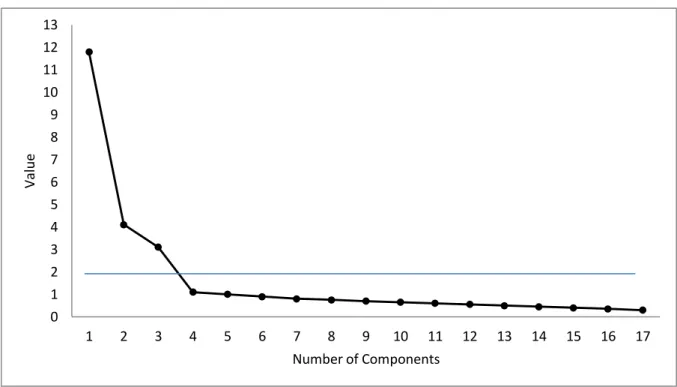
Figure 1. Eigenvalues from the Explanatory Factorial Analysis after Varimax rotation of a 31-variable data set containing the CNFU items.
Exploratory Factorial Analysis (EFA) by principal component method with Varimax
rotation was used to identify factors including all 31 items, with the primary purpose to
validate the scales of CNFU for a mixed European sample (see Table A1 in Appendix for
factor loadings). The analysis provided a three-factor solution that explained 61.7 percent of
the variance, with the first factor accounting for 37.71%, the second factor 13.62% and the
third factor 10.39% of the overall variance. A graphical representation of the eigenvalues can
be seen in Figure 1. In line with Cattell’s scree test (Cattell, 1966), one of the most used
strategies to determine the number of components to retain (Raîche, Walls, Magis, Riopel &
Blais, 2013), we can clearly see the cut-off point after three factors.
0 1 2 3 4 5 6 7 8 9 10 11 12 13 1 2 3 4 5 6 7 8 9 10 11 12 13 14 15 16 17 V al ue Number of Components
25
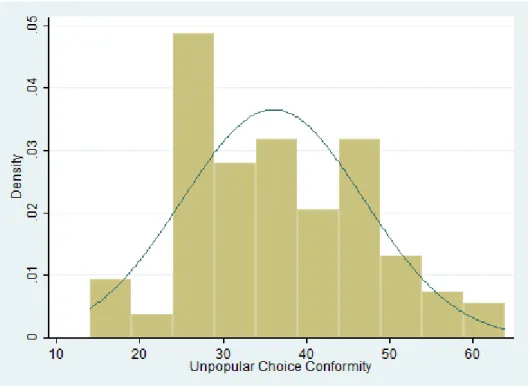
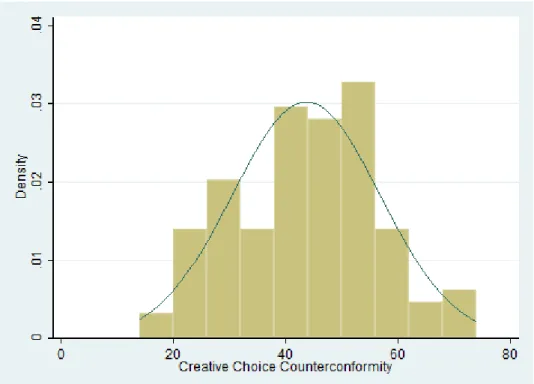
Descriptive statistics are presented in Table 1. The skewness and kurtosis values are
within a tolerable range for the assumption of a normal distribution and examination of the
histograms suggests that the distributions of all three scales are approximately normal (see
Figure B2-B4, Appendix). Shapiro-Wilk tests confirmed further proof of a normal
distribution.
Table 1.
Descriptive statistics for the three CNFU scale factors (N = 106) No. of
items
M (SD) Skewness Kurtosis Alpha (stand.) Creative Choice Counterconformity 11 3.98
(1.19)
-.09 -.37 .94
Unpopular Choice Conformity 11 3.17 (0.99)
.31 -.40 .89
Avoidance of similarity 9 3.40
(1.32)
.30 -.98 .95
To control for internal consistency, we use and report the standardized Cronbach’s
alpha coefficient. In line with George and Mallery’s (2003) rules of thumb, we obtain excellent internal consistency for the creative choice counterconformity and avoidance of
similarity scale, while the unpopular choice counterconformity scale is evaluated as good
(close to excellent).
Overall, these analyses indicate and support the notion of three distinct factors
underlying the concept of CNFU and that these factors are highly internally consistent. No
item had to be eliminated, and the data were well suited for parametric statistical analyses.
Qualitative Results
As previously defined, innovative communicators are one standard deviation above regarding
both fashion opinion leadership and fashion innovativeness. In our sample, seven participants
26
Hirschman & Adcock, 1978). As statistical analysis with such a small number is redundant,
some qualitative insights will be presented. To name some characteristics, most of them are
women and still students (five out of seven) and younger than the sample’s average.
Furthermore, six different nations are represented. Conclusively we can say, apart of the
qualitative results, no further inferences can be made and results show no clear indication for
a specific pattern observed.
Descriptive statistics
After appropriate item reversals, we summed up the items per individual; therefore a high
score reflects a high level of the respective construct. We then performed a reliability analysis
to compute alpha coefficients for each scale in order to estimate the internal consistency. The
results can be seen in Table 2 and all alpha coefficients ranging between moderate and
acceptably high. Comparing the obtained alpha coefficients to other studies in the field of
consumer research, we can see that they even exceed the average alpha values (Peterson,
1994).
Table 2.
Descriptive statistics and correlations
Variables CNFU ATSCI FI OL OS Age
Mean 110.3 38.8 36.4 25.9 25.5 24.7 Sdt. dev. 27.9 10.7 8.5 6.4 7.3 4.8 Low 56 12 13 10 6 19 High 189 67 56 37 39 55 Skewness .16 .15 -.07 -.44 -.49 3.9 Kurtosis -.49 -.24 .04 -.61 -.24 22.9 CNFU (0.94)a ATSCI -.14 (.84) FI .40** -.14 (.78) OL .29* -.04 .47** (.82) OS -.31* .40** -.11 -.00 (.88) Age 0.03 .03 .06 -.02 .12 -
Notes. *p < 0.05, **p < 0.01. aCronbach’s alpha coefficient shown in parentheses on the diagonal; CNFU = Consumers’ need for uniqueness; ATSCI = Attention to social comparison information; FI = Fashion innovativeness; OL = Fashion opinion leadership; OS = Fashion opinion seeking
27
The negative correlation between CNFU and ATSCI (r = -.14) shows a tendency that
those constructs are negatively associated. Despite of significant connections between the
constructs obtained in previous studies (Bertrandias & Goldsmith, 2006; Tian et al., 2001), the
results obtained here reveal no significant correlation and therefore H1 is not supported.
In order to test the remaining hypotheses, linear regressions were performed (see
Table 3). In the first analysis, fashion OS was regressed on sex, age, ATSCI, CNFU and FI.
The result of this regression indicates that the five predictors explained 25.2% of the variance
(R² = 0.252, F(5, 100) = 6.75, p = 0.000). Attention to social comparison information is
positively related to opinion seeking in fashion (β = 0.25, p = 0.000) which supports H4. This
suggests that consumers who monitor their environment are in fact seeking clothing tips and
advice from others. However, consumers’ need for uniqueness is negatively related to opinion
seeking in fashion (β = -0.07, p = 0.005) suggesting that the more consumers emphasize
uniqueness, the less likely they are to seek clothing advice from other individuals. This result
supports H3.
Table 3.
Regression results
Independent variables β SE t R²
Dependent variable : clothing opinion seeking
0.252** Sexa -2.074 1.312 -1.58 Age 0.162 0.129 1.25 ATSCI 0.249 0.059 4.22** FI 0.049 0.081 0.60 CNFU -0.071 0.025 -2.89**
Dependent variable: clothing opinion leadership
0.245** Sexa 1.589 1.174 1.35 Age -0.053 0.115 -0.46 ATSCI 0.018 0.053 0.34 FI 0.306 0.073 4.18** CNFU 0.028 0.022 1.29
28
Opposed to this, the results show that neither age nor sex had a statistically
significant effect on opinion seeking. The trend which indicates that being female decreases
the urge for opinion seeking cannot be supported. There was no significant effect for gender
concerning fashion opinion seeking, t(104) = 1.23, p = 0.11. Additionally, the results do not
support the notion that fashion innovation is related to opinion seeking in a significant
manner. We therefore have to reject H7.
In the second part of the analysis, fashion opinion leadership was regressed across
levels of gender, age, ATSCI, FI and CNFU. The result of this regression indicates that the
five predictors explained 24.5% of the variance (R² = 0.245, F(5, 100) = 6.54, p = 0.000).
Here, apart from fashion innovation, no factor was statistically significant. According to
hypothesis 5, ATSCI should be positively related to opinion leadership; however it seems that
opinion leaders are not significantly more attentive to social clues than non-leaders.
Moreover, the coefficient for CNFU is not significant, although Tian et al. (2001), apart from
Bertrandias and Goldsmith (2006), obtained a significant relation between those two
constructs. Besides the just mentioned results, a significant correlation of r = .29 between
consumers’ need for uniqueness and opinion leadership in fashion was obtained (see Table 2).
The solution to this problem is the factor fashion innovativeness in the regression. It
seems that the strong connection between CNFU and OL is mediated by this variable. Baron
and Kenny (1986) propose the following solution:
To test for mediation, one should estimate the three following equations: first,
regressing the mediator on the independent variable; second, regressing the dependent
variable on the independent variable; and third, regressing the dependent variable on both the
29
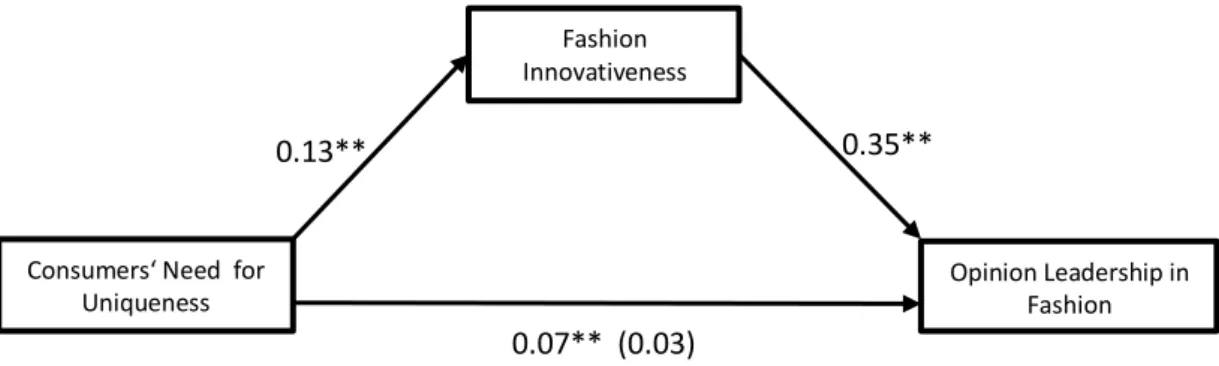
Figure 2. Standardized regression coefficients for the relationship between consumers’ need for uniqueness and opinion leadership as mediated by fashion innovativeness. The standardized regression coefficient between consumer’s need for uniqueness and opinion leadership in fashion, controlling for fashion innovativeness, in parenthesis.
**p < .01.
In step 1 of the mediation model, the regression of OL on CNFU, ignoring the
mediator, was significant, β = 0.066, t(105) = 3.05, p = 0.003. Step 2 showed that the
regression of the CNFU scores on the mediator (FI), was also significant β = 0.126, t(105) =
4.63, p = 0.000. Step 3 of the mediation process showed that the mediator was significant, β =
0.353 t(105) = 5.40 , p = 0.000. Finally, step 4 revealed that, controlling for the mediator (FI),
CNFU scores were no longer a significant predictor of OL, β = 0.026, t(105) = 1.18, p =
0.242. To test the approximate significance for the indirect effect of the independent variable
on the dependent variable via the mediator, we used Sobel’s method (1982). The Sobel test
conducted found a full mediation in the model (z = 3.52, p = 0.000).
For both dependent variables, opinion seeking and opinion leadership in fashion,
assumptions for regression were tested. Results indicate that the assumption of linearity for
the overall equation, assumption of homoscedasticity and assumption of normality of the error
term (Black, Babin, Anderson, & Tatham, 1998) were sufficiently met.
Discussion
With steadily growing interest in uniqueness in the fashion business, the current research
contributes not only to a better understanding of the psychology of clothing opinion leaders
0.13** 0.35**
Fashion Innovativeness
Consumers‘ Need for Uniqueness
Opinion Leadership in Fashion 0.07** (0.03)
30
and opinion seekers, but facilitates marketers’ identification of an important consumer
segment, which functions as an effective communication tool. What are the motivations and
underlying concepts for opinion leaders and opinion seekers in fashion like? Our study aimed
to investigate the psychological factors that differentiate opinion leaders and opinion seekers,
moreover the overlap between fashion opinion leadership and fashion innovation sought to be
explained. Besides, the personality construct consumer’s need for uniqueness was validated
for the first time with a mixed European sample, as past research has focused on the
validation with mainly non-European consumers (Park et al., 2008), therefore contributing to
cross-cultural authentication.
In the case of opinion seeking, we were not only able show a strong positive
association with attention to social comparison, but a strong negative association to
consumer’ need for uniqueness. In simple terms, individuals who are highly attentive to social information and monitor the environment seek more clothing advice from others.
Furthermore, the results suggest that the more a consumer tries to be unique, the less likely he
is to seek clothing advice from others. This is in line with Bertrandias and Goldsmith’s
(2006) work on opinion seeking and demonstrates a successful replication. We hypothesized a
positive relationship between fashion innovation and opinion seeking in clothing based on the
premise that seeking information increases the chances to become innovative (Rogers, 1995;
Sun et al., 2006). However, no significant relation was obtained and the hypothesis was not
supported.
On the other hand, opinion leadership was solely predicted by fashion innovation in a
significant manner. It seems like the more often an individual purchases brands and products
that are novel, the more he is the center of interpersonal communication networks and
influences others. As fashion innovativeness makes up the largest part concerning the
31
the potential for positive word-of-mouth marketing. Fashion innovativeness is the tendency of
an individual to purchase brands and products that are different and novel (Steenkamp et al.,
1999). In combination with opinion leadership, which bears a communicative and influential
component, the individual can be seen as a “trendsetter”.
The effectiveness of such a trendsetter as word-of-mouth channel for a brand can be
already seen in the fashion world (e.g., Jack Wills) as well as outside (e.g., Apple). In 2012,
the British Fashion brand Jack Wills implemented a ‘Seasonnaires’ program, which can be
seen as key innovation in opening different sales channel. The company recruits young
good-looking people who seem cool, outgoing and communicative. These ‘influencers’ are given free clothing and accessories, and then attend parties, circulate on campus, travel to targeted
locations and host parties on the beach and in local clubs (Kotler, Armstrong, Harris, &
Piercy, 2013). Not only do they connect the brand to exciting events, but also promote their
products through peers. Beyond an incredible 32.5% increase in turnover from 2011 to 2012
(Watterson, 2012), their success can also be seen in the number of Facebook-Fans which
skyrocketed to over half a million in 2013. Outside the fashion domain, Apple’s ‘Campus
Representative’ program aims for the same objective, by equipping inspiring, leading and connected individuals on campus with all kinds of their products, and create an efficient and
effective marketing option.
Previous studies struggled to identify a meaningful relationship between opinion
leadership and innovativeness (Kotler & Zaltman, 2001), and different explanations were
given in terms of underlying motivation. According to Bertrandias & Goldsmith’s (2006)
results, opinion leadership can be explained by attention to social comparison information and
consumers’ need for uniqueness. Following their interpretation, fashion leaders main
motivation is to feel unique while they are attentive to social clues. While ATSCI turned out
32
leadership. This relation seems however to be mediated by the construct of fashion
innovativeness. Mediation analysis with Baron and Kenny’s (1986) method revealed a full mediation effect and confirmed by Sobel’s test (1982), the results demonstrate that the
predictive effect of CNFU loses its significance when including fashion innovativeness. More
specifically, it was found that fashion innovativeness fully mediated the relationship between
CNFU and opinion leadership. This is non-consistent with previous literature and further
research is needed to confirm this effect.
One explanation for the mediation can be found when comparing the items included
in the different scales. For instance “I like to buy new clothes that have a new and original style” is one item of the fashion innovativeness scale (Goldsmith & Hofacker, 1991), while “I have sometimes purchased unusual brands as a way to create a more distinctive personal
image” is included in the CNFU scale (Tian et al., 2001). Those items are unambiguously similar, to name just one example. Furthermore, feedback from participants in the current
study contained statements like “I had the impression that questions reoccurred several times” or “Some items asked the same thing, but reversed”. We therefore propose as direction for future research to investigate the convergent and discriminant validity of those two measures
to make research on this topic clear-cut and unobscured.
A main aspiration of the current research was to analyze and detect the innovative
communicator, a term shaped by Baumgarten (1975). To be part of this consumer group, individuals need to be one standard deviation above fashion opinion leadership and fashion
innovativeness. However, only around seven percent of participants fulfilled these criteria -
which made statistical analysis redundant. Nonetheless, academics as well as marketers
should be highly interested in this consumer segment, as they show willingness to regularly
purchase new products, and the disposition to communicate these products and exert influence
33
increasing the number of participants in the studies to obtain valid predictions - or by focusing
on qualitative methods, including additional demographic information, personality traits,
beliefs and values in the assessment.
With the rise of social media, particularly Facebook and Twitter, the concept of
opinion leadership has become increasingly important in the last decade. An example in the
fashion world is Karl Lagerfeld, a fashion icon and with no doubt an opinion leader, who
exerts influence on his more than 400.000 Twitter Followers. With recurring tweets like the “PicOfTheWeek”, he presents each week a new apparel outfit, and promotes different brands and products. Moreover, Avishai Sharon, CEO and co-Founder of the website ‘Trendemon’
has already optimized this new form of social word-of-mouth marketing. His company
created a way to identify trendsetters within a community and offers this knowledge to
advertisers (Katz, 2012). Not only is less money spent on advertising, but their technology
enables to control for direct results of return on investment in relation to social media
interaction, for instance. It therefore facilitates or even solves the ever existing problem of
marketers to efficiently measure their marketing efforts (Stewart, 2009). Having this in mind,
future research should administer topics like the reach of such e-opinion leaders, the
differences between on- and offline opinion leaders or the identification of the ‘trendsetter
2.0’.
Finally, the validation of the concept consumers’ need for uniqueness in Europe shall
be highlighted. Having its origins in the United States, the trait which is expressed by the need
to pursue differentness through the acquisition of consumer goods, is conceptualized as a
cross-cultural trait (Tian et al., 2001). Despite the broad use of the concept, there was a lack of
confirmation for European consumers, as CNFU studies have been mostly
single-country-based or sample groups consisting of Americans (Ruvio et al., 2008). The current study is the
34
with a mixed European sample. Based on the explanatory factorial analysis, no items had to
be removed and all three subscales as well as the construct en bloc revealed good or even
excellent internal consistencies.
Limitations and future research
As a first limitation, we need to point out that the main goal, to assess the
psychological motivations of a consumer group defined as innovative communicator
(Baumgarten, 1975), was not reached. The main reason is the limited number of participants
in this segment, as only approximately seven percent of subjects were both one standard
deviation above opinion leadership in fashion and fashion innovativeness. Although this
percentage is in line with previous studies (e.g., Hirschman & Adcock, 1978), future research
needs to address this consumer group by means of increased sample size, as it offers helpful
insights not only for psychologists, but as well for marketers and advertisers.
Next, the current results obtained through regression analyses are based on
correlations, as the research format was a questionnaire study. This raises the question to what
extent we can make causal inferences. Already in 1921, Sewall Wright pointed out that “the
ideal method of science is the study of the direct influence of one condition on another in
experiments in which all other possible causes of variation are eliminated” (p. 557). Despite
this argumentation, one must have in mind that the present study sought to investigate
underlying psychological motivations, and all constructs and their scales refer to personal
dispositions. As personality traits are stable, habitual patterns of behavior, thought, and
emotion (Goldberg, 1993), social psychological research is constantly confronted with the
issue of lacking causation (Baron & Kenny, 1986). We defend, however, the denomination of
the variables attention to social comparison information, consumers’ need for uniqueness and
fashion innovativeness as independent or predicting variables, and opinion leadership and
35
line of arguments: Firstly, the previously mentioned independent variables all bear mainly
underlying psychological motivations of the self, while opinion leadership and seeking
include primarily behavioral components. This argument is supported by Ralph Waldo
Emerson’s (1841) quote “The ancestor of every action is a thought” and the common consent that our beliefs and feelings determine our behavior (Myers & Smith, 2000). Secondly, this
way of aligning the variables is identical to previous research on this topic and emphasizes the
pragmatic approach.
Conclusion
Our study is original is many ways. We were not only able to investigate underlying
motivations for opinion leaders and seekers in fashion, but also to offer a first validation of
the construct consumers’ need for uniqueness with a mixed European sample. While opinion
seekers are highly susceptible to their environment (which they monitor constantly) and do
not feel the urge to distinguish themselves via clothing, opinion leaders appear to be merely
motivated by the innovation and the acquisition of new products. Despite the fact that they
differentiate themselves through the need to express their uniqueness compared to
non-seekers, this connection is completely mediated by fashion innovativeness. The original goal
to assess underlying psychological motivations of communicative innovators was not
achieved, due to the small fraction of those individuals in the study. Nonetheless, the results
offer new insights about consumers in fashion from both psychology and marketing
perspectives, and are of value for the two disciplines. The various implications of these
36 References
Adarves-Yorno, I., Postmes, T., & Haslam, S. A. (2007). Creative innovation or crazy irrelevance? The contribution of group norms and social identity to creative behavior. Journal of Experimental Social Psychology, 43(3), 410-416.
Anderson, E. W. (1998). Customer satisfaction and word of mouth. Journal of service
research, 1(1), 5-17.
Baumgarten, S. A. (1975). The innovative communicator in the diffusion process. Journal of
Marketing Research, 12-18.
Baron, R. M., & Kenny, D. A. (1986). The moderator–mediator variable distinction in social psychological research: Conceptual, strategic, and statistical considerations. Journal of
personality and social psychology,51(6), 1173.
Batra, S. K., & Kazmi, S. H. H. (2009). Consumer Behaviour-2nd. Excel Books India.
Bearden, W. O., Netemeyer, R. G., & Teel, J. E. (1989). Measurement of consumer
susceptibility to interpersonal influence. Journal of consumer research, 8, 473-481.
Bearden, W. O., & Rose, R. L. (1990). Attention to social comparison information: An individual difference factor affecting consumer conformity. Journal of Consumer
Research, 461-471.
Bertrandias, L., & Goldsmith, R. E. (2006). Some psychological motivations for fashion opinion leadership and fashion opinion seeking. Journal of Fashion Marketing and
Management, 10(1), 25-40.
Black, W. C., Babin, B. J., Anderson, R. E., & Tatham, R. L. (1998). Multivariate data analysis. New Jersey.
Bughin, J., Doogan, J., & Vetvik, O. J. (2010). A new way to measure word-of-mouth marketing. McKinsey Quarterly, 2, 113-116.
Burns, D. J., & Brady, J. (1992). A cross-cultural comparison of the need for uniqueness in Malaysia and the United States. The Journal of social psychology, 132(4), 487-495.
37
Buttle, F. A. (1998). Word of mouth: understanding and managing referral marketing. Journal
of strategic marketing, 6(3), 241-254.
Cattell, R. B. (1966). The scree test for the number of factors. Multivariate behavioral
research, 1(2), 245-276.
Church, A. T. (2001). Personality Measurement in Cross‐Cultural Perspective. Journal of
Personality, 69(6), 979-1006.
Chan, K. K., & Misra, S. (1990). Characteristics of the opinion leader: A new dimension. Journal of Advertising, 19(3), 53-60.
Cramer, K. M., & Gruman, J. A. (2002). The Lennox and Wolfe revised self-monitoring scale: Latent structure and gender invariance. Personality and Individual Differences, 32(4), 627-637.
Daneels, E. & Kleinsmith, E. J. (2001). Product innovativeness from the firm’s perspective: Its dimensions and their relation with project selection and performance. Journal of
Innovation Management, 18(6), 357-373.
Davis, L. L., & Lennon, S. J. (1985). Self-monitoring, fashion opinion leadership, and attitudes toward clothing. In M. Solomon (Ed.), Psychology and fashion (pp. 177 -182). Lexington, MA: D. C. Heath.
Dollinger, S. H., & DiLalla, D. L. (1996). Cleaning up data and running preliminary analyses. In F. T. L. Leong and J. T. Austin (Eds.), The Psychology Research Handbook (pp. 167-176). CA: Thousand Oaks Sage
Donaton, S. (2003, November 17). Marketing’s New Fascination: Figuring out word-of-mouth. Advertising Age. Retrieved from
http://adage.com/article/viewpoint/marketing-s-fascination-figuring-word mouth/96859/
Eurostat Statistical Book (2012). Consumers in Europe. Retrieved from
http://epp.eurostat.ec.europa.eu/cache/ITY_OFFPUB/KS-CD-12-001/EN/KS-CD-12-001-EN.PDF
Flynn, L. R., Goldsmith, R. E., & Eastman, J. K. (1996). Opinion leaders and opinion seekers: two new measurement scales. Journal of the Academy of Marketing Science, 24(2), 137-147.